

Folding, bagging and identifying the individual garment
The individual pack is the layer a customer eventually opens, and a layer often left to the factory's judgement. Fold, bag and sticker are three separate decisions, and each of them changes how the goods look, how they stack and how the warehouse finds them.
Contents
Garments typically leave a factory folded, bagged and stickered, and specifications rarely say how. The default is whatever the packing team does for that garment type, which is usually sensible and is nonetheless somebody else's decision.
Hanger or flat
The first decision is whether the goods are folded at all. Garments shipped on hangers arrive ready to go straight onto a rail, which suits some retail operations and some product types, particularly structured outerwear and tailoring where fold creases are a problem.
It is also a more involved shipment. The hanger becomes a specified component with its own model, size, hook orientation and sometimes branding or a size indicator; the goods take considerably more volume; and the receiving operation has to be set up for them. None of that is a reason against it, but all of it belongs in the specification rather than being discovered at booking.
| Folded and bagged | On hangers | |
|---|---|---|
| Volume | Compact; more pieces per carton | Substantially more volume per piece |
| Presentation on arrival | Requires unpacking and often pressing | Ready to rail, no fold creases |
| Components to specify | Bag, sticker, fold | Hanger model and size, hook orientation, any cover, plus the sticker |
| Receiving | Standard carton handling | Depends on the receiving operation being set up for it |
| Suits | Most knitwear and casualwear | Structured outerwear, tailoring, crease-sensitive product |
Where garments do ship on hangers, the hanger specification comes from the buyer. Some retail programmes standardise on particular hanger systems, and those are that programme's requirement rather than an industry standard.
Specifying a fold
Fold matters for three reasons that have nothing to do with aesthetics: it determines the folded footprint, which determines the bag and therefore the carton; it determines what is visible through the bag; and it determines where the creases fall.
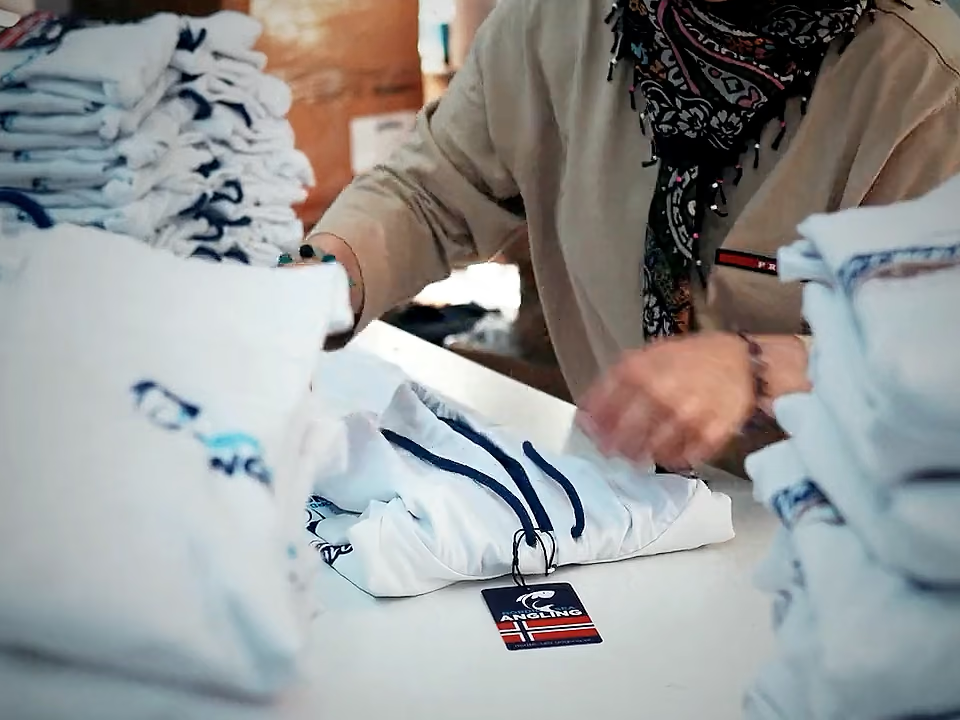
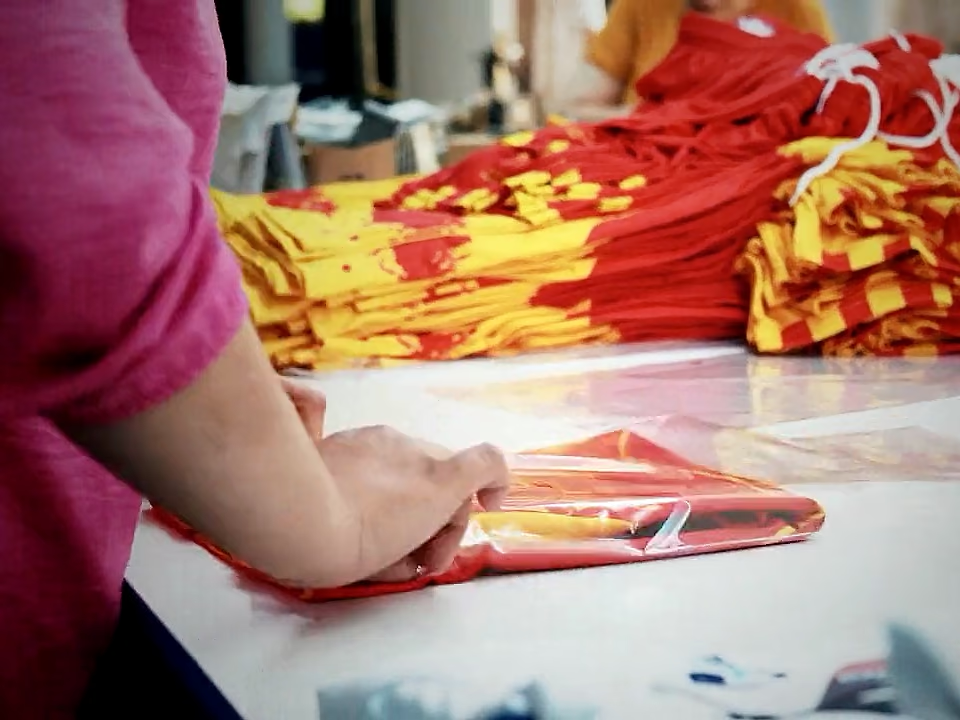
A fold sequence
Illustrative only. Fold method and dimensions are specified per product; there is no standard fold, and the right one depends on the garment and where it is going.
A buyer who needs a consistent folded footprint, usually because the goods have to fit a fixture or a standard bag, should say so in measurable terms rather than describing the fold in words.
That last point is worth flagging early rather than late. A print or an embroidery placed across a natural fold line will be creased through it every time, and the fold may need designing around the artwork. Where a placement is already fixed, artwork placement sets out how it was specified and what moving it would involve.
Choosing the bag
An individual bag does unglamorous work: it keeps the garment clean through handling and transit, keeps sizes separated so a warehouse can find them, and gives the sticker somewhere to live.
Bag size follows from the folded garment rather than from the garment type. A folded piece has a footprint and a thickness, and the bag has to accommodate both plus whatever headspace the closure needs. That is why a bag specification that works for one fabric weight can be wrong for the same style in a heavier one, and why published bag dimensions by garment type are unreliable: they assume a fold and a thickness they cannot know.
| Closure | Character |
|---|---|
| Self-seal adhesive strip | Sealed once; the common default for goods opened by the end customer |
| Resealable | Can be opened and reclosed, which suits goods handled or tried on before sale |
| Heat seal | Fully closed with no adhesive strip |
| Open | Where the bag is protection in transit only and will be removed before sale |
Bag material is worth raising early where a programme has requirements around it, because material choices interact with destination-market packaging rules, covered on the pack-out hub. Claims about a material's environmental characteristics need evidence and definitions rather than adjectives, which is the same discipline applied to material certification.
The sticker
A sticker on the bag is how a warehouse identifies what is inside without opening it, and how a picker finds the right size in a mixed carton. What it carries is a buyer decision, and the useful split is between the part a person reads and the part a scanner reads.
Two kinds of information, often on one sticker
Human-readable
- Style name or number
- Colour
- Size, usually the most prominent element
- Sometimes the composition or a short description
Machine-readable
- A product barcode carrying the identifier for that specific variant
- Supplied by the buyer rather than created by the factory
- One per style, colour and size combination
They coexist rather than substituting for each other: a scanner cannot read a size printed in text, and a person cannot read a barcode. Where the identification data comes from and why a factory should not invent it is covered in GTIN, SSCC and logistics labels.
Placement is a specification line too. A sticker on the bag, on the garment, on a hangtag or on the hanger are four different decisions with different consequences for the receiving operation, and none of them is the default.
What to state
The individual pack, specified
- Folded or on hangers, and the hanger specification if the latter
- Fold method, with folded dimensions where a consistent footprint is needed
- Any insert, board or tissue
- Bag type and closure
- Whether warning text or perforations are required for the destination market
- Sticker artwork, and what it must carry
- Sticker placement
- The barcode data for every style, colour and size combination
- Whether anything else goes in the bag, such as a hangtag or a leaflet
Most of that will be the same across a programme and only needs saying once. The lines that change per variant are the ones to get right first, because they are the ones that turn into physical rework if a value is wrong.
Individual packing for promotional distributors and merch web shops
Goods for a promotional distributor or a merch web shop are unpacked, picked and posted one piece at a time, so the individual pack has to work without anyone re-checking it. Bag size is stated per size band rather than once per style, because an XS and a 3XL hoodie fold to different footprints and thicknesses. Where the pieces go on to consumers, a resealable strip lets a returned garment go back into its bag, and any suffocation warning or other text the destination market and the shop require is printed on the bag. The size sticker carries the size in large type next to the variant barcode.
Carton counts are fixed by size, usually one size and colour per carton at an agreed count, so a shop can book stock in without opening every carton. These instructions are part of the pre-production data approved with the sample, next to the size chart and the placement sheet. Merch programmes are covered on the custom merch page and distributor orders on the promotional textiles page; mixed and solid cartons are compared in cartons, assortments and shipping marks.
Questions this raises
What size polybag does a garment need?
It follows from the folded garment rather than from the garment type. A folded piece has a footprint and a thickness, and the bag has to take both plus whatever headspace the closure needs. That is why a bag size that suits a style in one fabric weight can be wrong for the same style in a heavier one, and why published bag sizes by garment type are unreliable.
Do apparel polybags need a suffocation warning?
It depends on the destination market, the characteristics of the bag, the retailer's requirements and whether a consumer has access to the bag. There is no single rule covering all apparel polybags everywhere, so the requirement has to be confirmed for your market and customer and then stated in the specification rather than assumed from a supplier's default.
Should garments ship folded or on hangers?
It depends on the product and the receiving operation. Hangers avoid fold creases and arrive ready to rail, which suits structured outerwear and tailoring, and they take considerably more volume and require the hanger itself to be specified. Folded and bagged is more compact and suits most knitwear and casualwear. Either way it belongs in the specification rather than being settled at booking.
What should go on a bag sticker?
Whatever the receiving operation needs to identify the contents without opening the bag, which usually means style, colour and a prominent size in text, plus a barcode carrying the identifier for that exact variant. The two are complementary rather than alternatives, and the barcode data comes from the buyer.
Fold, bag and sticker are three decisions
Tell us all three, plus the barcode data per variant. If you need a consistent folded footprint, give the dimensions and we will pack to them.
Start a project