Sourcing reference
Certified materials in apparel: what the documents actually prove
Certification in textiles is a chain of evidence rather than a badge. A certificate attaches to a specific organisation, a specific scope and often a specific shipment, and a costly mistake a buyer can make is assuming that certified fabric arriving at a factory produces a certified garment leaving it.
Buyers ask whether a garment can be made in certified material, and the honest answer usually starts with a question back: certified to what, and what claim do you need to make at the end. Those are different problems with different evidence requirements, and separating them early is what stops a programme discovering at shipment that the documentation does not support the label on the swing ticket.
Four different things get called certified
Much confusion in this subject comes from one word doing four jobs. Keeping them apart makes many other questions easier to answer.
| What is certified | What that means | Typical example |
|---|---|---|
| A material | A fibre or fabric produced under a scheme's requirements by an organisation certified for that process | A mill certified to produce fabric under an organic or recycled-content standard |
| A product | An article tested or assessed against the scheme's criteria | A finished textile article certified for harmful substances |
| A facility | A site assessed against requirements for how it operates | A production facility assessed under a facility scheme |
| A transaction | A specific shipment of goods between two certified parties, documented as such | A delivery of certified fabric from a mill to a garment factory |
These are not interchangeable, and no one of them implies another. A facility assessment says nothing about the fibre content of what leaves it, and social-compliance evidence is a separate subject again, covered in factory audits. A harmful-substance product certification says nothing about whether the cotton was organic or the polyester recycled. A material certificate says nothing on its own about a particular shipment.
Does certified fabric make a certified garment?
In general, no. For the schemes that certify along a processing chain, the answer depends on whether every organisation that handles the goods is itself certified, and on whether the goods move with the documentation the scheme requires.
GOTS is the clearest illustration, because its own position is explicit: each company involved in processing the product must itself be certified by an approved independent certification body. A certified mill supplying an uncertified garment factory does not produce a certified finished garment. The fabric was certified when it left the mill; the garment is not, because the step that made it sat outside the certified chain.
Where a chain carries a claim, and where it stops
For schemes that certify each organisation in the processing chain, a claim survives only as far as certification does. Not every scheme works this way, which is why the scheme has to be identified before the question can be answered.
This is not a reason to avoid certified materials. It is a reason to decide at the start which claim the finished product needs to carry, because that decision determines whether it is enough to buy certified fabric or whether the whole route has to sit inside a certified chain. Working it out after bulk is how a programme ends up with certified material and no usable claim.
Who certifies whom
The governance is worth understanding because it tells you whose document you are actually looking at, and who to ask when something does not add up.
The governance chain
A standard owner defines the scheme. Accreditation bodies authorise certification bodies. Certification bodies audit and certify individual organisations. The certificate belongs to the organisation at the bottom.
The practical consequence: the standard owner does not audit your supplier. A certificate is issued by a certification body operating under the scheme, and it identifies both the certified organisation and the body that certified it. When a buyer verifies a claim, those two identities are among the first things to check against the scheme's own records.
The documents
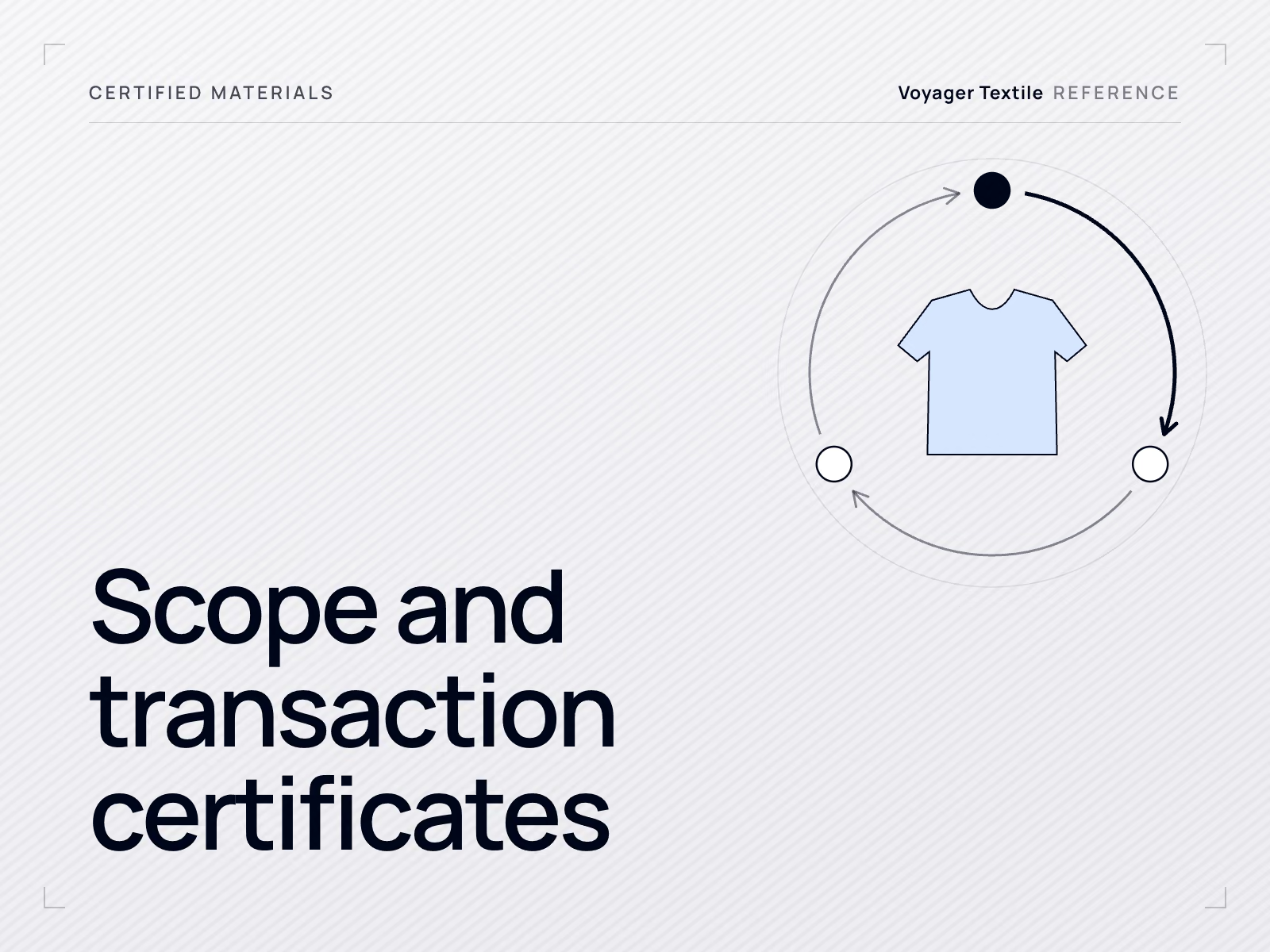
Two document types carry much of the weight, and they answer different questions. A scope certificate answers who is certified and for what. A transaction certificate answers what actually shipped.
A supplier presenting a valid scope certificate has shown you something real and necessary. What it does not show, on its own, is that the specific material being quoted falls inside that certified scope, or that the specific delivery is covered. Those are separate checks, and asking for them is routine due diligence rather than an accusation. The distinction is set out in scope and transaction certificates.
The schemes a buyer meets often
| Scheme | What it addresses | What it does not establish |
|---|---|---|
| GOTS | Textiles made from certified organic fibres, across processing, manufacturing and trading, with each processing company certified | Harmful-substance testing as a product label, or recycled content |
| Textile Exchange recycled standards | Recycled content with chain of custody, and in the case of the Global Recycled Standard additional processing criteria | Organic fibre origin, or that a finished garment is certified because its fabric was |
| OEKO-TEX STANDARD 100 | Testing of textile articles and their components for harmful substances | Fibre origin, organic status, recycled content, or how a facility operates |
Each has its own page: GOTS, recycled content certification and OEKO-TEX STANDARD 100. They are separate pages because they are separate systems, and treating them as variations on one idea is the error the whole cluster exists to correct.
Certification, and the claim you make to a customer
Being able to source certified material is not the same as being entitled to any particular wording on a label or a website. Schemes operate their own claims and labelling rules, covering what may be said, at what content threshold, and whether a mark may be used at all. Those rules sit alongside the technical standard rather than inside it, and alongside the legal restricted-substance requirements covered in chemical compliance, which apply whether or not anything is certified.
It follows that the useful question in development is not "is this certified" but "what exactly do we want to be able to say, and what evidence does that require". A programme that answers that first tends to buy the right documentation. One that answers it last tends to buy documentation it cannot use.
What to establish before you make a claim
Before a certified-material claim goes anywhere near a label
- Which scheme, named specifically rather than as a general reference to certification
- Which organisation holds the certificate, and which certification body issued it
- Whether the certificate is currently valid, checked against the scheme's own records rather than a PDF alone
- Whether the material being quoted falls inside the certified scope
- Whether the scheme requires transaction-level documentation for the delivery, and whether it will be issued
- Whether every processing step after the fabric needs to be certified for the claim you intend to make
- What the scheme's claims and labelling rules permit at the content level you will actually achieve
- Whether the market you sell into imposes its own requirements on the wording
The workflow for doing this when a supplier claim lands is in verifying certification claims, which also covers how to write the requirement into an enquiry so the answer arrives with the quotation rather than after it.
How this fits a development programme
Certification requirements belong with the other material decisions, in the bill of materials and in the enquiry itself, not in a later conversation about labels. A required standard changes which fabrics can be offered, which affects price, minimum quantities and lead time, and those consequences are easier to accept before a fabric has been approved than after.
For a Voyager development requiring certified material, the standard and the documentation needed should be defined before material approval rather than assumed afterwards. Certified fabrics and materials can be sourced where a programme specifies them, and what a given standard requires beyond the fabric itself is confirmed for the specific material and order.
Buyer questions
Does GOTS-certified fabric make the finished garment GOTS certified?
No, not on its own. GOTS requires each company involved in processing the product to be certified by an approved independent certification body, so a certified mill supplying an uncertified garment factory does not produce a certified finished garment. What claim remains available depends on the scheme and on where certification stops in the chain.
What is the difference between a certified material and a certified product?
A certified material is produced under a scheme's requirements by an organisation certified for that process, and travels with documentation. A certified product is an article assessed against a scheme's criteria, which is how harmful-substance certification works. Neither implies the other, and neither implies anything about the facility that made it.
Is a supplier's certificate enough to support my claim?
It is necessary and usually not sufficient. A valid scope certificate shows who is certified and for what. It does not by itself show that the material you are being quoted sits inside that scope, or that a specific delivery is covered. Confirming both is normal due diligence.
Can Voyager Textile produce certified garments?
Certified fabrics and materials can be sourced where a programme specifies them, and the documentation the supplier provides is passed on. What a particular standard requires beyond the material, including whether the manufacturing step itself has to sit inside a certified chain, depends on the scheme and is confirmed for the specific material and order. Any certification status is a matter for the certified organisations and their certification bodies.
Define the standard before the fabric
If a programme needs certified material, tell us the standard, the composition, the weight, the product and the claim you intend to make. That determines which fabrics can be offered and what documentation has to travel with them.
Start a project