

Sourcing & production knowledge
Answers from the
production floor.
80 guides for apparel buyers on quotations, specifications, sampling, manufacturing, decoration, inspection and shipping.
Start here
Choosing a manufacturer
Comparing factories and sourcing countries, telling a manufacturer from an agent, and deciding which supply model fits your business.
 How Voyager Textile Researches and Reviews Its Guides: Sources, Review and UpdatesManufacturing guides with references to regulations, standards and material specifications. Check the cited sources for your product and market requirements.Read the guide
 Certifications and auditsOEKO-TEX, GOTS and GRS certified materials can be sourced where the buyer specifies them, subject to availability and to the scope of the supplier's certificate. The supplier's documents, and any transaction documentation the order needs, are reviewed for that order.Read the guide
 Voyager Textile at a Glance: Capacity, Minimums, Lead Times, In-House ProcessesVoyager Textile is a direct apparel manufacturer and exporter in Türkiye with about 70 people and a capacity of about 100,000 pieces per month. The minimum is 300 pieces per colour and per style. Samples take 5-7 business days and bulk 4-5 weeks after sample approval.Read the guide
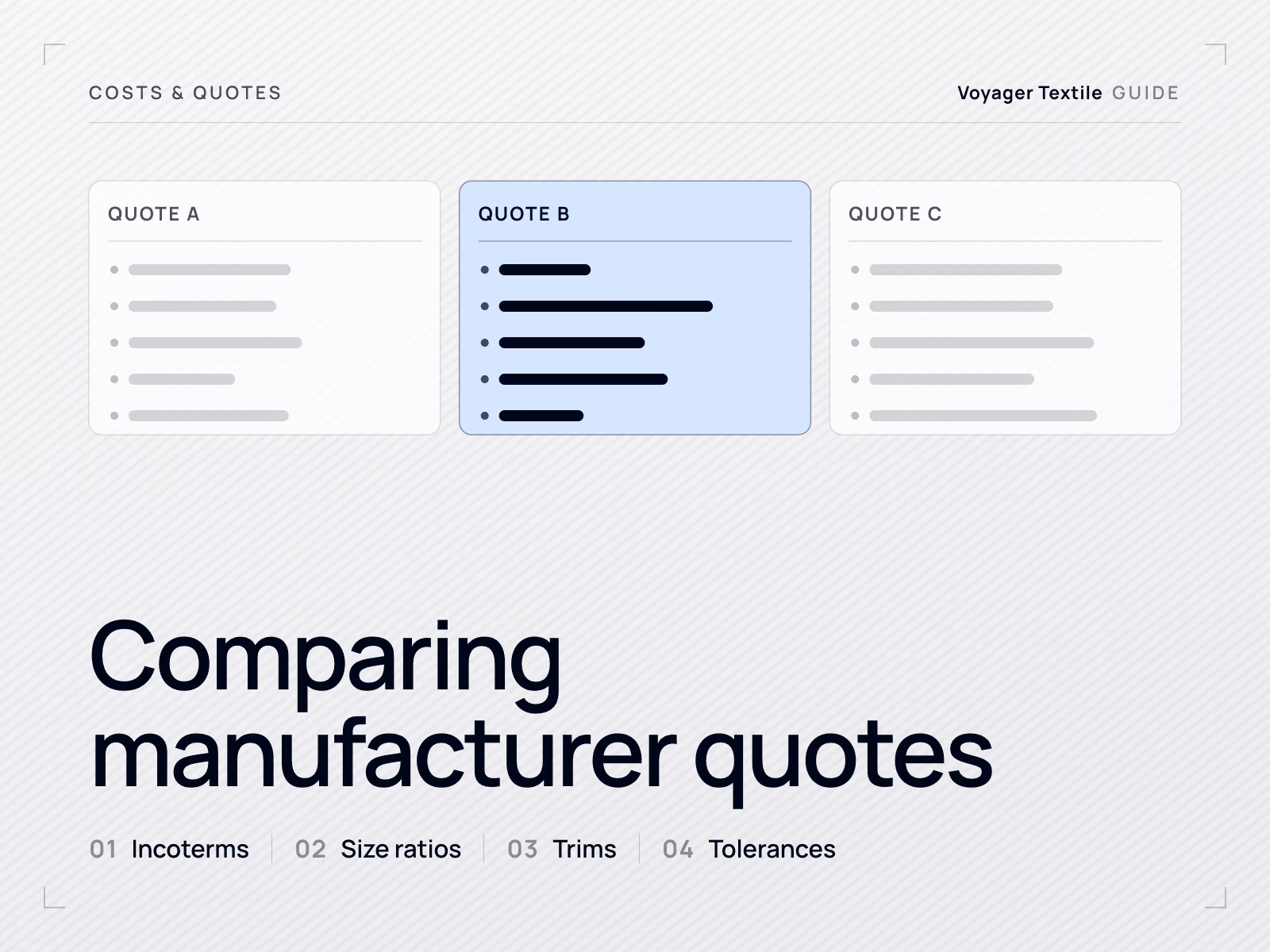 How to Compare Clothing Manufacturer Quotes: Incoterms, Size Ratios, Trims and TolerancesCompare clothing manufacturer quotes line by line against one specification, not by unit price. Put every quote on the same Incoterm, the same quantity basis and size ratio, the same trims and packing, and the same tolerances, and list what each one excludes. Only then do the unit prices describe the same garment.Read the guide
 Questions to Ask a Clothing Manufacturer, With the Answers You Should GetAsk a clothing manufacturer questions whose answers can be checked later: where the garment is made, which processes are in-house, the minimum per colour and per style, how long sample and bulk take and from when, and what bulk is checked against. A good answer is specific, written and carries a unit. Voyager Textile's own answers are given where they do not depend on the product.Read the guide
 Clothing Manufacturer Red Flags: How to Vet a Supplier Before You Pay a DepositBefore paying anything, a buyer can check four things about a clothing manufacturer: whether the factory it describes can be seen, whether the sample is made the way bulk will be made, whether the quotation states what it prices, and whether questions get specific written answers. One signal proves nothing. Several unanswered ones are a reason to stop and ask.Read the guide
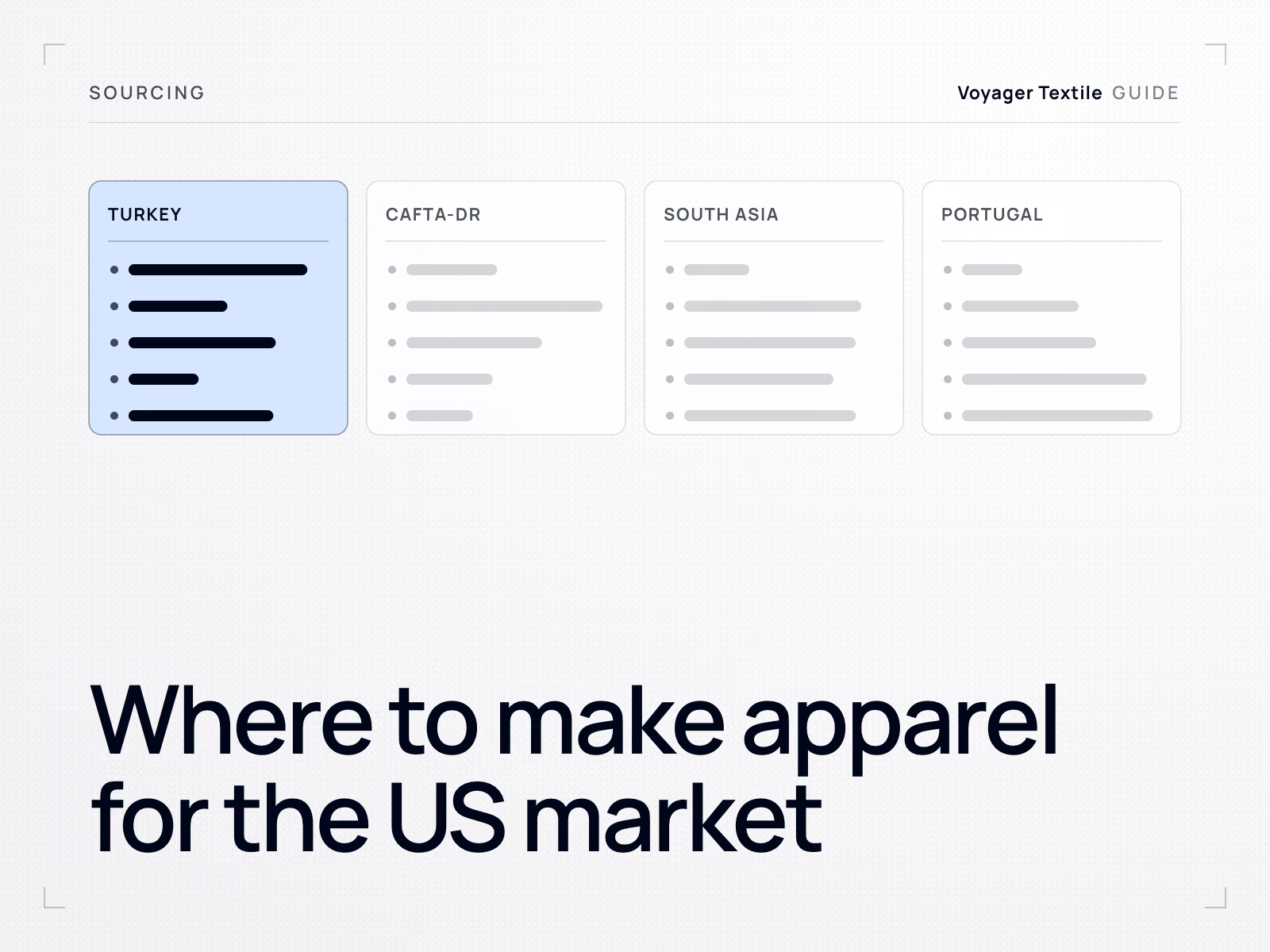 Where to Make Apparel for the US Market: Turkey, CAFTA-DR, South Asia or PortugalFor the US market, the country of origin decides the duty. Garments from CAFTA-DR countries that meet the yarn-forward rule enter duty free; garments from Türkiye, South Asia and most other origins pay the normal HTS rate plus an additional Section 301 duty; EU garments, Portugal included, pay a combined rate of at least 10 percent. Minimums and lead time then decide between the options that remain.Read the guide
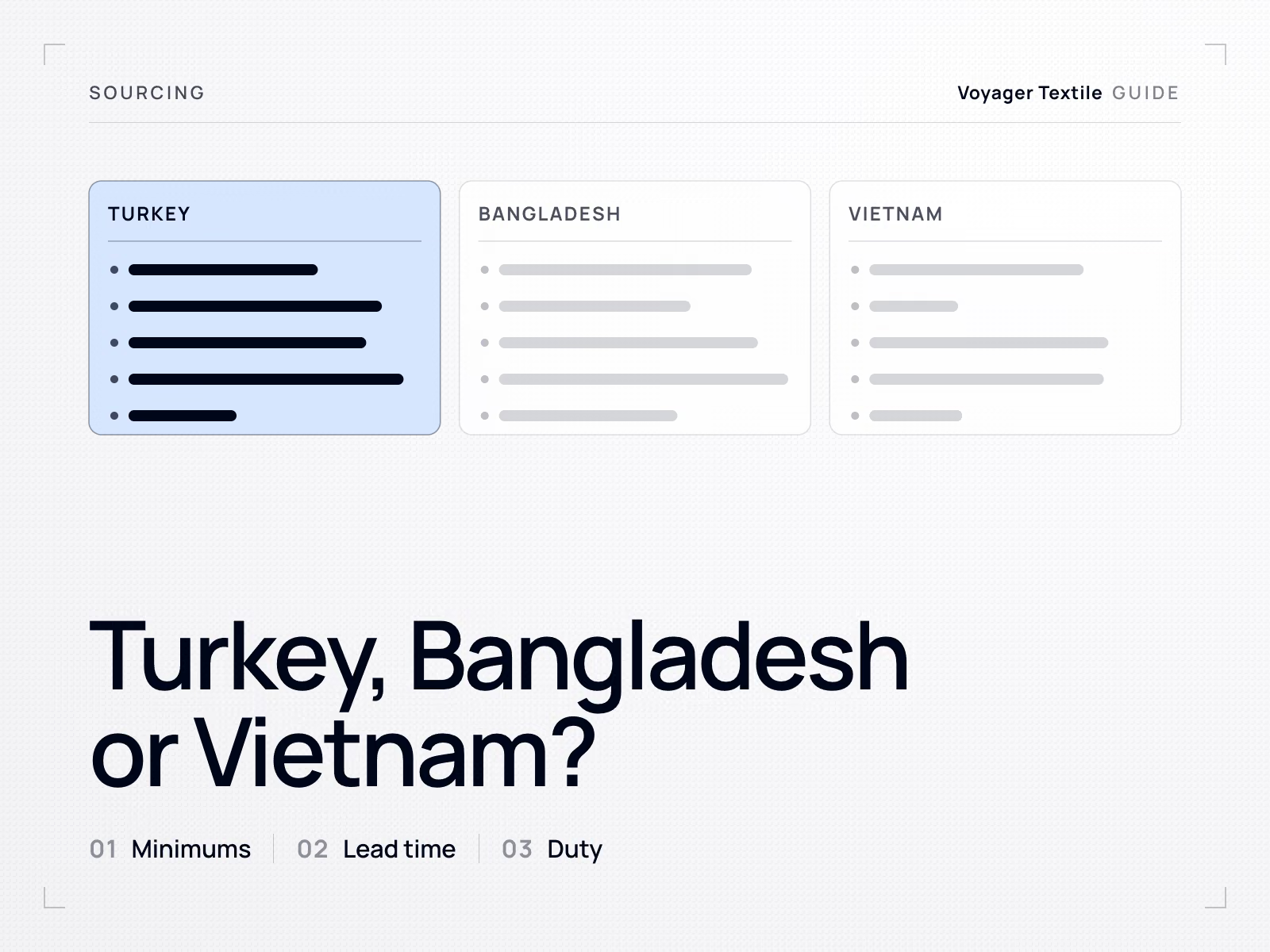 Turkey vs Bangladesh vs Vietnam for 300 to 3,000 Pieces: Minimums, Lead Time and DutyAt 300 to 3,000 pieces per style, Türkiye usually fits better than Bangladesh or Vietnam: minimums are lower, road freight to Europe takes days, and apparel enters the EU duty free under the customs union. Bangladesh and Vietnam are typically built for larger volumes, and their advantage grows as the quantity per style rises. Duty into the EU and the US differs for all three and should be checked for the exact tariff code.Read the guide
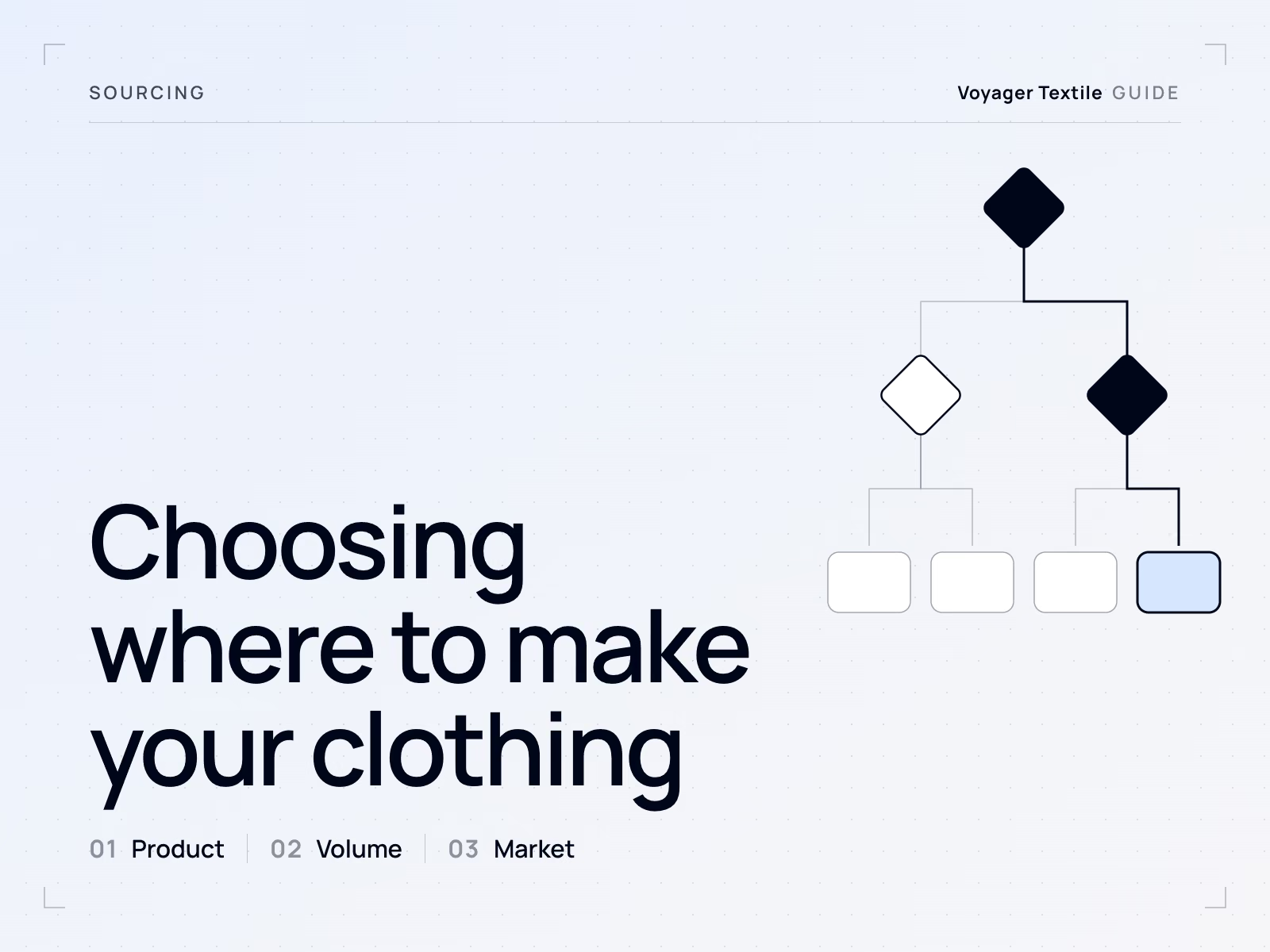 Best Country to Manufacture Clothing: A Decision Framework by Product, Volume and MarketThe best country to manufacture clothing is the one that fits your sales market, your product and your order size per style, in that order. The market decides the duty you pay, the product narrows the countries with the right fabric and skills, and the quantity per style and colour decides which factories will take the order at all. Lead time and compliance then separate the shortlist.Read the guide
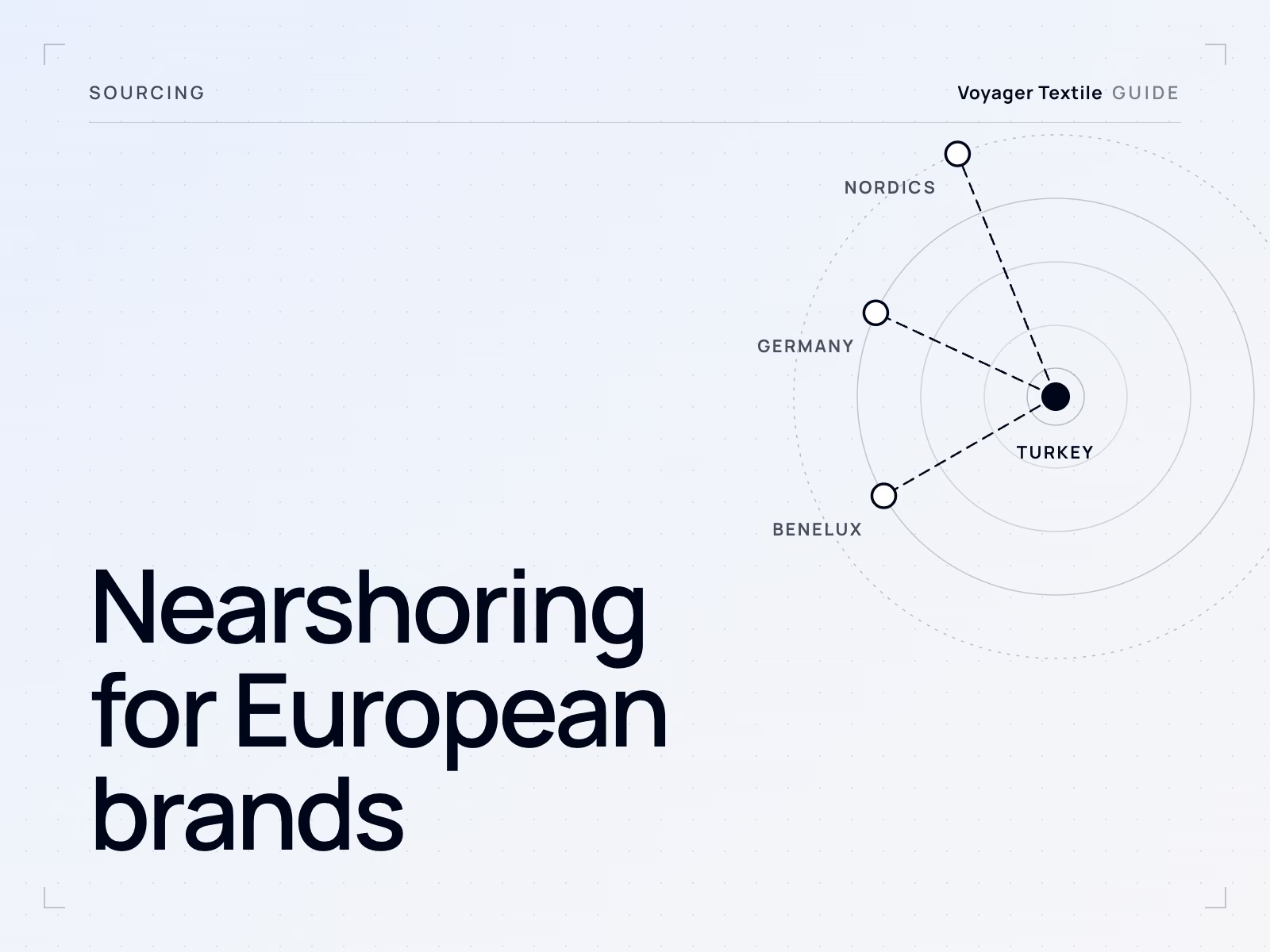 Nearshoring Clothing Production for European Brands: Where Turkey FitsNearshoring clothing production for a European brand usually means choosing between an EU country such as Romania, Bulgaria or Poland and a customs-union partner such as Türkiye. EU factories ship with no customs formalities at all; Türkiye ships duty free under the EU-Türkiye customs union with an A.TR certificate and a customs declaration. The choice then turns on product range, fabric sourcing, minimums and lead time.Read the guide
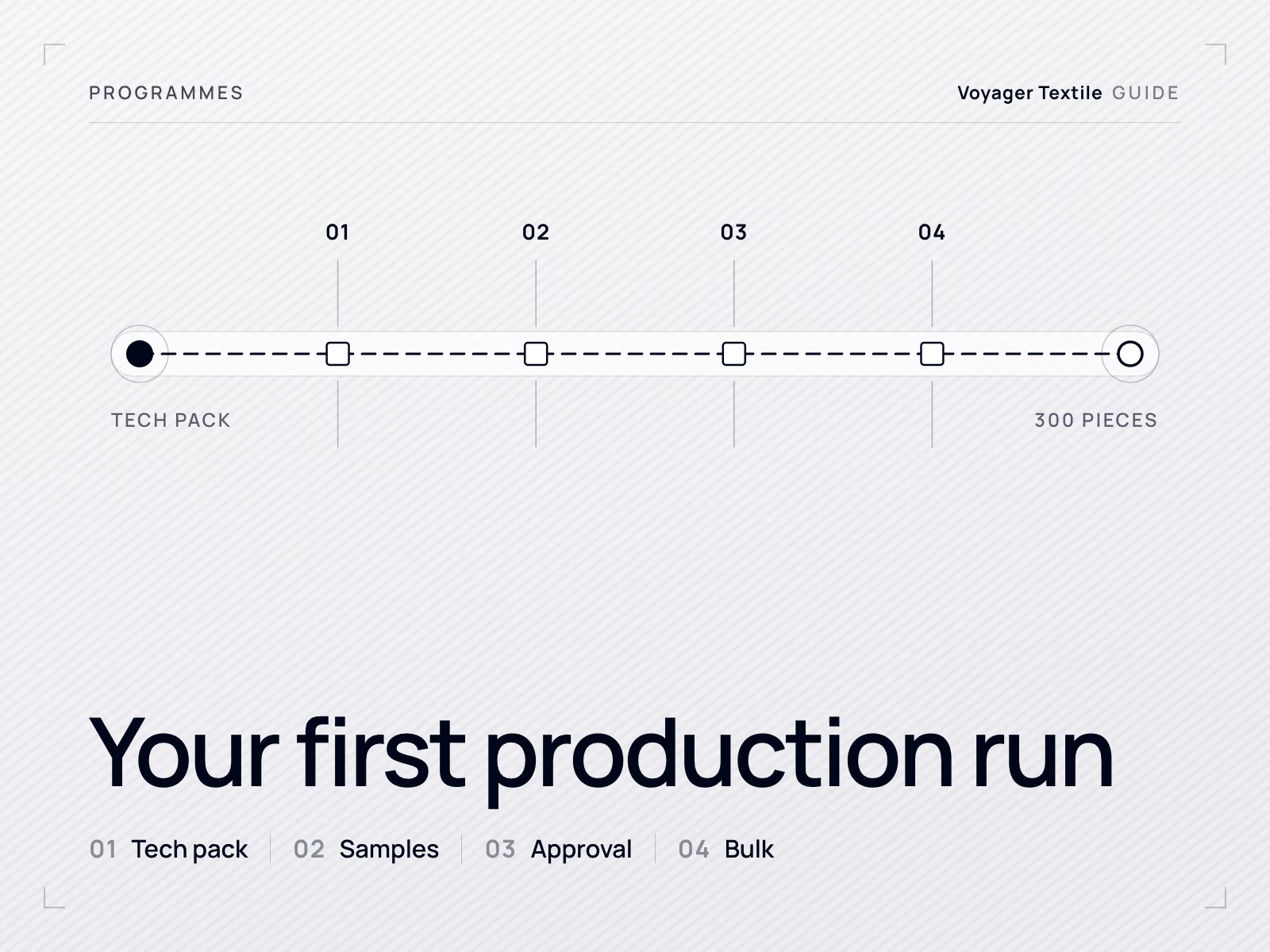 Your First Production Run: From Tech Pack to 300 Finished PiecesA first production run for a new clothing brand has five stages: prepare the specification, sample, approve, produce in bulk, then inspect and ship. At Voyager Textile a sample takes 5-7 business days, bulk takes 4-5 weeks after sample approval, and the minimum is 300 pieces per colour and per style, with sizes split inside the 300.Read the guide
 How to Find a Reliable Clothing Manufacturer in TurkeyConfirm the supplier's production role, product experience and capacity for your order. Evaluate samples against your specification alongside factory information, relevant documentation and agreed quality controls.Read the guide
 Turkey vs Portugal for Clothing ManufacturingPortugal tends to suit smaller European runs, premium knitwear and brands that need an EU-internal supply chain. Turkey tends to suit wider product ranges, larger volumes and projects that need custom fabric or custom colour development. Both are nearshore options for Europe, and the right answer depends on your product, volume and market.Read the guide
 Turkey vs China for Clothing ManufacturingChina usually wins on price at high volume and on complex technical products with deep component supply. Turkey usually wins on speed of replenishment, smaller commitments and the amount of cash tied up in stock. For European buyers there is also a duty difference, and for US buyers a supply-chain documentation difference, that often matter more than the unit price.Read the guide
 Clothing Manufacturer vs Sourcing Agent: Which Model Fits Your Business?Work directly with a factory when your range sits in one or two product families and you can supply a specification. Use a sourcing agent when you buy across many categories or countries, or when you have no technical staff to run development. The deciding question is not price, it is who is accountable for the garment.Read the guide
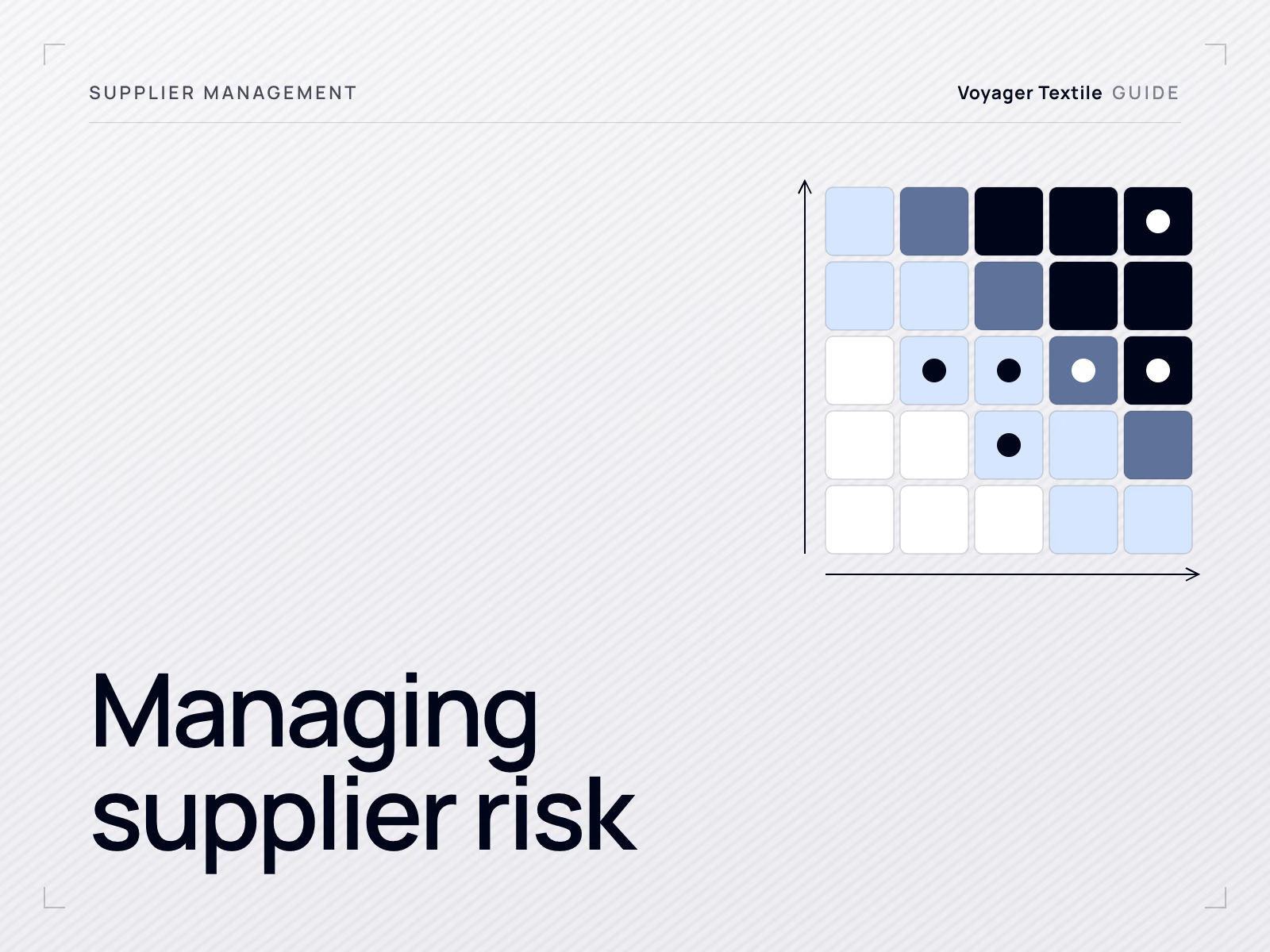 How to Manage Supplier Risk in Apparel SourcingSupplier risk is not a worse version of supplier performance. It asks a different question: if this factory, mill or specialist process became unavailable, where would supply actually stop, and what alternative route could genuinely produce an acceptable product? Many programmes that believe they are dual-sourced are not.Read the guide
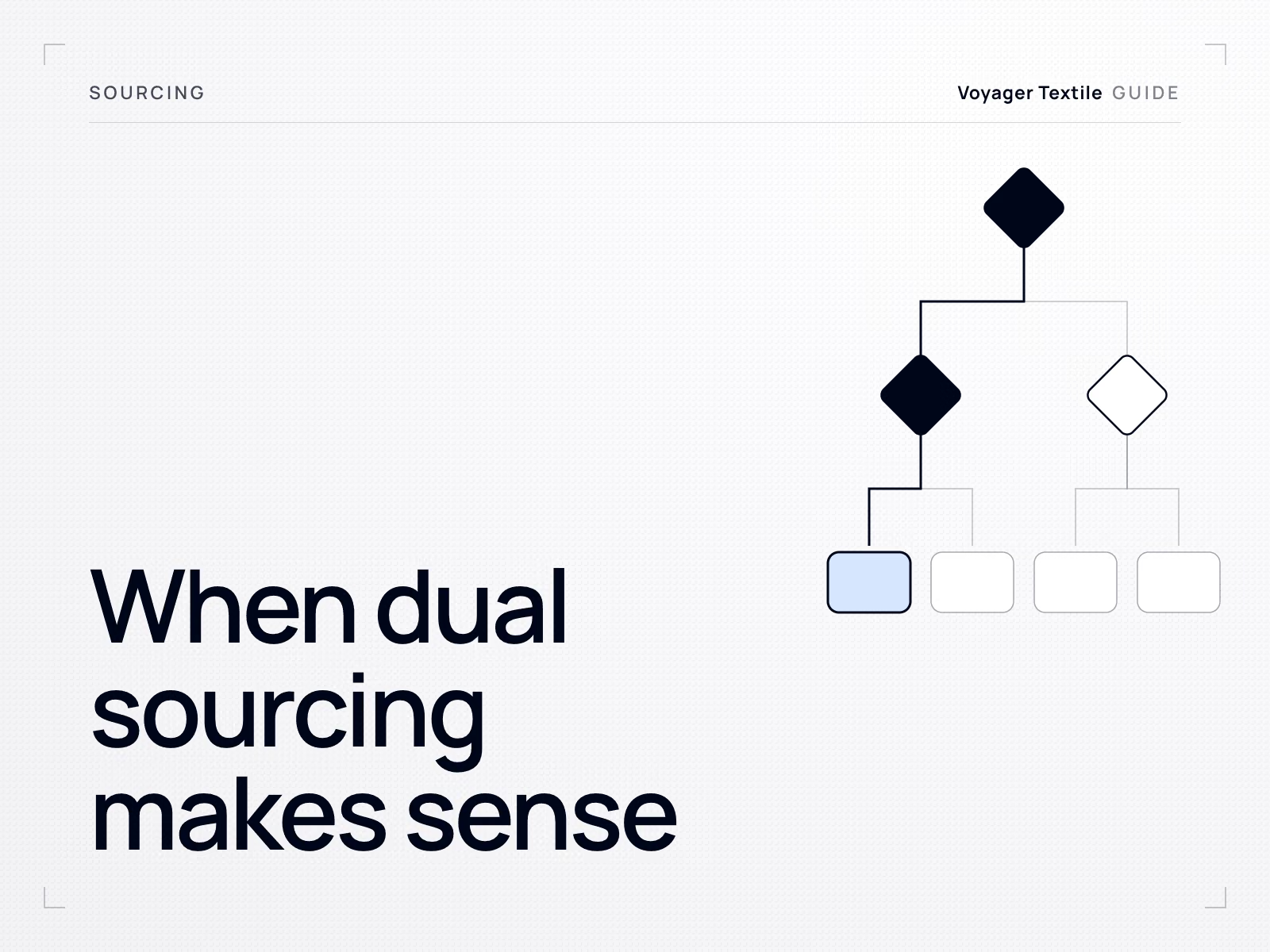 When Does Dual Sourcing Make Sense in Apparel Production?Dual sourcing is a structural decision with a real price, not a default best practice. Two factories can improve availability and leverage, and they can also produce two visibly different garments. Whether it is worth it depends on what would actually stop supply, how tolerant the product is of variation, and whether the duplicated development can be justified.Read the guide
 How to Qualify and Approve an Apparel SupplierSupplier approval is a decision about scope, not a status a factory holds. An audit answers what an audit asks, a certificate describes a management system, a sample shows what could be made once, and none of them, alone or together, establishes that a supplier can produce your programme in bulk. Approval says what this supplier may make, on what evidence.Read the guide
 OEM, ODM, Private Label and White Label Clothing: What Is the Difference?Private label clothing is apparel made by a manufacturer and sold under the buyer's own brand, with the buyer's labels and packaging and, in most programmes, the buyer's own design and specification. OEM and ODM describe who designs the product: the buyer in OEM, the factory in ODM. In general trade usage white label means a standard product sold under several buyers' brands; at Voyager Textile it means unbranded production to the buyer's own design.Read the guide
 Custom-Made Apparel vs Branded Blanks for Merchandise BuyersBlanks win on speed, small quantities and low risk. Custom manufacturing wins when the product itself has to be different: your fabric, your fit, your exact brand colour, your labels. The decision point is usually the quantity at which decorated blanks stop being cheaper and start being merely easier.Read the guide
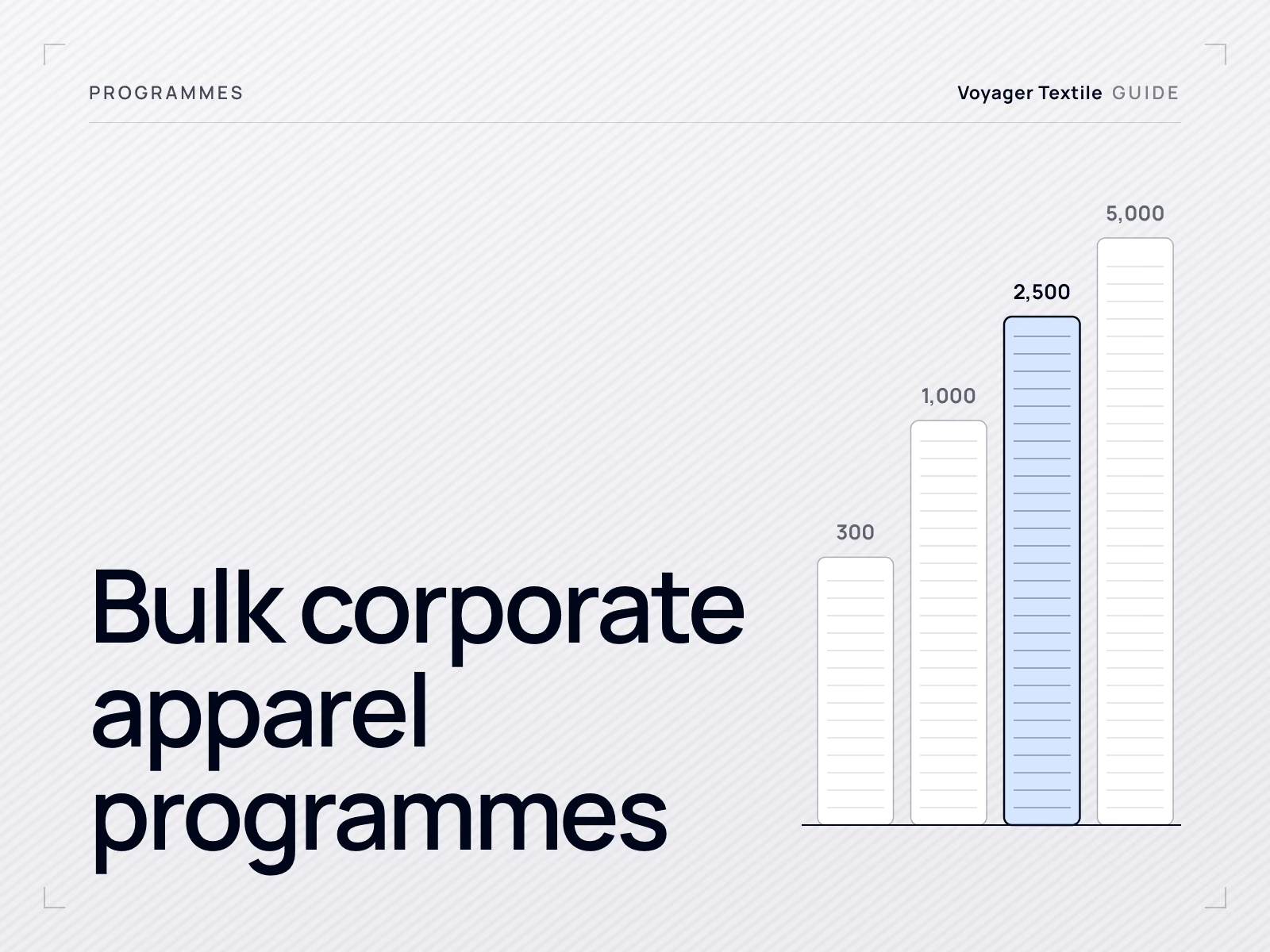 Bulk Corporate Apparel Programmes: A Procurement GuideCorporate clothing is branded clothing that a company issues to its staff for work, events and customer contact, made to one specification and reordered as the workforce changes. A corporate apparel programme often fails on logistics rather than on product. Size planning, a workable approval process, colour continuity across years and a clear distribution model decide whether people actually wear the clothing. The garment itself is the easy part.Read the guide
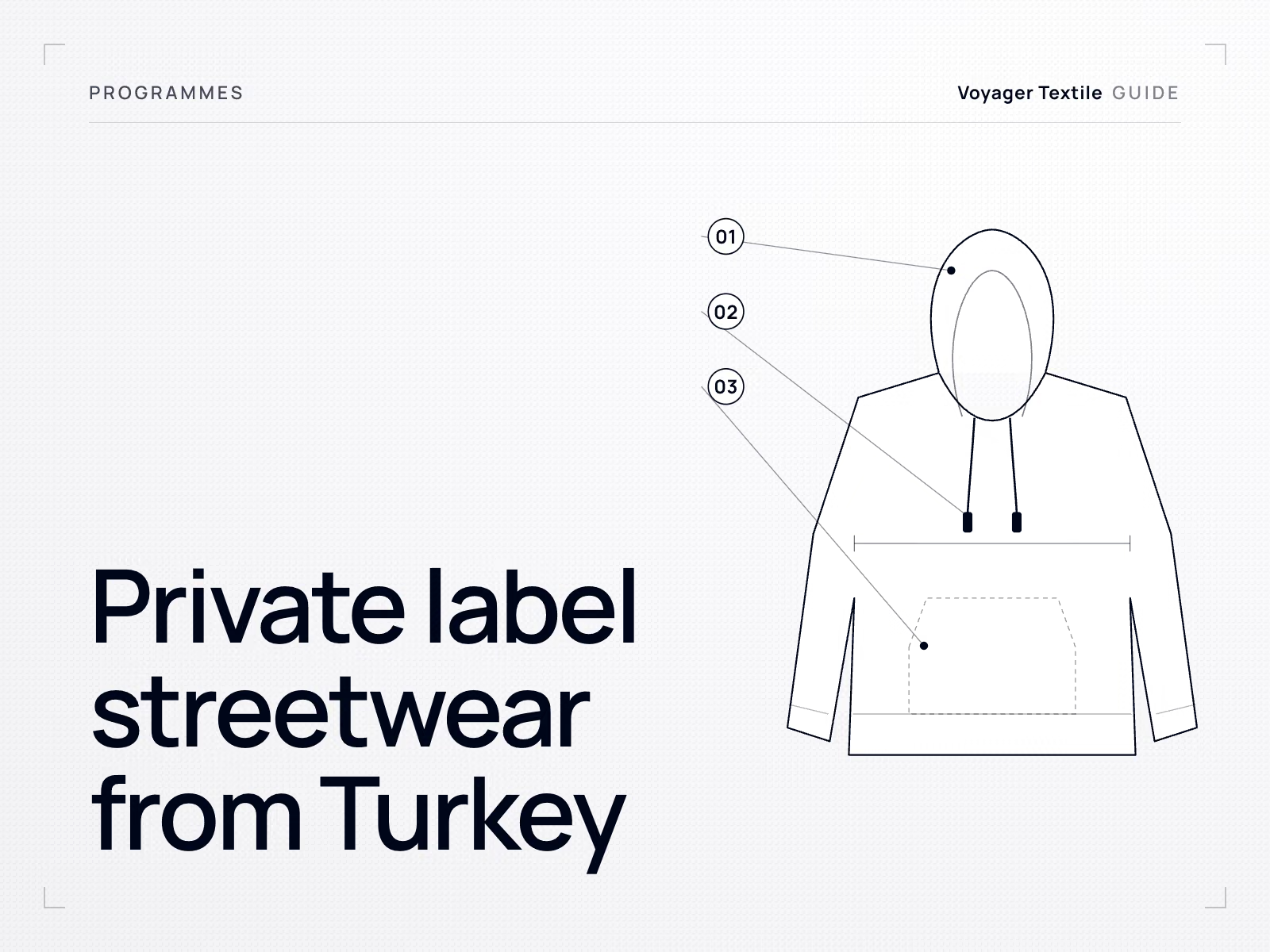 Private Label Streetwear Manufacturing in Turkey: Fabrics, Fits and FinishesStreetwear quality comes from four decisions: fabric weight and quality, pattern proportion, rib and trim consistency, and finishing. Ordering a heavier fabric is the easy part. Getting the proportions right, and repeating them across sizes and reorders, is what separates a considered product from a scaled-up basic.Read the guide
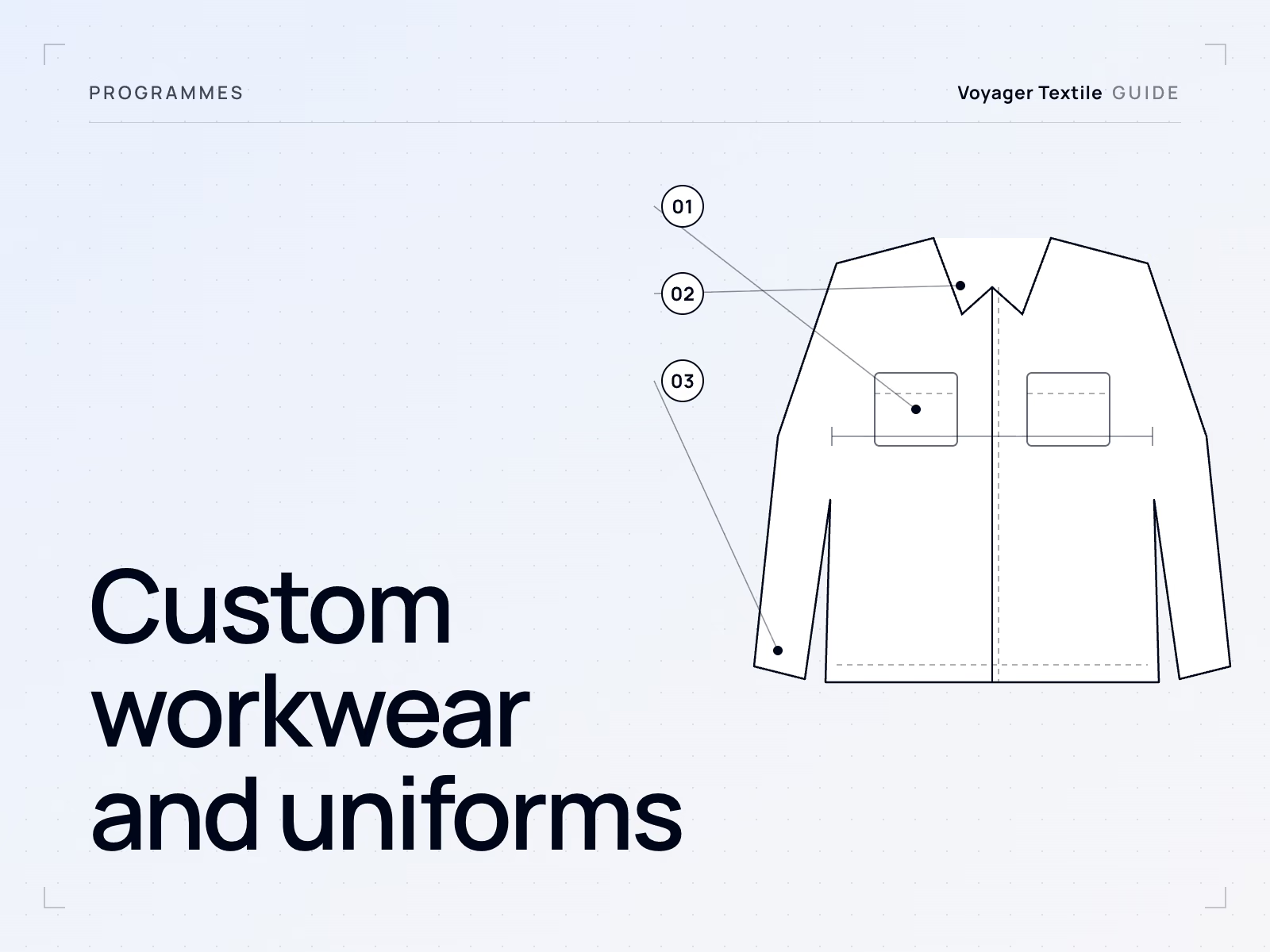 Custom Workwear and Uniform ManufacturingWorkwear is judged over years, not seasons. Fabric that survives repeated hot washing, construction reinforced where garments actually fail, decoration that does not peel and a size range that stays available are what matter. Appearance is a requirement, but durability and repeatability are the specification.Read the guide
 Moving Clothing Production to a New ManufacturerMoving a style is a re-development, not a copy. The specification, the sealed sample and the colour standards transfer; the pattern interpretation, the fabric source, the trim supply and the machine settings do not. Treating the move as development with a very good brief produces a far better result than treating it as a handover.Read the guide
 Apparel Manufacturing in Türkiye: What Buyers Should KnowTürkiye has a domestic textile supply chain and road-freight connections to Europe that can support custom fabric development and repeat orders. Assess each programme through product-specific quotations, material availability and the supplier's capabilities. Compare total landed cost and delivery timing alongside unit price.Read the guide
MOQ, costs and quotes
What sets minimum quantities, unit cost, payment and lead times, and how to brief a factory so the quotation is comparable.
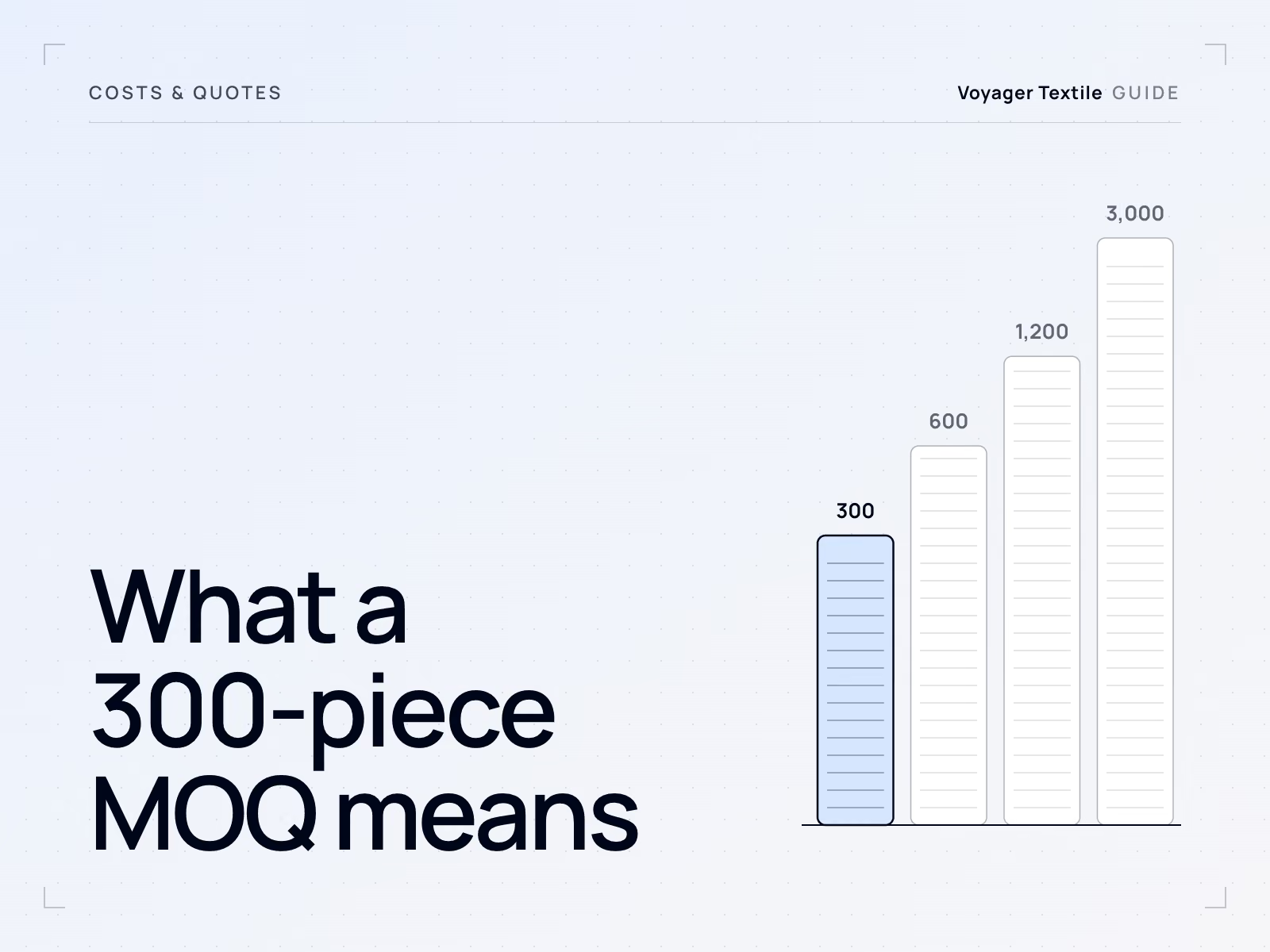 What Does a 300-Piece MOQ Mean in Custom Apparel Manufacturing?At Voyager Textile, a 300-piece MOQ means 300 pieces per colour and per style, for every product including all-over sublimation. Sizes can be split within the 300.Read the guide
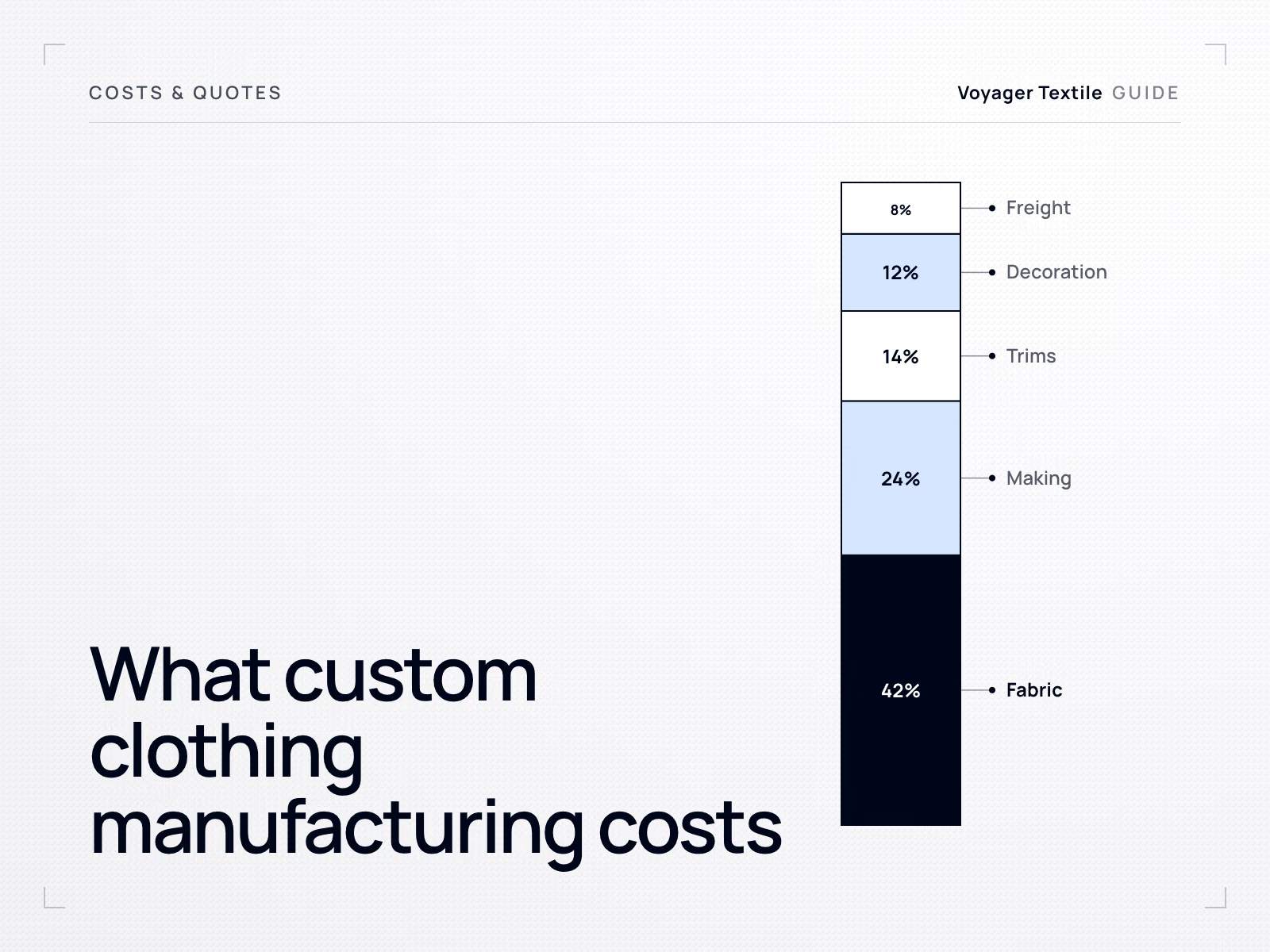 How Much Does Custom Clothing Manufacturing Cost?There is no useful price list for custom apparel, because the same garment can differ in price several times over depending on fabric, weight, construction and quantity. What is useful is knowing which lines make up a quotation, which of them you control, and how to compare two quotes that appear to be for the same product.Read the guide
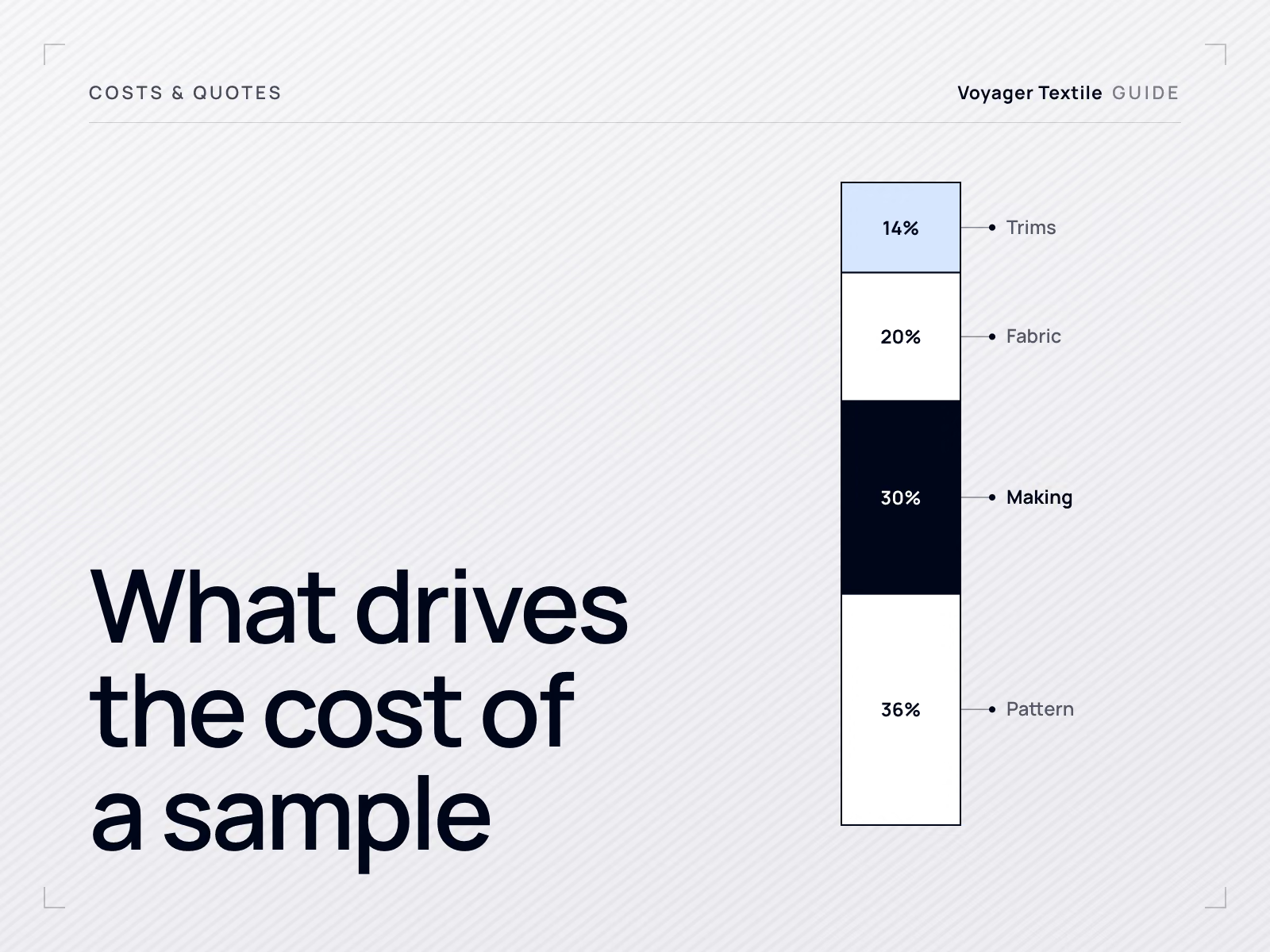 What Determines the Cost of an Apparel Sample?A sample is not one unit taken out of a bulk run. It is the first physical execution of a product that does not exist yet, and most of the work involved happens once per specification rather than once per garment. Bulk production spreads that work across the whole order. A sample cannot.Read the guide
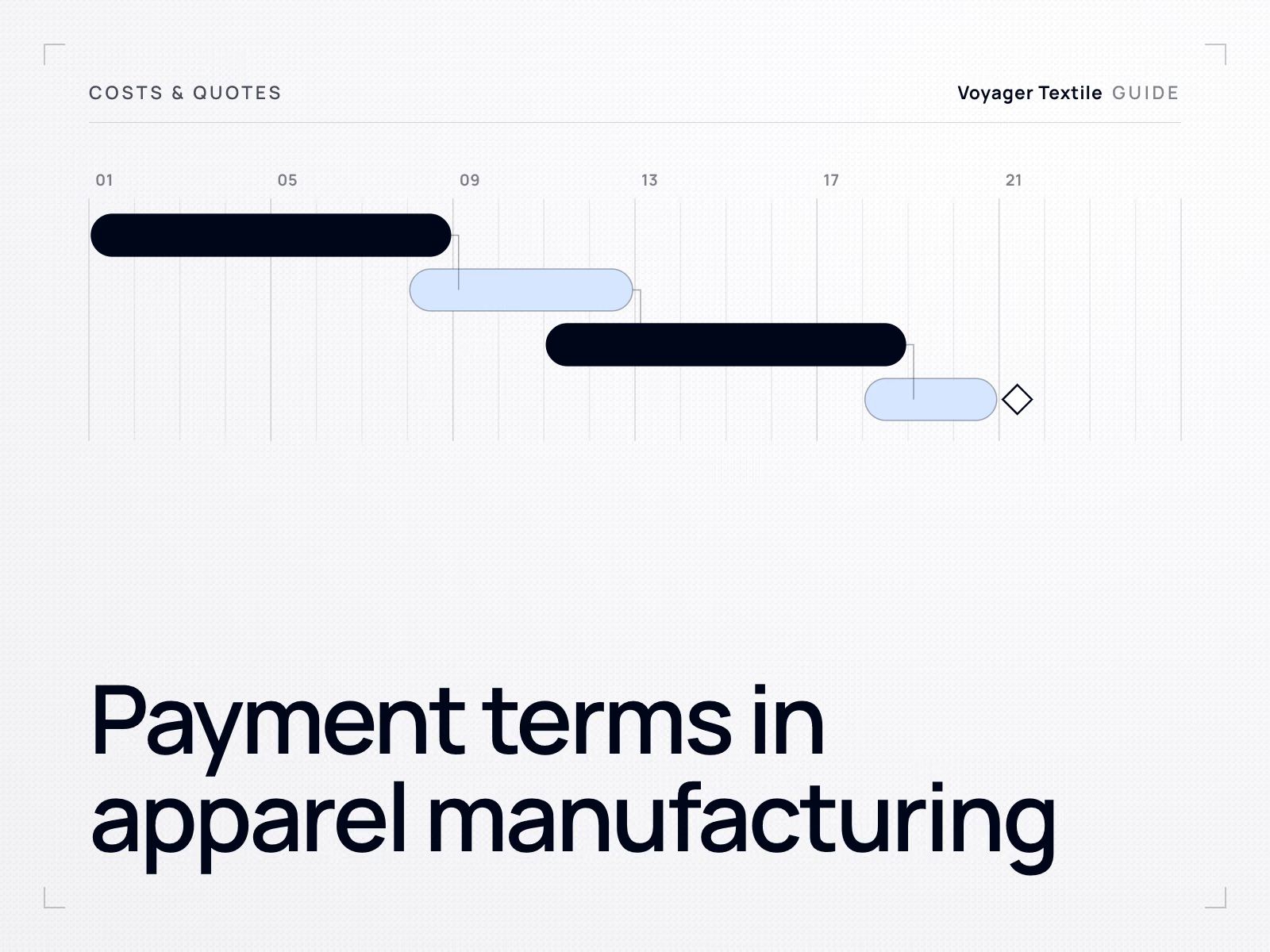 Payment Terms in Apparel ManufacturingPayment in an apparel order has two separate axes that are constantly confused: when money becomes due, and through what mechanism it is paid and controlled. Neither is decided by the Incoterm, and neither settles who owns the goods. This guide explains the structures that exist, what each one does to the exposure on both sides, and what has to be agreed before anyone sends anything.Read the guide
 What an Apparel Purchase Order Should ContainA purchase order is the buyer's commercial instruction: what is being ordered, on what terms, to arrive when. It is not the technical specification and it does not replace one. Many apparel order problems that look like factory errors start as a purchase order that named a quantity without naming the size breakdown, or a delivery date without naming which milestone it referred to.Read the guide
 Confidentiality, NDAs and Exclusivity in Apparel ManufacturingAn NDA governs who may disclose information and what they may use it for. It transfers no ownership, creates no exclusivity, and does not stop a supplier working with anyone else. Those are three separate instruments that get requested as one, and exclusivity is the one that commonly fails, because it is rarely scoped.Read the guide
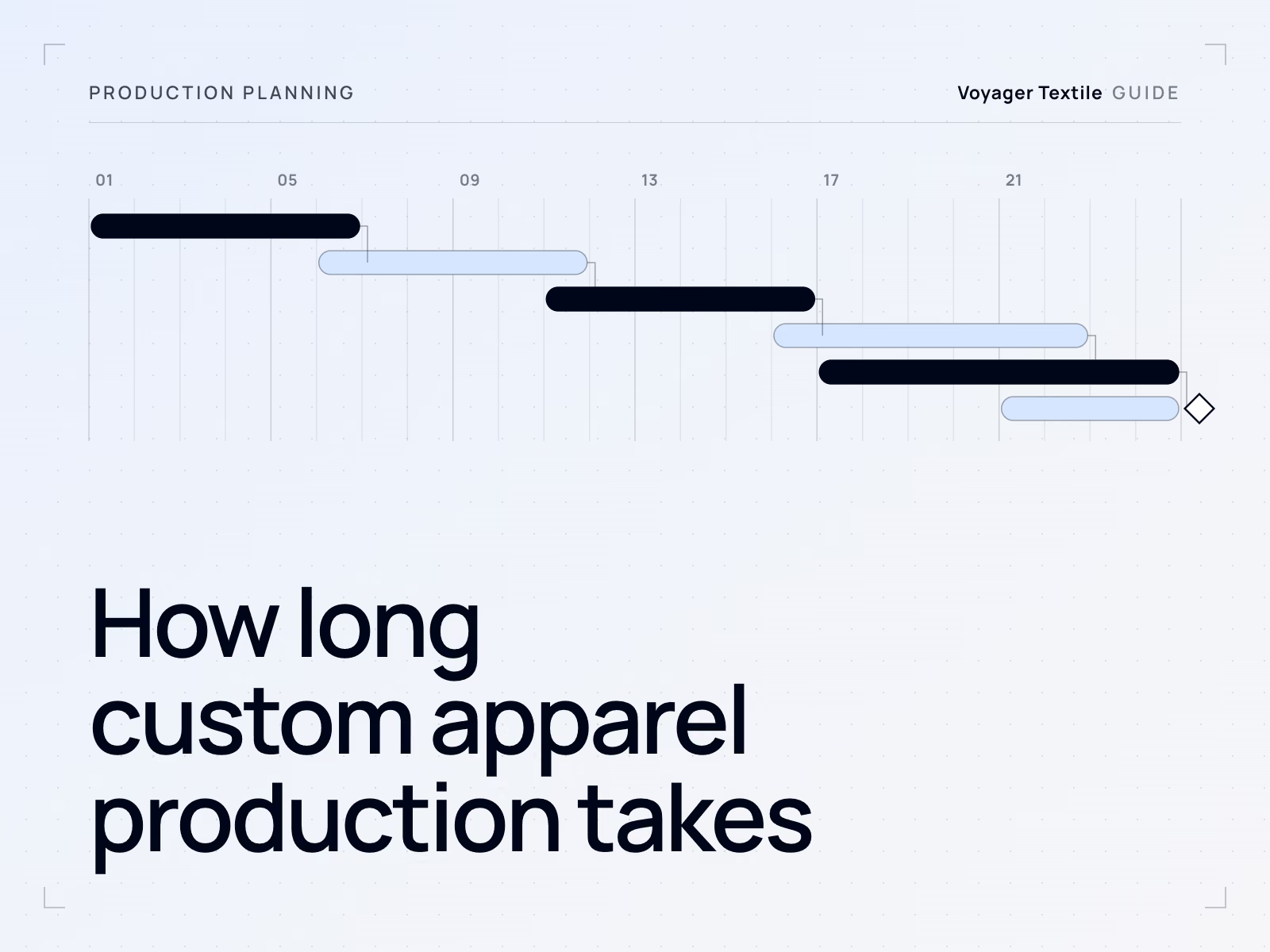 How Long Does Custom Apparel Production Take?Bulk production at Voyager Textile typically takes 4 to 5 weeks after sample approval. Everything before that, specification review, fabric sourcing, custom colour development and sampling, and everything after it, packing and transport, is additional and varies by project. Planning properly means treating those stages separately rather than asking for one number.Read the guide
 How to Build and Run an Apparel Time-and-Action CalendarA time-and-action calendar turns a promised delivery date into dated milestones with owners and dependencies. Its value is not the list of dates but the ability to answer one question when something slips: does this actually move the shipment, or not?Read the guide
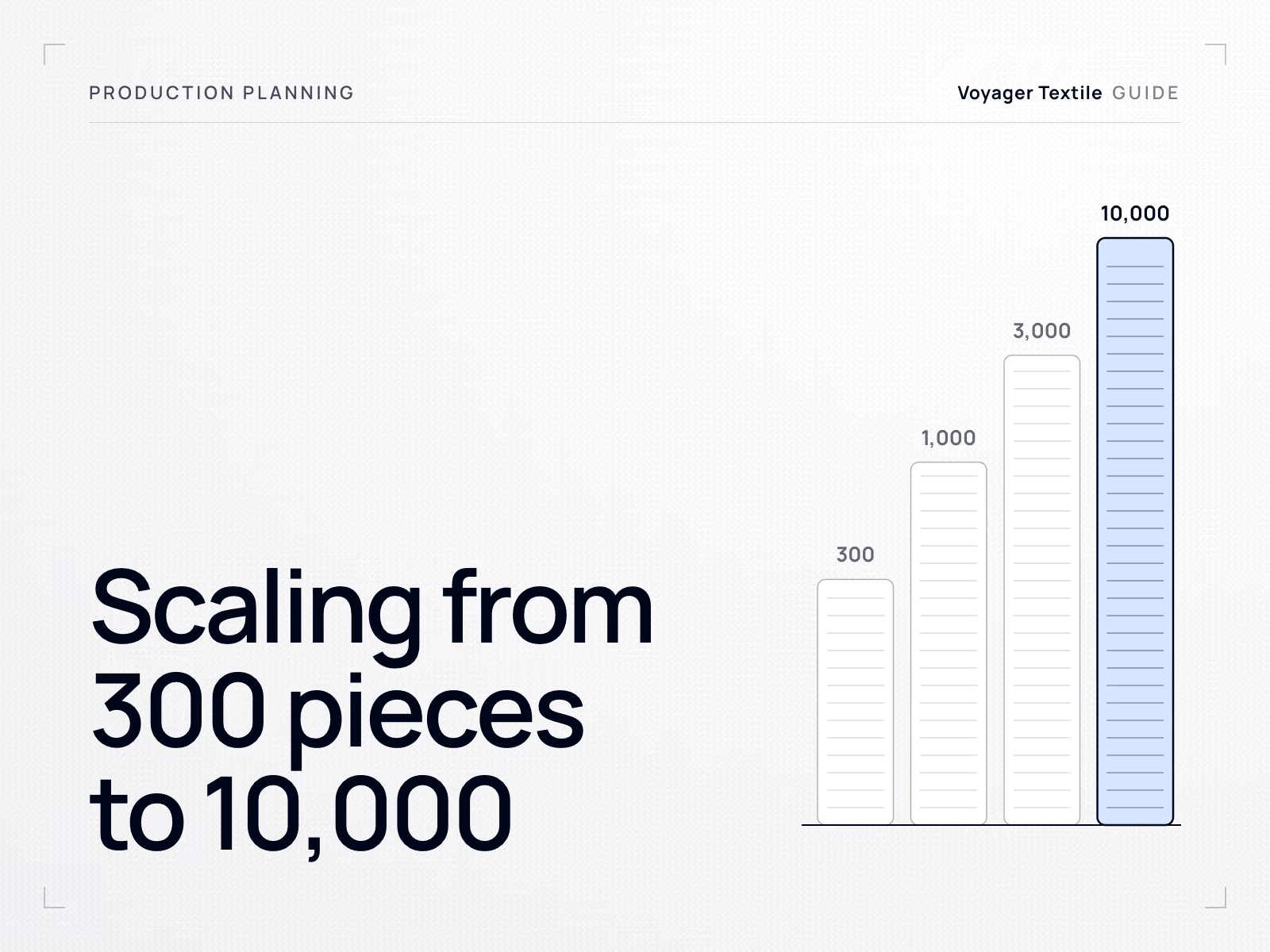 How to Scale Apparel Production from 300 Pieces to 10,000 and BeyondScaling apparel production is a planning problem rather than a manufacturing one. The garment does not change; what changes is that fabric must be booked ahead, capacity must be reserved, colour has to hold across dye lots, and quality control has to move from looking at everything to sampling properly.Read the guide
 How to Prepare an Apparel Manufacturing RFQAn accurate apparel quotation needs ten things: the product, the quantity, the fabric, the colours, the size split, the decoration with artwork, the labels and packing, the destination, the delivery date and who to reply to. Send those and you will get a real price. Send a photograph and a target price and you will get an assumption.Read the guide
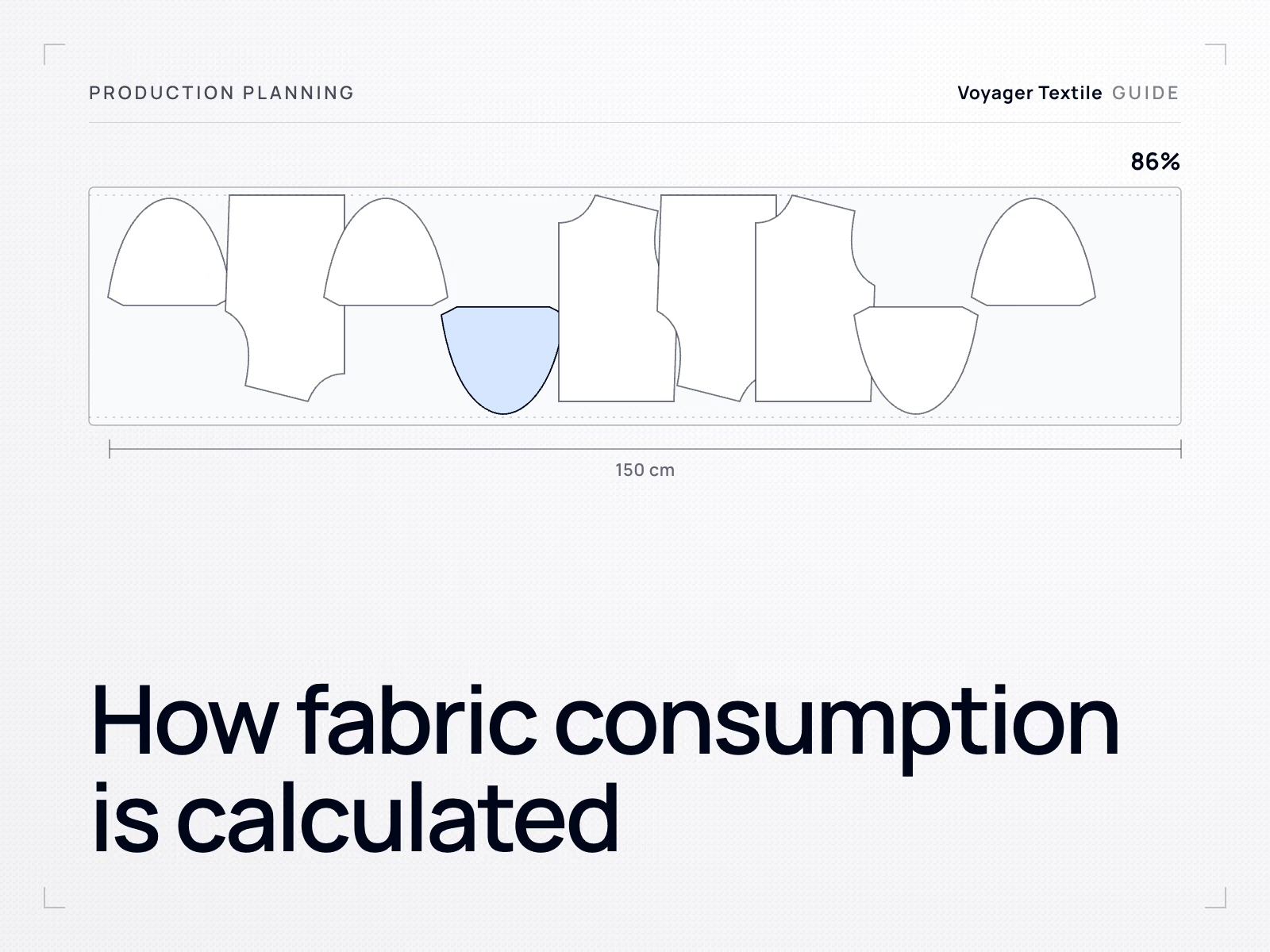 Fabric Consumption in Apparel ManufacturingFabric consumption is how much cloth one garment uses, including the part that becomes waste. It is the largest single input into the price of most knitted garments, and it is decided by the pattern, the fabric width and the marker rather than by the garment's finished weight. Early estimates are approximations; a marker is the measurement.Read the guide
Development and sampling
Tech packs, patterns, samples, fabric, colour, decoration, labels and packaging: the decisions taken before a bulk order.
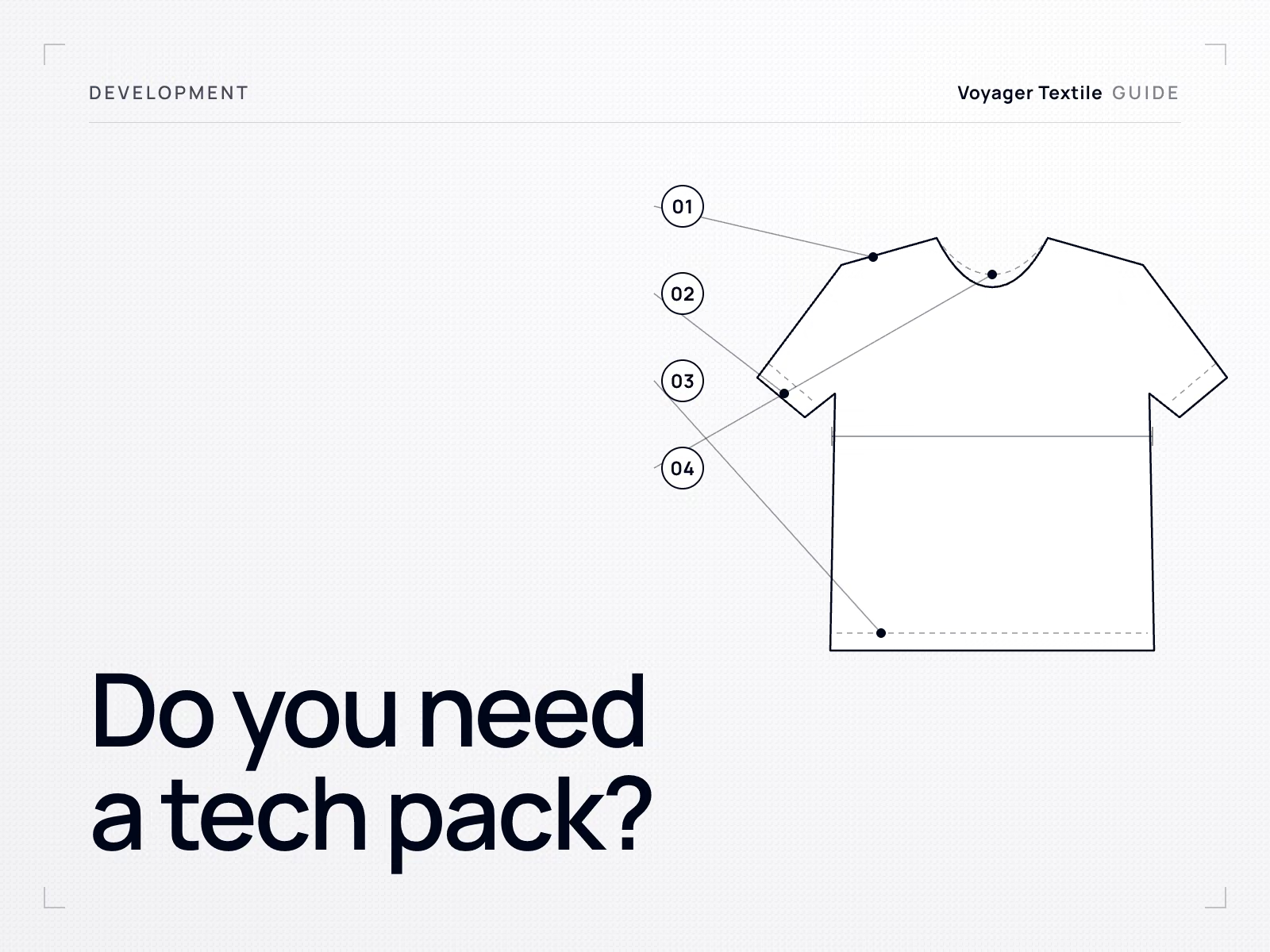 Do You Need a Tech Pack to Manufacture Clothing?You do not need a tech pack to start a conversation with a factory, but something has to define the garment before a sample is made. A tech pack is the clearest form of that definition. Reference samples, measurements and clear photographs can do the same job at the start, and the factory can help you build the rest.Read the guide
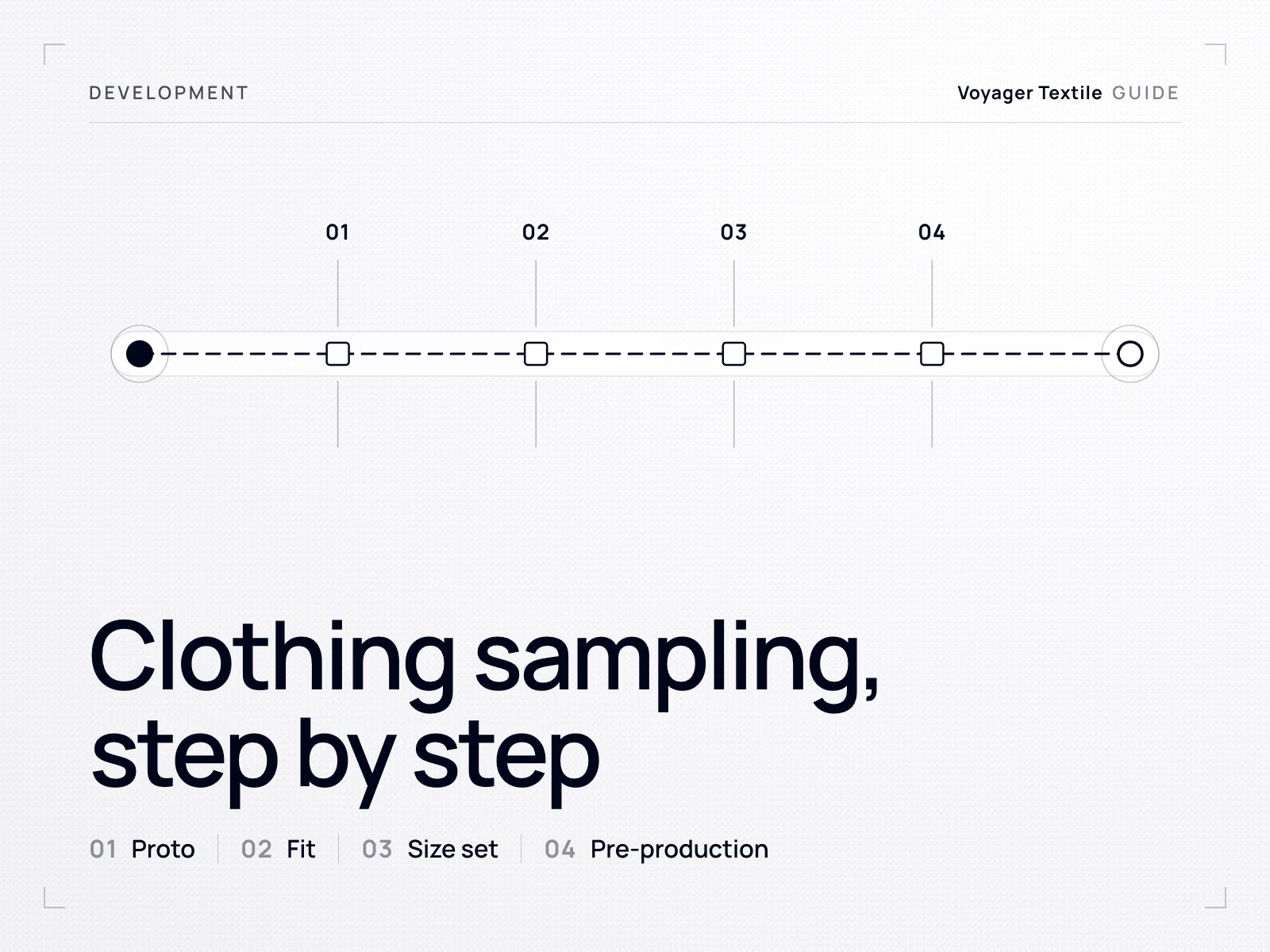 Clothing Sampling Explained: Proto, Fit, Size Set and Pre-Production SamplesEach sample stage supports a different decision: the proto helps assess construction, the fit sample checks measurements and fit, the size set checks grading and fit across selected sizes, and the pre-production sample checks the agreed bulk materials and decoration. Agree the stages and approval criteria for the project.Read the guide
 Who Owns the Pattern, Tech Pack and Artwork?Ownership of the pattern is rarely discussed until the moment it matters, which is usually the day a buyer wants to move production. The honest answer is that it depends on what was agreed, so the useful work is agreeing it. This guide sets out the asset categories, the questions each one raises, and what to settle before files start moving.Read the guide
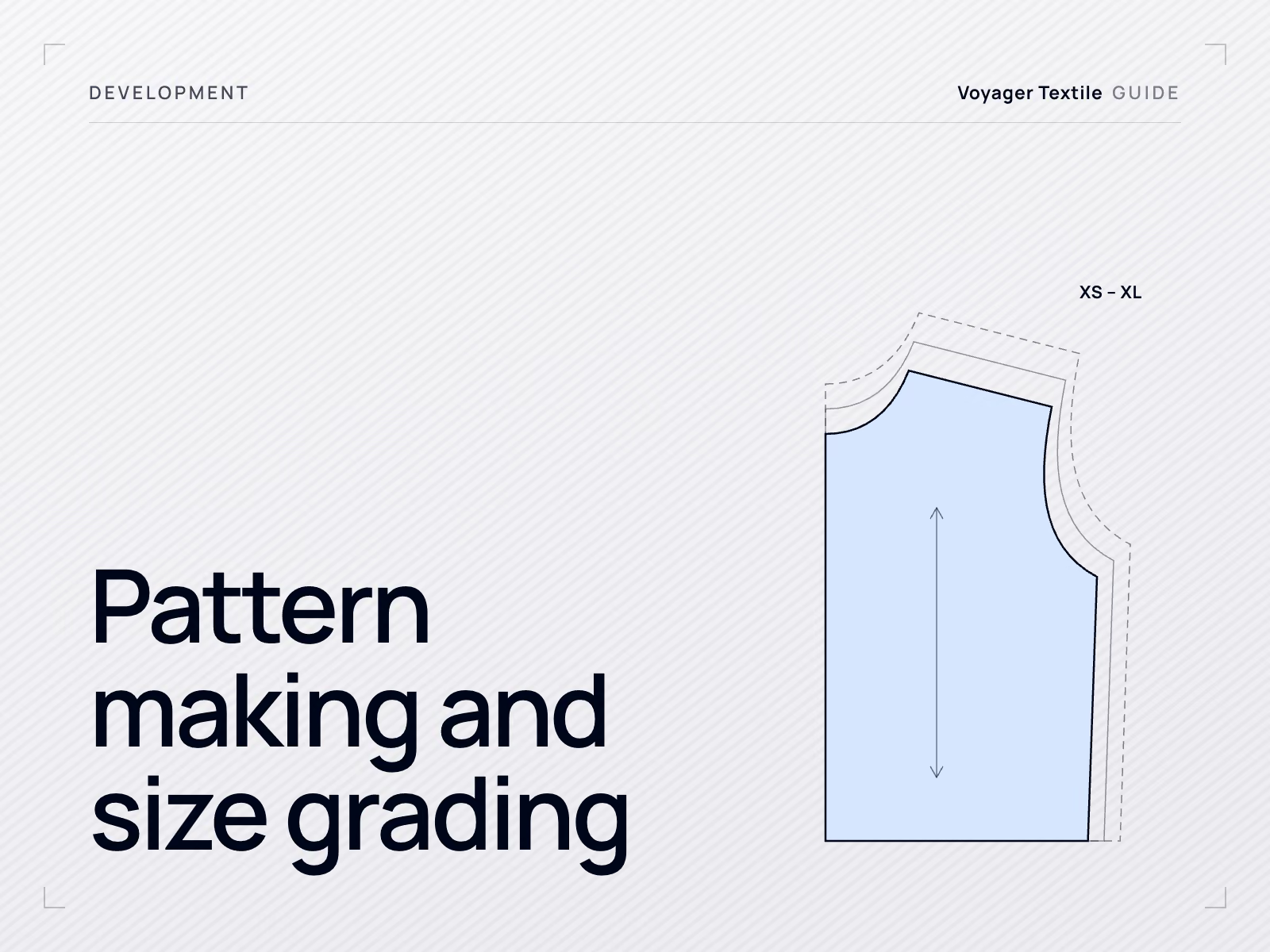 Pattern Making and Size Grading for Bulk ApparelAgree the measurements, tolerances, graded size chart and sample approval process before production. Confirm who supplies, reviews and approves the patterns. These records, together with fit checks in the intended fabric, support consistent production across sizes and reorders.Read the guide
 How to Keep Colour, Fit and Branding Consistent Across ReordersReorders can vary when materials, patterns, trims, production conditions or specifications change. Keep approved physical references together with version-controlled specifications, tolerances and change records, and check each new run against them.Read the guide
 Garment Washing and Finishing: What Apparel Buyers Need to SpecifyIf a garment is washed or dyed after it is sewn, that process is part of the product, not a cosmetic step at the end. It changes dimensions, colour, surface and hand, so a specification that does not say which processing state it applies to cannot be checked, and a sample that never went through the process may not represent what will arrive.Read the guide
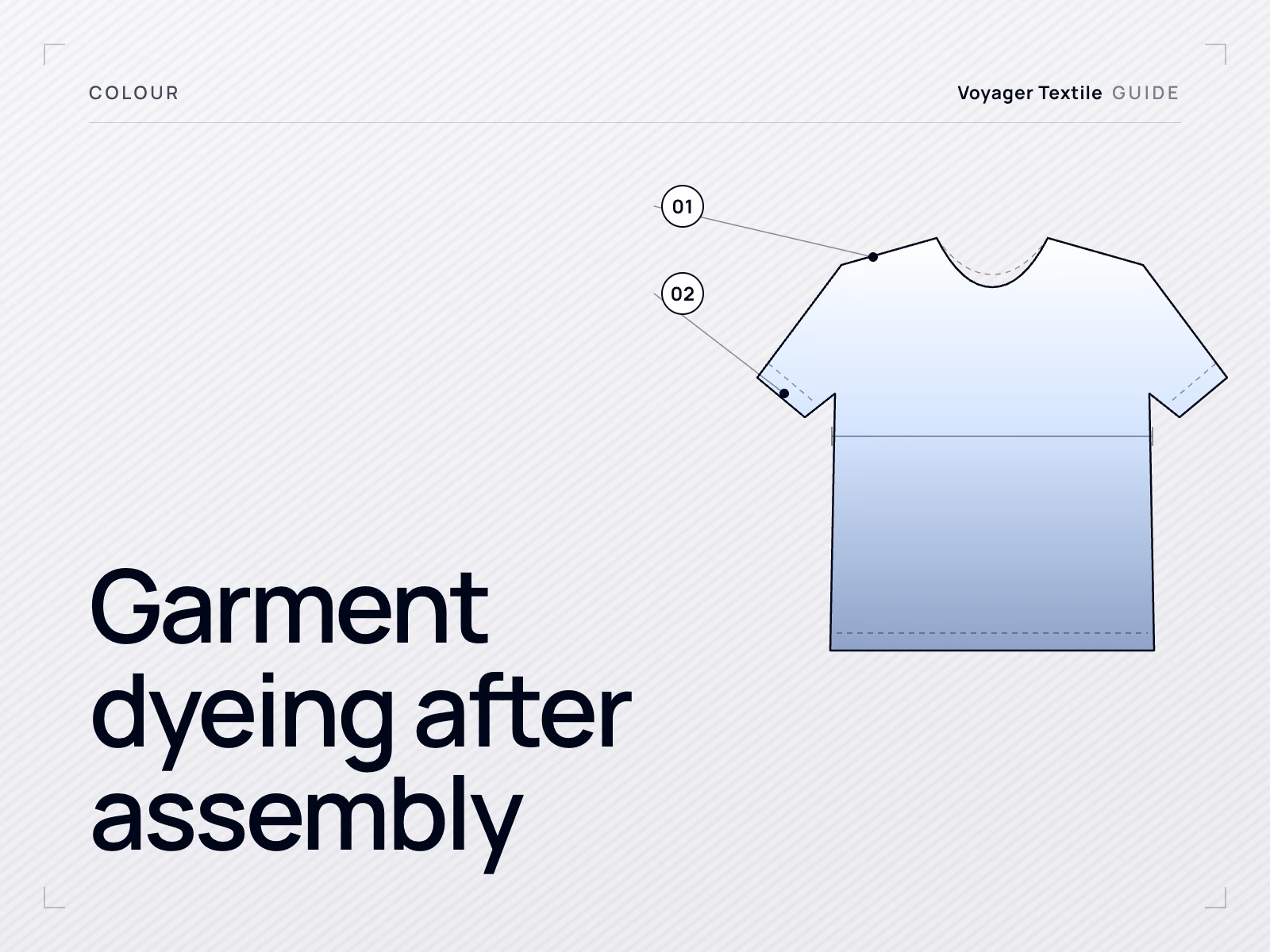 Garment Dyeing: How Dyeing After Assembly Changes What You SpecifyIn garment dyeing, colour is applied after the garment is cut and sewn. The consequence is that the whole assembled product is processed at once, body fabric, sewing thread, ribs, interlinings, trims, hardware and labels, and each can respond differently. The result belongs to the garment, not to the body fabric, which changes what has to be specified and what has to be approved.Read the guide
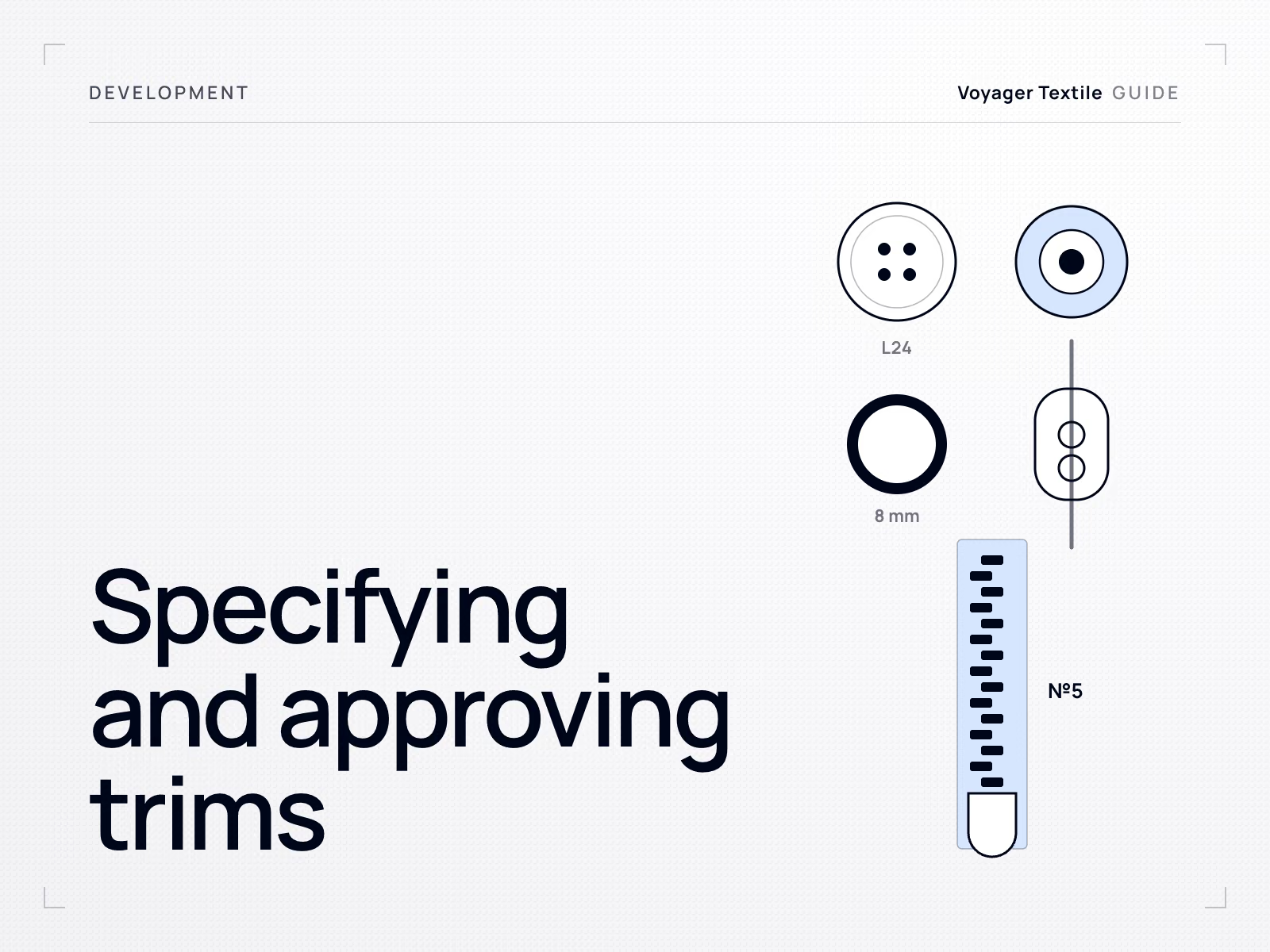 How to Specify and Approve Trims, Hardware and ComponentsA zipper, a button or an elastic is a category, not a specification. Getting the intended part into bulk means knowing which actual component was approved, what defines it, how it functions and attaches, what happens to it during the garment's real processing, what evidence applies to its particular risks, and what has to be looked at again if the source changes.Read the guide
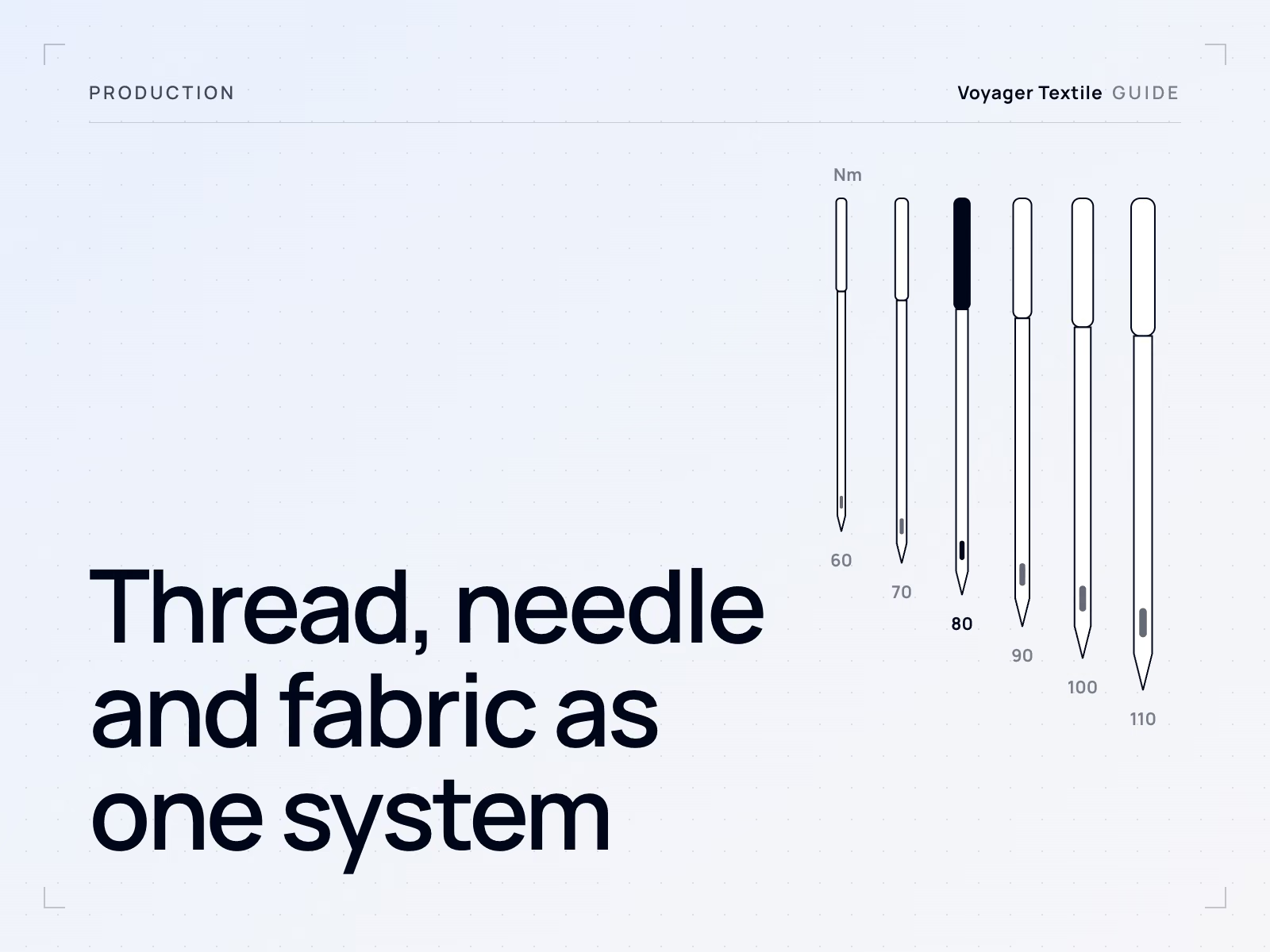 Sewing Thread and Needles: The Needle, Thread and Fabric SystemNeedle, thread and fabric are not three decisions. They are one system, and many sewing faults are a mismatch between them rather than a fault in any of the three. Knowing how that system works is what lets a buyer specify the right things, recognise a real defect from a sample, and stop asking for a stronger thread when the thread was never the problem.Read the guide
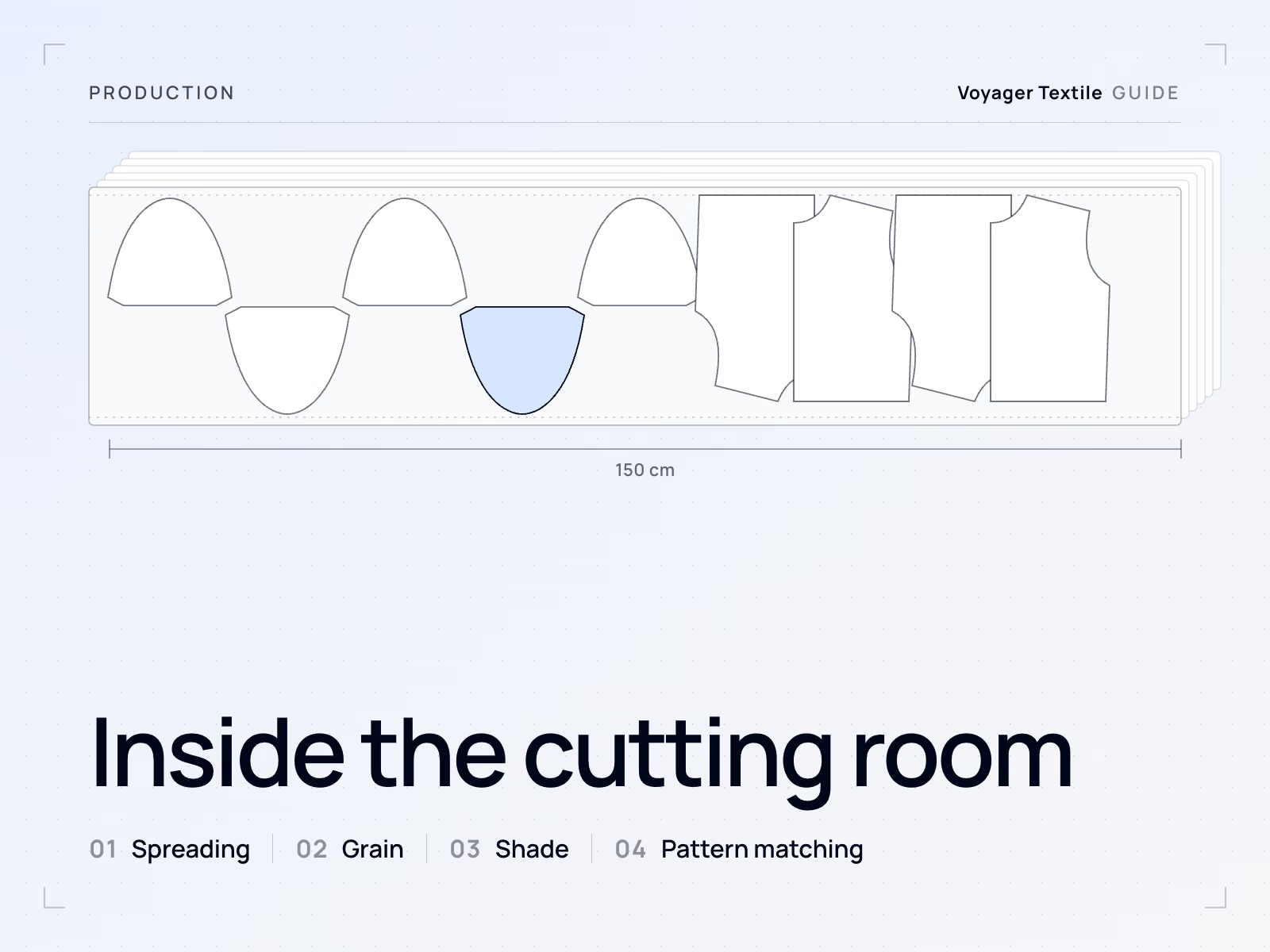 The Cutting Room: Spreading, Grain, Shade and Pattern MatchingSpreading, panel direction, shade grouping and cutting accuracy affect garment consistency. They must work with suitable fabric, an approved pattern and controlled sewing and finishing. Investigate the full process when measurements, shade or seam alignment differ from the agreed standard.Read the guide
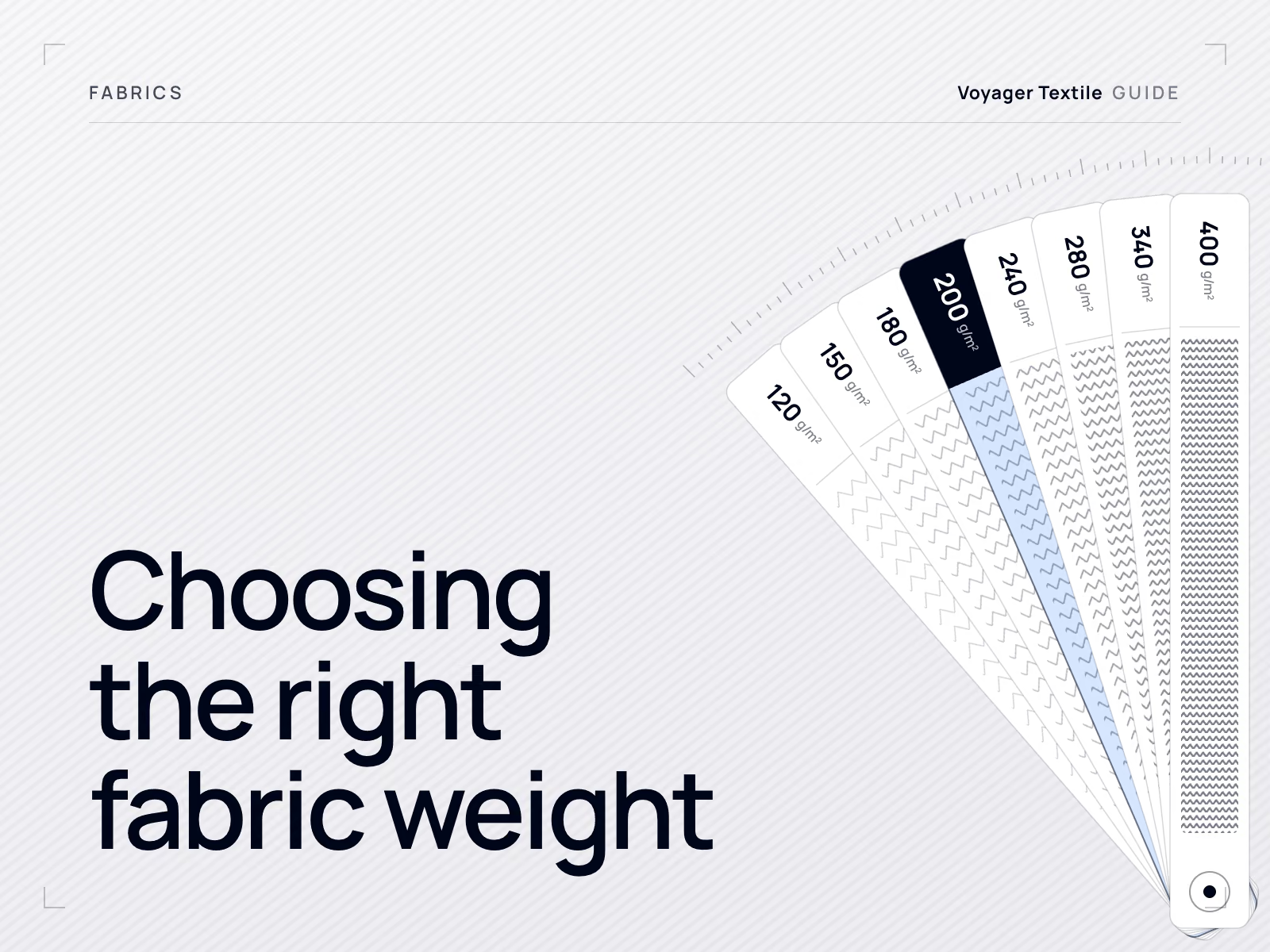 Fabric GSM Explained: Choosing the Right WeightGSM is grams per square metre: the mass of one square metre of fabric. It describes weight, not quality. Higher GSM means more mass for the same area, but warmth, opacity, drape, durability and price also depend on fibre, construction and finish.Read the guide
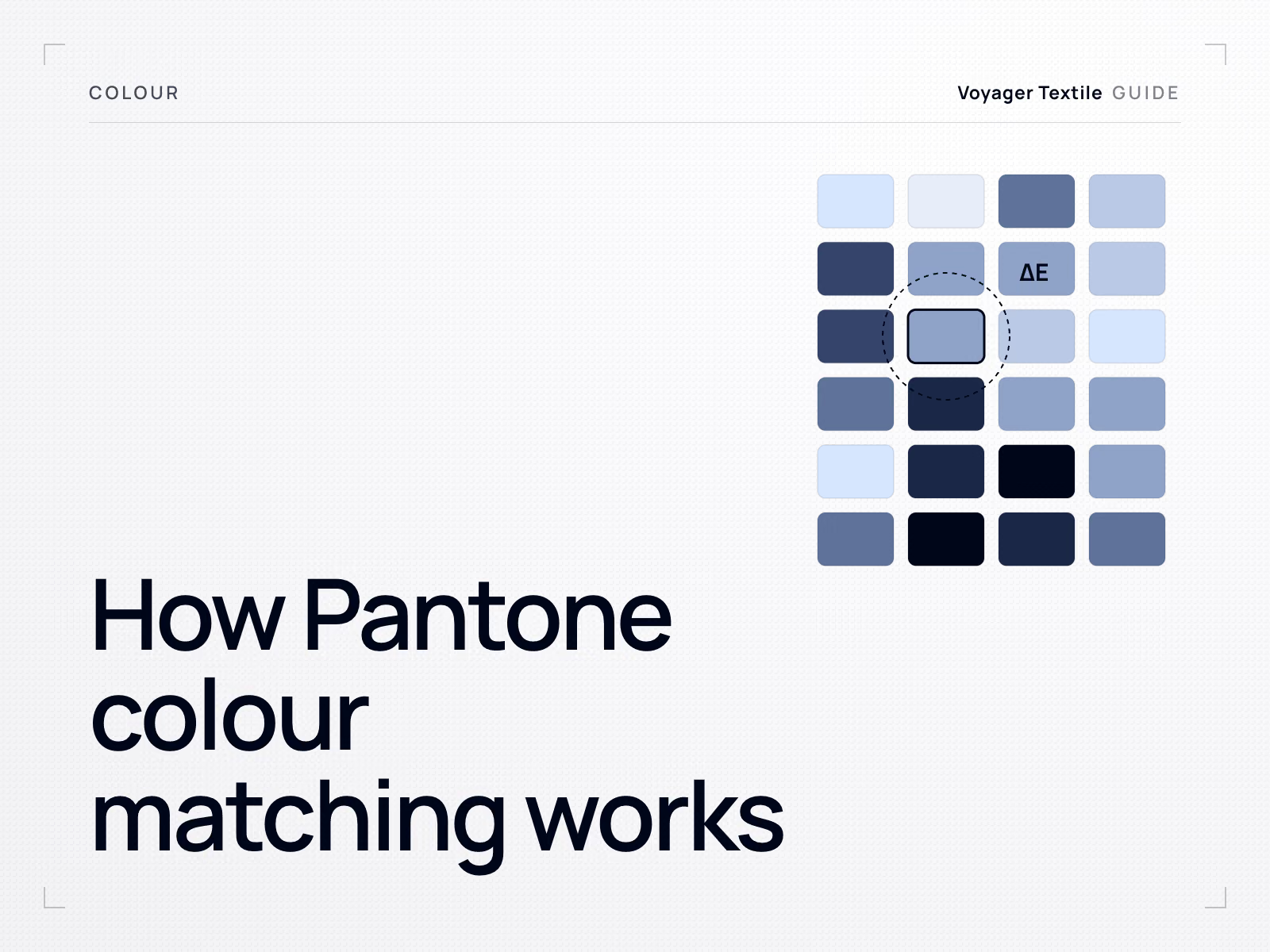 How Pantone Colour Matching Works in Apparel ManufacturingLab dips are small dyed fabric samples developed against an agreed colour target before bulk dyeing. Record the approved sample, target, tolerance and assessment method, including any accepted difference from the Pantone reference. At Voyager Textile, custom colour starts at 300 pieces per colour and per style; polyester-based fabrics are assessed separately.Read the guide
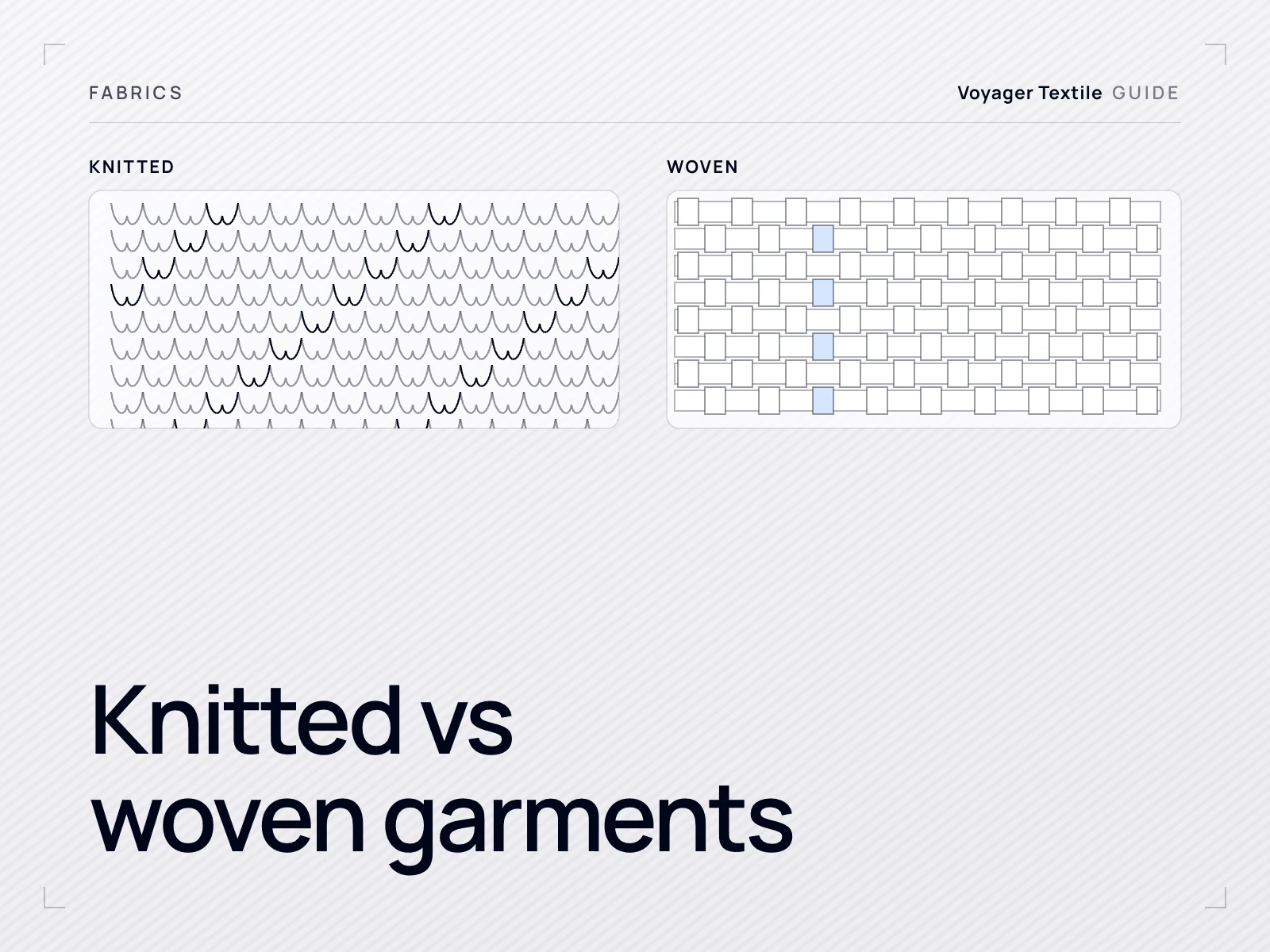 Knitted vs Woven Garments: What Buyers Should Know Before ProductionKnitted fabric is made by looping yarn, so it stretches. Woven fabric is made by interlacing yarns at right angles, so it is stable and needs ease built into the pattern. That single difference changes the pattern, the machinery, the seams, the fit and often the factory.Read the guide
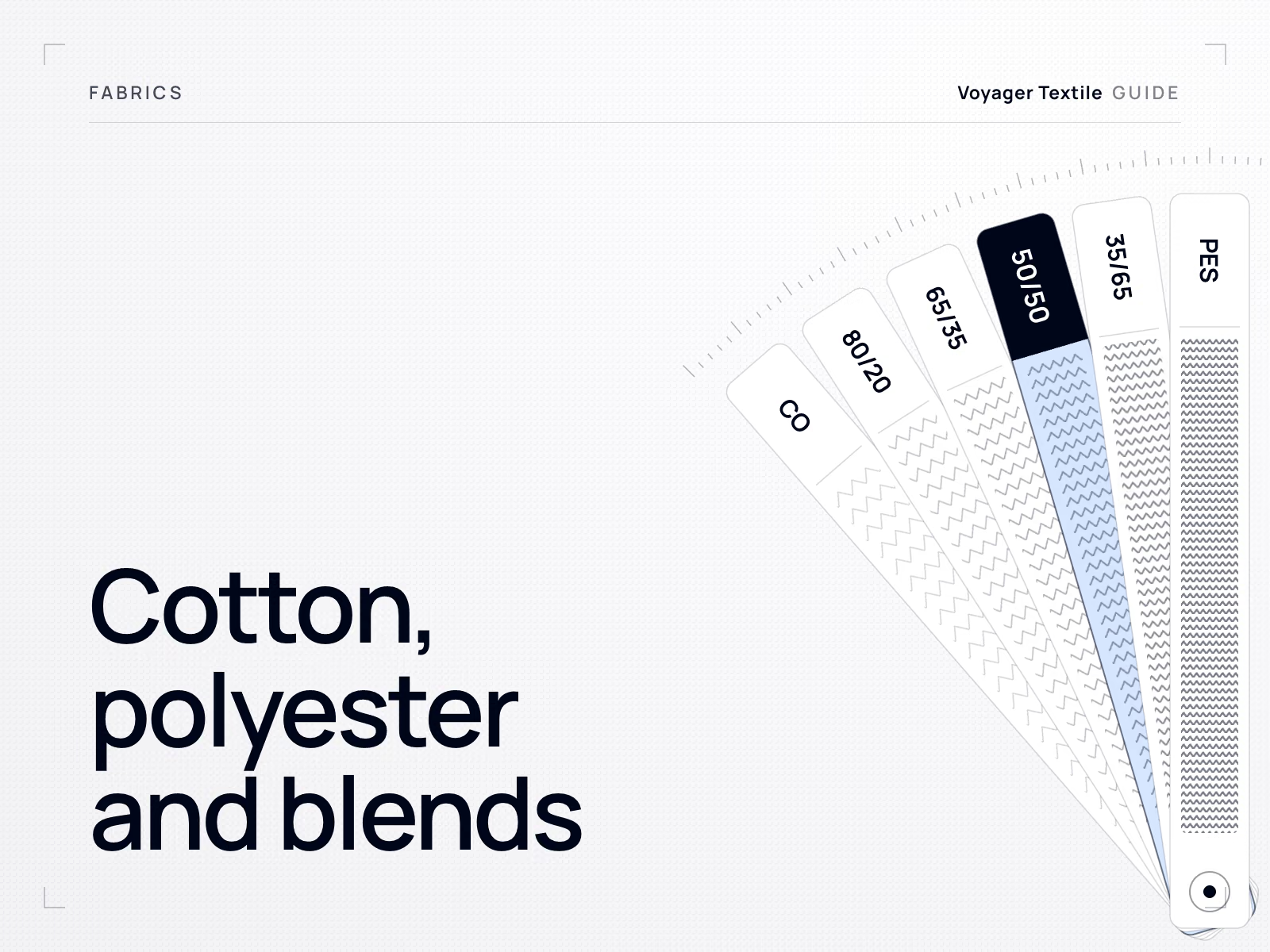 Cotton, Polyester and Blends: Choosing the Right CompositionCotton is comfortable, breathable and takes reactive dyeing well, but it shrinks and dries slowly. Polyester is strong, stable, fast drying and the only base for sublimation printing, but it manages odour less well. Blends exist because many end uses want part of each. Choose composition from what the garment has to do, not from a preference for natural or synthetic.Read the guide
 Screen Printing vs DTF vs DTG vs Embroidery for Bulk ApparelChoose by artwork first, then fabric, then quantity. Screen printing suits few-colour designs at volume. DTF handles complex or photographic artwork across many fabrics. DTG suits detailed artwork on cotton in smaller runs. Embroidery suits logos and lettering where a premium, durable finish matters more than fine detail.Read the guide
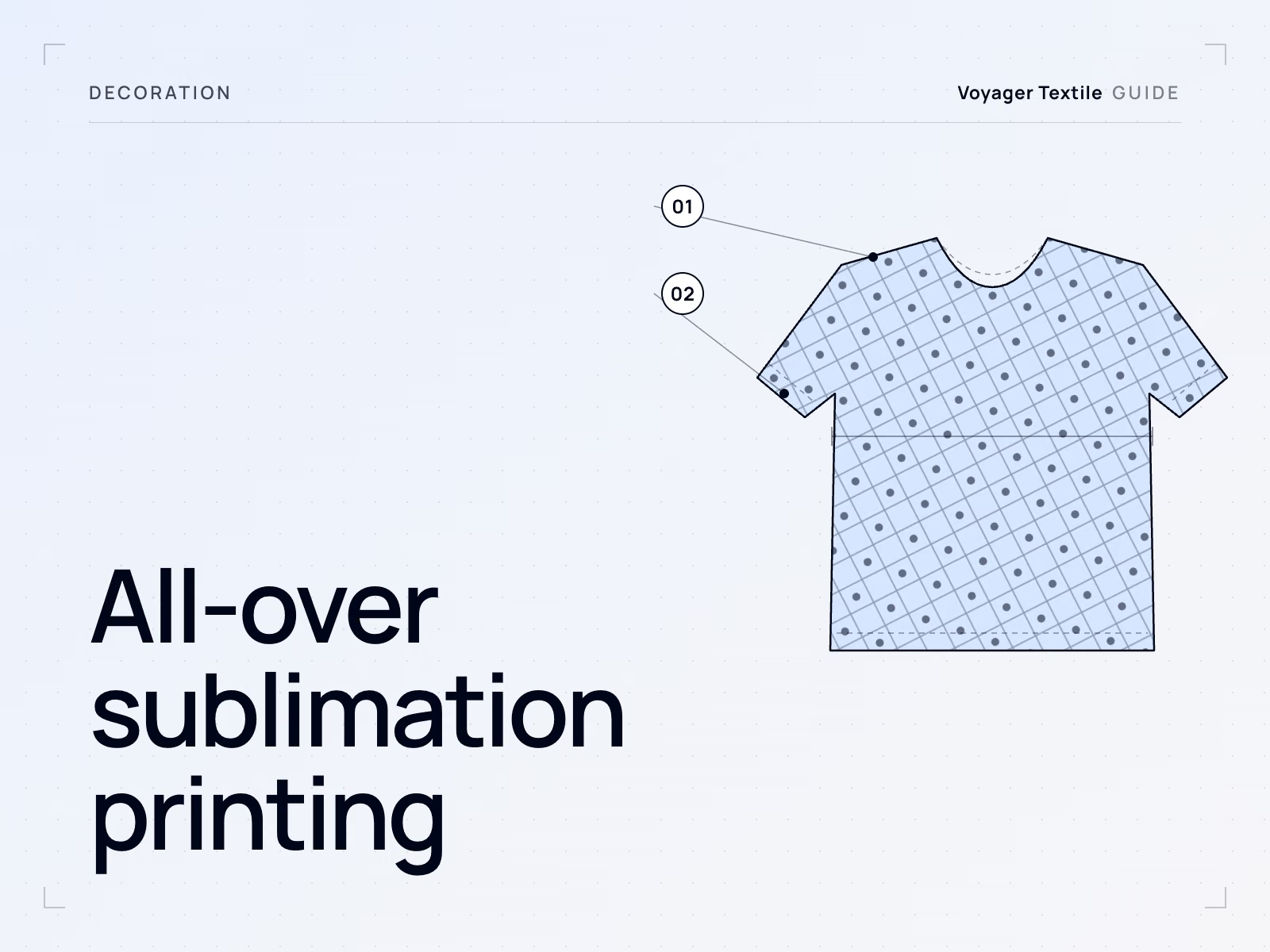 All-Over Sublimation Printing for Custom ApparelAll-over sublimation can print polyester fabric or panels before assembly for edge-to-edge designs. Seam matching still requires planned artwork and agreed tolerances. The dye enters the fibre rather than forming a surface film. At Voyager Textile, the minimum is 300 pieces per colour and per style.Read the guide
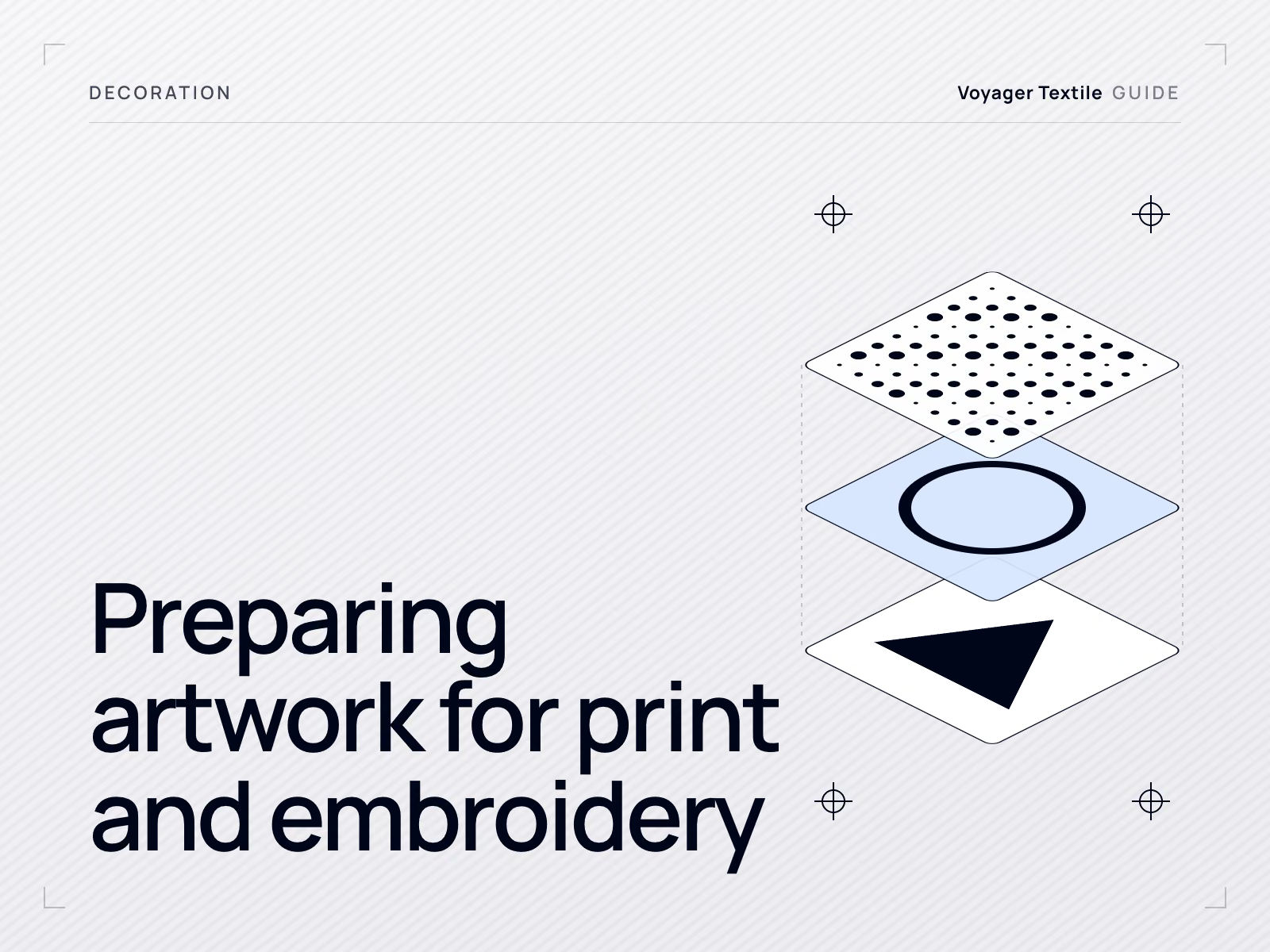 How to Prepare Artwork Files for Printing and EmbroiderySend vector files where the design allows it, raster files at the real print size and at high resolution where it does not, fonts outlined, colours specified by reference rather than by appearance, and a placement note giving position and physical size. A mock-up showing the logo on a garment is not an artwork file.Read the guide
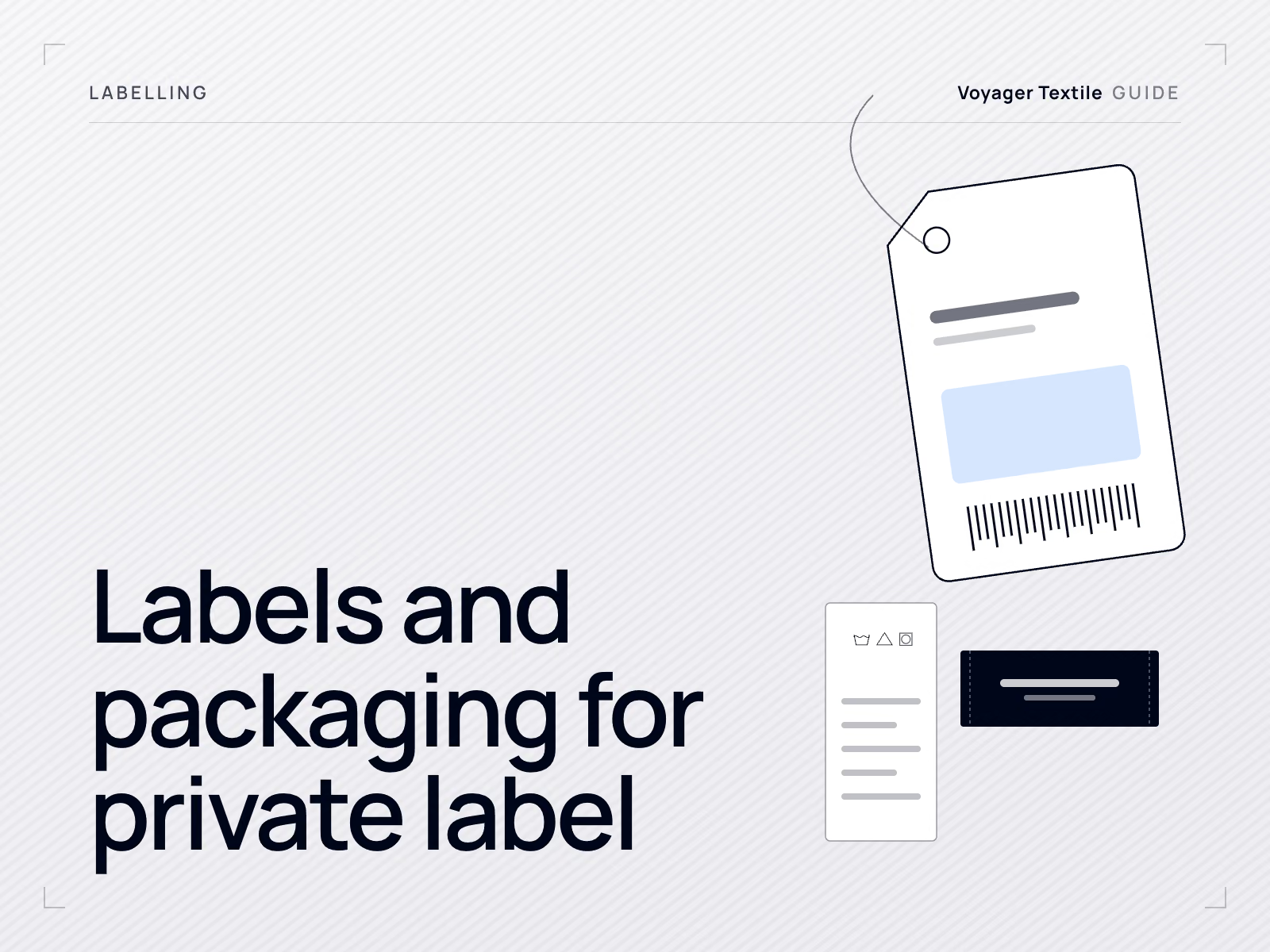 Private Label Clothing Labels and PackagingLabels and packaging are production items with their own suppliers, minimums and lead times, not a finishing touch. A garment cannot be packed until they exist, so they belong in the specification from the start rather than being decided once the goods are sewn.Read the guide
Compliance and labelling
Labelling, product-safety and environmental rules that apply to apparel sold in the EU and the United States.
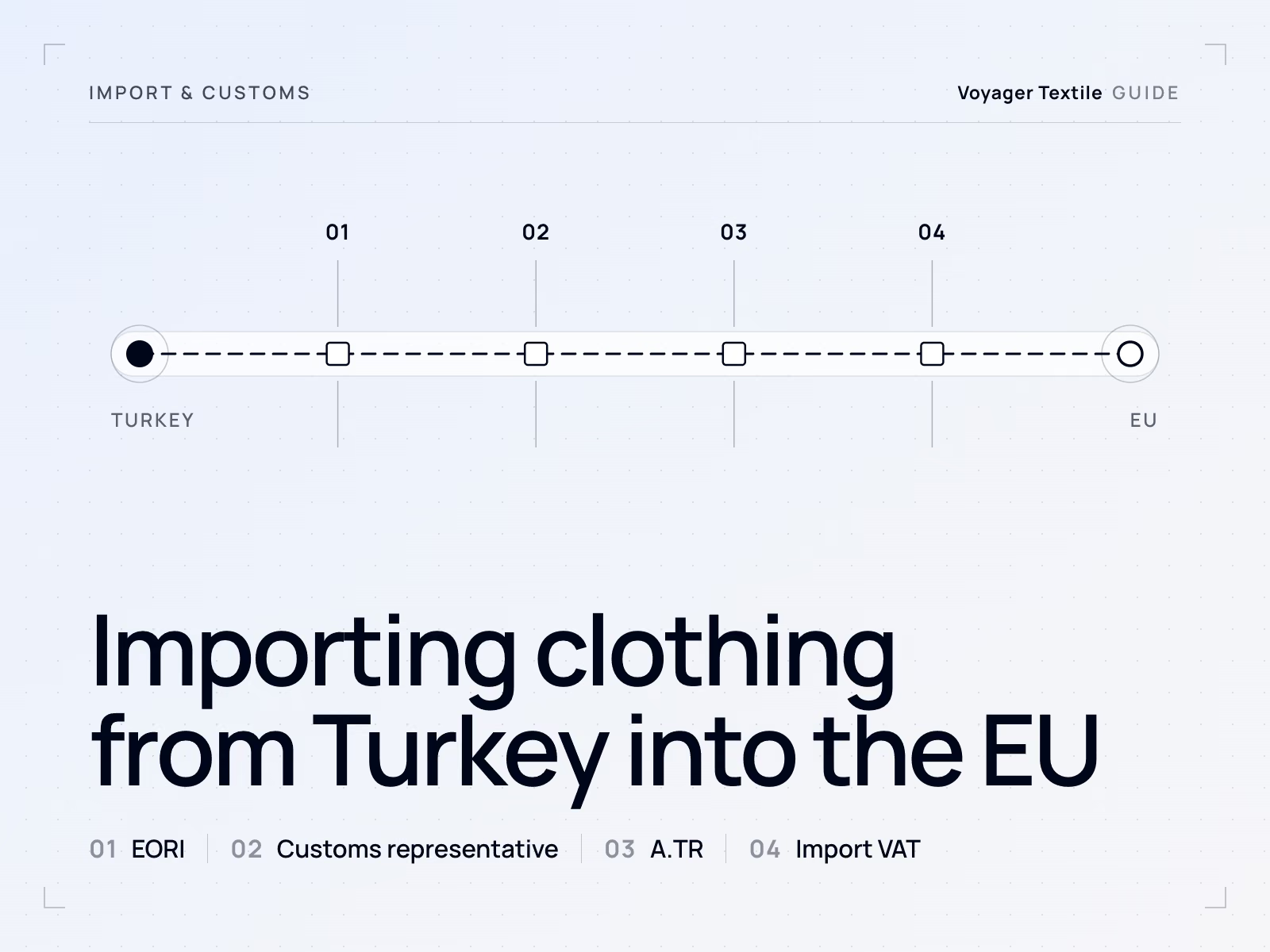 Importing Clothing from Turkey into the EU: EORI, Customs Representative, A.TR and Import VATClothing from Türkiye in free circulation, travelling with an A.TR movement certificate, pays no EU customs duty. It is still an import: the goods need a customs declaration lodged by a declarant established in the EU with an EORI number, often through a direct or indirect customs representative, and import VAT is due in the Member State of import, deductible for a business that is entitled to deduct it.Read the guide
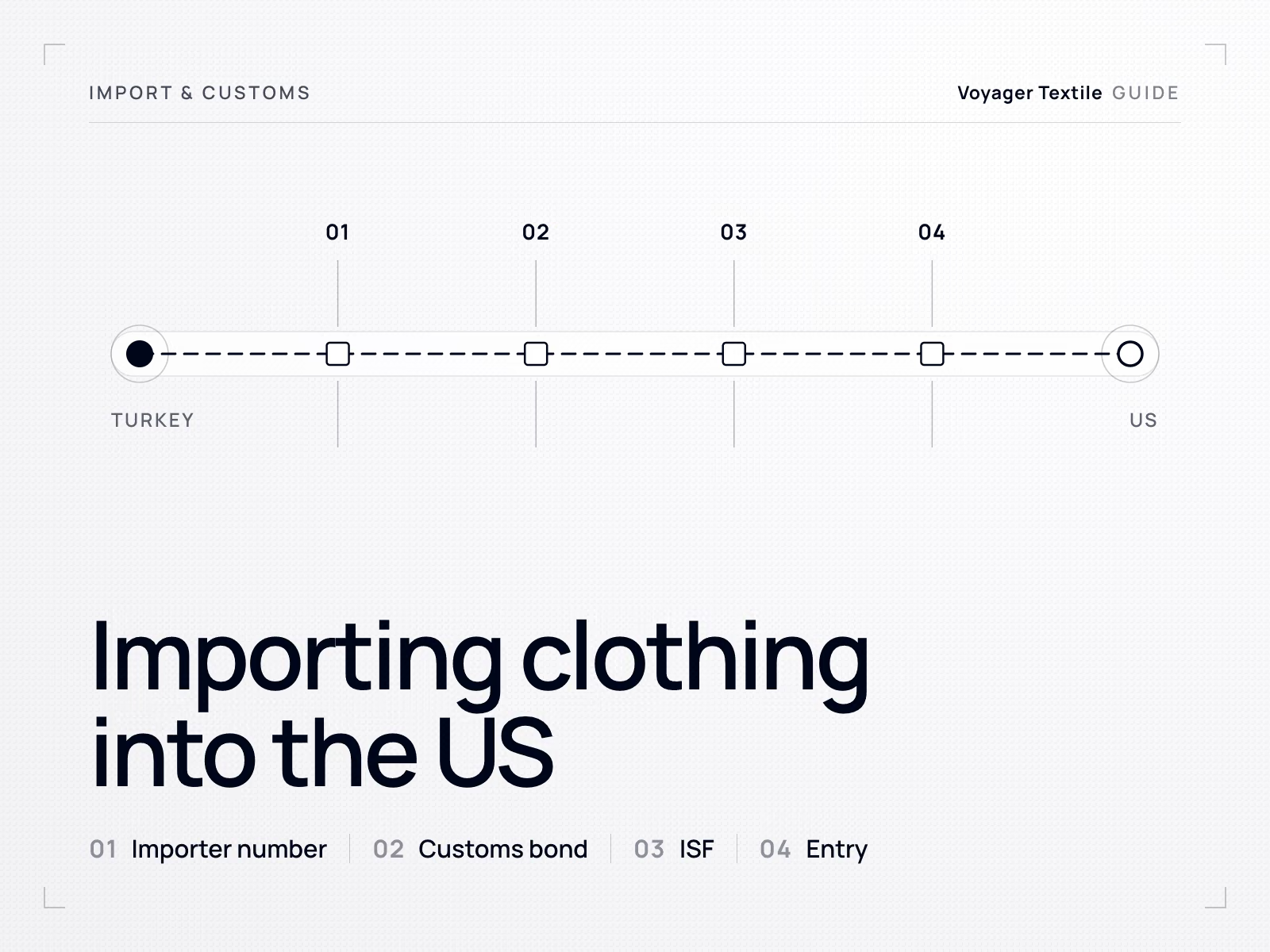 Importing Clothing into the US for the First Time: Importer Number, Customs Bond, ISF and EntryA first US clothing import needs four things in place before the goods sail: an importer of record, a CBP importer number filed on Form 5106, a customs bond (continuous or single transaction), and, for ocean freight, an Importer Security Filing sent no later than 24 hours before the container is loaded in Türkiye. Entry then follows within 15 calendar days of arrival.Read the guide
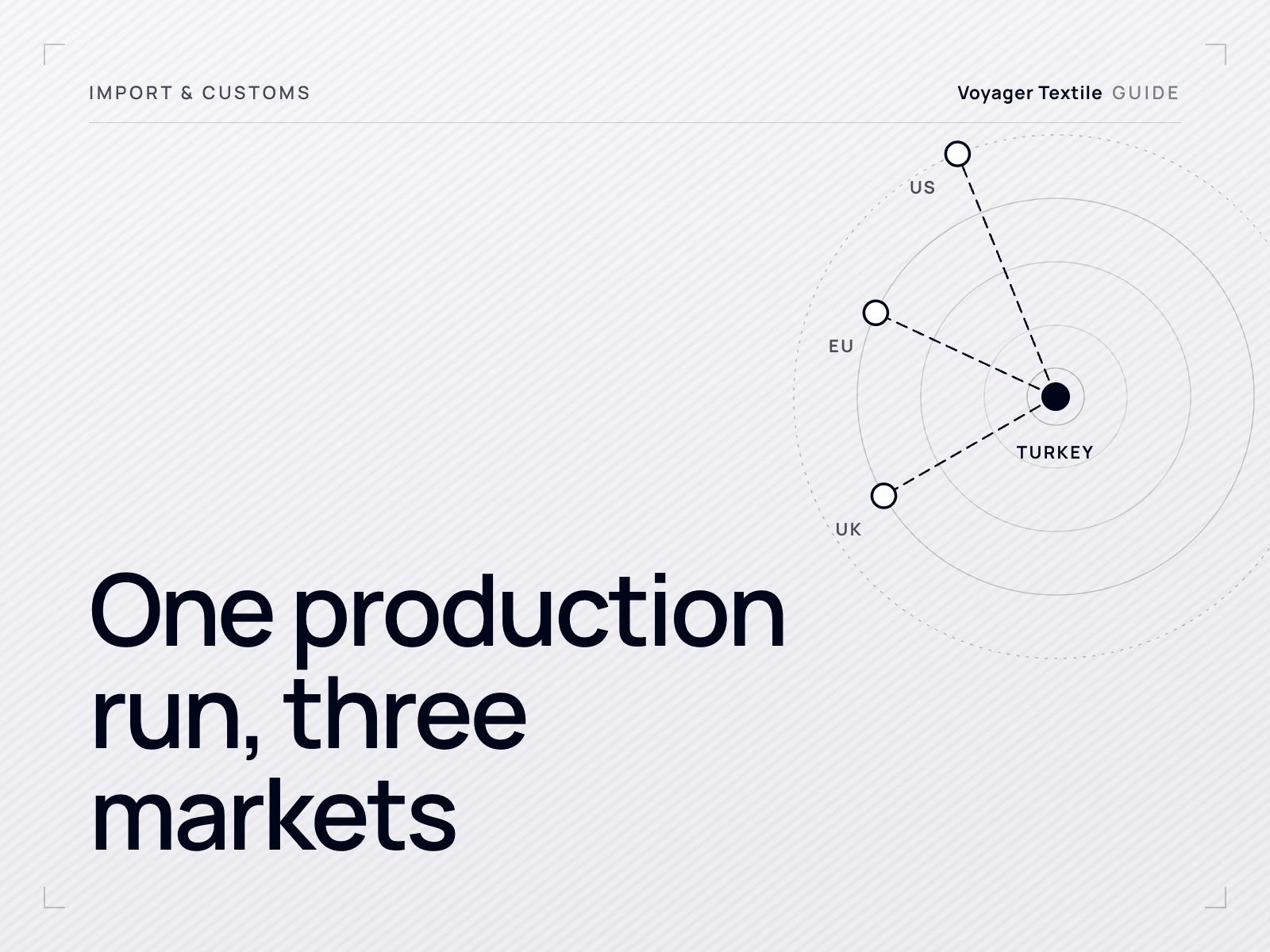 One Production Run, Three Markets: How the EU, UK and US Treat Turkish-Made ApparelOne production run can serve all three markets, but each border asks a different question. The EU asks whether the goods are in free circulation, shown by an A.TR. The UK asks whether the garment meets the UK–Türkiye preferential origin rule, which for most garments means the fabric was also made in Türkiye, the UK or the EU. The US asks where the garment was assembled, then charges its general rate plus 12.5% under Section 301. Plan fabric and labels for all three before cutting.Read the guide
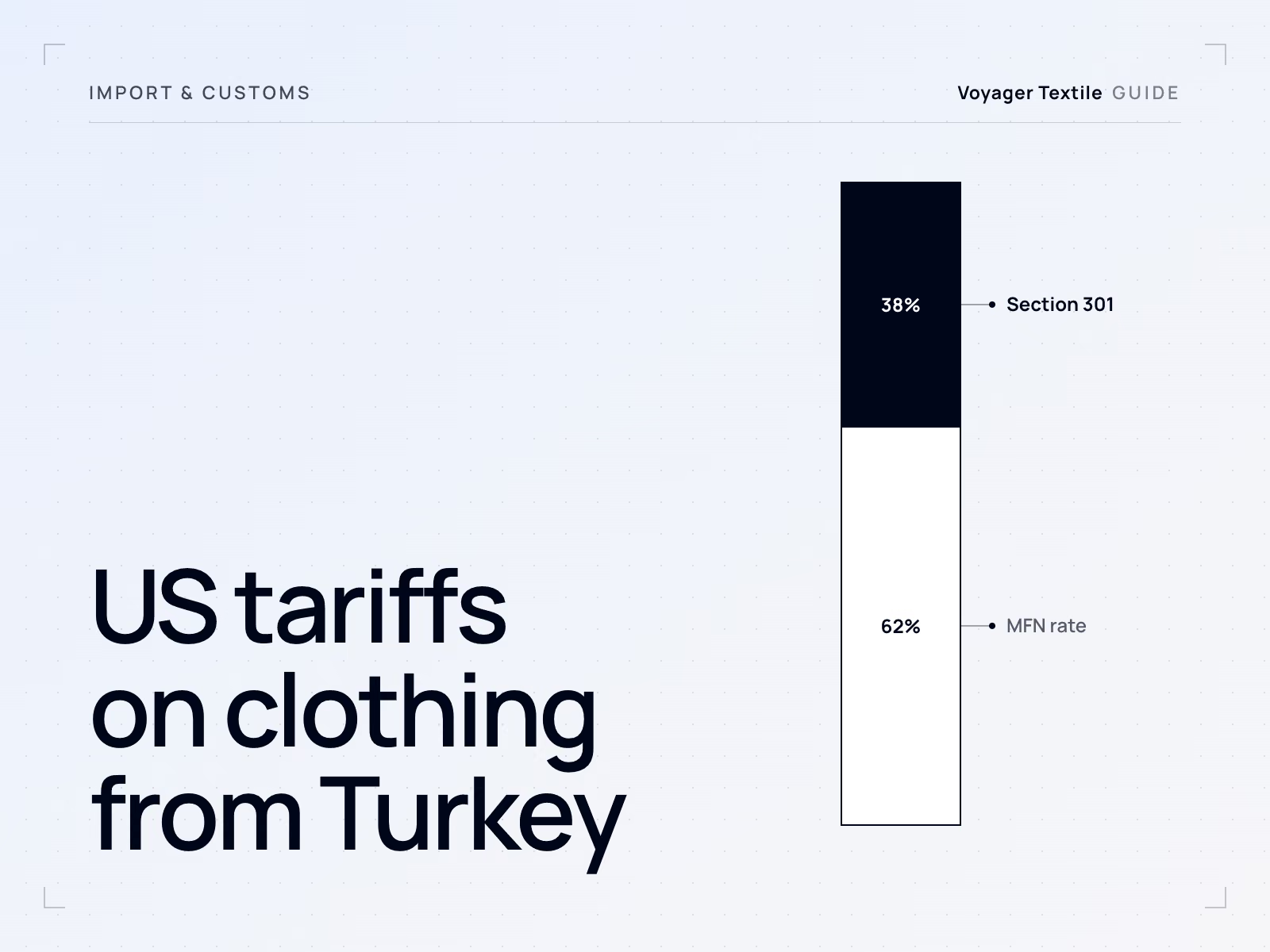 US Tariff on Clothing from Turkey: How the Section 301 Duty Adds to the MFN RateClothing of Turkish origin entered in the United States on or after 24 July 2026 pays two layers of duty: the general rate for its HTSUS subheading, and an additional 12.5% ad valorem under Section 301, heading 9903.05.79. The importer of record owes both. The Section 301 action is under challenge at the US Court of International Trade, and CBP collects it unless a court orders otherwise.Read the guide
 PFAS-Free Apparel for the EU: The PFHxA Restriction on ClothingFrom 10 October 2026, clothing and related accessories for the general public cannot be placed on the EU market if any homogeneous material contains 25 ppb or more of PFHxA and its salts, or 1,000 ppb or more of PFHxA-related substances. The rule is entry 79 of REACH Annex XVII, added by Commission Regulation (EU) 2024/2462. A buyer needs it written into the order and backed by a test report for each material.Read the guide
 Environmental Claims on Apparel: What the EU Now Prohibits OutrightThe EU has added a small number of environmental marketing practices to the list of things that are unfair in all circumstances, meaning nobody has to prove a consumer was misled. They catch language the apparel industry uses often. Separately, the directive much published guidance told brands to prepare for is not law and is currently blocked, while the one that actually binds has received far less attention.Read the guide
 EU Apparel Labelling and Compliance: A Private Label Buyer's GuideEU law requires a garment sold to consumers to carry its full fibre composition, using the fibre names set out in Regulation (EU) No 1007/2011, in the language of the country where it is sold. Care instructions and origin marking are not required by that regulation. Since December 2024 the General Product Safety Regulation adds traceability and responsible-operator obligations, and if you sell under your own brand, those obligations are yours.Read the guide
 EU Textile Extended Producer Responsibility, and What It Actually RequiresThe EU has adopted a binding common framework requiring every Member State to establish extended producer responsibility for textiles and footwear. The operational obligations, registering, reporting, paying, are national, so the question that matters is not whether the EU has rules but which Member State market you are placing the product on.Read the guide
 Who Is the Producer Under Textile EPR?The factory that made the garment is not automatically the producer, and the brand is not automatically the producer either. The definition turns on establishment, on whose name the product carries, and on who first makes it available in a specific Member State, so the answer changes with the market and the structure, not with the sewing.Read the guide
 Can Unsold Clothing Be Destroyed in the EU?For apparel, clothing accessories and footwear on the Ecodesign Regulation's list, destruction of unsold consumer products has been prohibited since 19 July 2026 for the enterprises currently in scope. The rule is not simply that clothes cannot be thrown away: product scope, enterprise size, the regulation's own definition of destruction and ten specific derogations all decide the answer.Read the guide
 GPSR for Apparel: Who Is Responsible for a Garment Sold in the EU?The General Product Safety Regulation has applied since 13 December 2024, and ordinary consumer clothing can fall within it. What it does not do is hand out roles automatically. Whether a brand, a factory or an importer carries manufacturer obligations depends on how the product is made, whose name it is sold under and who is established where, and none of it can be read off an Incoterm.Read the guide
 Product Safety Documentation for ApparelTechnical documentation under the General Product Safety Regulation is safety evidence, not a manufacturing specification. A tech pack describes how to build the garment; the documentation records what could go wrong with it, what was done about that, and what supports the conclusion. They share facts, and neither replaces the other.Read the guide
 When Does Workwear Become PPE in the EU?One question separates ordinary workwear from regulated PPE: is the product designed and manufactured to be worn for protection against a risk to health or safety? If it is, the EU conformity route applies, and that route decides everything else, the category, whether a notified body is involved, what documentation exists and whether CE marking belongs on the garment at all.Read the guide
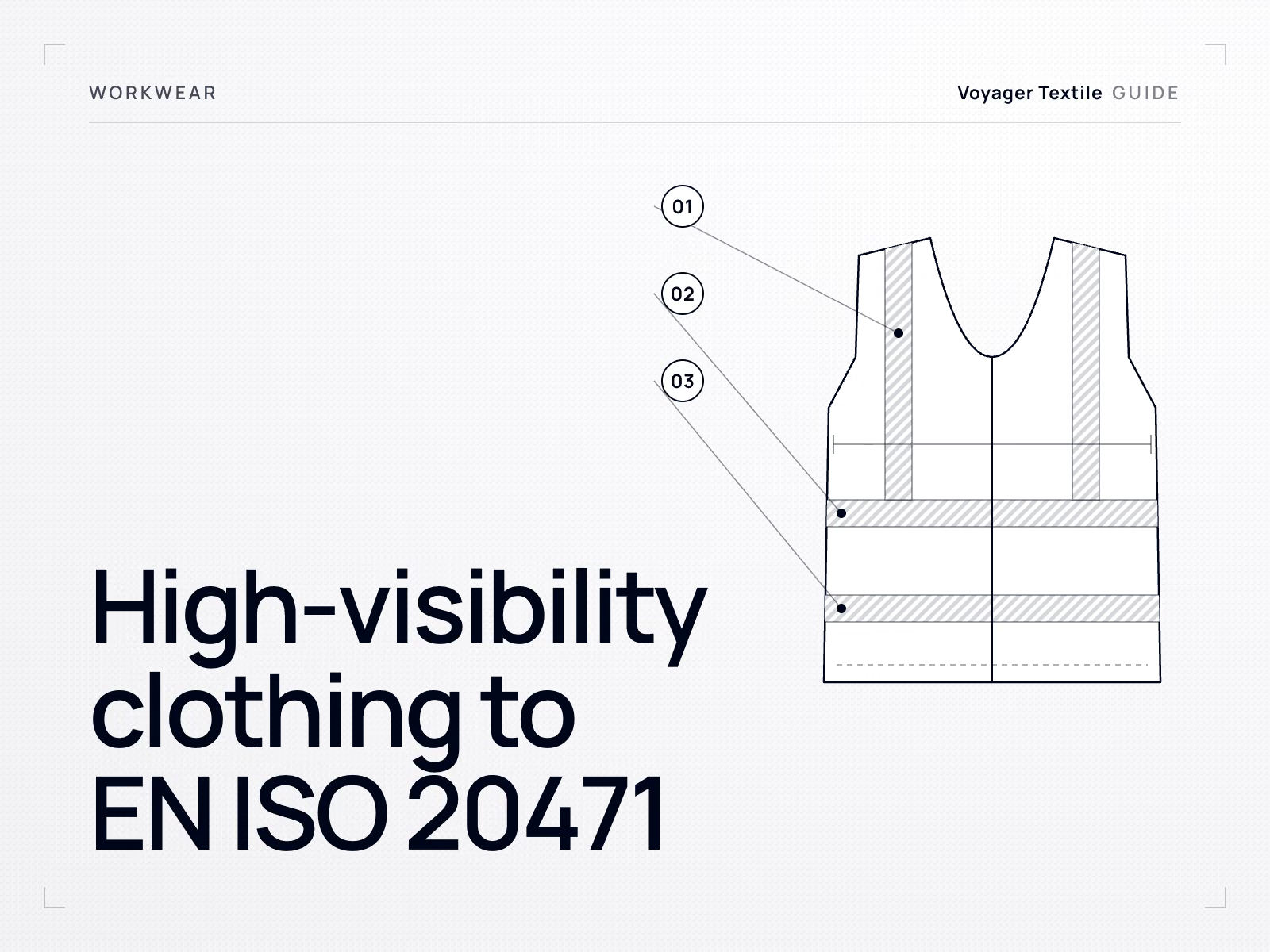 High-Visibility Clothing and EN ISO 20471High-visibility conformity is a property of the complete garment, not of its materials. Background fabric, retroreflective material, how much of each there is, where it sits, the design, every size in the range and how the garment performs after cleaning all form part of it. Sewing tape onto a yellow vest addresses none of that.Read the guide
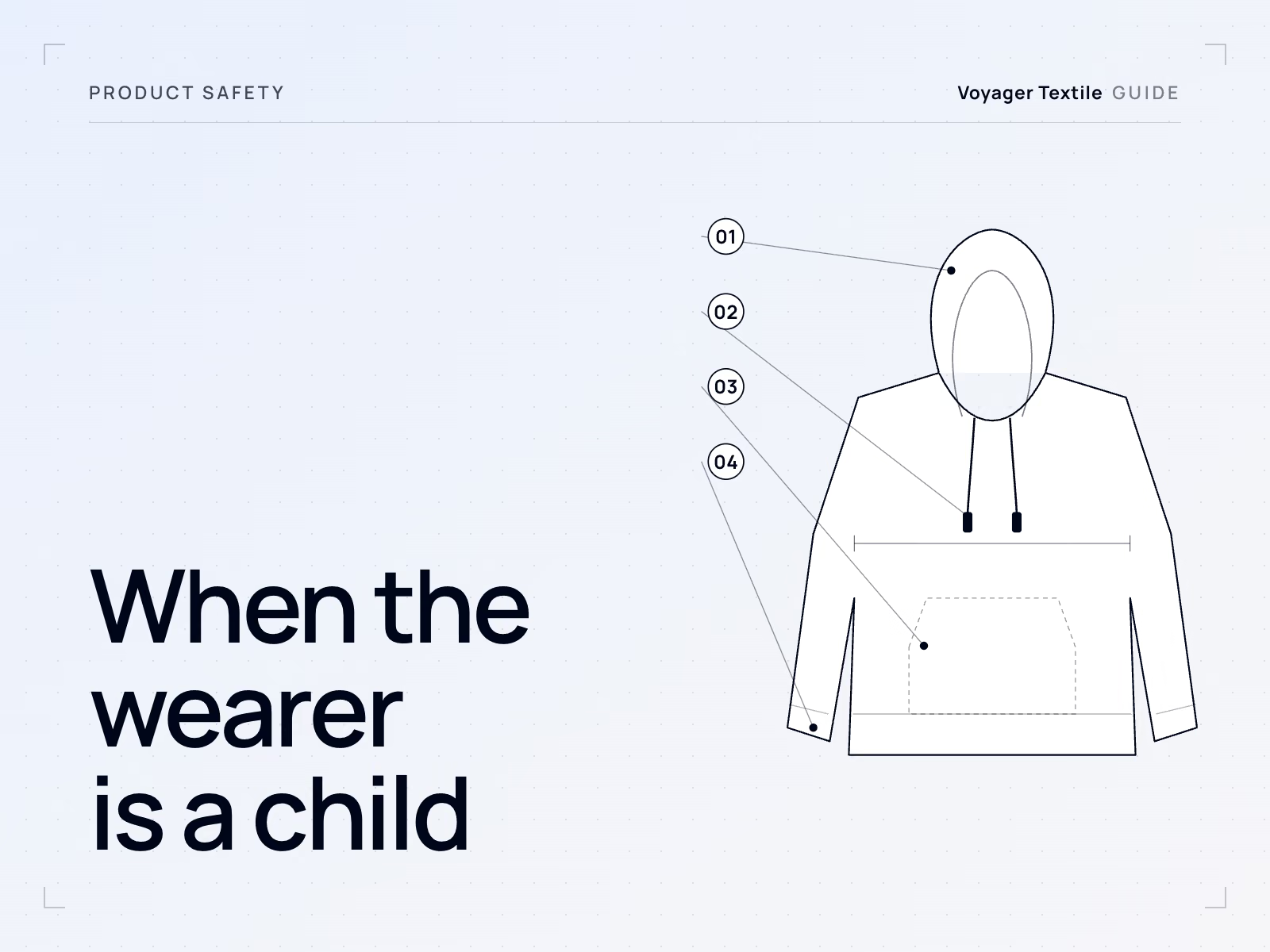 Children's Apparel Safety: What Changes When the Wearer Is a ChildExtending a style into children's sizes is usually treated as grading. It is a new safety assessment. Changing the intended wearer changes foreseeable behaviour, which changes what a cord, a loop, a button or a decorative badge means on the same garment, and none of that is discovered by making the pattern smaller.Read the guide
 EN 14682: Cords and Drawstrings on Children's ClothingEN 14682 is the one children's clothing standard cited in the current EU framework, and it addresses a single risk family: strangulation and entrapment from cords and drawstrings. Its requirements depend on the age group, the area of the garment and the cord's configuration together, which is why no single rule about drawstrings is correct.Read the guide
 US Apparel Labelling and Import RequirementsA garment sold in the United States must carry three things on its label under the Textile Act: fibre content, country of origin, and the name or registered identification number of the business responsible for it. A separate rule requires care instructions. At the border, the importer of record is responsible for classification, duty and proving the supply chain is clean.Read the guide
Import, duty and shipping
Origin rules, customs treatment and how goods move from a Turkish factory to your warehouse.
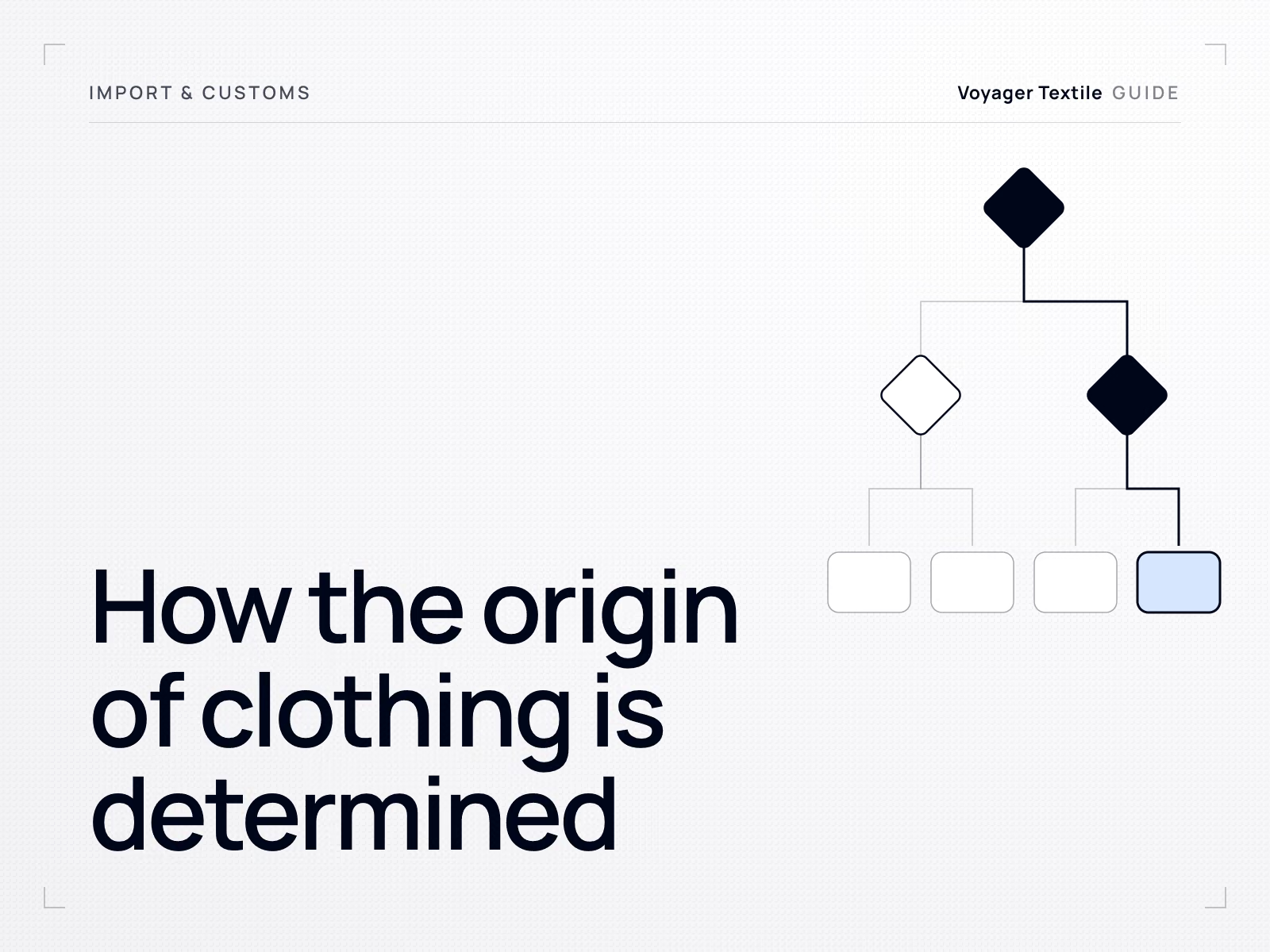 How Is the Country of Origin of Clothing Determined?Customs origin is decided by a specific rule applied to a specific tariff heading, not by the address of the factory. For most finished garments the EU rule turns on complete making-up, which is why imported fabric does not automatically prevent origin being acquired where the garment was made, and why importing a finished garment and decorating it does not automatically confer origin either.Read the guide
 Does an A.TR Certificate Prove Turkish Origin?No. An A.TR movement certificate establishes that goods meet the free-circulation conditions of the EU–Türkiye Customs Union, which is a customs status. It does not determine or certify where the goods were made, and the Customs Union arrangements expressly reach goods that came from third countries.Read the guide
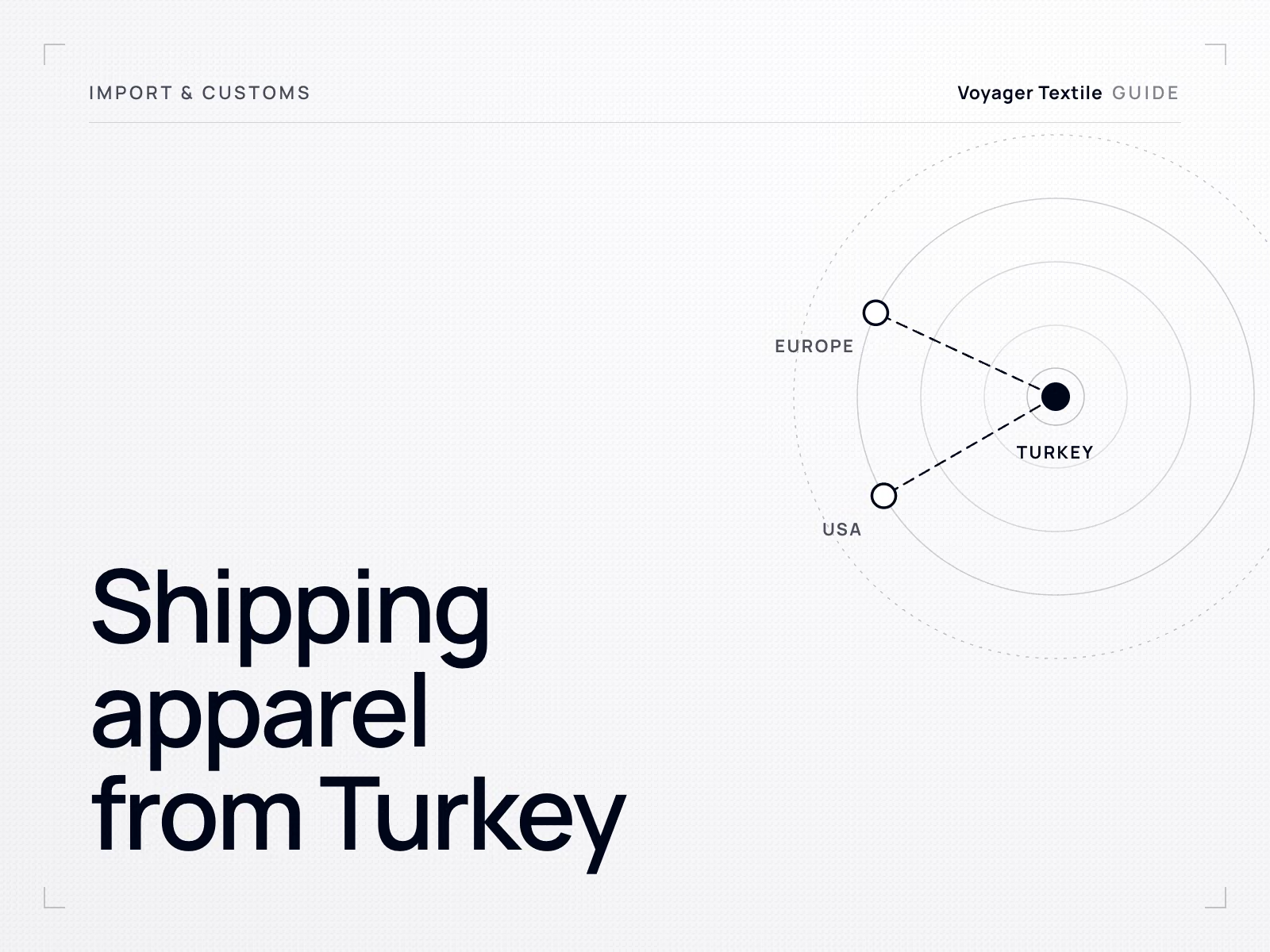 Shipping Apparel from Turkey to Europe and the USATwo decisions govern everything else: which Incoterm applies, which sets where the seller's responsibility ends, and who is the importer of record in the destination country. Settle both at quotation stage, because a price without an Incoterm cannot be compared with anything.Read the guide
Quality and production problems
Inspection, needle control, supplier quality agreements and what to do when a bulk order does not match the sample.
 How to Manage Apparel Supplier Performance After the First OrderMany buyers decide whether a supplier is good long before they can say what they are measuring. A working system separates development, quality, delivery, documentation, corrective action and commercial reliability, attributes each failure to whoever caused it, and only lets a sustained pattern drive a sourcing decision.Read the guide
 How to Build an Apparel Supplier ScorecardA scorecard is only as good as its definitions. Many of them fail not because the wrong things were measured but because nobody said which event on-time refers to, what the defect denominator is, or what happens when a number is missed. This is how to define the metrics so both sides can read the same result the same way.Read the guide
 What Is a Supplier Quality Agreement in Apparel?No standard requires a document with this title, and plenty of apparel relationships work without one. What matters is that recurring quality responsibilities are controlled somewhere, which changes need notifying, which need approving, how deviations are handled, who inspects, and what happens when production does not conform.Read the guide
 Apparel Quality Control Explained: AQL, Tolerances and TestingApparel quality control includes in-process checks, final inspection and testing of relevant material and garment properties. Define the specification, tolerances, inspection plan and test criteria together; an approved sample is one of the references used.Read the guide
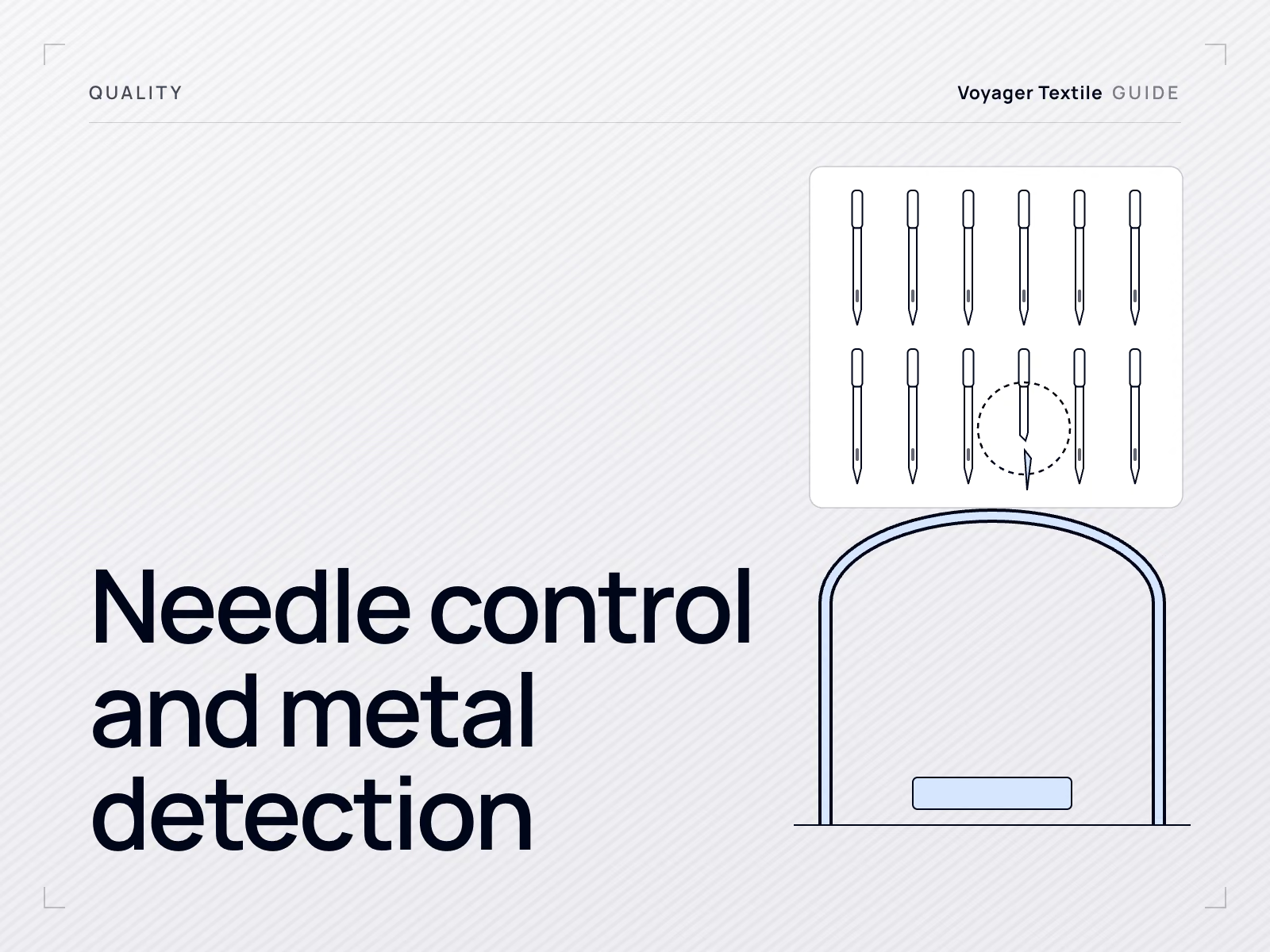 Needle Control and Metal Detection in Apparel ManufacturingA needle detector answers one narrow question about one garment at one moment. Preventing uncontrolled sharps, recognising a breakage, containing the product that might be affected and deciding on an explicit basis whether it can be released are four other questions, and no machine answers them. What a buyer is assessing is the system, and what demonstrates it is evidence rather than a policy document.Read the guide
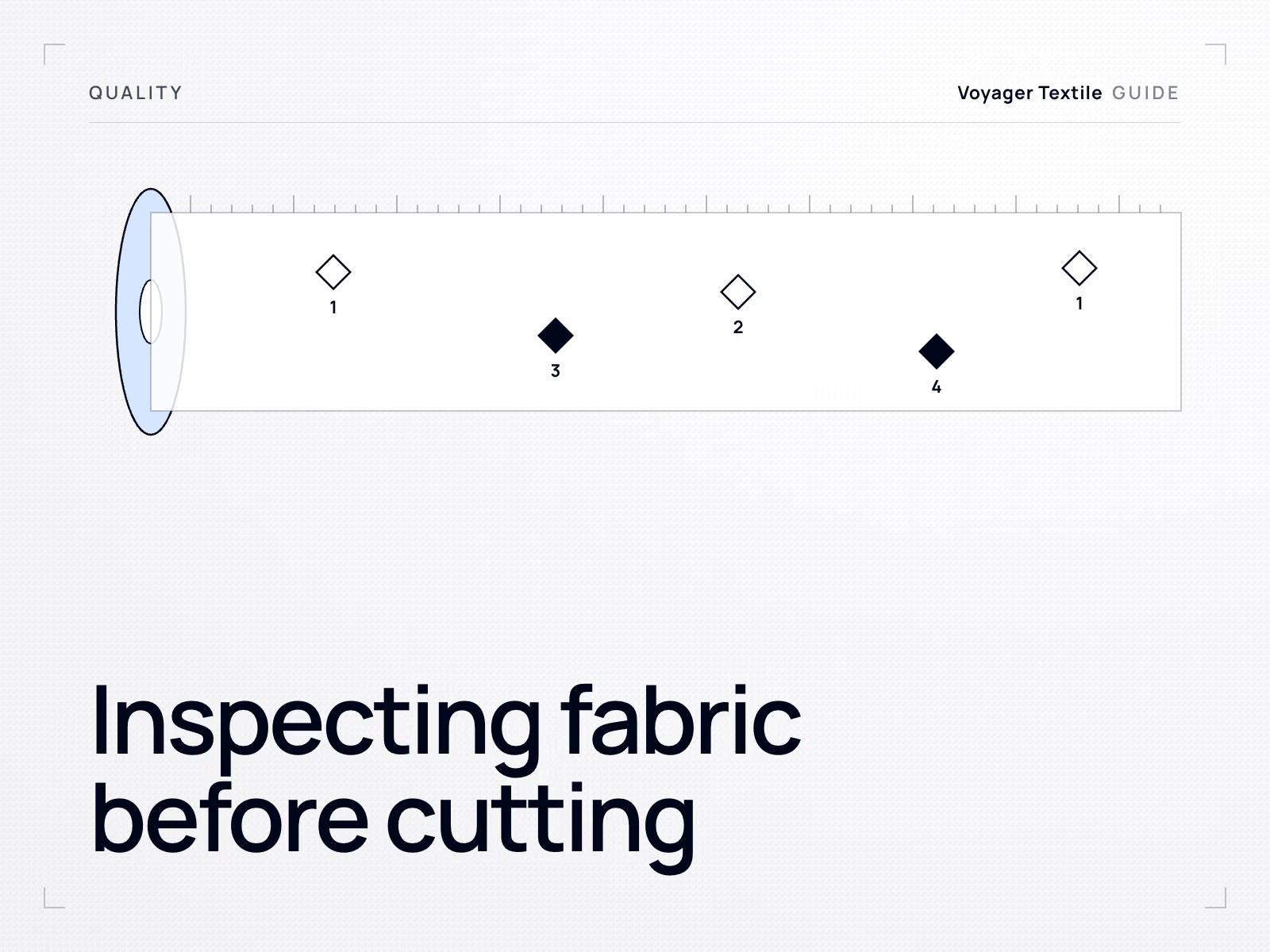 Incoming Fabric Inspection: What Happens Before CuttingFabric is inspected before it is cut because that is the last moment a problem is cheap. A faulty roll can be rejected or downgraded; the same fault discovered after cutting has already been turned into panels, and after sewing it has been turned into garments. The checks are quantity, identity, width, weight, shade and visible faults, and the last two decide how the order is planned.Read the guide
Have a project rather than a question?
Send the product, the quantity and whatever specification you already have. We review it for manufacturability, tell you what is still missing and come back with a technical assessment.