Compliance and shipping
High-Visibility Clothing and EN ISO 20471
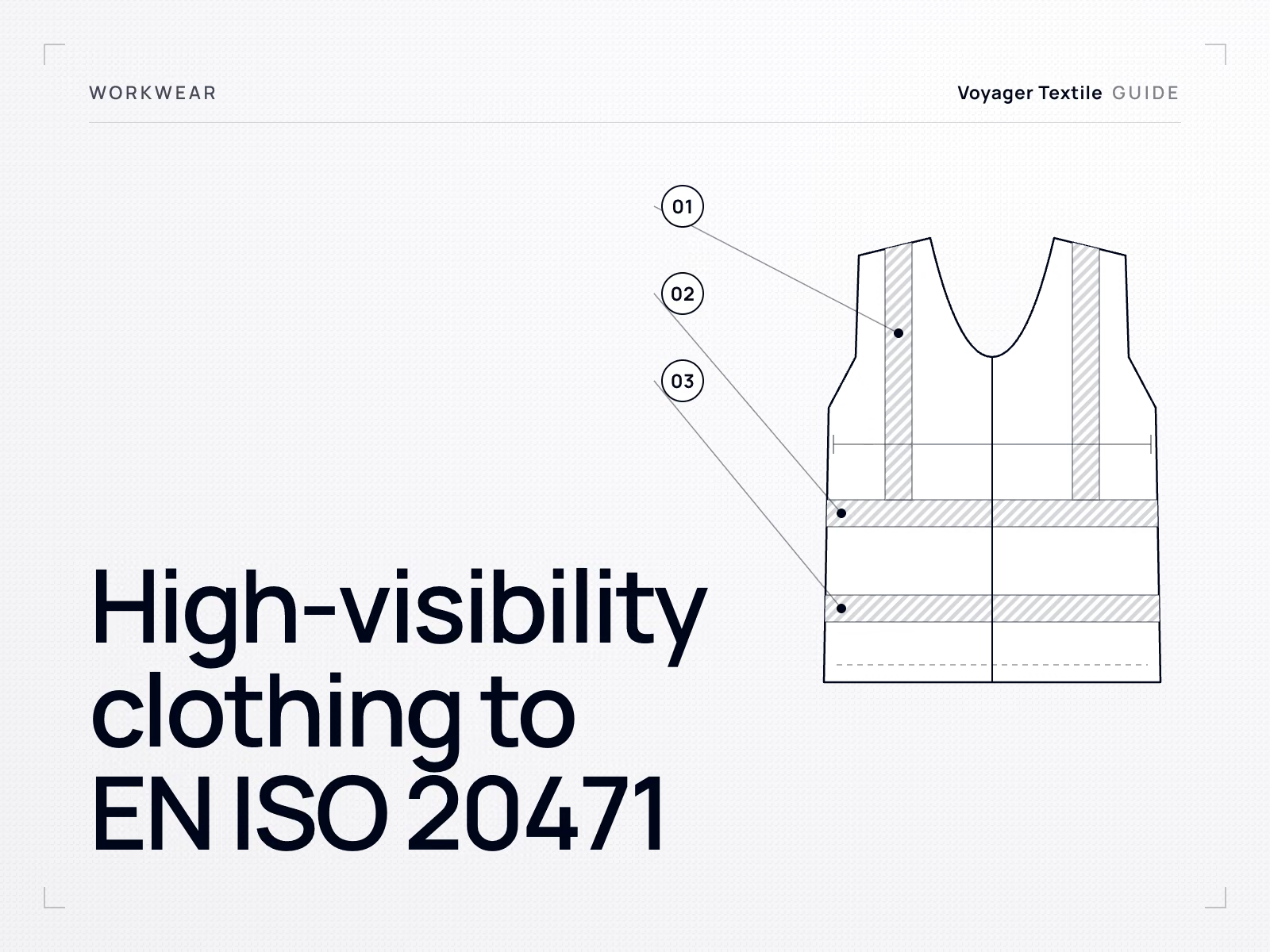
High-visibility conformity is a property of the complete garment, not of its materials. Background fabric, retroreflective material, how much of each there is, where it sits, the design, every size in the range and how the garment performs after cleaning all form part of it. Sewing tape onto a yellow vest addresses none of that.
Contents
High-visibility clothing is a protective category a general apparel buyer often meets, because it looks like ordinary workwear and is bought through ordinary workwear channels. It is also where the gap between what a garment looks like and what it has been assessed as is widest.
Define the intended protection before development. The conformity assessment must cover the finished garment, its intended use and the applicable requirements.
What the standard is, and where it sits
EN ISO 20471 covers high-visibility clothing capable of visually signalling the wearer's presence, with test methods and requirements. In the EU it functions as a harmonised standard supporting Regulation (EU) 2016/425, which means a product conforming to it is presumed to conform with the essential health and safety requirements the standard covers.
That pairing is worth understanding. EN ISO 13688 sets general requirements for protective clothing, the sort of thing that applies whatever the hazard, such as innocuousness, sizing and the information the manufacturer supplies, and is intended to be used alongside a standard covering a specific protective performance. High visibility is that specific performance. Neither does the other's job.
Conformity belongs to the garment
This is the point that changes how a buyer briefs a factory. High-visibility performance is not a fabric property that a garment inherits. It is a property of the finished product, assembled the way it will be sold.
What is actually being assessed
No dimension, area or class value appears here: those belong to the standard and to the assessment of a specific design. The point is the list, not the numbers.
- Background material. The fluorescent fabric, which carries requirements of its own including colour and how it performs over the garment's life.
- Retroreflective material. The tape or film, which is a separate material with separate requirements.
- How much of each there is. The standard works in terms of minimum areas of visible material, which is why the amount present matters and not merely the presence.
- Where it sits. Placement and configuration are part of signalling a human form, not decoration.
- The garment design. Panels, closures and coverage all bear on what is visible in wear.
- Every size in the range. A garment assessed in one size does not establish the smaller ones, and minimum-area requirements interact with small sizes in ways that catch programmes out.
- Performance after cleaning. How the materials behave over specified cleaning is part of the picture rather than an afterthought.
What the classes mean
The standard defines classes reflecting how much visibility performance the garment provides, through the configuration and the amounts of background and retroreflective material. Higher classes correspond to greater visibility-material requirements.
The actual requirements attached to each class are in the standard, and this page does not reproduce them. Anyone specifying a class needs the standard itself and competent input, not a summary table on a supplier's website.
Logos, branding and decoration
The commercially awkward question, and one worth raising before artwork is finalised rather than after. Corporate high-visibility garments usually carry branding, and branding is applied to the same surfaces the standard is concerned with.
A logo can occupy area that was counted as visible material, cover retroreflective tape, interrupt a configuration, or add a material to a surface that was assessed without it. Whether a particular decoration affects conformity depends on what it is, where it goes, how large it is and what the assessed design was.
How decoration is specified in general, including placement and artwork preparation, is covered in artwork placement. What is different here is that the decoration decision interacts with a conformity assessment, so it stops being purely a design question.
Changing a high-visibility product
The changes that matter are ordinary sourcing decisions, which is exactly why they slip through. A different fluorescent fabric from another mill. A different reflective tape with a similar specification sheet. A revised panel layout for better fit. A new size added to the range. A logo moved.
Each of these may bear on conformity, and none of them is automatically fatal. The Regulation requires that changes in the design or characteristics of the product are adequately taken into account by whoever holds the manufacturer's obligations. That means assessment, not assumption in either direction, and it means one certificate does not extend to a second garment simply because it is also high-visibility.
What to establish before sourcing
Before asking for a quotation
Sourcing readiness rather than a compliance checklist. Several of these need competent compliance input rather than a supplier's assurance.
- Whether the garment is genuinely intended as high-visibility protective clothing, or is a bright garment with reflective detailing.
- Which class the risk assessment calls for, and who carried out that assessment.
- The standard reference with its edition and amendment, and confirmation that it is currently harmonised.
- Which party holds the manufacturer's obligations under the Regulation.
- Whether you are buying an existing certified product or asking for one to be developed, which are very different projects with very different timelines.
- What documentation will exist, who holds it, and what the certificate actually covers.
- How branding will be handled, and that it forms part of the assessed design.
- Which sizes the range covers, and that the smallest ones are addressed rather than assumed.
- How future changes to materials, layout or branding will be assessed.
For ordinary corporate garments that simply need to be visible without being protective clothing, a bright branded gilet for an event, for instance, the honest answer is usually to build ordinary apparel and not describe it as high-visibility. How vests are made in general is covered in vest and gilet manufacturing, which already draws this line.
Questions buyers ask
What does EN ISO 20471 cover?
High-visibility clothing capable of visually signalling the wearer's presence, with test methods and requirements covering the background fluorescent material, the retroreflective material, the amounts and placement of each, and the garment as a complete product. In the EU it is a harmonised standard supporting Regulation (EU) 2016/425, so conformity with it gives a presumption of conformity with the essential requirements it covers.
Is adding reflective tape to a garment enough?
No. Conformity is a property of the complete garment, covering the background material, the retroreflective material, the amounts of each, the placement, the design, every size in the range and performance after cleaning, plus the assessment, documentation and marking the conformity route requires. A high-visibility garment is developed as one rather than converted into one.
What do the classes mean?
They reflect how much visibility performance a garment provides, through its configuration and the amounts of background and retroreflective material, with higher classes requiring more. A class is not a quality grade: Class 3 is not premium and Class 1 is not inferior. Which class is appropriate follows from a risk assessment rather than from preference.
Does every size in a range meet the same class?
Not automatically, and this catches programmes out. Minimum-area requirements do not shrink with the garment, so a design that meets a class in a large size may not in the smallest sizes. A range should be addressed as a range rather than evidenced in one size and assumed across the rest.
Can a logo affect high-visibility conformity?
It can. Branding is applied to the same surfaces the standard is concerned with, so a logo may occupy area that was counted as visible material, cover retroreflective tape or alter an assessed configuration. There is no universal maximum logo size, any figure quoted as one is a house rule, and the right approach is to include decoration in the assessed design rather than add it afterwards.
Is a reflective tape test report proof that the garment complies?
No. A report on a tape or a fluorescent fabric is evidence about that material. The standard is concerned with the assembled garment, so material evidence supports conformity work without being conformity. This is the same distinction between a fabric result and a garment result that applies to performance claims generally.
Is ISO 20471 being revised, and does a 2026 edition exist?
A revision is in development at draft stage. No new edition is published, ISO 20471:2013 with its 2016 amendment remains the published standard, and the European harmonised reference is EN ISO 20471:2013 with EN ISO 20471:2013/A1:2016. A draft is not a standard, and a future ISO edition would still require European adoption and citation in the Official Journal before it became the harmonised reference.
Does one certificate cover all our high-visibility garments?
No. A certificate covers what it says it covers, so a second garment built differently is a second question. Changes to materials, layout, size range or branding on a certified product have to be assessed against the approved type by whoever holds the manufacturer's obligations, rather than assumed to be covered or assumed to require full recertification.
Decide the category before the design
Share the intended use, destination market and protective requirements before development. Agree the product evidence and conformity route at the start.
Discuss a specification