Compliance and shipping
When Does Workwear Become PPE in the EU?
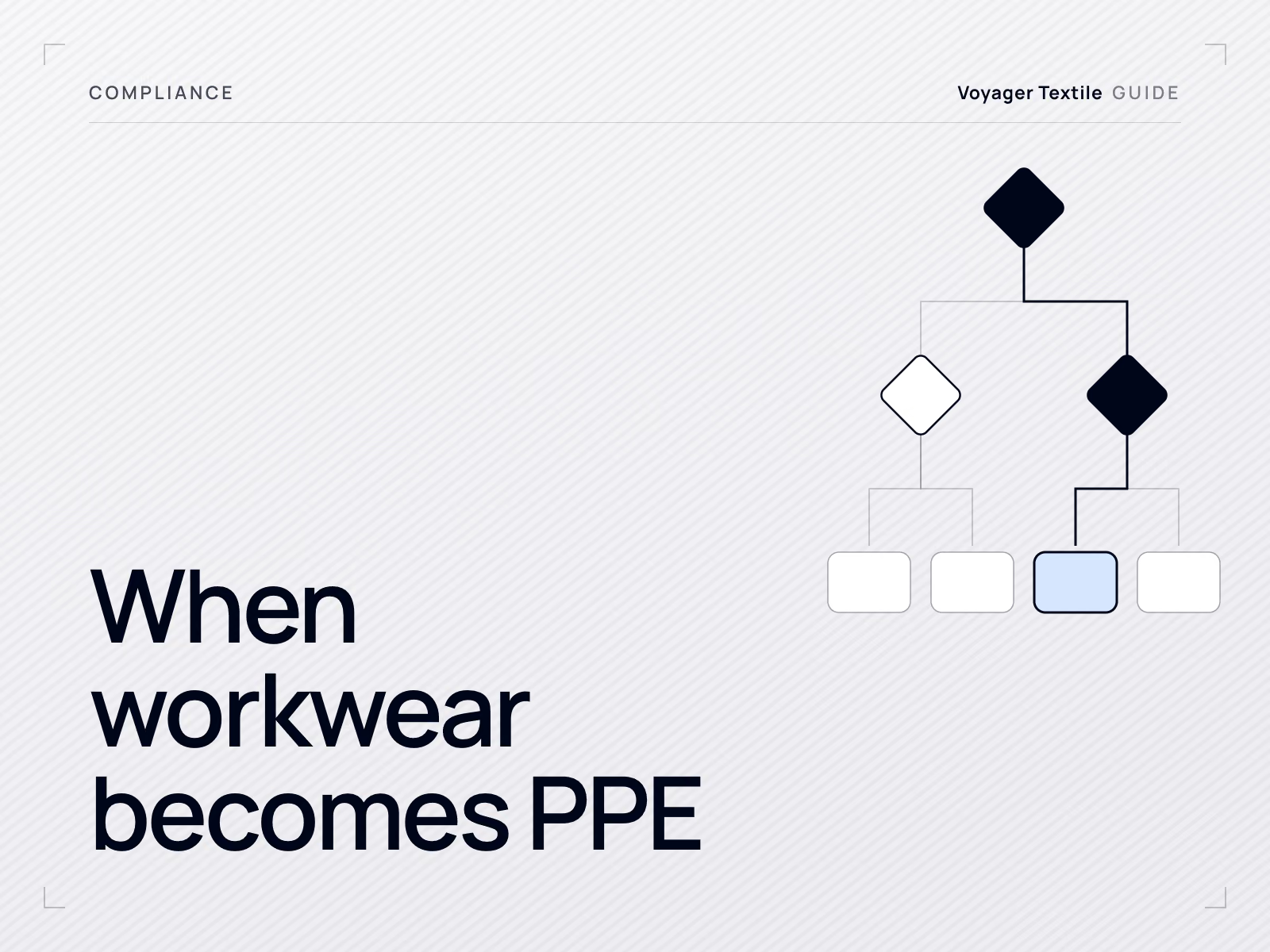
One question separates ordinary workwear from regulated PPE: is the product designed and manufactured to be worn for protection against a risk to health or safety? If it is, the EU conformity route applies, and that route decides everything else, the category, whether a notified body is involved, what documentation exists and whether CE marking belongs on the garment at all.
Contents
- The question that decides it
- Categories I, II and III
- The conformity routes
- Standards, and what they actually do
- Test reports, certificates, declarations and CE marking
- Technical documentation, and what it is not
- Who is the manufacturer
- Changing a certified product
- What PPE conformity does not replace
- Before you send the RFQ
- Questions buyers ask
Buyers ask for workwear and sometimes mean PPE. The words are used interchangeably in sourcing and they are not interchangeable in law, and the difference decides whether a garment can be developed like any other product or whether it enters a conformity regime with its own documentation, its own third-party assessment and its own marking.
Define the intended protection before development. The conformity assessment must cover the finished garment, its intended use and the applicable requirements.
The question that decides it
Regulation (EU) 2016/425, which has applied since 21 April 2018, defines personal protective equipment as equipment designed and manufactured to be worn or held by a person for protection against one or more risks to that person's health or safety.
Everything follows from that sentence, and two words in it do most of the work: designed and protection. A garment is not PPE because of what it is called, what it is made of or where it is worn. It is PPE because it was designed and manufactured to protect a person against a risk.
One question, two routes
A classification question, not a determination for any particular product. The garment name does not answer it; the intended protective purpose does.
| Garment | Can be ordinary apparel when | Can be PPE when |
|---|---|---|
| A vest | It is a branded gilet or a warehouse tabard with no protective function | It is designed to make the wearer visible in a hazardous environment |
| A jacket | It is a corporate softshell or an ordinary weatherproof shell | It is designed to protect against a defined risk covered by the Regulation |
| A coverall | It is durable work clothing | It is designed to protect against a hazard such as flame or chemical splash |
| An apron | It is a hospitality or service apron | It is designed to protect the wearer against a specific risk |
A performance claim does not settle it either
Waterproof, thermal, antibacterial and moisture-wicking are performance properties, and having one does not put a garment into this Regulation. What matters is whether the product is designed and manufactured to protect against a risk to health or safety, which is a question about purpose rather than about a test result. Performance properties and how to specify them are covered separately in performance claims.
There is one apparel case where the line is drawn explicitly. The European Commission's PPE Regulation Guidelines treat garments designed and manufactured to have specific UV-protective properties against natural UV radiation as Category I PPE, which is set out in UV protection and UPF. That is a specific position on a specific protective purpose, not a general rule that a performance word creates PPE.
Rainwear works the same way. An ordinary waterproof jacket is ordinary apparel; protective clothing against rain is a separate thing with its own harmonised standard, EN 343:2019, and the distinction is drawn on the rain jacket page alongside how such garments are actually built.
Categories I, II and III
Where a product is PPE, the Regulation classifies it by the risk it protects against, and that classification decides the conformity route. The categories are defined by risk, not by product type.
- Category I covers exclusively a listed set of minimal risks: superficial mechanical injury; contact with cleaning materials of weak action or prolonged contact with water; contact with hot surfaces not exceeding 50 °C; damage to the eyes from exposure to sunlight, other than during observation of the sun; and atmospheric conditions that are not of an extreme nature.
- Category II covers risks other than those listed in Categories I and III. It is defined by exclusion, so working out whether a product falls here means checking the other two lists first.
- Category III covers exclusively risks that may cause very serious consequences such as death or irreversible damage to health, against a listed set that includes hazardous substances and mixtures, harmful biological agents, ionising radiation, high and low temperature environments, falling from a height, electric shock, drowning, chainsaw cuts, high-pressure jets, bullet wounds or knife stabs, and harmful noise.
The conformity routes
Each category has its own route, set out in the Regulation. The practical difference is how much third-party involvement is required and at which point.
Category, then route
The category follows the risk and the route follows the category. Which route applies to a specific product is part of the conformity assessment.
| Category | Route | Third party |
|---|---|---|
| Category I | Internal production control (module A) | None required |
| Category II | EU type-examination (module B), then conformity to type based on internal production control (module C) | A notified body performs the type-examination |
| Category III | EU type-examination (module B), then either conformity to type with supervised product checks at random intervals (module C2) or conformity to type based on quality assurance of the production process (module D) | A notified body performs the type-examination and remains involved in production |
One consequence worth knowing, because it is visible on the product: the notified body's identification number accompanies the CE marking where the Category III production modules apply. Its absence next to a CE mark is not a fault; it reflects the route the product went through.
What a notified body is, and is not
A notified body is an organisation that a Member State has notified to the Commission as authorised to carry out third-party conformity assessment tasks under this Regulation. It is a legally designated role with a defined scope, and it is not a synonym for a laboratory.
Standards, and what they actually do
The legal obligation is conformity with the essential health and safety requirements the Regulation sets out. Harmonised standards are a route to demonstrating that, not the obligation itself.
PPE conforming to harmonised standards whose references have been published in the Official Journal is presumed to conform with the essential requirements those standards cover. That is a strong and useful mechanism, and it is a presumption rather than a mandate: applying a harmonised standard is the well-trodden route, and it is not the only permissible one.
Test reports, certificates, declarations and CE marking
Buyers ask suppliers for the CE certificate. There is no such single document, and the phrase covers at least four different things that are issued by different parties and prove different things.
What the phrase is hiding
Asking for the CE certificate does not say which of these you want. Asking for the specific one does.
CE marking
CE marking is a marking applied to the product, indicating conformity with the applicable EU legislation. Where the Category III production modules apply it is accompanied by the identification number of the notified body involved, affixed by that body or under its instructions, and it may be followed by a pictogram indicating the risk protected against.
- It is not a quality mark. It says nothing about durability, comfort, workmanship or whether a garment is better than another CE-marked garment.
- It is not EU approval. No EU authority approves each product. Third-party assessment happens where the route requires it, and the manufacturer's obligations remain in all cases.
- It does not belong on ordinary clothing. CE marking applies where EU harmonisation legislation requires it, and affixing it to a product outside that scope is not permitted. Adding it to ordinary corporate workwear does not make the workwear more compliant; it makes it wrong. The same point from the general product safety side is in GPSR for apparel.
EU declaration of conformity
The manufacturer draws up an EU declaration of conformity stating that fulfilment of the applicable essential health and safety requirements has been demonstrated. It follows a model structure set out in the Regulation, contains the elements the applicable module specifies, is kept continuously updated, and is translated into the language or languages the Member State requires where the PPE is placed or made available.
The manufacturer either provides it with the PPE or includes in the instructions the internet address at which it can be accessed. A buyer asking whether the declaration exists, and where, is asking a question with a definite answer.
EU type-examination certificate
Where the route requires it, a notified body examines the technical design and issues an EU type-examination certificate. The Regulation sets a limit on its validity of a maximum of five years, with a review process. That is a maximum rather than a guaranteed term, and a certificate's own stated scope and status are what matter.
Reading a certificate rather than filing it
Reading these fields does not verify a certificate, and a buyer with doubts should verify the issuing body and the document through proper channels.
- Which body issued it, and its notified body identification number.
- Which legal entity it was issued to, and whether that is the party supplying you.
- Which product, model or type it covers, and whether that is the garment you are buying.
- Which legislation and which standard, with edition and amendment.
- Its scope and any stated limitations.
- Its issue date and status, bearing in mind the validity limit and the review process.
Technical documentation, and what it is not
The Regulation requires technical documentation specifying the means the manufacturer used to ensure conformity. In outline it includes a complete description of the PPE and its intended use, an assessment of the risks it is intended to protect against, the applicable essential requirements, design and manufacturing drawings with the explanations needed to understand them, the harmonised standards applied and which parts where applied only partly, any other technical specifications used instead, and the results of tests.
The manufacturer keeps that documentation and the declaration of conformity for ten years after the PPE has been placed on the market.
| Document | What it is for |
|---|---|
| Apparel tech pack | A manufacturing specification: how to build the garment. See what a factory actually needs |
| General product safety documentation | Safety evidence for consumer products under the general framework. See product safety documentation |
| PPE technical documentation | Conformity documentation under this Regulation, built around the risks the product protects against |
Who is the manufacturer
The Regulation defines a manufacturer as any person who manufactures PPE, or has it designed or manufactured, and markets it under their name or trademark. As under the general product safety framework, that legal role and the physical sewing factory are not automatically the same thing.
Two related points carry over from elsewhere on this site. OEM and ODM are commercial sourcing terms and not regulatory roles, so neither settles this question, see OEM, ODM and private label. And an Incoterm allocates transport, cost and risk and decides nothing about who is the manufacturer, the importer or the party responsible for conformity, as set out in payment terms and Incoterms.
Importers and distributors have their own obligations, which are verification-oriented rather than design-oriented: satisfying themselves that the required conformity procedure was carried out and the required documentation exists, that identification and marking are present, that storage and transport do not jeopardise conformity, and that corrective action is taken where a product is not in conformity. Economic operators must also be able to identify who supplied them and to whom they supplied, for ten years in each direction.
Manufacturing outside the EU does not remove any of this. A non-EU factory can make PPE for the EU market, and the obligations attached to placing it there still have to be met by the appropriate operators in the chain. Which operator that is depends on the arrangement rather than on where the sewing happens.
Changing a certified product
This is where private-label programmes often go wrong, because the changes involved look routine. A different fluorescent fabric, a different reflective tape, a new panel layout, a logo added to a chest, a different trim supplier, an extended size range: each is an ordinary sourcing decision, and each may bear on conformity.
The Regulation requires manufacturers to have procedures for series production to remain in conformity, and specifically that changes in the design or characteristics of the PPE, and changes in the harmonised standards or other specifications by reference to which conformity is declared, are adequately taken into account.
What PPE conformity does not replace
- Chemical restrictions. Restricted-substance requirements apply to the materials regardless of conformity assessment. See chemical compliance.
- Textile fibre labelling. Composition labelling is a separate obligation, covered in EU labelling compliance.
- Quality control. Production inspection maintains the specification; it is not a conformity assessment procedure and does not substitute for one. See quality control.
- Sample approval. Approving a pre-production sample is a commercial and technical act, not a conformity assessment.
- Care and maintenance information. Where protective performance depends on correct cleaning, the manufacturer's information matters more than usual, which is a different question from ordinary care labelling, covered in garment care and testing.
Before you send the RFQ
Questions to answer first
This is sourcing readiness, not a legal completeness test. Several of these need competent compliance input rather than a supplier's opinion.
- What risk, if any, is this garment designed to protect the wearer against.
- Whether the product is therefore PPE at all, or ordinary occupational clothing.
- Which risk category applies, if it is PPE.
- Which standard applies, with edition and amendment, and whether its reference is currently harmonised.
- Which party holds the manufacturer's obligations under the Regulation.
- Whether a notified body is required by the route, and if so which one and within what scope.
- What documentation must exist, and who holds it.
- What marking and user information the product must carry, and in which languages.
- How design changes will be handled once a type is approved.
- Whether you are buying a certified product or asking a factory to develop one, which are very different projects.
Questions buyers ask
Is all workwear PPE?
No. Personal protective equipment is equipment designed and manufactured to be worn or held for protection against one or more risks to a person's health or safety. A branded polo, an office uniform, warehouse trousers or a hospitality apron are occupational clothing, and being worn at work does not make a garment PPE.
Is a hi-vis vest PPE?
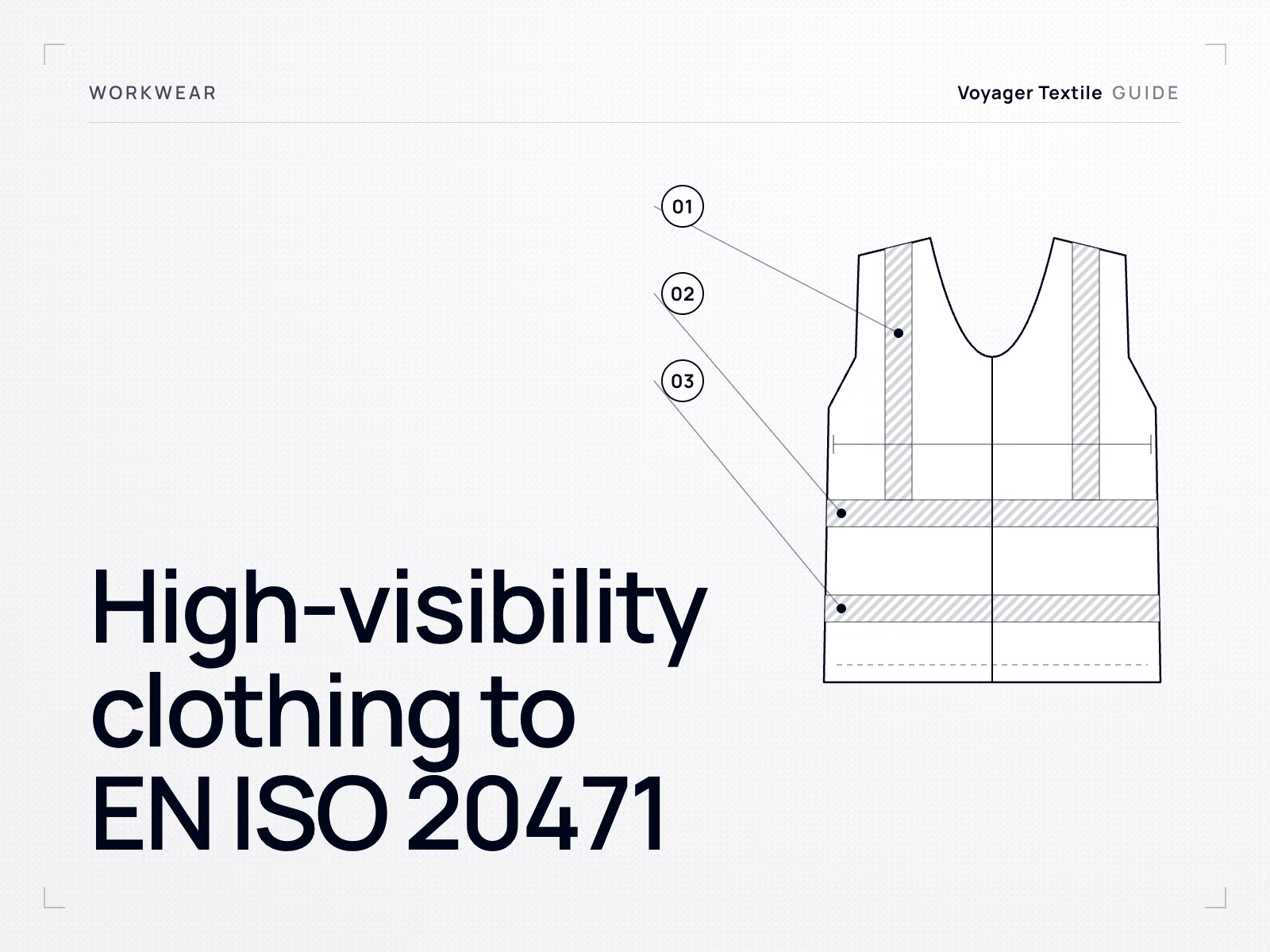
A garment designed to make the wearer visible in a hazardous environment is protective clothing and falls within the Regulation. A bright vest with reflective strips sewn on is not automatically compliant with anything, because conformity belongs to the complete garment and its assessment. See high-visibility clothing.
Is a waterproof jacket automatically PPE?
No. A performance property does not by itself put a product into this Regulation; what matters is whether it is designed and manufactured to protect against a risk to health or safety. Protective clothing against rain is a distinct thing with its own harmonised standard, EN 343:2019, and an ordinary waterproof jacket is ordinary apparel.
What are PPE Categories I, II and III?
Category I covers exclusively a listed set of minimal risks. Category III covers exclusively risks that may cause very serious consequences such as death or irreversible damage to health, against a listed set. Category II covers risks other than those in Categories I and III. The category attaches to the risk protected against, not to the garment type.
When is a notified body required?
Category I requires no third-party involvement: it uses internal production control. Category II requires EU type-examination by a notified body, followed by conformity to type based on internal production control. Category III requires EU type-examination plus a production route in which a notified body remains involved, which is also why the body's identification number accompanies the CE marking on Category III products.
Is a test report the same as PPE certification?
No, and this is a common misunderstanding in the area. A laboratory can test a material or a garment and issue a report of a measured result. An EU type-examination certificate is issued by a notified body and records that the technical design was examined against the applicable requirements. A test laboratory is not automatically a notified body.
Is there such a thing as a CE certificate?
Not as a single document. The phrase usually covers four different things: test reports issued by laboratories, an EU type-examination certificate issued by a notified body where the route requires one, the EU declaration of conformity drawn up by the manufacturer, and the CE marking itself, which is a marking rather than a document. Asking for the specific one you need gets a useful answer.
Does CE marking mean the garment is high quality?
No. CE marking indicates conformity with the applicable EU legislation for the product. It says nothing about durability, comfort or workmanship, it is not an approval issued by an EU authority, and it does not belong on ordinary clothing that is outside the scope of harmonisation legislation.
Does using EN ISO 20471 make a garment legally compliant?
Using a harmonised standard whose reference is published in the Official Journal gives a presumption of conformity with the essential requirements that standard covers. The legal obligation is conformity with the applicable essential health and safety requirements, and applying the standard is a route to demonstrating it rather than the obligation itself. Standards also have editions and amendments, which a specification should state.
Is EN ISO 13688 enough on its own?
No. It sets general requirements for protective clothing and is intended to be used together with a standard covering a specific protective performance. A garment described only as EN ISO 13688 certified has not been described in terms of what it protects against.
Who is the manufacturer of private-label PPE?
The Regulation defines a manufacturer as a person who manufactures PPE, or has it designed or manufactured, and markets it under their name or trademark. An importer or distributor is considered a manufacturer where they place PPE on the market under their own name or trademark, or modify PPE already on the market in a way that may affect compliance. Which party holds the role follows the arrangement and the definition, so neither side should assume the other has it.
Does adding our logo to a certified garment affect anything?
It may, and it should be assessed rather than assumed either way. The Regulation requires that changes in the design or characteristics of the PPE are adequately taken into account, and on some protective clothing a logo occupies material area or alters an assessed configuration. Not every change needs recertification and not every change is harmless; the point is that the assessment happens.
Does an Incoterm decide who is responsible for CE marking?
No. A delivery term allocates transport, cost and risk between seller and buyer. It does not determine who holds the manufacturer's obligations, who the importer is, or who is responsible for conformity assessment and marking. Those follow the Regulation's definitions and the actual commercial arrangement.
Name the risk before the RFQ
Share the intended use, destination market and protective requirements before development. Agree the product evidence and conformity route at the start.
Discuss a specification