Buyer reference
Apparel chemical compliance: restricted substances, evidence and what to specify
Four different systems restrict chemicals in clothing, and they are constantly mistaken for one another. Legislation applies to the product placed on a market. A brand RSL is a contractual requirement that may go further. An industry programme such as ZDHC works on the chemicals entering production. A product certification tests against its own criteria. Meeting one says nothing about the other three.
Chemical requirements reach a factory as a single instruction, make it compliant, and rarely mean one thing. Behind that instruction sit a regulation that applies wherever the goods are sold, a buyer's own restricted substances list that may go considerably further, a voluntary industry programme that works on the chemicals entering the dyehouse, and possibly a certification scheme with criteria of its own. Each has a different issuer, a different scope and a different kind of evidence.
This section explains how those systems fit together, so that a buyer can specify what they actually need and read the documents that come back. It explains sourcing and compliance concepts; it does not determine the complete legal requirements for a particular product in a particular market, which depend on the product, the components and where it is sold.
Four control systems, one garment
A central point to hold on to is that these are separate systems rather than levels of the same one. A garment can satisfy a legal restriction and still fail a customer's RSL. A chemical supplier can hold industry conformance for a dye while the finished garment has never been tested. A certificate can be genuine and cover a component that is not the one in question.
Who sets what
Four issuers, four kinds of obligation. Only the first applies regardless of what a supplier holds; the others apply because of a contract, a membership or a scheme.
| System | What it is | Commonly mistaken for |
|---|---|---|
| Legal requirement | Restrictions in the law of the market where the product is placed. Applies to the product, whoever made it and whatever else they hold. | A certificate a supplier can send. It is not one. |
| Buyer RSL | A brand or retailer's own restricted substances list, issued as part of the commercial relationship, often broader and more frequently updated than the legal minimum. | Law. It is a contractual requirement. |
| Industry programme | A voluntary framework such as ZDHC, working mainly on the chemical formulations used in manufacturing rather than on the finished product. | Proof that the garment passes anything. It is an input-side control. |
| Product certification | A scheme certifying that a defined article meets the scheme's own criteria, covered in certified materials. | A general compliance statement. Its scope is what its certificate says. |
Chemical risk is not only in the fabric
Buyers reasonably think about fabric first, because fabric is most of the garment by weight. Restricted-substance requirements do not work that way. They apply to substances in materials and components, and a garment is a collection of separate materials made by different suppliers using different chemistry.
The garment as a set of components
Each component is a separate material with its own chemistry and its own supply chain. No universal list says which of them needs what: that depends on the requirement, the material and the market.
- Dyes and finishes. Colour and performance finishes are applied chemistry, and both are the reason a fabric quality can behave differently in one colour than another.
- Prints and coatings. A printed or coated surface is a different material sitting on the fabric. Ink systems, adhesives and transfer films each have their own composition, which is why decoration is assessed on its own rather than inherited from the base cloth. See printing against embroidery.
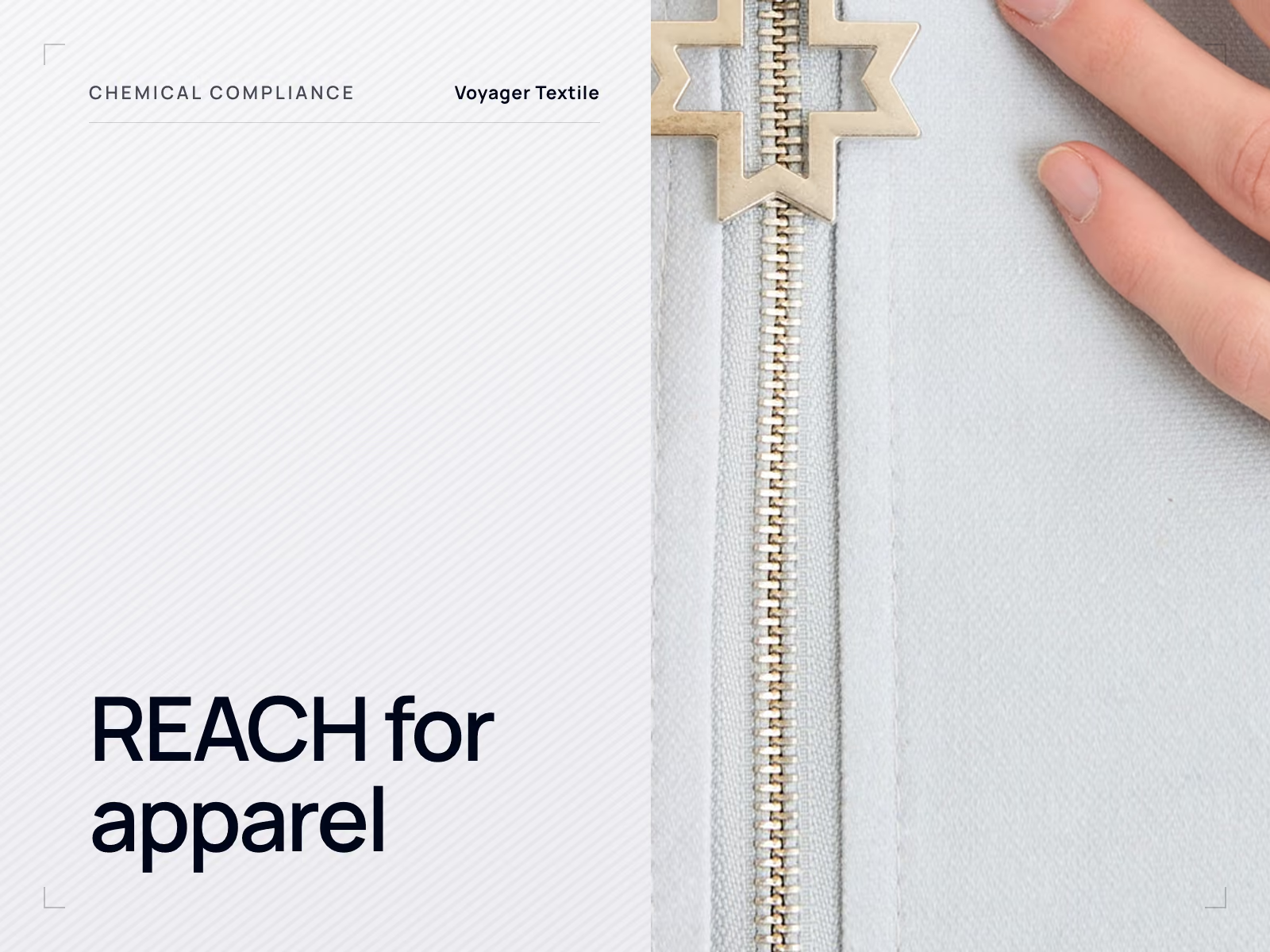
- Metal components. Zips, snaps, rivets, eyelets, buckles and metal-plated parts. Restrictions on metals in items with prolonged skin contact are scoped to exactly this kind of component.
- Plastic and moulded parts. Buttons, cord ends, sliders, badges, and anything flexible and plasticised.
- Elastics, foams and interlinings. Materials that rarely appear in a specification and are still components of the article.
- Labels, patches and hangtags. Printed and coated items in their own right, covered specification-wise in labels and packaging.
Two practical consequences. First, a document covering the fabric does not cover the trim, and asking whether it does is ordinary due diligence rather than distrust. Second, changing a component changes what the existing evidence covers, a different zip supplier, a new print method or an added coating can all put the programme somewhere its documents do not reach.


Where the destination market decides the requirement
The same garment can face different chemical requirements depending on where it is sold and who it is for. Two structures matter particularly to the buyers this site works with, and they are built quite differently.
European Union
The main instrument is REACH, which restricts certain substances in articles under defined conditions and separately requires information to be communicated about substances of very high concern above a threshold. It applies to the product placed on the market rather than to a company, and there is no such thing as a REACH certificate. How that works, what Annex XVII actually is and how it differs from the Candidate List is covered in REACH restricted substances for apparel. What has to appear on the label itself is a separate subject, covered in EU labelling compliance.
United States
The federal chemical requirements that bear on clothing are concentrated on children's products, defined as products intended primarily for children 12 years old and younger. They do not apply to adult apparel, and treating them as though they do is a common and expensive misreading.
- Total lead. Section 101(a) of the Consumer Product Safety Improvement Act limits lead content in any component of a children's product intended primarily for children 12 and under to 100 ppm. The Commission is required to review the limit periodically and revise it downward where technologically feasible; in a determination published on 24 June 2026 it found that current regulations already require the lowest technologically feasible amount and did not revise the limits.
- Lead in paint and surface coatings. Paints and similar surface-coating materials bearing lead at 0.009% or more by weight are banned hazardous products. This is a separate limit from total lead, and a painted component can be in scope of both.
- Phthalates. Regulated phthalates are limited in accessible component parts of children's toys and child care articles.
- Third-party testing and certification. Manufacturers and importers of children's products subject to the lead requirements certify using a CPSC-accepted third-party laboratory. Children's products also carry tracking-label requirements and a Children's Product Certificate. Current requirements are published by the CPSC.
Clothing sold in the United States also has to meet flammability requirements, which apply far more broadly than the children's chemical rules. That is a physical performance requirement rather than a chemical one, and it is mentioned here only so it is not filed in the wrong place. General US labelling and import requirements are covered in US labelling and import requirements.
Requirements in both markets change, and some fast-moving areas, PFAS being the clearest example, are moving in law and in brand RSLs at the same time and at different speeds. Anything in this area should be checked against its current source rather than against a page, including this one.
What counts as evidence
Much confusion about chemical compliance is really confusion about documents. Five things circulate under the general heading of proof, and they prove different things.
| Document | What it establishes | What it does not |
|---|---|---|
| Supplier declaration | The supplier's written position against a stated requirement, for a stated material | An analytical result. It is an attestation, not a measurement. |
| Laboratory test report | An analytical result for the submitted sample, by a stated method, against stated criteria | That other colours, components, styles or production lots behave the same |
| Product certificate | That a defined article meets a scheme's own criteria, within the scope on the certificate | That a legal requirement or a buyer RSL is met. Scope is covered in scope and transaction certificates. |
| Chemical product conformance | That a chemical formulation conforms to an MRSL to a stated level of evidence | Anything about the finished garment |
| Compliance statement | The supplier's position on a legal requirement | A document issued by a regulator. No regulator issues one. |
A declaration is not worthless because it is not a test, and a test is not conclusive because it is analytical. The useful question is always the same: what exactly was covered, and does it correspond to what will be produced? Reading a report on those terms is covered in chemical test reports.
How a chemical requirement runs through a project
There is no universal protocol, and any supplier presenting one should be asked whose it is. What follows is the sequence the work tends to take when it is done properly, which is enough to see where a decision is currently missing.
From requirement to production approval
A step buyers often skip is the second. A requirement stated as a market and a standard, without a list of the materials and components it has to reach, produces evidence for the fabric and silence about everything else.
What to specify in an RFQ
Chemical requirements are cheapest to satisfy when they arrive with the enquiry rather than after the sample. What a complete commercial brief contains is covered in how to write an RFQ; this is the chemical-specific part of it.
Chemical-compliance information to send with an enquiry
Anything left blank here becomes an assumption, and assumptions in this area are resolved by testing rather than by discussion.
- Destination market or markets, since the applicable law follows where the goods are sold.
- Product category, and whether it is a children's product, because that changes which requirements apply at all.
- Your own RSL, with its version or date identifier, not simply a request to be compliant.
- Which materials and components the requirement covers: fabric, trims, prints, coatings, labels, packaging if it is included.
- Any certification you require on the materials themselves, stated as a scheme and a scope.
- Whether testing is required, and if so whether a particular laboratory must be used.
- Which evidence you will accept: declaration, existing report, new test, or a combination by component.
- The format and language you need documents in, and who they are addressed to.
- When the evidence is needed relative to sampling, bulk material booking and shipment.
- Who carries the cost of testing, which is a commercial allocation rather than a given.
Where this sits next to the rest of the site
- Certification is covered in certified materials. A certificate can be part of a chemical-compliance programme; it is not the programme, and no scheme certifies against every buyer's requirements.
- Care and wash testing is a different question with different methods, covered in garment care and testing. Colourfastness and dimensional change are performance, not restricted substances.
- Quality control is covered in apparel quality control and incoming fabric inspection. Inspection looks at what a garment is; chemical testing looks at what it contains.
- Social compliance is covered in factory audits. An ethical audit is not a chemical audit, and neither substitutes for the other.
- General product safety is covered in GPSR for apparel. Chemical restriction testing evidences one part of a product's safety picture rather than the whole of it.
- Functional finishes are covered in performance claims. A repellent or antimicrobial treatment is chemistry, so it sits inside restricted-substance requirements as well as inside whatever claim it supports.
- Packaging is covered in pack-out specification. Packaging materials fall inside a chemical requirement only where the requirement says so.
Read in order, the three references below cover the instruments, the European legal framework and the documents. They are written to be read separately.
Buyer questions
Is REACH a certification?
No. REACH is EU chemicals legislation. No EU body issues a certificate declaring a factory or a garment REACH compliant, so a supplier offering a REACH certificate is describing something that does not exist. What can exist is a supplier declaration, a laboratory test report against specified restrictions, or a compliance statement.
Is a brand's restricted substances list a legal requirement?
It is a contractual one. A brand or retailer RSL is part of the commercial relationship, and it is frequently broader and updated more often than the legal minimum. Meeting the law does not mean meeting a customer's RSL, and meeting one customer's RSL does not establish anything about another's.
Does chemical compliance apply to trims and prints as well as fabric?
Yes. Requirements apply to substances in materials and components, and a garment is a set of separate materials: dyes and finishes, prints and coatings, metal and plastic trims, elastics, foams, labels and adhesives. Evidence covering the fabric does not automatically cover any of them.
Do US children's product chemical rules apply to adult clothing?
No. The federal lead and phthalate requirements are scoped to children's products, meaning products intended primarily for children 12 years old and younger. Adult apparel sold in the United States is subject to flammability requirements and to labelling and import rules, which are separate subjects.
What should I send a manufacturer if chemical compliance matters to my programme?
The destination market, the product category and whether it is a children's product, your own RSL with its version identifier, which materials and components the requirement covers, what evidence you will accept, whether a specific laboratory is required, and when the documentation is needed. Anything omitted becomes an assumption.
Send the requirement with the enquiry
If your programme carries restricted-substance requirements, send the destination market, the product category and your own RSL version with the enquiry. We will tell you which materials and components it reaches, what documentation the material suppliers already hold, and where testing would be needed to close the gap.
Discuss a specification