Specification, sampling and quality
Incoming Fabric Inspection: What Happens Before Cutting
Fabric is inspected before it is cut because that is the last moment a problem is cheap. A faulty roll can be rejected or downgraded; the same fault discovered after cutting has already been turned into panels, and after sewing it has been turned into garments. The checks are quantity, identity, width, weight, shade and visible faults, and the last two decide how the order is planned.
Contents
- Why it happens before cutting
- What is checked when the rolls arrive
- How faults are graded: the four-point system
- Shade: the check that decides how the order is cut
- Testing that belongs at this stage
- Relaxation and skew
- What happens to fabric that fails
- What a buyer should specify
- How this works at Voyager Textile
- Questions buyers ask
Most buyers never see this stage and most quality conversations skip it, which is odd, because a meaningful share of garment defects are fabric defects that were allowed through. A cutting room can cut accurately from bad cloth all day. This is the check that decides whether it has to.
Why it happens before cutting
The cost of a fabric fault multiplies at every subsequent operation. A fault found on the roll costs a claim against the mill. The same fault found after spreading has consumed cutting time and turned into panels that may or may not be usable. Found after sewing, it is a finished garment, and the labour is gone whether the garment ships or not.
Incoming inspection is part of the quality-control process. Schedule it early enough to resolve material issues before cutting; a production slot may already have been reserved.
What is checked when the rolls arrive
| Check | What is verified | Why it matters |
|---|---|---|
| Identification | Article, composition, colour and lot against the order and the roll tickets | Keep lot identity traceable and check compatibility before combining fabric |
| Quantity | Length or weight received against the delivery note | Short delivery discovered at cutting stops production |
| Width and usable width | Full width and the width actually usable inside the selvedges | Marker efficiency and consumption are calculated on usable width |
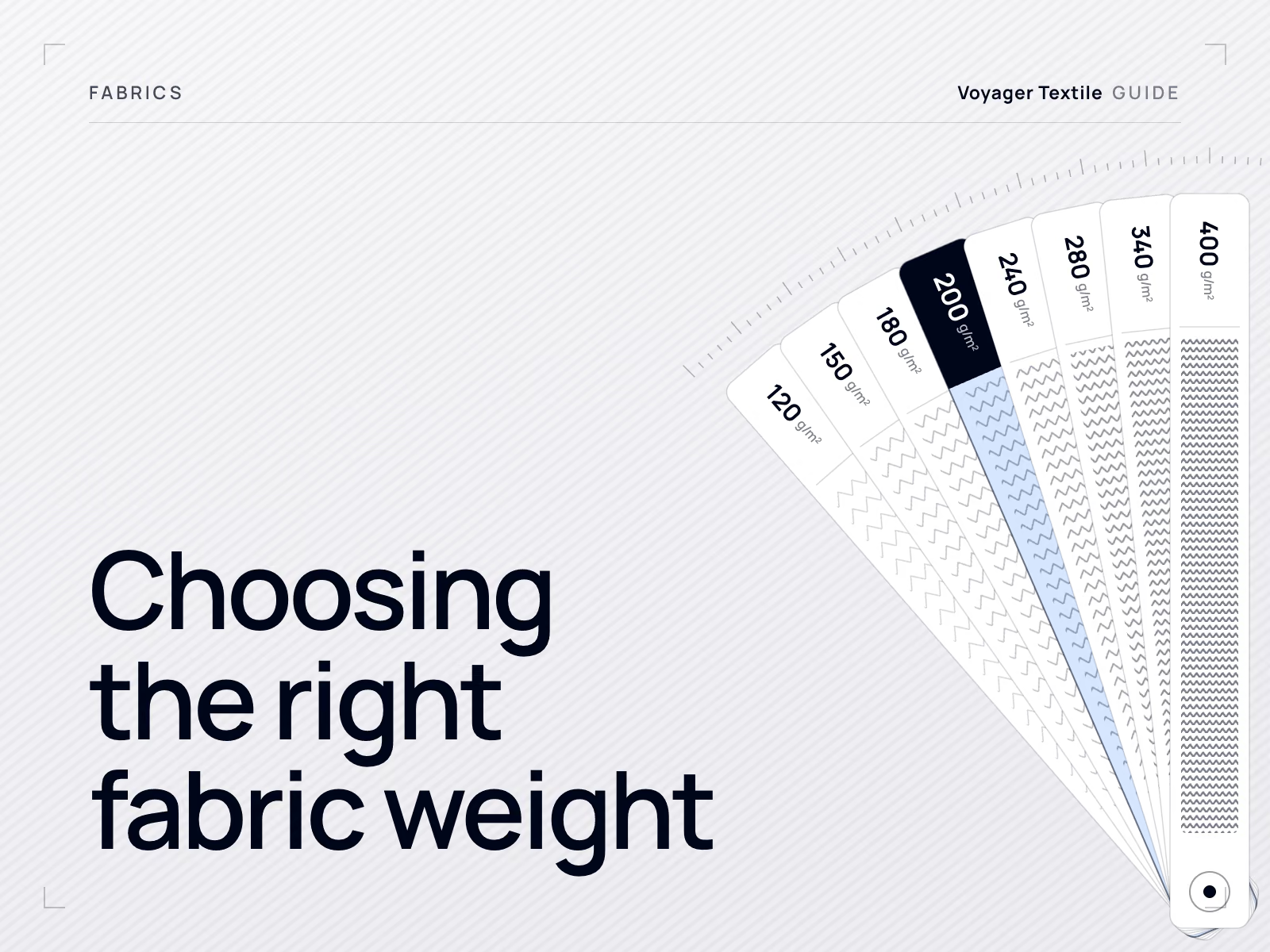
| Weight | Measured weight against the specified g/m² and its tolerance | Out-of-tolerance weight requires assessment against the fabric specification |
| Shade | Roll against the approved standard, and rolls against each other, including side to centre to side | Decides whether rolls can be cut together |
| Visible faults | Holes, stains, contamination, knitting or weaving faults, and any continuous defect | Graded and totalled to accept, downgrade or reject the roll |
| Skew or bow | Whether the weft or course line runs square to the selvedge | Bow or skew can affect panel alignment and garment appearance; assess the intended fabric |
How faults are graded: the four-point system
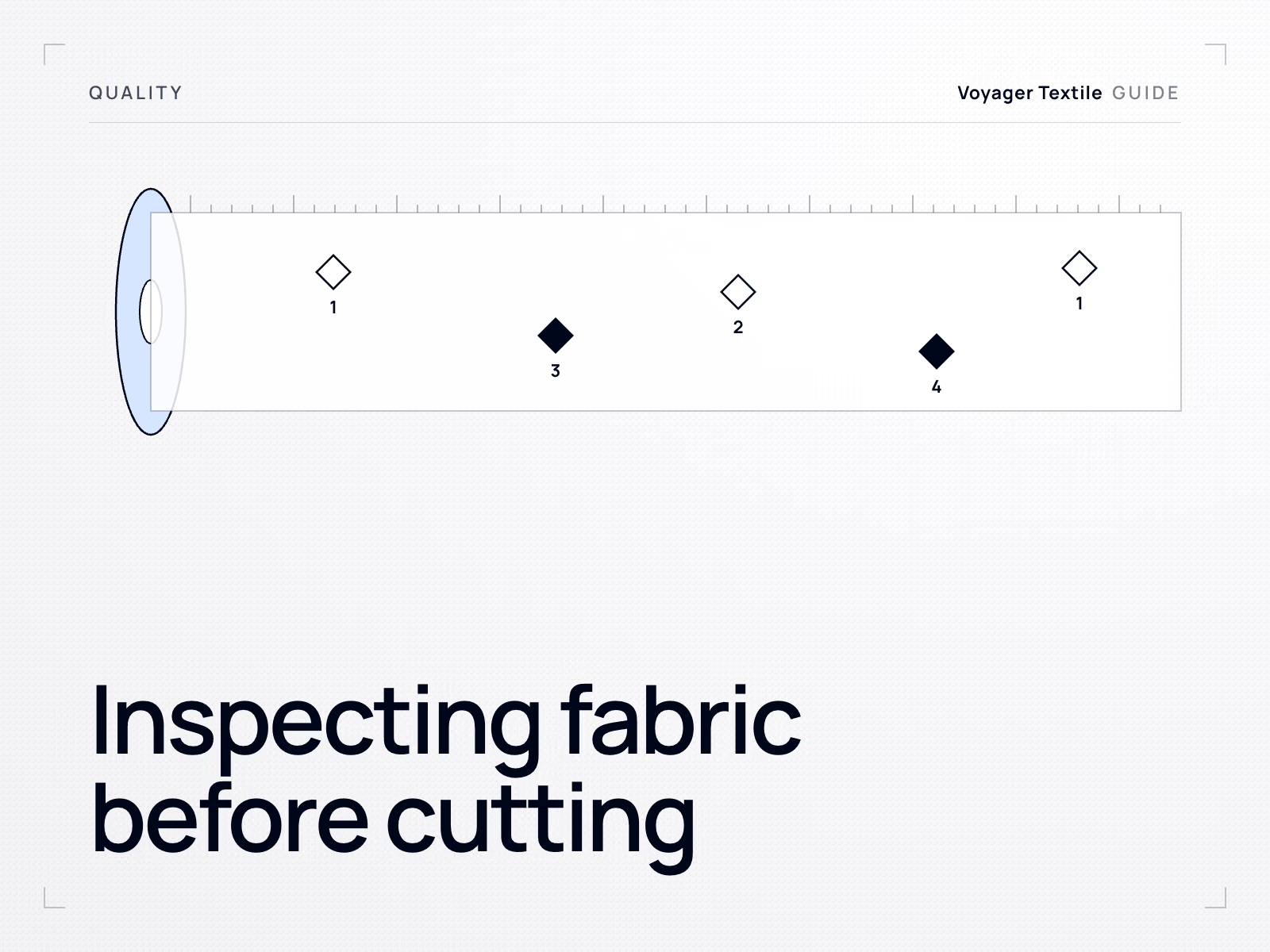
The four-point system is one approach to visual fabric grading. ASTM D5430 covers different point-assignment options, so agree the option, defect rules and reporting units before comparing roll scores. The outline below describes a common four-point approach; the agreed method governs the inspection.
- A defect up to 3 inches, about 75 mm, scores 1 point. Over 3 up to 6 inches scores 2, over 6 up to 9 inches scores 3, and anything over 9 inches, about 230 mm, scores 4.
- No more than 4 points can be assigned to any single defect, and no single linear yard can carry more than 4 points however many faults it contains.
- Score holes and openings under the agreed method. Do not assume every hole receives 4 points: some methods distinguish smaller and larger holes.
- A continuous defect running along the roll scores 4 points for every yard in which it appears.
- Points are totalled and expressed per 100 square yards, which makes rolls of different lengths comparable.
Inspection conditions are part of the method rather than a detail: fabric is inspected on a machine under adequate lighting at a controlled speed, because faults missed at speed are faults that reach the cutting table.
Shade: the check that decides how the order is cut
Dyeing is a batch process, so rolls vary. Two things are assessed: whether each roll matches the approved standard, and whether the rolls match one another, including across the width of a single roll, which is why the check is taken at both selvedges and the centre.
Group compatible rolls into shade bands and plan cutting to keep panels within the agreed shade tolerance. Check variation within rolls as well as between them: one roll or band does not by itself guarantee a match. Investigate mismatches against roll records and cutting controls rather than assigning responsibility from the symptom alone. See why fabric shade varies between dye lots.
Testing that belongs at this stage
Select incoming tests according to material risks and the agreed specification before releasing fabric for cutting. Later garment processing can also change performance, so incoming results do not replace any required garment-stage or final-product tests.
- Dimensional stability, tested at the wash the product will actually receive. A fabric outside the agreed limit is a fabric problem, and it becomes a garment problem the moment it is cut.
- Colourfastness, particularly rubbing on dark shades, which is where unfixed surface dye shows up. The tests and how to specify them are in the colourfastness reference.
- Pilling, where the programme has a surface durability requirement, as covered in fabric pilling.
- Weight verification checks mass per unit area against the specification and tolerance; it cannot by itself establish fabric identity or detect every substitution.
Relaxation and skew
Assess the relaxation needed before spreading so that fabric is not cut under unintended tension. Check bow, skew and dimensional stability against the specification; the risk of garment twisting also depends on yarn, construction and processing. Investigate an unacceptable result before cutting rather than assuming it is inevitable or impossible to correct. See the cutting room and why T-shirts twist after washing.
What happens to fabric that fails
Options are limited and all of them cost time, which is the argument for inspecting early rather than thoroughly at the last minute.
- Reject the roll and claim against the mill, which is clean but leaves a quantity gap to fill.
- Accept it at a lower grade for a less critical use, if one exists in the programme.
- Cut around identified faults, which the cutting room can do when faults are marked, at the cost of efficiency and additional fabric.
- Accept it with the buyer's agreement, where the fault is cosmetic and the alternative is missing a date. This should be a documented decision, not a silent one.
What a buyer should specify
Worth writing into the order
- The fabric specification in full, including structure, composition, weight and finish
- The proportion of rolls to be inspected, and the grading system to be used
- The acceptance threshold in points per 100 square yards, and whether it applies per roll or as an average
- The shade standard, the assessment lighting, and the acceptable variation
- Whether panels of one garment must come from a single roll or shade band
- Which tests are required on incoming fabric, with methods and pass criteria
- What happens to failing fabric, and who decides
- Whether inspection reports should be shared with you
Most of these take one line each and remove an entire category of later dispute. How they fit into the wider inspection framework is covered in the quality control guide.
How this works at Voyager Textile
Incoming fabric is checked before cutting for shade continuity across rolls, width, weight and visible faults, and knitted fabric is relaxed before spreading. Where a customer's programme requires a specific grading system, threshold or test regime, that is agreed at specification stage and applied to the order rather than assumed. The production sequence it sits inside is set out on the manufacturing processes hub.
Questions buyers ask
What is the four-point system?
A visual fabric grading approach that assigns penalty points to faults and reports them against an agreed area. ASTM D5430 includes different point-assignment options. Confirm the chosen option, size bands, hole and continuous-defect rules, maximum points and reporting units before using the result for acceptance.
How many points per 100 square yards are acceptable?
There is no universal figure. The scale is standardised and the pass mark is a commercial agreement, with published practice varying and brands setting their own limits, sometimes with a tighter average across rolls than for a single roll. Agree it in writing with your supplier.
Is every roll inspected?
Inspection may cover all rolls or a defined sample. Agree the sampling basis, coverage and acceptance rules for the programme, including what happens when inspected rolls fail.
Why does fabric need to be relaxed before cutting?
Because it arrives under tension from knitting, dyeing and finishing. Cutting tensioned fabric produces panels that contract afterwards, so the garment measures correctly at the cutting table and short at final inspection. Relaxation lets the fabric recover first.
What is shade banding?
Grouping rolls by assessed shade compatibility to support consistent cutting. Panels must still meet the agreed shade tolerance, including any variation within a roll. Shade banding does not make every difference acceptable or guarantee a perfect match.
Should incoming inspection reports be shared with the buyer?
They can be, and it is worth asking for on programmes where fabric quality has been an issue. Even where reports are not routinely issued, agreeing that they exist and can be produced changes how carefully the stage is documented.
Want fabric checks written into your order?
Tell us the fabric and the risks that matter for your product. We will confirm what is checked before cutting, which tests belong on the incoming fabric, and what the acceptance criteria should say.
Discuss fabric quality requirements