Production problem
Why do T-shirts twist after washing?
A T-shirt that twists after washing is usually showing spirality: residual torque in the yarn releasing as the knitted loops relax. It is a fabric and yarn property rather than a sewing fault, which is why it cannot be corrected in the sewing room and has to be addressed at yarn selection, knitting, finishing and cutting.
What you are seeing
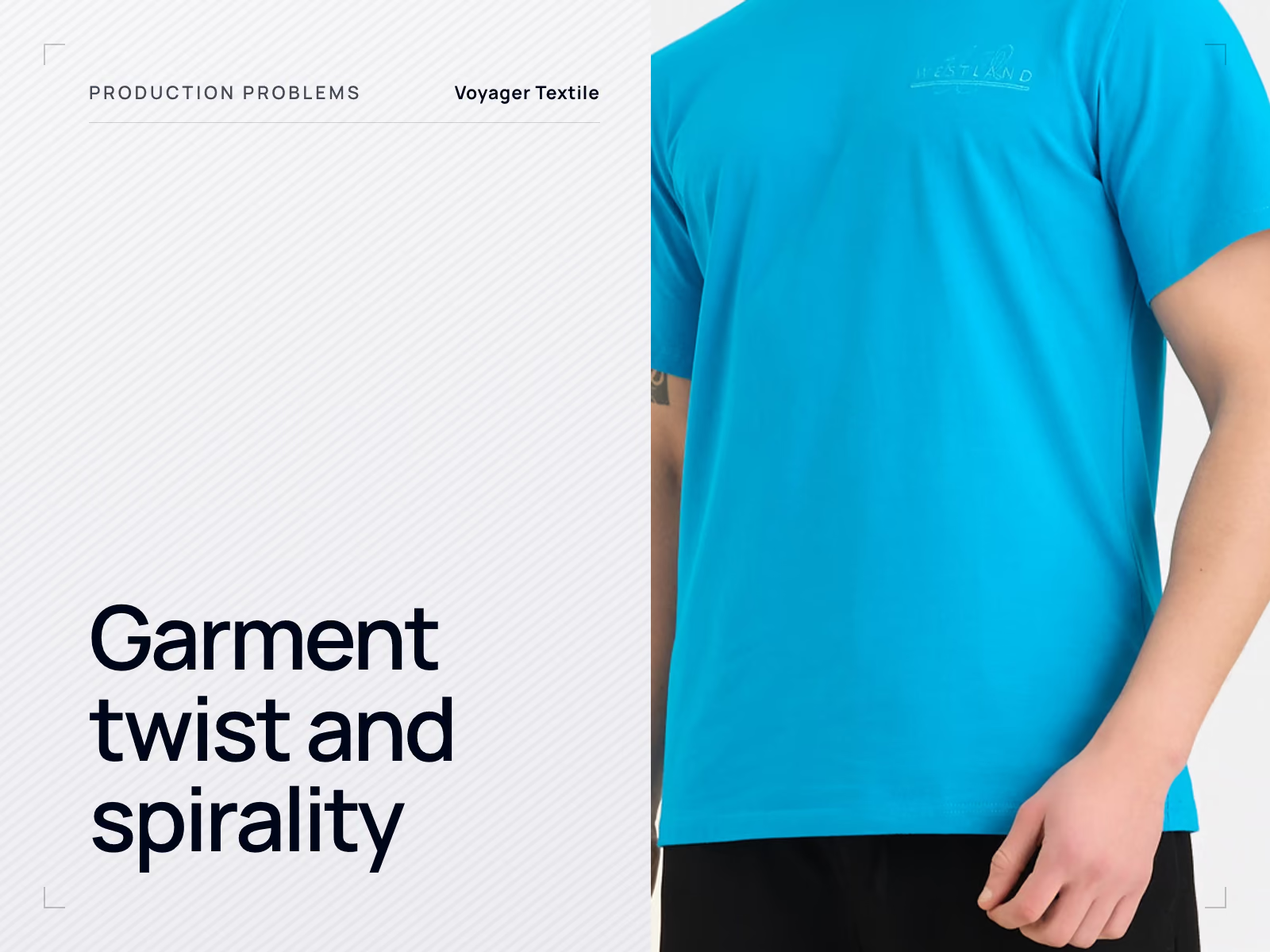
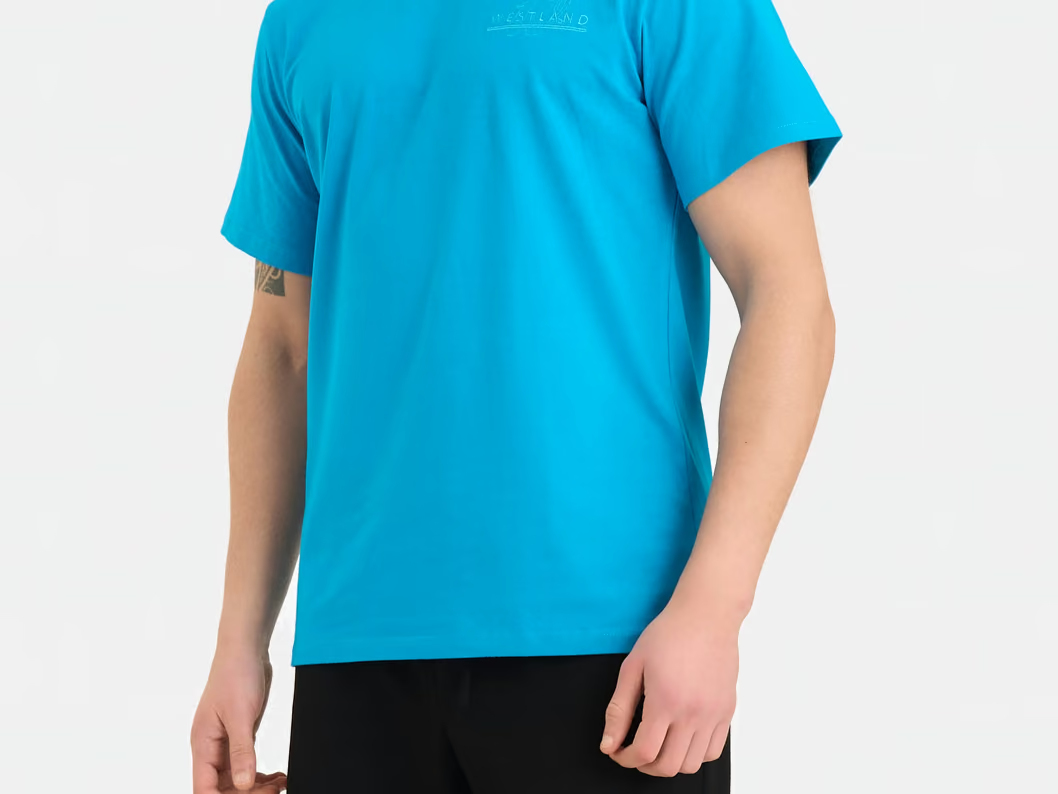
After the first or second wash, the side seams have rotated around the body so that a seam which was straight down the side now runs towards the front or the back. Both seams move in the same direction, and the effect is usually more visible at the hem than at the armhole.
Contents
Spirality is one of the few defects that is genuinely invisible at final inspection and obvious to the customer. The garment leaves the factory measuring correctly with straight side seams, and the fault appears the first time it is washed and dried. That timing is the clue to the mechanism, because it points at the fabric relaxing rather than at anything that happened at the sewing machine.
What is actually happening in the fabric
Yarn is spun with twist, and that twist stores energy. When the yarn is knitted into loops, the twist is held in place by the structure. Washing and drying release the fabric from that restraint: the yarn tries to untwist, the loops skew, and the whole fabric develops a diagonal bias. In a finished garment, that bias shows up as the side seams rotating around the body, which is also why the fault presents differently on a body built without side seams, as described in tubular and side-seam construction.
Textile research consistently attributes the effect primarily to this residual torque, and identifies the variables that make it worse: finer yarns hold proportionally more twist for their diameter, and slacker structures with a longer stitch length give each loop more freedom to rotate. A tighter knit restricts loop movement and reduces spirality; a loose, light single jersey in a fine count is among the most exposed constructions.
This is also why single jersey is affected more than interlock or rib. Double-faced structures balance the forces between the two faces, while single jersey has nothing to oppose the torque.
Confirm it is spirality before blaming the fabric
Three different faults produce a garment that looks twisted, and they have completely different owners. Work through them in this order.
| Possible cause | How it presents | How to confirm |
|---|---|---|
| Spirality | Straight before washing, twisted after. Both side seams rotate in the same direction, consistently across the order | Compare an unwashed piece with a washed one from the same carton. If the unwashed garment is straight, the fabric is relaxing |
| Off-grain cutting, described in the cutting room | Twisted from the start, before any washing, and often inconsistent between bundles or sizes | Lay an unwashed garment flat and check whether the side seam is already displaced. Check whether only some bundles are affected |
| Pattern or assembly | A consistent displacement present from the start, the same on every piece, often with one seam affected more than the other | Measure the sealed approved sample. If the approved sample shows the same displacement, the pattern is the source |
Where it can be controlled
Every effective control sits upstream of the sewing room, which is the uncomfortable part of this defect: by the time a garment exists, the outcome is largely fixed.
- Yarn structure. Plied yarns balance twist between the strands and are substantially less prone to spirality than single yarns. Where a single yarn is used, plaiting and twist-balanced yarns reduce the effect.
- Alternating twist direction. Arranging S-twist and Z-twist yarn packages alternately on the knitting machine lets the opposing torques cancel, and this is one of the more effective mill-level measures available.
- Fabric tightness. A shorter stitch length and a tighter structure restrict loop rotation. It also makes the fabric heavier and firmer, so it is a product decision as well as a technical one.
- Finishing. Compacting mechanically pre-shrinks and stabilises the fabric before it reaches the cutting table, and it reduces both shrinkage and skew. Heat setting stabilises synthetic and blended fabrics in the same way.
- Cutting direction. Research indicates that cutting all panels in the same direction can reinforce the skew, while opposing directions can partly cancel it. This is a mitigation rather than a cure, and it has to be agreed with the factory rather than assumed.
None of these can be applied retrospectively. If a fabric has been knitted from a single yarn in a slack structure and finished without compacting, the spirality is in the roll before anyone cuts it.
How to specify and measure it
Spirality is measurable, which means it can be specified rather than argued about. The standard reference method is AATCC TM179, which determines skewness change in fabrics and twist in garments after repeated home laundering, using benchmarks applied before washing. It is worth knowing that the method itself notes that garment twist is not purely a fabric property: the way the garment is assembled contributes as well, which is exactly why the differential diagnosis above matters.
For a programme where twist would be commercially damaging, the practical approach is to test the fabric before bulk, agree a maximum acceptable twist after a stated number of wash cycles, and write it into the specification alongside shrinkage. Specifying it is what turns it from a complaint into a pass or fail.
Preventing it on the next order
What the buyer should specify
- That a wash test is required on the sample, with the wash and dry conditions stated
- An acceptable twist limit after washing, tested to a named method
- Yarn quality, including whether a plied or twist-balanced yarn is required
- Fabric structure and target weight, since a slack light jersey is the highest-risk choice
- Whether the measurement chart applies before or after washing
What the factory controls
- Fabric approval, including checking skew on the incoming roll
- Relaxation before spreading, so the fabric is not cut under tension
- Cutting direction consistency across panels
- Compacting and finishing specification with the mill
- Flagging at fabric selection that a chosen construction carries this risk
What this means commercially
Spirality is a clear example of a fault where the cheapest fabric is not the cheapest decision. A fine, slack, single-yarn jersey is inexpensive per kilogram and carries the highest twist risk, and the cost of the difference appears months later as returns rather than at quotation. If a programme is price sensitive and also sold to end consumers who will wash it weekly, the fabric conversation deserves more time than the sewing conversation.
The garment-level context, including where relaxation and cutting sit in the sequence, is in the T-shirt manufacturing process. Fabric weight and structure choices are covered in the GSM guide and the knitted versus woven guide.
Questions this raises
Can twisting be fixed after the garments are made?
No. Pressing will hide it temporarily, and the twist returns at the next wash because the torque is still in the yarn. The only real remedies are upstream, at yarn selection, knit structure, finishing and cutting.
Is spirality a manufacturing defect or normal fabric behaviour?
Both, depending on degree. Some skew is inherent to single jersey. It becomes a defect when it exceeds a limit that was agreed before production, which is why the limit should be specified and tested rather than left to judgement.
Do heavier T-shirts twist less?
Usually, but weight is not the reason. Heavier jerseys tend to be knitted tighter with coarser yarns, and it is the tighter structure and coarser yarn that restrict loop rotation. A heavy but slackly knitted fabric can still twist.
Why did the same fabric behave differently on a previous order?
Because yarn lot, knitting tension and finishing can all change between fabric productions even under the same article number. If a previous order was acceptable, ask for the new fabric to be tested against the retained sample before cutting.
Developing a jersey programme and want to avoid this?
Send the fabric you are considering, or the intended weight and use. We will flag whether the construction carries a twist risk and propose a wash test before bulk rather than after it.
Discuss a fabric specification