

Hotel and Corporate Uniforms from Turkey for GCC Buyers
Voyager Textile manufactures hotel and corporate uniforms in its own factory in Türkiye for hotel groups, pre-opening teams, companies and uniform suppliers in the UAE, Saudi Arabia and the other GCC states. Every department's garments are made to one specification in the property's colours, from 300 pieces per colour and per style, with a sample in 5-7 business days and bulk production typically in 4-5 weeks after sample approval.
Last reviewed:
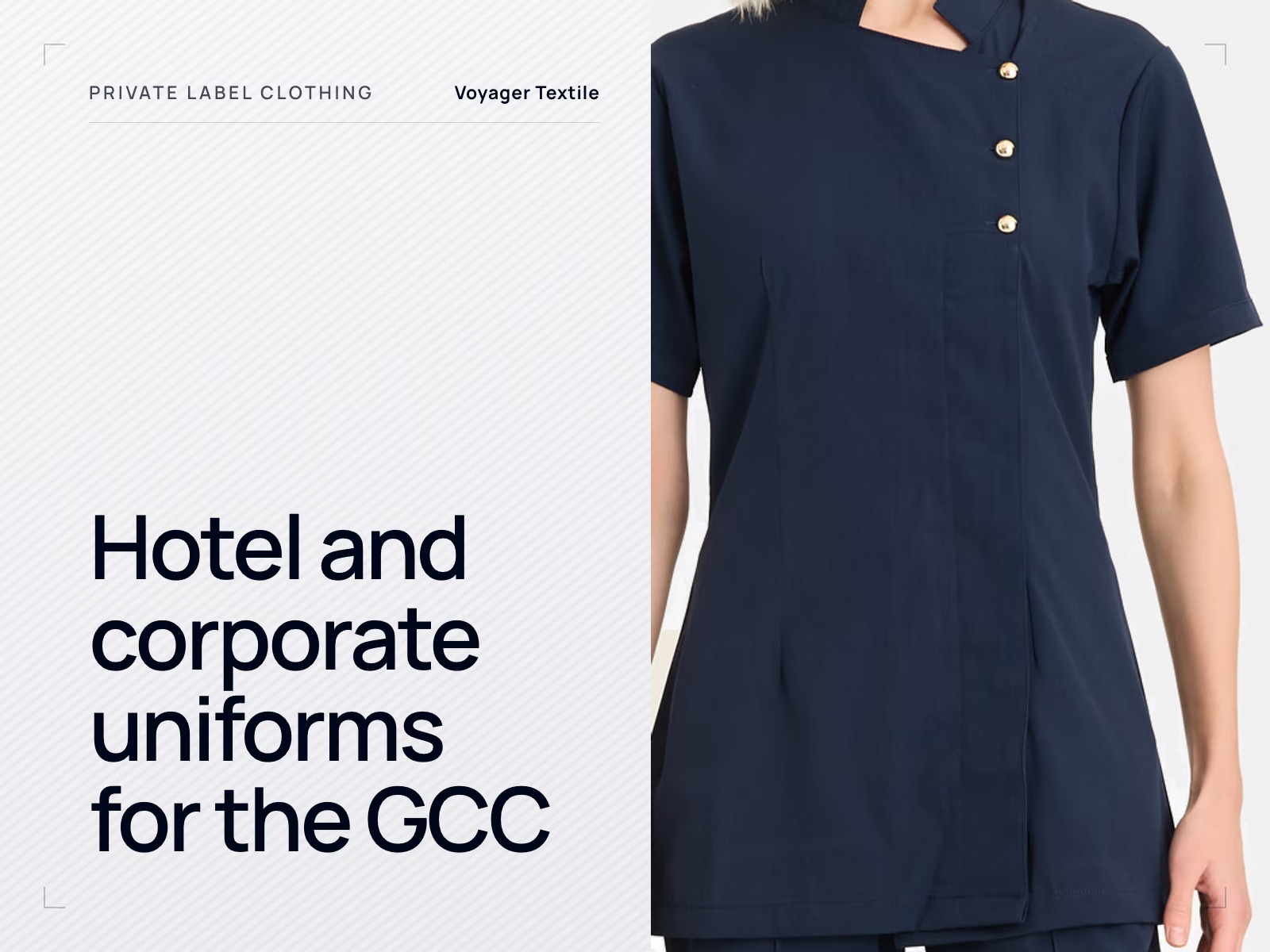
Contents
- What a hotel uniform programme from Turkey covers
- Hot-climate fabrics for uniforms in the Gulf
- Covered cuts for uniforms in the GCC
- One programme for every hotel department
- Opening calendar: planning uniforms for a new hotel
- Shipping uniforms from Turkey to the UAE and Saudi Arabia
- For uniform suppliers and distributors in the UAE and Saudi Arabia
- Reorders and multi-year uniform programmes
- Questions this raises
Voyager Textile makes hotel and corporate uniforms in its own factory in Türkiye, for buyers in the United Arab Emirates, Saudi Arabia and the other Gulf Cooperation Council (GCC) states: hotel groups and pre-opening teams, company purchasing departments, and the uniform suppliers who equip hotels and companies in the region. Every garment is made to the buyer's design; there are no stock styles. The minimum is 300 pieces per colour and per style, a sample takes 5-7 business days, and bulk production typically takes 4-5 weeks after sample approval. Goods ship from Türkiye for each order; Voyager has no office, warehouse or stock in the Gulf.
What a hotel uniform programme from Turkey covers
A hotel uniform programme coordinates colour standards, branding and size designations across departments. Garment measurements and label content are specified for each style to combine a consistent appearance with the needs of each role. The same approach applies to corporate uniforms for offices, retail, events and service teams, which are covered garment by garment on the corporate clothing page. The table shows the usual garments per hotel department and where the construction detail is.
| Department | Usual garments | Points to specify | Detail |
|---|---|---|---|
| Front of house: reception, concierge, guest relations | Shirts and blouses, trousers and skirts, waistcoats (vests); tailored jackets are confirmed per project at the quotation stage | One colour matched across woven fabrics, sleeve and hem lengths, name-badge position | Shirt manufacturing, trousers, vests and gilets |
| Food and beverage service | Shirts, waistcoats, polo shirts, aprons | Apron length and pockets, a stain-release finish as a technical option | Apron manufacturing, polo shirts |
| Housekeeping | Tunics, polo shirts, trousers, aprons | Room to bend and lift, pocket layout, a fabric that holds colour through frequent hot washing | Uniform manufacturing |
| Kitchen | Chef jackets, kitchen trousers, aprons | Closures, sleeve length, the hygiene rules of the site | Food-industry workwear |
| Spa and fitness | Tunics and trousers, polo shirts, T-shirts | Soft hand, light colours checked for opacity | Tunic construction as in medical scrubs |
| Security | Shirts or polo shirts, work trousers, an outer layer for cooler nights | Pockets, reinforced seams, epaulettes as an option | Trouser manufacturing |
| Engineering and maintenance | Work trousers, work jackets, coveralls (overalls) | Knee-pad pockets, tool pockets, durability in industrial laundering | Private label workwear |
Hot-climate fabrics for uniforms in the Gulf
Select fabric for the role, working conditions and laundering requirements. Lightweight or more open structures are options to assess alongside opacity and durability, with the choice confirmed per project at quotation. The weights below are indicative ranges from the site's fabric pages; the fabric for each garment is fixed on the approved sample.
| Fabric option | Indicative weight | Typical use | Trade-off |
|---|---|---|---|
| Single piqué, cotton or cotton-polyester | Around 160 to 190 g/m² | Polo shirts for housekeeping, spa, security and events | Can be more open than double piqué at 190 to 220 g/m²; compare airflow and shape retention on the actual fabrics |
| Polyester-cotton twill | Commonly offered around 195 to 300 g/m²; the lighter end for hot climates | Trousers, kitchen and housekeeping garments | Check colour and dimensional stability under the required laundering conditions; cotton-rich blends can crease more |
| Performance polyester knits, such as bird-eye | Around 130 to 180 g/m² for bird-eye and honeycomb structures | Outdoor roles: pool, beach, valet, events | Can dry quickly, but light shades need an opacity check and the fabric is sensitive to hot ironing |
| Woven shirting, cotton or polyester-cotton | Confirmed per project at the quotation stage | Front-of-house shirts and blouses | Polyester-cotton can retain a pressed appearance longer; compare comfort on the actual fabrics, including weave, weight and finish |
| Linen and linen blends | Confirmed per project at the quotation stage | Resort and outdoor service wear | Cool to wear, but creases readily and needs care instructions staff can follow |
Heat and sweat change what should be tested. Specify colourfastness to perspiration (ISO 105-E04) and to washing (ISO 105-C06), dimensional change after washing and drying (ISO 6330 with ISO 5077) and pilling (ISO 12945-2) in the order, as explained in colourfastness. A fabric sold as cooling or breathable should come with test data; thermal and water-vapour resistance are measured under ISO 11092. Blends and their trade-offs are compared in cotton-polyester blended fabrics.
Covered cuts for uniforms in the GCC
Covered cuts provide the coverage specified in the buyer’s dress code. Sleeve length, garment length, ease and neckline are pattern decisions approved on the sample and graded across sizes. Options include:
- Long sleeves on shirts, blouses and tunics, with three-quarter sleeves as an option for kitchen and housekeeping roles.
- Longer tunic and blouse lengths that cover the hip, with side vents so staff can move and bend.
- More ease through chest and hip, so the garment does not cling in heat, graded to your own size chart.
- Full-length trousers for all roles, and skirts at mid-calf or ankle length where skirts are part of the design.
- Higher necklines and collars that sit correctly with a head covering worn by the staff member.
- Opaque fabrics in light colours, checked on the sample in the colour that will be produced.
Women's and men's garments are made on separate patterns where specified, and a size-set fit check can be agreed before bulk. How patterns and size charts are built is in pattern making and size grading, and the fit trial in garment fit development.
One programme for every hotel department
Use a shared brand-colour reference, such as Pantone TCX, and approve the colour on each fabric. Coordinate branding across departments while defining garment measurements, label content and packing instructions for each style. How colour is held across different fibres is in Pantone colour matching.
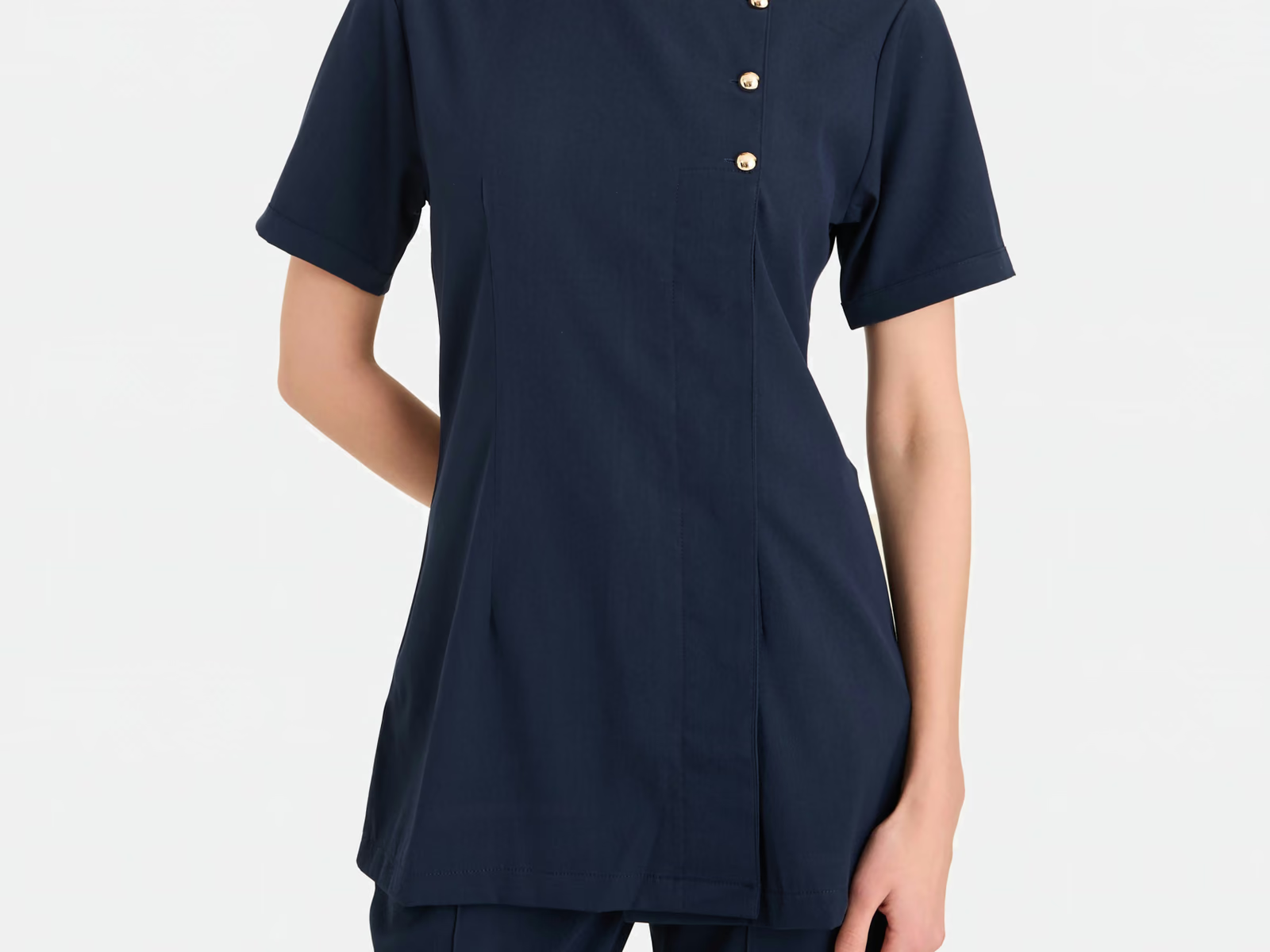
The minimum of 300 pieces per colour and per style applies to each garment in the programme, and sizes can be split inside the 300. A style worn in several departments counts once, so sharing one polo shirt or one trouser between housekeeping, spa and security helps smaller teams reach the minimum. Packing can be per department, per employee or per property, with the labels and carton marks described in clothing labels and packaging.
Opening calendar: planning uniforms for a new hotel
Plan uniforms backwards from the date staff need them, including pre-opening training where applicable. The stages in order:
- Headcount per department and staff sizes, collected against the size chart that will be used for the programme.
- Design, fabric choice and lab dips for any custom colour.
- A sample of each style: 5-7 business days.
- Sample approval and the agreed size-set fit trial: allow time for fitting, any revisions and the buyer’s review.
- Bulk production: typically 4-5 weeks after sample approval, in calendar weeks.
- Shipping from Türkiye, customs clearance in the destination country and distribution to staff.
Development, sampling and shipping come on top of the 4-5 weeks of bulk production. Pre-opening teams usually recruit in waves, so plan a top-up order for later hires; it is a new production run and meets the minimum of 300 per colour and per style again. The stages and what controls each are in apparel production lead times, and a dated plan for the whole order in the time and action calendar.
Shipping uniforms from Turkey to the UAE and Saudi Arabia
Uniforms ship from Türkiye under the Incoterm agreed in the quotation, which allocates responsibility for import clearance and costs. Voyager prepares the commercial invoice, packing list and export documents, and a certificate of origin where the importer requires one; routes and terms are in shipping apparel from Turkey.
The GCC states apply the Common Customs Law of the GCC States. Under its Article 27, every customs declaration is accompanied by a detailed original invoice, and customs may ask for an Arabic translation of invoices issued in another language; under Article 25, imported goods are subject to proof of origin under the rules of the agreements in force. Dubai Customs lists the commercial invoice, certificate of origin, packing list and bill of lading or air waybill among the documents for an import from outside the GCC, lodged by a registered importer or an authorised customs broker. Customs duty is collected at the first point of entry into the GCC, and garments are classified under the GCC Unified Customs Tariff; the duty for each garment depends on its tariff code and is confirmed by the importer. How origin and classification relate is in apparel country of origin.
Import VAT is charged on top of customs duty. In the UAE, Federal Decree-Law No. 8 of 2017 on Value Added Tax sets a standard rate of 5% on supplies and imports and makes the importer responsible for the tax. In Saudi Arabia, the Zakat, Tax and Customs Authority (ZATCA) states in its Guideline on Imports and Exports under VAT Provision that the standard import VAT rate is 15%, subject to applicable exemptions. The tax is calculated on the customs value plus customs duty and other charges.
Saudi Arabia: the SASO textile regulation and SABER
Clothing on the Saudi market falls under the Technical Regulation for Textile Products issued by the Saudi Standards, Metrology and Quality Organization (SASO), which covers products with at least 80% textile fibre by weight. The label has to be sewn or firmly fixed to the garment and written in Arabic, with another language allowed alongside it. It gives the fibre names with their mass percentages, the size, the country of origin and the care information, and the outer packaging carries the supplier's name and commercial registration.
The supplier placing the product on the market needs a certificate of conformity from a body accepted by SASO: Type 1a under ISO/IEC 17067 for textile products other than underwear and products for children under 36 months, which need Type 3. The product also needs a technical file with a supplier declaration of conformity and laboratory reports on hazardous chemicals. SASO's guide to the regulation describes registering products on the SABER platform and obtaining a shipment certificate for each consignment before it ships. Voyager sews labels to the Arabic and English content the buyer supplies and provides the fibre composition and care data for the technical file; how the regulation applies to a particular uniform order is confirmed per shipment with the buyer's importer.
The UAE and the other GCC states
Labelling, origin marking and conformity requirements for clothing in the UAE, Qatar, Kuwait, Bahrain and Oman are confirmed per shipment with the buyer's importer.
For uniform suppliers and distributors in the UAE and Saudi Arabia
Uniform suppliers and distributors in Dubai, Abu Dhabi, Riyadh, Jeddah and elsewhere in the region can use Voyager as their manufacturer: we make the garments to their design and label, and they sell, import and service the programme for their hotel and corporate clients. What that looks like in practice:
- Your brand or unbranded. Garments carry your woven labels, hangtags and Arabic label content, or are produced unbranded to your design (white label). Mandatory product information is still required on unbranded garments. The difference between the models is in OEM, ODM, private label and white label.
- Several clients, one factory. Define the colour standard and approved sample for each distinct style. The minimum is 300 pieces per colour and per style.
- Packing to your distribution. Per client, property, department or employee, with carton marks to your instructions.
- Documents for your importer. Commercial invoice, packing list and, where required, a certificate of origin for each shipment, plus the product data your importer needs for any conformity registration.
- Import arrangements. Agree responsibility for customs clearance and import costs under the quoted Incoterm, and confirm any SABER registration with the importer. Every order, including a reorder, is a new production run shipped from Türkiye.
- Communication. Directly with the production team, with a reply usually within one business day.
Reorders and multi-year uniform programmes
A hotel or corporate programme repeats the same garments for years, and new pieces are worn next to old ones. We keep the approved samples, patterns, colour standards and packing instructions on file, so each reorder is checked against the original references; how to keep colour and fit from drifting is in reorder consistency, and planning the programme as a whole in corporate apparel programmes. Certified materials (OEKO-TEX, GOTS, GRS) can be sourced where specified, subject to availability and certificate scope; a material certificate alone does not establish certification of the factory or finished garment.
Questions this raises
What is the minimum for custom hotel and corporate uniforms?
The minimum for custom hotel and corporate uniforms is 300 pieces per colour and per style, including custom Pantone colours. Sizes can be split inside the 300, and a style shared by several departments counts once. Polyester-based Pantone colours are assessed separately.
How long does it take to make custom hotel uniforms?
Custom hotel uniforms take 5-7 business days for the sample, and typically 4-5 weeks for bulk production after sample approval. Colour development, fit trials, shipping to the Gulf and customs clearance come on top of that.
Can you make hotel uniforms to our own design and label?
Yes. Hotel uniforms are made to your own design, colours and labels, with packing to your specification. There are no ready-made styles; the catalogue shows previous production, not stock.
Can you ship hotel uniforms from Turkey to Dubai or Saudi Arabia?
Yes. Hotel uniforms ship from Türkiye to Dubai, Saudi Arabia and the other GCC states under the Incoterm agreed in the quotation. Responsibility for import clearance, duty and import VAT in the destination country follows the agreed Incoterm.
Who pays import duty and VAT on uniforms shipped to the GCC?
Import duty and VAT on uniforms shipped to the GCC are paid by the importer, unless the Incoterm places them on the seller. Duty depends on the tariff code; the standard VAT rates are 5% in the UAE and 15% on Saudi imports.
Do uniforms for Saudi Arabia need Arabic labels?
Uniforms for Saudi Arabia need labels in Arabic under SASO's Technical Regulation for Textile Products; another language may appear alongside. Voyager sews labels to the content the buyer supplies, and the importer confirms the requirements per shipment.
Do you have a warehouse or stock in the UAE or Saudi Arabia?
No. Voyager has no office, warehouse or stock in the UAE, Saudi Arabia or elsewhere in the Gulf. Every order is produced in Türkiye and shipped to the buyer's importer.
Planning uniforms for a hotel or a client in the Gulf?
Send the departments, garments, brand colours, logo files and headcount by size if you have it, with the opening or roll-out date. We usually reply within one business day.
Start an RFQContinue with
- Jacket Manufacturer in Turkey: Softshell, Puffer, Fleece, Windbreaker and Bomber Jackets
- Tracksuit Manufacturer in Turkey: Track Jackets, Fleece Sets and Windbreaker Sets
- Private Label Workwear Manufacturer in Turkey: Work Trousers, Jackets and Polos for Brands, Distributors and Company Programmes
- Medical Scrubs Manufacturer in Turkey: Private-Label Scrub Sets
- Shorts Manufacturer in Turkey: Sweat, Sports, Work and Woven Shorts Made to Your Design
- Sublimated Teamwear Manufacturer in Turkey: Football Kits, Training Wear and Club Programmes
- Private Label Activewear and Leggings Manufacturer in Turkey
- Polo Shirt Manufacturer in Turkey: Piqué, Corporate and Private-Label Polos
- Hoodie and Sweatshirt Manufacturer in Turkey: Heavyweight, Oversized and Zip Hoodies
- T-Shirt Manufacturer in Turkey: Regular, Heavyweight and Oversized T-Shirts
- Promotional Textiles Manufacturer for Distributors: Own-Brand T-Shirts, Polos, Sweatshirts and Hoodies Made in Turkey
- Corporate Clothing Manufacturer: Corporate Fashion Collections Made in Turkey in Your Brand Colours
- Custom Merch Manufacturer in Turkey: Cut-and-Sew Hoodies, Sweatshirts, T-Shirts and Shorts for Brands, Artists and Companies
- Full-package vs CMT apparel manufacturing
- Manufacturing clothing from a reference garment