Compliance and shipping
How Is the Country of Origin of Clothing Determined?
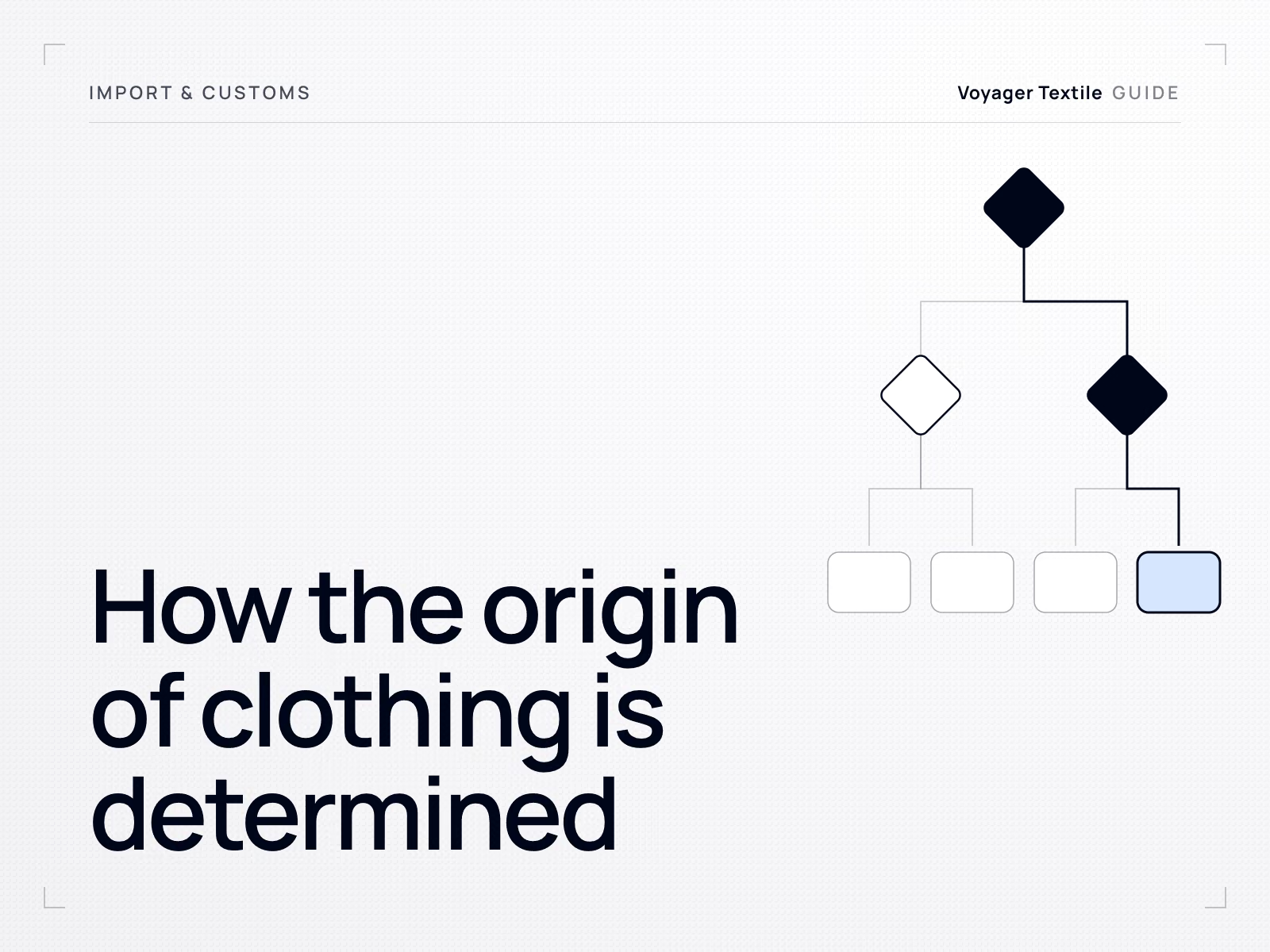
Customs origin is decided by a specific rule applied to a specific tariff heading, not by the address of the factory. For most finished garments the EU rule turns on complete making-up, which is why imported fabric does not automatically prevent origin being acquired where the garment was made, and why importing a finished garment and decorating it does not automatically confer origin either.
Contents
- Five questions that get treated as one
- The rule the EU actually applies
- Classification chooses the rule
- What complete making-up actually says
- Knitted and woven garments split on different criteria
- What a production route means in practice
- Operations that never confer origin
- When the primary rule is not met
- Evidence, and what a document cannot do
- "Made in Türkiye" on the label
- Before accepting an origin claim
- Questions buyers ask
Five different things routinely get spoken about as though they were one: where the factory is, what the customs origin is, whether the goods qualify under a trade agreement, what customs status they hold, and what the label says. They have different rules, different documents and different answers, and a buyer who treats them as interchangeable will eventually be wrong about at least one.
Confirm product classification, origin and documentation with your customs representative for the destination market and date of import.
Five questions that get treated as one
Different questions, different rules
Each row is answered by a different body of rules. Answering one of them says nothing about the other four.
This guide is about the second row: non-preferential origin, which the Türkiye Ministry of Trade describes in its own guidance as the economic nationality of goods. It is what a customs declaration records, and it is the origin that trade-policy measures and trade statistics run on. The fourth row, customs status, and the movement certificate that evidences it, is a different subject and is covered in what an A.TR certificate actually proves.
The rule the EU actually applies
The Union Customs Code sets out two situations. Goods wholly obtained in a single country originate there, a category built for harvested crops, mined minerals and animals, which no manufactured garment falls into. Everything else is the second situation.
That is a part many explanations miss. For goods on the delegated regulation's list, the goods are considered to have undergone their last substantial processing in the country in which the rules set out in that list are fulfilled, or which those rules identify. Apparel is on that list. So the question is never really whether sewing feels substantial; it is whether the specific rule for that specific garment is met.
Classification chooses the rule
The list is organised by tariff heading, so the garment has to be classified before its origin rule can even be identified. Two products that look similar on a line sheet can sit in different headings and take different rules, and getting the heading wrong means applying the wrong test from the start.
This guide does not attempt to teach classification, which is a separate discipline with its own binding-ruling procedure. What matters here is the dependency: classification first, then the origin rule. One point of housekeeping is worth knowing, the apparel tables in the delegated regulation are set out against an earlier Harmonised System edition, and the Commission maintains updated working versions of the list rules, so the version in force at the relevant time is the one to work from.
What complete making-up actually says
For most finished garments the applicable rule is complete making-up, and the list's own introductory notes define it. The definition is short and repays reading closely, because many summaries of it are wrong in one direction or the other.
Read that first half carefully. The operations the rule requires are the ones that come after cutting. That drafting is why imported fabric does not, by itself, stand in the way: the rule is not asking where the cloth came from, it is asking where the garment was made from it. It is also why the second half matters commercially, a garment that was made up but not, say, finally pressed or packed elsewhere has not automatically failed the test.
Knitted and woven garments split on different criteria
Both apparel chapters use split headings, and the splits are not built the same way. This is a detail that often gets flattened into one wrong sentence.
| Chapter | Split | Primary rule |
|---|---|---|
| 61, knitted or crocheted | Obtained by sewing together or otherwise assembling two or more pieces of knitted or crocheted fabric, cut to form or obtained directly to form | Complete making-up |
| 61, knitted or crocheted | Other | Manufacture from yarn |
| 62, not knitted or crocheted | Finished or complete | Complete making-up |
| 62, not knitted or crocheted | Unfinished or incomplete | Manufacture from yarn |
So a knitted garment is sorted by how it was constructed, and a woven garment by whether it is finished. A T-shirt, a polo, a sweatshirt or a hoodie assembled from cut panels sits on the complete making-up side of the knitted split. A finished pair of trousers or a finished jacket sits on the complete making-up side of the woven split. Neither of those is a general statement about the whole chapter, and the heading has to be checked rather than assumed.
What a production route means in practice
The route, and where the rule enters it
Conceptual sequence, not a determination for any particular garment. The rule is chosen by classification, not by which stage feels most important.
A useful thing a buyer can do is stop asking who made it and start asking what happened where. Each of the stages above can sit in a different country, and the answer emerges from applying the right rule to that map, not from the address on the invoice.
Five familiar situations, and what each one really asks
No scenario is given an origin here. The classification and the actual facts settle each one.
Two of those deserve saying plainly, because the intuitions run in opposite directions and both intuitions are unreliable. Imported fabric does not prevent a garment acquiring origin where it was made, because the applicable rule for finished garments is about the making-up rather than the cloth. And importing a finished garment and decorating it does not confer origin: the main garment-manufacturing operation already happened elsewhere, and printing, embroidering or relabelling does not undo that. Neither observation is a conclusion about a specific product.
Operations that never confer origin
The delegated regulation lists operations that are not substantial, economically-justified processing for origin purposes, whatever else they cost or however long they take. The apparel-relevant ones are worth knowing by heart.
- Affixing marks, labels or other similar distinguishing signs on products or their packaging
- Changes of packing, breaking up and assembling consignments, and other simple packaging operations
- Putting goods up in sets or ensembles, or putting them up for sale
- Simple assembly of parts of products to constitute a complete product
- Operations to preserve products during transport and storage, and operations facilitating shipment
- Simple sorting, classifying, matching, screening and washing
- Any combination of the above
There is a related provision on processing that is not economically justified: where the facts establish that the purpose of carrying out an operation in a particular country was to avoid trade-policy measures, that operation does not count, and for listed goods the chapter's residual rule applies instead. This guide explains that the provision exists and does not explore how to work around it.
When the primary rule is not met
If the primary rule for the heading is not satisfied anywhere, origin does not simply default to the last country that touched the goods. Both apparel chapters carry the same residual rule: origin is the country in which the major portion of the materials originated, determined on the basis of the value of the materials.
That is a genuinely different test, and it is why a failed primary rule can produce an answer nobody expected, potentially the country the fabric came from rather than the country the sewing happened in. It applies only as a fallback, and treating a value-of-materials calculation as the main origin question is a common and expensive error.
Evidence, and what a document cannot do
Origin has to be declared, and where it has been indicated in a customs declaration the authorities may require the declarant to prove it, and may ask for further evidence in the event of reasonable doubt. The responsibility for getting it right sits with the declarant.
A certificate of origin is not a universal shipping requirement either. The Türkiye Ministry of Trade's own guidance states that issuing one on export is not mandatory and that it is issued where the importing country requires one for the goods in question. Assuming every consignment needs one, or treating the absence of one as a problem, both misread what it is for.
- Records that actually support a determination tend to be ordinary production documents: the bill of materials, fabric and yarn sourcing information, where cutting took place, the making-up sequence, any subcontracted processing and where it happened, and finishing.
- What is needed varies by case. There is no universal origin evidence pack, and inventing one would be as unhelpful as having none.
- Subcontracting matters. If part of the origin-conferring work happened in another country, the analysis changes, the location of the main contract is not the question.
Where the answer genuinely matters and the facts are awkward, pre-cut panels, split processing, a product near a classification boundary, there is a formal route. Binding Origin Information is a decision by an EU country's customs authorities on the preferential or non-preferential origin of goods. It binds the trader who holds it and all EU customs authorities, and a trader can usually hold and benefit from one for up to three years. It applies to the goods and circumstances it describes, which is exactly what makes it useful and exactly why it is not a general certificate.
"Made in Türkiye" on the label
This is a different question again, and the answer surprises many buyers: EU textile labelling law does not require a country-of-origin statement. The textile regulation governs fibre names and the labelling of fibre composition, and the Commission's own guidance on it confirms that origin labelling is not among its requirements while economic operators may state the country of origin provided the information is not misleading.
That leaves the practical question of what a factual claim should be anchored to. Customs origin is determined under the customs rules described above; a consumer-facing claim is voluntary under the textile regulation but constrained by the misleading-practices rules. The customs determination is the obvious defensible reference point for a factual origin claim about the same goods, and where a business needs certainty about that relationship it is a legal question rather than a sourcing one.
Things that do not determine origin
Commercial facts
- The brand's nationality
- Which company issues the invoice
- Whether the programme is private label
- Whether the arrangement is called OEM or ODM
- The delivery term agreed
Product and paperwork facts
- Where the goods were warehoused or transited
- Where the label or hangtag was attached
- The fibre composition on the label
- A material or certification scheme document
- The legal manufacturer named under product-safety law
A German brand does not make a German-origin garment, and an invoice from a Dutch company does not make a Dutch one. A delivery term allocates transport, cost and risk between seller and buyer and settles nothing about origin, see payment terms and Incoterms. *Designed in* somewhere is a separate factual claim about design, and it neither creates nor implies origin; if both statements appear on a garment, each has to be independently true.
Before accepting an origin claim
Twelve things to establish
An operational checklist for interrogating a claim, not a determination. Several of these questions are properly answered by a customs broker or authority rather than by a supplier or a buyer.
- Classify the finished garment, because the heading selects the rule
- Identify which regime the question is about, non-preferential origin, a preferential agreement, or a labelling claim
- Map every country involved in production, not just the last one
- Establish the status of the inputs: yarn, fabric, or already-cut panels
- Establish where cutting took place, or where knitting to shape took place
- Establish where the making-up was performed, and how much of it
- Establish where finishing happened, and whether anything was subcontracted abroad
- Apply the primary rule for that heading and split, rather than a general impression of substantiality
- Consider the minimal-operation list, and the residual rule if the primary rule is not met
- Identify what evidence actually supports the determination, and whether it exists
- Treat customs status and any movement document as a separate question
- Review any consumer-facing origin wording separately again, against the misleading-practices standard
One closing caution that applies to the whole exercise. These are the EU's non-preferential rules. The Commission itself notes that third countries may apply different non-preferential rules, so a determination made for an EU import is not automatically the garment's origin everywhere in the world. A single answer marketed as universal is one of the clearer signs that the analysis has not been done.
Questions buyers ask
How is the country of origin of clothing determined in the EU?
By applying a specific rule to a specific tariff heading, not by looking at where the factory is. Since a garment is never wholly obtained in one country, the applicable test is where it underwent its last substantial, economically-justified processing, and for goods on the EU's list of product-specific rules, that means the country where the rule for that heading is fulfilled. For most finished garments the rule is complete making-up.
Does sewing a garment in Türkiye make it Turkish origin?
Not automatically, and not because of the address. What matters is whether the applicable rule for that garment's heading is satisfied there. For a finished garment assembled from cut pieces, the rule is generally complete making-up, which asks whether all the operations following cutting were performed in that country. Sewing is usually the bulk of those operations, but the determination depends on the heading, the split within it and what was actually done and where.
Can clothing made from imported fabric still have Turkish origin?
Potentially yes, for EU non-preferential purposes. The complete making-up rule that applies to many finished apparel headings is concerned with the operations following cutting rather than with where the fabric came from, so imported cloth does not by itself stand in the way. That is not a blanket answer: the classification and the actual manufacturing route still have to be checked, and a different split within the heading can bring a manufacture-from-yarn rule into play instead.
If panels are cut abroad and only sewn in Türkiye, what is the origin?
There is no categorical answer, and anyone offering one quickly has not read both relevant provisions. The complete making-up definition is drafted around the operations following cutting, which points one way; the separate list of operations that never confer origin includes simple assembly of parts to constitute a complete product, which points another. Which applies depends on the heading, the split and what the work actually involved. This is exactly the situation Binding Origin Information exists for.
Does printing or embroidering an imported blank T-shirt in Türkiye change its origin?
It should not be assumed to. A finished blank has already undergone the garment-manufacturing operations that the applicable rule is about, and decoration applied afterwards does not undo that. Affixing marks and labels is expressly listed among operations that do not confer origin. The conclusion still has to come from applying the rule for the product's heading rather than from the fact that a process happened in a particular country.
Does sewing in a Made in Türkiye label change the origin?
No. Affixing marks, labels or similar distinguishing signs is on the list of operations that are not substantial processing for origin purposes. A label states an origin; it does not create one, and putting one into a garment that originates elsewhere makes the statement wrong rather than making it true.
Is the fabric's origin the same as the garment's origin?
No, and they are determined separately. Fabric has its own origin under its own rule, and the finished garment has its own. For many finished garments the rule turns on the making-up rather than on the origin of the cloth, so a garment can have fabric from one country and origin in another. The reverse is also true: locally produced fabric does not make a garment local if the origin-conferring work happened elsewhere. The only exception to that separation is the residual rule, which looks at where the major portion of the materials originated, and it applies only when the primary rule has not been met.
Are knitted and woven garments treated the same way?
No, and this is a useful detail in the subject. In the knitted chapter, the split turns on construction, whether the garment was obtained by sewing together or otherwise assembling two or more pieces. In the woven chapter, the split turns on whether the article is finished or complete. Both splits lead to complete making-up on one side and manufacture from yarn on the other, but they sort products by different criteria, so the same reasoning cannot be carried across.
Is country of origin required on EU textile labels?
The EU textile labelling regulation requires fibre composition information and does not itself impose a general country-of-origin labelling requirement. Businesses may state the country of origin voluntarily provided the information is not misleading. National requirements in a specific market can differ, so the destination is worth checking before treating that as an absolute answer for the whole EU.
Can we write Made in Türkiye voluntarily?
Voluntary does not mean unconstrained. The unfair commercial practices rules cover misleading claims about geographical or commercial origin expressly, so an origin statement has to be true and not liable to deceive. The customs determination for the same goods is the obvious reference point for a factual claim, and where the relationship between the two matters commercially it is a question for legal advice rather than for a sourcing decision.
Is Designed in Germany, Made in Türkiye allowed?
They are two separate factual claims and each has to be independently true. Design location says nothing about origin, and stating it does not make a garment German. The origin half has to be supportable on the origin rules in the ordinary way. Nothing here should be read as approval of any particular label wording.
Does the buyer's country or the brand's nationality affect origin?
No. Origin follows the manufacturing rules applied to the goods. A German brand, a Dutch importer, a private-label arrangement, an OEM or ODM description and the invoicing entity are all commercial facts that leave the origin analysis untouched. Delivery terms such as FOB, FCA or DDP allocate transport, cost and risk and settle nothing about origin either.
What is Binding Origin Information?
A decision by the customs authorities of an EU country on the preferential or non-preferential origin of specified goods. It binds the holder and all EU customs authorities, and is usually held and relied on for up to three years. It applies to the goods and circumstances described in it rather than acting as a general certificate, which is what makes it worth having for an awkward manufacturing route and what stops it being a Made in certificate.
Is an EU origin determination valid everywhere?
No. These are the EU's non-preferential rules, and the Commission notes that third countries may apply different ones. A determination made for an EU import is not automatically the garment's origin in another market, and preferential origin under any particular agreement is a further separate question with its own rules.
Tell us the route, not just the destination
What we can do is describe the actual production route accurately, where the fabric came from, where cutting happened, what was made up where, and what was subcontracted, which is the information any determination has to start from.
Discuss a programme