Choosing a manufacturer
Apparel Manufacturing in Türkiye: What Buyers Should Know
Türkiye has a domestic textile supply chain and road-freight connections to Europe that can support custom fabric development and repeat orders. Assess each programme through product-specific quotations, material availability and the supplier's capabilities. Compare total landed cost and delivery timing alongside unit price.
Contents
Compare the supply chain, delivery routes and trade conditions with the needs of your product. Then assess the individual factory's experience, capacity and quality controls. Voyager Textile manufactures in Türkiye.
The industry in outline
İHKİB's 2024 annual sector report, citing Turkish Exporters Assembly data, records approximately US$17.9 billion in ready-made clothing and apparel-sector exports for January–December 2024. EU countries accounted for 57.4% of that total.
The EU share shows the importance of European demand to the sector. It does not establish any individual factory's experience with your specifications, compliance documentation or communication requirements. Assess those capabilities directly, alongside the supplier's commercial stability.
An integrated supply base
Türkiye's domestic textile base spans several stages of the garment supply chain. Knitters producing jersey, interlock, piqué, terry and fleece; weavers producing bottom-weight and workwear cloths; dyeing and finishing capacity; and trim and label suppliers all operate domestically alongside the garment factories.
A domestic supplier network can reduce transport and coordination between the mill, dye house and garment factory. The benefit depends on material availability, development requirements and supplier schedules. Check these for both custom developments and programmes using stock fabrics rather than assuming local sourcing always shortens the lead time.
It is not total self-sufficiency. Technical laminates, some performance constructions and certain yarns are imported, as they are in most markets. A factory should say plainly which materials are domestic and which are not rather than implying that everything is local. The structures themselves are covered in the fabric references.
Distance, transit and what it changes
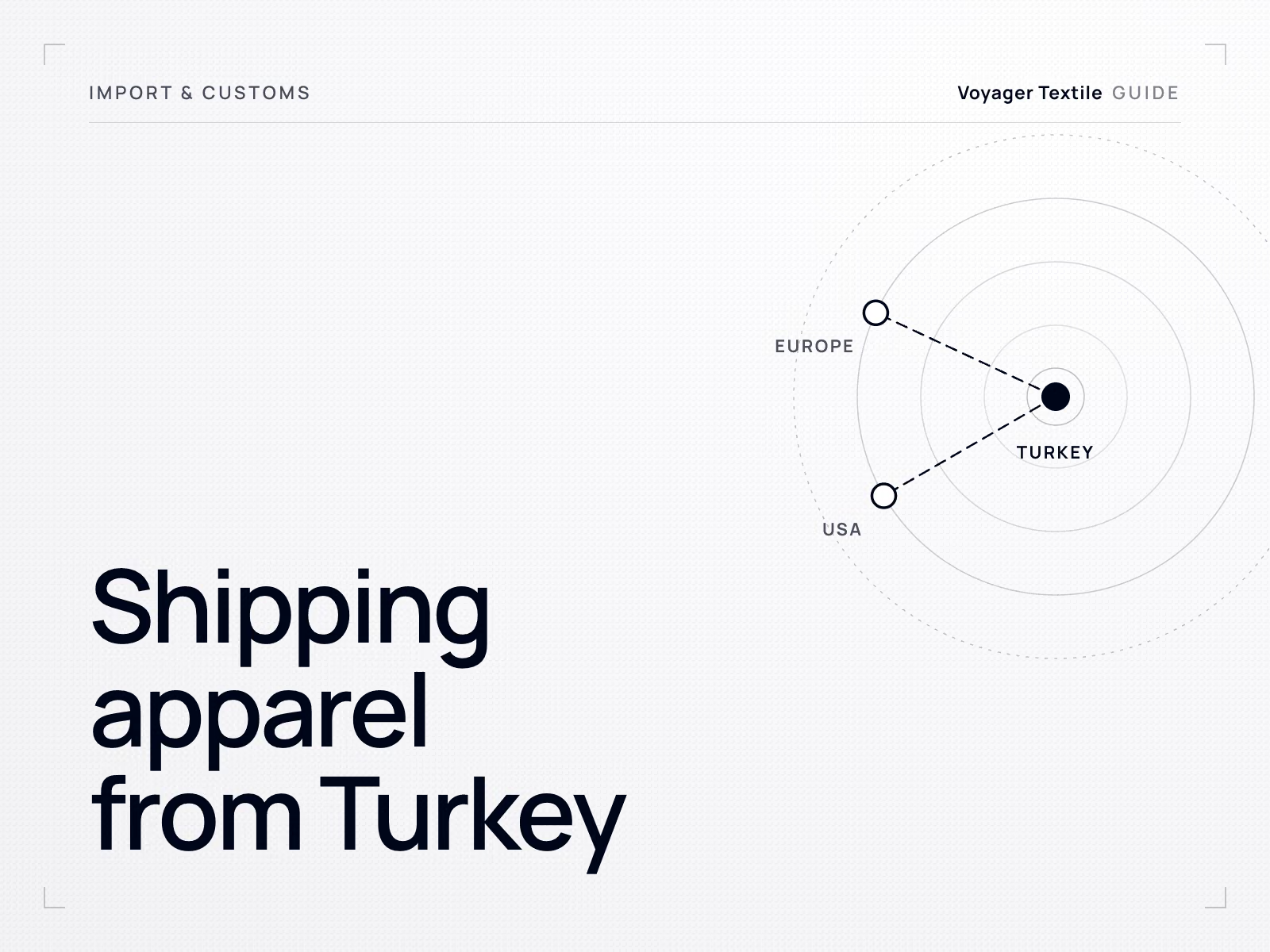
Road freight from Türkiye can offer shorter transit to European destinations than sea freight from more distant sourcing markets. Compare the actual route, service and customs-clearance time. For in-season reorders, include material availability and production lead time as well as freight transit in the delivery plan.
For US buyers, compare the actual sea or air route, service frequency and total delivery schedule. A connected domestic supply base may help development, but sampling and approval times depend on the product and supplier. The trade-offs against offshore sourcing are set out in Türkiye compared with China, and against another nearshore option in Türkiye compared with Portugal.
The trade framework
This is the part most worth verifying rather than assuming, because it is product specific and it changes.
- European Union. Industrial goods, including apparel, circulate free of customs duty between the EU and Türkiye under their customs union, provided the goods are in free circulation and the shipment is accompanied by an A.TR movement certificate. Import VAT and national charges still apply. The Commission publishes the framework through Access2Markets.
- United Kingdom. Preferential treatment here depends on origin rather than on free circulation, and how a garment's origin is determined is set out in country of origin for clothing. The UK has its own trade arrangement with Türkiye following its departure from the EU, and preferential treatment depends on rules of origin and correct documentation for the specific product. Confirm the position for your commodity code with your customs broker rather than assuming EU treatment carries over.
- United States. There is no free trade agreement, so apparel from Türkiye is a dutiable import, and additional tariff measures have changed repeatedly since 2025. Check the current rate for your exact classification in the Harmonized Tariff Schedule close to your shipping date. Duty-free de minimis treatment for shipments valued at or below 800 dollars was also suspended for all countries with effect from 29 August 2025.
The documentation side of a shipment, including Incoterms and who is responsible for what, is covered in the shipping guide.
Where Türkiye tends to be a good fit
- Programmes needing custom fabric or custom colour development, where local coordination between mill, dye house and factory can support development. Confirm the actual schedule.
- European brands reordering in season, when material availability, production and transport can meet the required delivery window.
- Mid-sized orders, where the chosen factory's minimum quantities, production setup and available capacity fit the programme.
- Products requiring detailed construction development, such as outerwear, uniforms and technical sportswear, where sampling and revisions are important to the programme.
- Buyers who want direct technical contact, where the factory offers access to the people responsible for development and production.
Where it may not be
- The lowest unit price on very large basic runs. Compare quotations from several sourcing markets on the same specification and quantity. Labour cost is one factor; productivity, materials, freight, duties and inventory costs also affect the comparison.
- Products depending on a specialist component ecosystem that is stronger elsewhere, particularly some technical hardware and unusual trims.
- Buyers who need one supplier for a very wide, fragmented range, which is a scale question rather than a country one.
- Programmes with no urgency and stable demand, where a long, cheap supply chain is a rational choice and speed is worth little.
Factories differ in product experience, equipment, capacity and quality controls. Country-level information helps identify sourcing options; evaluate each supplier against the requirements of the actual order.
Manufacturing outside the EU does not remove EU obligations from goods sold to EU consumers. Which party in the chain carries which of them is a separate question, set out in GPSR for apparel.
Due diligence still decides the outcome
Confirm the supplier's role, where production will take place and which operations are subcontracted. Check experience with your product type and capacity for your order. Review samples alongside the specification, relevant compliance documents and agreed inspection requirements.
The question set is in how to find a reliable clothing manufacturer in Turkey, and compliance claims in particular deserve the scrutiny described there: certified fabric, a certified garment and a certified factory are three different statements.
Voyager Textile in this context
Voyager Textile is a direct manufacturer and exporter based in Türkiye, producing private-label and custom garments to customer specification for buyers in Europe and the United States. Development, cutting, sewing, embroidery, transfer and sublimation printing, quality control and export preparation are handled in our own factory by a team of around 70 people, with screen printing and specialist raised printing run by established partner facilities under our project management. Capacity is approximately 100,000 pieces per month, and bulk production typically takes 4 to 5 weeks after sample approval. Custom apparel production starts at 300 pieces per colour and per style, including custom Pantone colours and all-over sublimation. Capacity is confirmed in the quotation for each project. Development, sampling and shipping time are additional. Pantone colour development on polyester is assessed separately.
Questions buyers ask
Is clothing manufacturing in Türkiye expensive?
Cost depends on the garment specification, quantity, materials and supplier. Compare quotations on the same basis, including freight, applicable duties and inventory costs, to assess the total cost of the programme.
Do goods from Türkiye enter the EU duty free?
Industrial goods including apparel circulate without customs duty under the EU and Türkiye customs union, provided the goods are in free circulation and the shipment carries an A.TR movement certificate. Import VAT and national charges still apply, and documentation should be confirmed with your forwarder for each shipment.
What about importing into the United States?
There is no free trade agreement, so apparel is dutiable, and tariff measures have changed repeatedly since 2025. Verify the current rate for your specific classification in the Harmonized Tariff Schedule near your shipping date, and note that duty-free de minimis treatment for shipments at or below 800 dollars was suspended for all countries from 29 August 2025.
How long does delivery from Türkiye to Europe take?
Transit time depends on the route, service and border procedures; confirm it with the carrier for the planned shipment. A short transit can support in-season reorders, provided material availability and production timing also fit the delivery window.
Can Turkish factories develop custom fabrics and colours?
This depends on the supplier and the requested fabric or colour. Ask which development stages are handled locally, which materials are imported, and what minimum quantity and lead time apply to the proposed specification.
Is 'Made in Turkey' clothing good quality?
The label identifies origin; assess quality against the specification, approved samples and inspection requirements. Customs documentation such as an A.TR establishes customs status, not garment quality. Check the supplier's product experience and quality controls alongside the relevant product-compliance documents.
What kinds of brands produce in Türkiye?
The brands that produce in Türkiye are mainly European fashion and retail labels, merch companies, promotional distributors, and corporate-wear and workwear buyers. Typical products are jersey tops, fleece, woven bottoms, outerwear, uniforms and sportswear, often where custom colour or in-season reordering matters.
What should buyers check when sourcing from Türkiye?
Check the factory's experience with your product, available capacity, quality controls and subcontracting arrangements. Assess the proposed materials, samples and delivery schedule against the order requirements. Country-level advantages do not establish whether a particular supplier can fulfil the order.
Assessing Türkiye for a specific programme?
Tell us the product, quantities and destination market so we can assess the production requirements for your project.
Discuss a sourcing question