Choosing a manufacturer
Turkey vs Portugal for Clothing Manufacturing
Portugal tends to suit smaller European runs, premium knitwear and brands that need an EU-internal supply chain. Turkey tends to suit wider product ranges, larger volumes and projects that need custom fabric or custom colour development. Both are nearshore options for Europe, and the right answer depends on your product, volume and market.
Contents
- The short comparison
- Cost: where the difference actually comes from
- Minimums: the practical difference for a new programme
- Lead time and logistics
- Product range: the factor buyers underestimate
- When Portugal is the better choice
- When Turkey is the better choice
- What about the UK and the United States?
- How to decide without guessing
- Questions buyers ask
Buyers usually reach this comparison after deciding that Asia is too far for their replenishment cycle. At that point Turkey and Portugal are the two serious nearshore options for the European market, and they are genuinely different rather than interchangeable. The honest summary is that Portugal is strongest at the smaller, premium, EU-internal end, and Turkey is strongest where volume, product breadth or material development matter. This guide sets out where each advantage actually comes from.
The short comparison
| Factor | Turkey | Portugal |
|---|---|---|
| Typical strength | Volume production, wide product range, custom fabric and colour development | Smaller premium runs, knitwear and jersey, finishing detail |
| Product breadth | Jersey, fleece, woven outerwear, workwear and uniforms, sportswear, home and promotional textiles | Strong in knitted tops, jersey and knitwear, with a narrower outerwear base |
| Minimum order quantities | Commonly a few hundred pieces per style, lower for some processes | Often lower for stock-fabric programmes, higher when custom fabric is involved |
| Unit cost at volume | Generally lower as quantities rise | Generally higher, with the gap narrowing on small runs |
| Fabric supply | Large domestic mill base for knits, wovens and dyeing | Strong domestic knit base, more imported fabric for other constructions |
| Transit into the EU | Road freight from Turkey, typically a few days across the continent | Inside the EU, so no customs entry at all |
| Customs treatment in the EU | Industrial goods circulate duty free under the EU and Türkiye customs union with an A.TR certificate | Intra-EU movement, no customs declaration or duty |
| Best fit | Programmes above a few hundred pieces per style, or needing custom colour, sublimation, uniforms or mixed product ranges | Small premium collections, EU-only brands, buyers who want the shortest possible physical distance |
Cost: where the difference actually comes from
The cost gap between the two countries is mostly a labour and scale gap, not a quality gap. Portuguese labour costs are higher, and Portuguese factories are on average smaller, which limits how far a long run can be optimised. Turkish factories tend to be larger and to hold more of the supply chain domestically, which is where the saving appears once quantities rise.
That is not the same as saying Turkey is always cheaper. On a 200-piece order of a simple jersey tee in a stock colour, the difference is often small, because at that size the price is dominated by set-up, fabric minimums and sampling rather than by sewing minutes. The gap widens as quantities grow and as construction becomes more labour-intensive. If you want to know which cost lines move in each case, the unit cost guide breaks the price down properly.
Minimums: the practical difference for a new programme
Portugal has a reputation for accepting smaller orders, and for stock-fabric programmes that is often true. The reputation breaks down as soon as custom fabric or custom colour enters the specification, because the minimum then comes from the mill and the dye house rather than from the sewing factory. That constraint applies in every producing country.
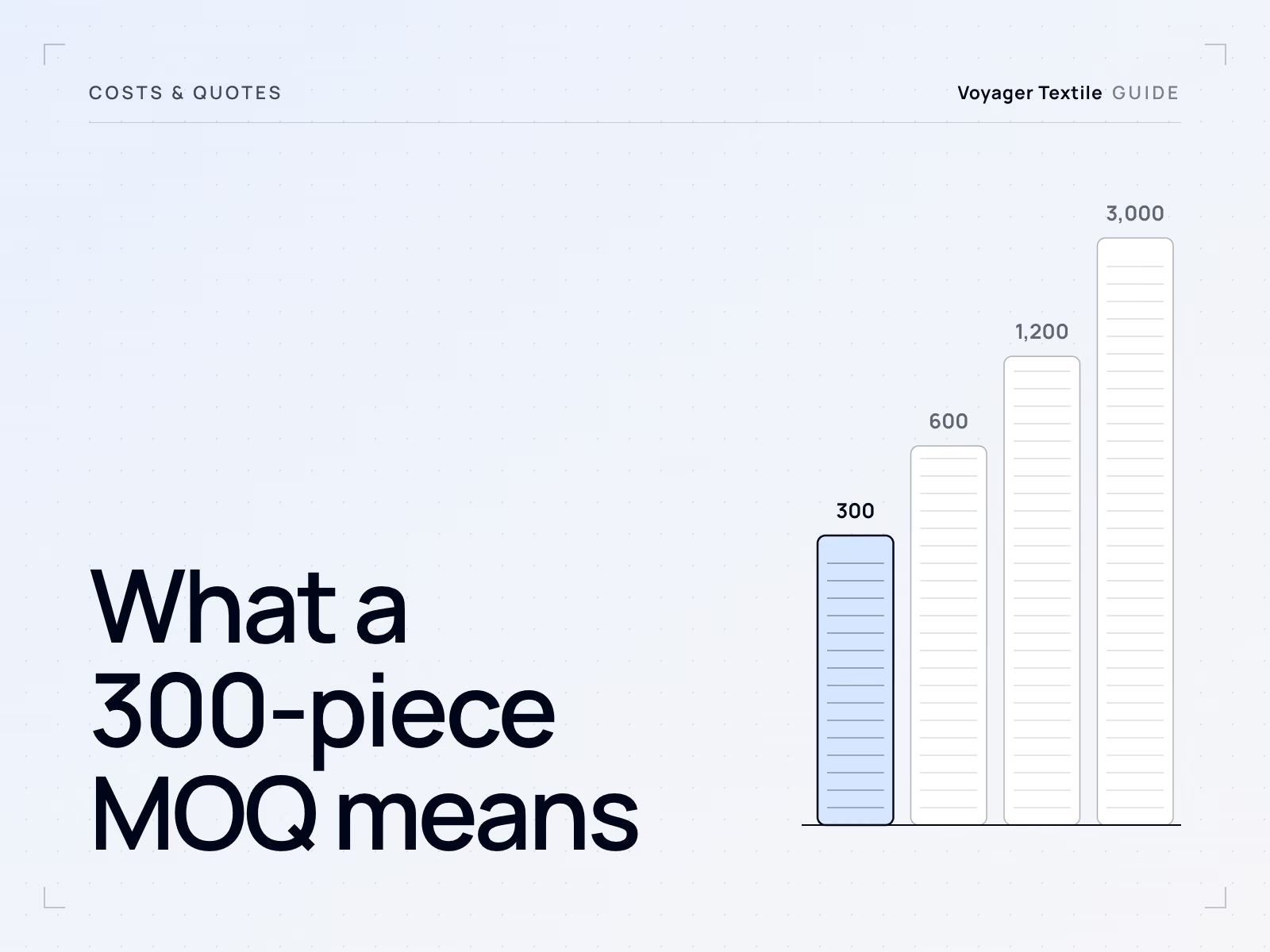
For reference, Voyager Textile produces custom apparel from 300 pieces per colour and per style, including custom Pantone colours and all-over sublimation. What a minimum does and does not commit you to, including how it interacts with sizes and colours, is covered in the MOQ guide.
Lead time and logistics
Portugal has the shorter physical route into most of Europe, and it has no customs entry at all, which removes a step rather than shortening one. Turkey adds a customs step but the road corridor into the EU is well established, and industrial goods move duty free under the customs union between the EU and Türkiye when accompanied by an A.TR movement certificate.
In practice the transit difference is measured in days, while the production difference is measured in weeks. Capacity availability, fabric booking and sampling rounds decide your delivery date far more often than the truck does. The lead time guide explains which stages actually move the date, and the shipping guide covers the documentation and Incoterms involved when goods leave Turkey.
Product range: the factor buyers underestimate
Portugal is deep in knitted tops and jersey, and that depth is real. If your range is tees, sweatshirts and knitwear for a European premium brand, you will find excellent Portuguese partners. The picture changes when a programme mixes categories. A corporate clothing programme that combines polos, softshell jackets, aprons and towels, or a sports programme that needs sublimated polyester alongside cotton fleece, is harder to place with one Portuguese factory and easier to place with one Turkish factory.
That matters commercially, because splitting a programme across countries multiplies your approvals, your colour standards and your shipments. Voyager Textile's reference catalogue shows the range side of that argument: tops, bottoms, coordinated sets, uniforms and scrubs, accessories and home and beach textiles produced in the same factory.
When Portugal is the better choice
- Your orders are genuinely small, in stock fabrics and stock colours, and you want to keep them small.
- Your product is premium knitwear or heavyweight jersey where a specific Portuguese mill and finish are part of the product story.
- Made in Portugal or Made in the EU is a marketing requirement rather than a preference.
- Your team wants same-timezone, short-haul factory visits several times per season during development.
- You are selling into the EU only and want to avoid customs entry entirely, including the administrative overhead of import declarations.
When Turkey is the better choice
- Quantities are moving past a few hundred pieces per style and unit cost has become a real constraint.
- You need custom fabric development or custom Pantone colour rather than a stock colour card.
- The programme spans several product families and you want one factory, one set of approvals and one shipment.
- You need all-over sublimation, performance polyester or teamwear alongside cotton products.
- You are running uniform or workwear programmes that must reorder identically for years.
- You are shipping to both Europe and the United States and want one production base for both markets.
What about the UK and the United States?
For UK buyers, neither country is domestic any more, so both involve an import entry. The United Kingdom has trade agreements covering goods from the EU and from Türkiye, and whether a specific garment enters at a preferential rate depends on rules of origin and correct documentation. Confirm the treatment for your product code with your customs broker before you build it into a landed cost.
For US buyers, neither Turkey nor Portugal has a free trade agreement with the United States, so both are dutiable imports and the applicable rates have changed repeatedly since 2025. Check the current rate for your specific classification in the US Harmonized Tariff Schedule and with US Customs and Border Protection before comparing landed costs. The practical difference between the two countries for a US buyer is therefore capability and capacity rather than duty.
How to decide without guessing
- Write one specification: product, fabric composition and weight, colours, size split, decoration, packing and target quantity.
- Send it unchanged to two or three factories in each country.
- Compare quotes line by line, checking that fabric composition and GSM match before comparing price.
- Compare the questions each factory asked. The quality of those questions predicts the quality of the production.
- Sample with one factory in each country if the programme justifies it, and measure both samples against your specification.
- Decide on total landed cost, capacity for your growth plan and confidence in communication, not on unit price alone.
Questions buyers ask
Is Portugal more expensive than Turkey for clothing manufacturing?
At comparable specification and quantity, Portuguese production is generally more expensive, mainly because of higher labour costs and smaller average factory scale. The difference is smallest on short runs, where set-up and fabric minimums dominate the price, and largest on long runs of labour-intensive garments.
Which country has lower minimum order quantities?
Portugal is often more flexible on small runs in stock fabrics. Once custom fabric or custom colour is involved, the minimum comes from the mill and dye house in both countries and the gap largely disappears. Voyager Textile produces custom apparel from 300 pieces per colour and per style.
Do goods from Turkey enter the EU duty free?
Industrial goods, including apparel, circulate free of customs duty between the EU and Türkiye under their customs union when accompanied by an A.TR movement certificate. Portugal is inside the EU, so its goods move without any customs entry at all. Confirm documentation requirements with your freight forwarder for each shipment.
Is Portuguese quality better than Turkish quality?
Quality is a factory-level attribute rather than a country-level one. Both countries contain excellent factories and weak ones. What decides your outcome is the specification you supply, the sample you approve and the inspection standard you agree, which is why the quality control guide is more useful than a country ranking.
Which is faster for reorders?
Reorder speed depends on whether the fabric and colour are already booked, not on the country. A repeat order in an existing fabric and approved colour is fast in both places. A repeat that needs new fabric dyeing takes weeks longer in both places. See keeping reorders consistent.
Can I use both countries at once?
Yes, and some brands do, keeping small premium capsules in Portugal and volume programmes in Turkey. The cost is duplication: two sets of patterns, samples, colour standards and inspections, plus two shipments. It is worth it when the two parts of the range genuinely have different requirements.
Compare us against your Portuguese quotation
Send the same specification you sent elsewhere. We will quote it line by line, state the fabric and weight we are pricing, and tell you where we would and would not be the better fit.
Request a comparable quote