Choosing a manufacturer
Nearshoring Clothing Production for European Brands: Where Turkey Fits
Nearshoring clothing production for a European brand usually means choosing between an EU country such as Romania, Bulgaria or Poland and a customs-union partner such as Türkiye. EU factories ship with no customs formalities at all; Türkiye ships duty free under the EU-Türkiye customs union with an A.TR certificate and a customs declaration. The choice then turns on product range, fabric sourcing, minimums and lead time.
Last reviewed:
Contents
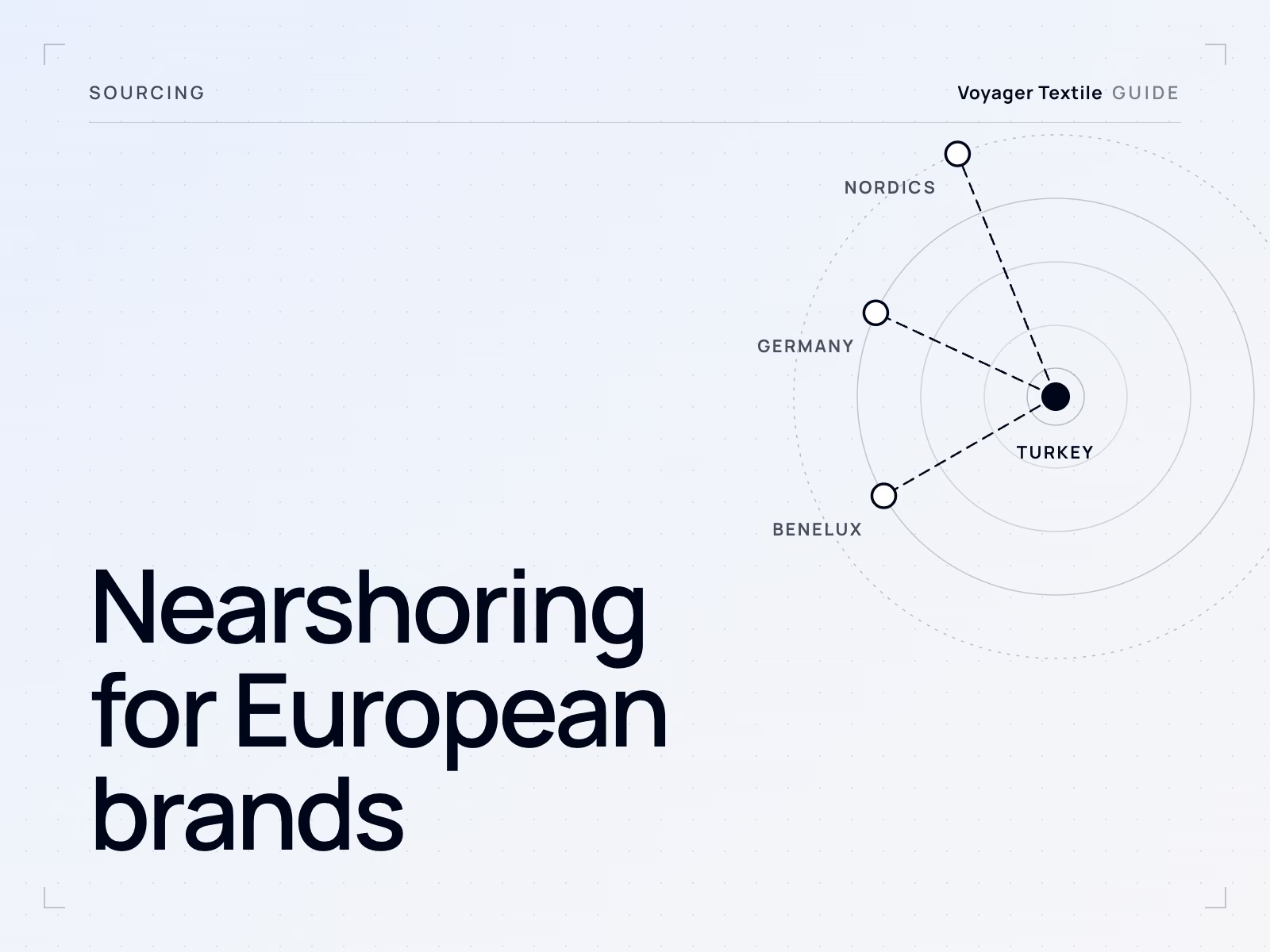
Nearshoring here means producing close enough to the European market that goods arrive by road in days rather than by sea in weeks, so a brand can order smaller quantities, reorder during the season and hold less stock. For EU buyers the realistic nearshore options are factories inside the EU, most often in Romania, Bulgaria and Poland, and factories in Türkiye. North Africa is also used, but this guide covers the two options European buyers compare most often.
Is Turkey part of Europe for apparel sourcing?
For customs purposes Türkiye is outside the EU, but apparel made there enters the EU without customs duty. Industrial goods, apparel included, move between the EU and Türkiye duty free under the customs union set up by Decision No 1/95 of the EC-Turkey Association Council, when the goods are in free circulation and travel with an A.TR movement certificate. Türkiye is not an EU member state and not part of the EU's customs territory, so every shipment still crosses a customs border and needs an import declaration.
| Question | EU factory (Romania, Bulgaria, Poland) | Türkiye |
|---|---|---|
| Customs duty into the EU | None; goods move inside the single market | None for apparel in free circulation, under the EU-Türkiye customs union |
| Customs formalities | None between member states | Export and import declarations and an A.TR movement certificate; import VAT is handled at entry |
| Transit to Western Europe | Road freight, typically a few days | Road freight, typically a few days plus border clearance; sea and Ro-Ro routes are also used |
| Origin on the label | Country of manufacture, for example Made in Romania | Made in Türkiye; the customs union does not create EU origin |
| Duty into the United States | Normal US rate; under the current Section 301 measure the combined rate on EU goods is at least 10 percent | Normal US rate plus an additional 12.5 percent under the current Section 301 measure |
Two consequences follow. First, an A.TR proves free circulation, not origin, so a garment made in Türkiye is labelled as Turkish and cannot carry a Made in EU claim; the difference is explained in A.TR versus origin. Second, a brand that also sells in the United States pays different duty on the same garment depending on where it was sewn, which is covered in where to make apparel for the US market.
Turkey or Eastern Europe: the comparison
The main difference is scope: many EU nearshore factories sew garments from fabric the brand or an agent supplies, while Türkiye has spinning, knitting, weaving, dyeing, cutting and sewing inside one country. That matters most when a programme needs a custom fabric or a Pantone colour.
| Factor | Romania, Bulgaria, Poland | Türkiye |
|---|---|---|
| Typical working model | Often cut-make-trim (CMT): the factory sews fabric and trims supplied by the brand; full-package suppliers exist but are fewer | Full package is common: the factory sources fabric, trims and decoration and delivers finished goods |
| Fabric and colour | Fabric is typically bought from mills elsewhere in Europe or in Asia and delivered to the factory | Knitting, weaving and dyeing are available in the country, so custom fabric and custom colour can be developed near the factory |
| Categories often cited | Tailoring, woven outerwear, knitwear and lingerie | Jersey and fleece, sweatshirts and hoodies, woven outerwear, workwear and uniforms, sportswear |
| Minimums | Typically low hundreds of pieces per style for CMT work, depending on the factory; the fabric mill sets its own minimum | Varies by factory; Voyager Textile works from 300 pieces per colour and per style |
| Lead time | Depends heavily on when the supplied fabric arrives | At Voyager Textile, samples in 5 to 7 business days and bulk in 4 to 5 weeks after sample approval |
An EU factory is the better fit when the brand already buys its own fabric, needs no customs border at all, wants an EU country of origin on the label, or runs very small capsule quantities in stock fabric. Türkiye is the better fit when the brand wants one supplier to handle fabric, colour, decoration and sewing, when the range mixes knitted and woven items, or when volumes grow beyond what a small CMT unit can take. Portugal is the other common EU option and has its own comparison in Turkey vs Portugal.
What nearshoring changes and what it does not
Nearshoring shortens transit time and makes reorders practical; it does not remove fabric lead time or the sampling stage. Most of the time a production run takes is development, fabric and sewing, and those steps take the same weeks wherever the factory is. The difference is the final leg: road freight from Türkiye or from within the EU takes days, while sea freight from South or South-East Asia to northern Europe typically takes several weeks.
The practical gain is lower stock and markdown risk rather than a lower unit price. A brand that can order 300 pieces per colour and per style, see how they sell and reorder within the season carries less unsold stock than one that commits to a full season's quantity months ahead. Why unit price alone misleads is set out in the Turkey and China comparison.
Compliance is the same wherever you sew
The EU rules on the garment do not change with the country of production. Fibre composition labelling under Regulation (EU) No 1007/2011, the General Product Safety Regulation and REACH restrictions apply equally to a garment sewn in Romania or in Türkiye, and the obligations sit with whoever places it on the EU market. The requirements are set out in EU apparel labelling and compliance.
Regulation (EU) 2024/3015 on products made with forced labour applies from 14 December 2027 and covers products made inside and outside the EU alike. The practical step is the same in every country: know which mill made the fabric and where the fibre came from, and keep that record per order.
How to compare nearshore quotations
Send every nearshore supplier the same brief
- The same tech pack, fabric specification and colour standard, so the quotations describe the same garment. The tech pack guide lists what it should contain.
- Who buys the fabric: the factory, the brand or an agent. A CMT price and a full-package price are not comparable.
- The minimum per colour and per style, and whether sizes can be split inside it.
- Sample time and bulk time after sample approval, stated separately.
- Incoterm and delivery point, so freight, customs clearance and import VAT are counted once.
- Which decoration is done in-house and which is sent to a partner facility.
Buyers moving an existing programme from Asia can follow the plan in moving clothing production to a new manufacturer. Buyers placing a first order can start with your first production run. For choosing among more than two countries, the decision framework works through product, volume and market in order.
Where Voyager Textile fits
Voyager Textile is a manufacturer in Türkiye with its own factory of about 70 people. Cutting, sewing, pattern making, embroidery, transfer printing and sublimation printing are done in the factory; screen printing and garment washing are coordinated with partner facilities. The minimum order is 300 pieces per colour and per style, capacity is about 100,000 pieces per month, and buyer-supplied fabric is accepted. Every garment is made to the customer's own design.
Questions buyers ask
Is Turkey in Europe for apparel sourcing?
For apparel sourcing, Türkiye is outside the EU but in a customs union with it, so apparel in free circulation enters the EU duty free with an A.TR certificate. Customs declarations are still required, and the garment's origin stays Turkish.
Can clothing made in Turkey be labelled Made in EU?
No. Clothing made in Türkiye cannot be labelled Made in EU, because the customs union removes duty but does not create EU origin. The origin is Türkiye, and the label should say so.
Is Turkey or Eastern Europe faster for nearshore clothing production?
Transit to Western Europe takes a few days by road from Türkiye and from Eastern Europe. Total lead time depends more on fabric: a factory that sources fabric in its own country avoids waiting for supplied fabric to arrive.
Do Romanian, Bulgarian or Polish clothing factories have lower minimums?
Some Romanian, Bulgarian and Polish factories doing cut-make-trim typically take low hundreds of pieces per style, but the fabric mill sets its own minimum. Voyager Textile works from 300 pieces per colour and per style, with fabric sourced by the factory.
Does nearshoring clothing production reduce cost?
Nearshoring clothing production usually reduces stock and markdown risk rather than unit price, because smaller orders and in-season reorders become practical. Compare landed cost on the same specification and Incoterm before deciding.
Compare a nearshore quote on the same specification
Send the tech pack or reference garment you sent to other suppliers. We will quote it at 300 pieces per colour and per style, state the fabric we are pricing, and tell you where an EU factory would suit you better.
Request a comparable quote