Choosing a manufacturer
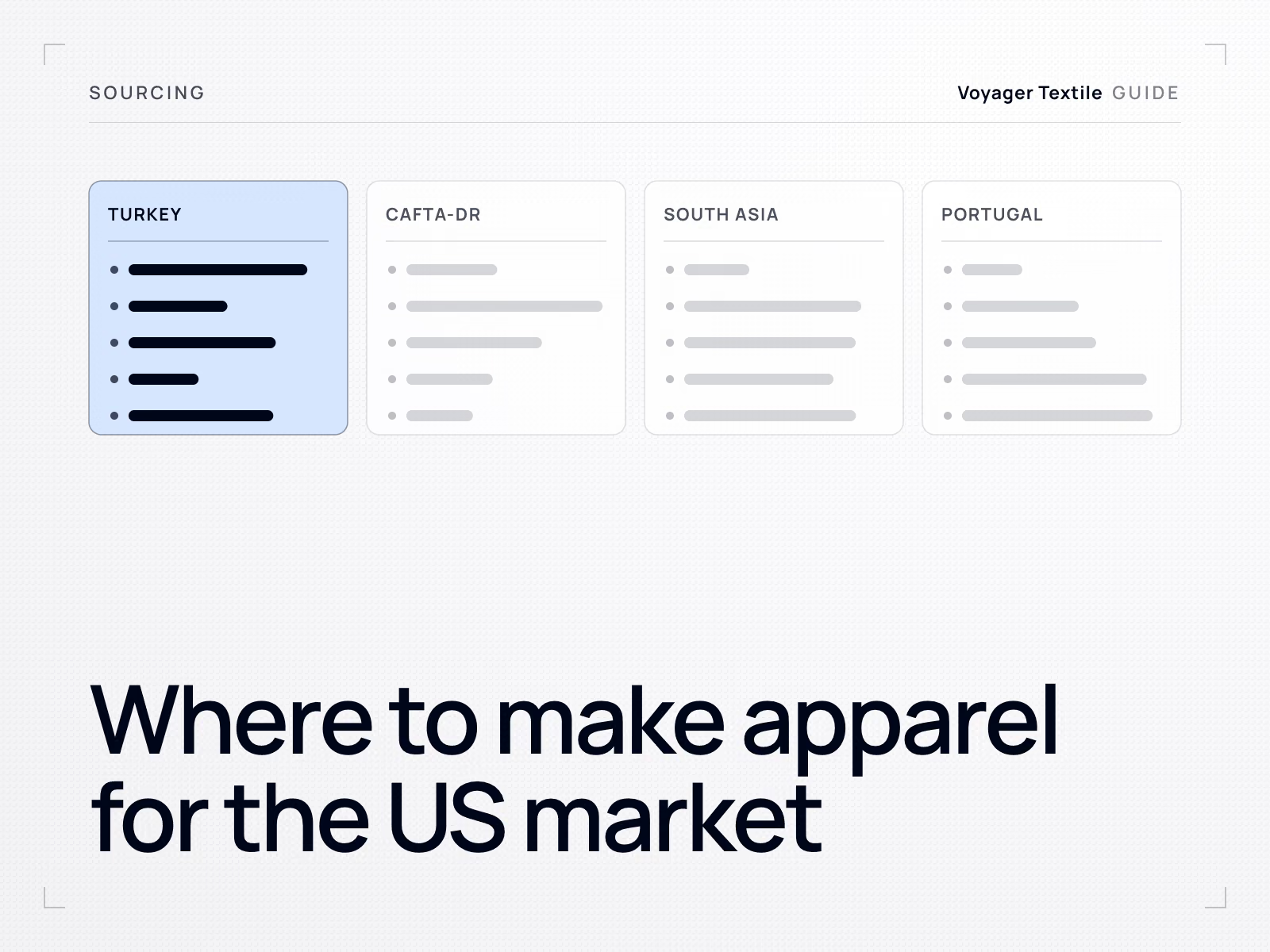
Where to Make Apparel for the US Market: Turkey, CAFTA-DR, South Asia or Portugal
For the US market, the country of origin decides the duty. Garments from CAFTA-DR countries that meet the yarn-forward rule enter duty free; garments from Türkiye, South Asia and most other origins pay the normal HTS rate plus an additional Section 301 duty; EU garments, Portugal included, pay a combined rate of at least 10 percent. Minimums and lead time then decide between the options that remain.
Last reviewed:
Contents
US buyers searching for private label clothing manufacturers in the USA usually compare domestic production with four regions abroad: Central America under CAFTA-DR, South Asia, Türkiye and Portugal. Each has a different duty position and suits a different order size. This guide sets out the duty first, because it is the one cost that is fixed by law, and then minimums and lead time.
The short comparison
| Origin | US duty position | Typical minimum per style | Transit to the US |
|---|---|---|---|
| United States | No import duty | Typically low hundreds of pieces at cut-and-sew factories | Days by truck |
| CAFTA-DR (Guatemala, Honduras, El Salvador, Nicaragua, Dominican Republic, Costa Rica) | Duty free and exempt from Section 301 when the garment meets the yarn-forward rule; otherwise normal rate plus 10 or 12.5 percent | Typically thousands of pieces at the large basics exporters | Typically days by sea to Gulf and East Coast ports |
| South Asia (Bangladesh, India, Pakistan, Sri Lanka) | Normal rate plus 10 percent | Typically in the low thousands at export factories | Several weeks by sea |
| Türkiye | Normal rate plus 12.5 percent | 300 per colour and per style at Voyager Textile | Several weeks by sea, or days by air |
| Portugal and other EU countries | Normal rate where it is 10 percent or more; otherwise a combined rate of 10 percent | Typically a few hundred pieces, often lower in stock fabric | Several weeks by sea, or days by air |
How US duty on apparel is built
US duty on imported apparel is the normal (column 1 general) rate in the Harmonized Tariff Schedule for the garment's code, plus any additional duty set for the country of origin. The normal rates on apparel are among the highest in the tariff and depend on fibre and construction: 16.5 percent for cotton knitted T-shirts (HTSUS 6109.10.00) and for cotton sweatshirts and hoodies (6110.20.20), and 32 percent for T-shirts and sweatshirts of man-made fibres (6109.90.10, 6110.30.30). Classification is the importer's responsibility, as the US labelling and import guide explains.
The additional duty now comes from the Section 301 action taken against 60 economies over forced-labour import rules, which applies to goods entered on or after 24 July 2026. CBP guidance sets 12.5 percent for Türkiye (heading 9903.05.79), 10 percent for Bangladesh, India, Pakistan and Sri Lanka, and a floor structure for EU goods: no additional duty where the normal rate is 10 percent or more, and a combined rate of 10 percent where it is lower. The measure is being challenged before the US Court of International Trade by importers and a group of US states; until a court decides otherwise it applies at entry.
CAFTA-DR works differently. Under the Dominican Republic-Central America-United States Free Trade Agreement, a garment enters duty free when it meets the yarn-forward rule: the yarn is spun, the fabric formed and the garment assembled in the United States or the CAFTA-DR region, with exceptions for fibres, yarns and fabrics on the agreement's short supply list. Such garments are also exempt from the Section 301 duty. A garment sewn in the region from non-qualifying fabric pays the normal rate plus that country's Section 301 rate of 10 or 12.5 percent.
Producing in the US or abroad: MOQ, lead time and landed duty
Producing in the US removes import duty and ocean transit; producing abroad usually gives a wider fabric choice and more capacity per style. The comparison below uses only rates set by law and indicative ranges, because unit prices vary too much by factory and specification to generalise.
| Garment and HTSUS code | Made in the US | CAFTA-DR, qualifying | Portugal | Bangladesh | Türkiye |
|---|---|---|---|---|---|
| Cotton knitted T-shirt (6109.10.00) | 0 | 0 | 16.5% | 26.5% | 29% |
| Cotton hoodie or sweatshirt (6110.20.20) | 0 | 0 | 16.5% | 26.5% | 29% |
| Polyester T-shirt (6109.90.10) | 0 | 0 | 32% | 42% | 44.5% |
Duty is charged on the customs value, which in the US is generally the transaction value excluding international freight, and the merchandise processing fee and, for ocean shipments, the harbor maintenance fee are added. Duty-free de minimis entry for low-value shipments is suspended, as covered in the US labelling and import guide.
What each route gives a US brand
Producing in the US
- No import duty, no customs entry, no ocean transit.
- Minimums at cut-and-sew factories are typically in the low hundreds of pieces per style.
- Domestic knitting and dyeing capacity is limited for some fabrics, so fabric choice can be narrower.
- A Made in USA claim has its own FTC rules, set out in the US labelling guide.
Producing abroad
- Duty depends on origin, from zero for qualifying CAFTA-DR garments to the normal rate plus 12.5 percent.
- Wider fabric, colour and decoration capacity per style.
- Transit of days from Central America, several weeks by sea from Türkiye, Portugal or South Asia.
- The importer of record carries classification, valuation and forced-labour documentation.
Where each route fits
- US domestic production fits short runs where speed and a Made in USA label matter more than fabric choice.
- CAFTA-DR fits volume basics, such as cotton T-shirts, fleece and knit polos, where yarn-forward fabric is available in the region and duty-free entry is achievable.
- South Asia typically fits large repeating volumes on long forecasts, with the 10 percent additional duty added to the normal rate.
- Portugal fits smaller runs in stock fabric and knitwear; under the current measure most apparel from the EU pays no additional duty because the normal rate is above 10 percent.
- Türkiye fits runs of 300 to a few thousand pieces per style with custom fabric, custom colour or embroidery and printing, and brands that sell the same range in the EU, where Turkish apparel enters duty free under the customs union.
Comparisons with other origins are in Turkey vs China, Turkey vs Portugal and Turkey vs Bangladesh vs Vietnam. The general method is in the decision framework.
Working with Voyager Textile from the US
Voyager Textile makes private-label apparel for US brands, merch companies, promotional distributors and corporate and workwear buyers from its factory in Türkiye. The minimum is 300 pieces per colour and per style, samples take 5 to 7 business days, and bulk takes 4 to 5 weeks after sample approval, with shipping on top. Replies usually come within one business day. Classification, duty and customs entry sit with the US importer of record; routes, Incoterms and documents are in shipping apparel from Turkey.
Questions buyers ask
Where is the best place to make apparel for the US market?
The best place to make apparel for the US market depends on duty, quantity and product. CAFTA-DR garments meeting the yarn-forward rule enter duty free; other origins pay the HTS rate plus any Section 301 duty. Smaller custom runs often suit Türkiye or Portugal.
What is the US tariff on clothing from Turkey?
The US tariff on clothing from Türkiye is the normal HTS rate plus an additional 12.5 percent under the Section 301 measure effective 24 July 2026, for example 29 percent on cotton T-shirts. The measure is being challenged in court.
Is clothing from Central America duty free in the US?
Clothing from Central America is duty free in the US under CAFTA-DR when it meets the yarn-forward rule or uses short-supply inputs. Qualifying garments are also exempt from the Section 301 duty; others pay both.
Do you work with US brands?
Yes. Voyager Textile works with US brands, merch and promotional companies and corporate and workwear buyers, from 300 pieces per colour and per style. Duty and customs entry sit with the US importer of record.
Is it better to manufacture clothing in the US or abroad?
Manufacturing clothing in the US avoids import duty and ocean transit and suits short runs; manufacturing abroad gives wider fabric choice and capacity. Compare landed duty for your HTS code, minimums per style and lead time.
Get a quote for your US programme
Send the specification, quantity per colour and style, and your delivery port. We will quote it with sample and bulk timing and state the fabric and Incoterm we are pricing.
Request a quote