Compliance and shipping
Importing Clothing into the US for the First Time: Importer Number, Customs Bond, ISF and Entry
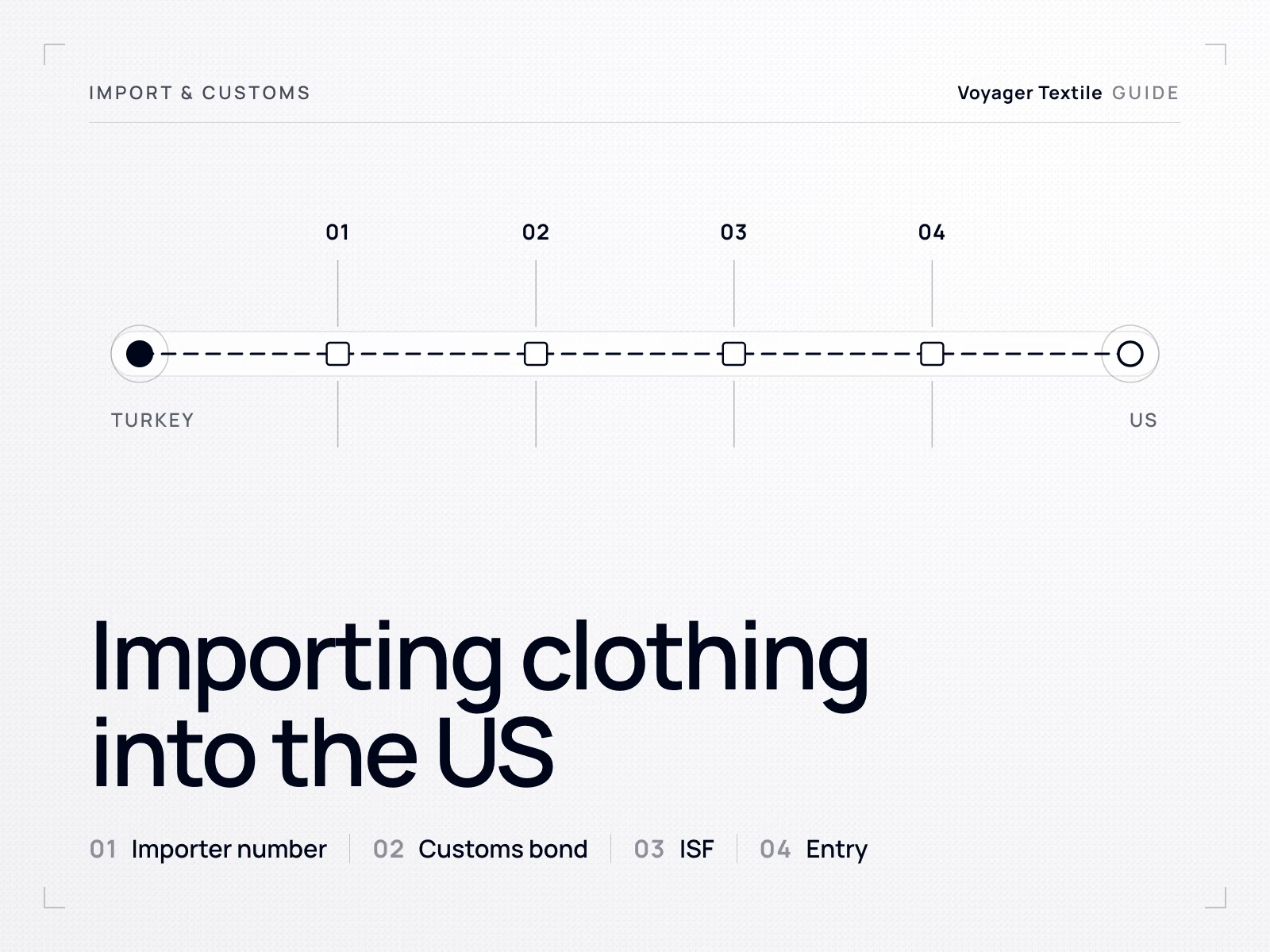
A first US clothing import needs four things in place before the goods sail: an importer of record, a CBP importer number filed on Form 5106, a customs bond (continuous or single transaction), and, for ocean freight, an Importer Security Filing sent no later than 24 hours before the container is loaded in Türkiye. Entry then follows within 15 calendar days of arrival.
Last reviewed:
Contents
- Who the importer of record is
- Who pays the duties
- Step 1: the importer number (CBP Form 5106)
- Step 2: a customs bond, continuous or single-entry
- Step 3: the Importer Security Filing (10+2) for ocean freight
- Step 4: entry and entry summary
- What the customs broker does
- Textile paperwork: invoice detail, the MID and the retired textile declaration
- How a Turkish manufacturer's documents fit
- The cost lines of a first US import, without figures
- Questions buyers ask
Confirm product classification, origin and documentation with your customs representative for the destination market and date of import.
Who the importer of record is
The importer of record is the party that enters the goods and owes the duty. 19 CFR 101.1 defines the importer as the person primarily liable for paying duties on the merchandise, and 19 CFR 141.1(b) makes that liability a personal debt, which is not discharged if a broker takes the money and does not pay CBP.
For a brand, merch company or distributor buying from Türkiye, the importer of record is normally the US buyer. A company incorporated outside the United States can enter goods for consumption only if it has a resident agent authorised to accept service of process and a bond with a resident corporate surety (19 CFR 141.18). That is why a Turkish factory quoting a delivered price needs a US structure before it can take the importer role.
Who pays the duties
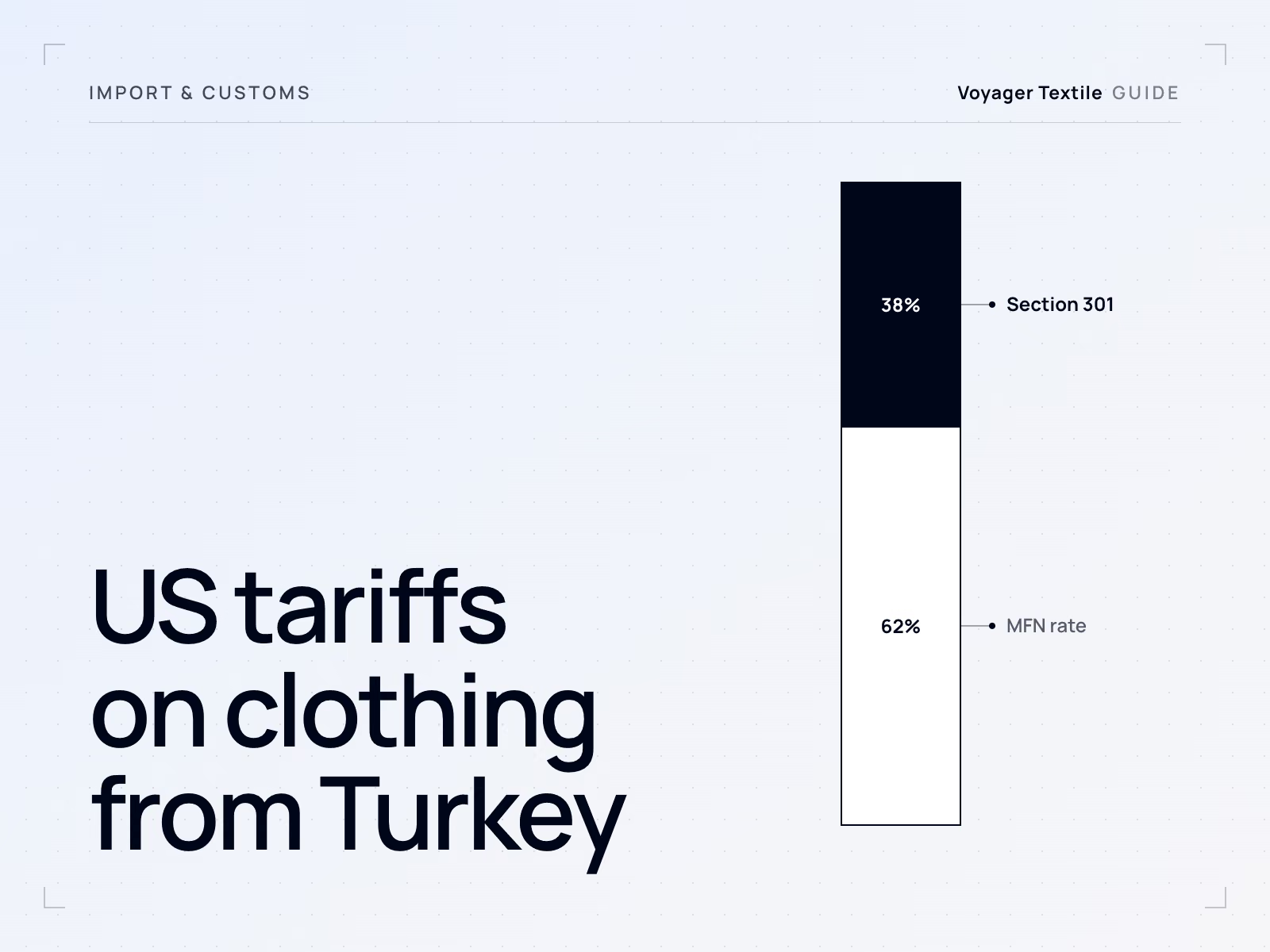
The importer of record pays the duties, deposited as estimated duties with the entry summary (19 CFR 142.12(c)) and settled when CBP liquidates the entry. The Incoterm decides who carries that cost commercially: under FCA or FOB the buyer pays; under DDP the seller has agreed to pay and must therefore be able to act as importer. How the general rate and the Section 301 duty on goods of Türkiye stack is explained in the US tariff guide.
Step 1: the importer number (CBP Form 5106)
CBP identifies every importer by a number registered on CBP Form 5106, the Create/Update Importer Identity Form. Under 19 CFR 24.5 the form is filed with the first formal entry, and a separate form is filed for the ultimate consignee if that is a different party. The number is the IRS employer identification number (EIN); without an EIN, the Social Security number; without either, CBP assigns an importer number.
The number lapses. Under 24.5(e) an importer number unused for one year, with no open transaction, is removed from CBP's files and a new Form 5106 is needed.
Step 2: a customs bond, continuous or single-entry
A formal entry needs a customs bond: a surety's guarantee that the importer will pay duties and meet CBP's demands. The bond used for imports is the basic importation and entry bond, whose conditions are set out in 19 CFR 113.62. It comes in two forms.
| Continuous bond | Single transaction (single-entry) bond | |
|---|---|---|
| Covers | All entries for the bond period | One entry only |
| Approved by | CBP Revenue Division; one continuous bond per activity per principal (19 CFR 113.12) | Revenue Division or the port director where filed (19 CFR 113.12) |
| Amount | Guideline: the greater of $50,000 or 10% of the previous year's duties, taxes and fees | Set per entry under CBP's bond guidelines |
| ISF | The 113.62 conditions include the ISF obligations (113.62(j)) | The ISF needs bond cover of its own or through the filing agent (19 CFR 149.5) |
The regulation itself sets only a floor and the factors. 19 CFR 113.13 requires every bond to be at least $100 and lets CBP weigh the importer's payment record, the value and nature of the goods and the degree of supervision; CBP can also ask for more security if a bond proves inadequate. The $50,000 or 10% guideline comes from CBP Directive 99-3510-004 and is restated in CBP's Federal Register notice of 24 October 2006 (71 FR 62276). Because the 10% is measured on duties, taxes and fees, a year with an added tariff layer raises the bond needed for the next.
Step 3: the Importer Security Filing (10+2) for ocean freight
Cargo arriving by vessel needs an Importer Security Filing (ISF) under 19 CFR Part 149. The ISF importer is the party causing the goods to arrive, normally the owner, purchaser or consignee, or a licensed broker acting for them (149.1). Air shipments do not need an ISF, because 149.2(a) applies to cargo arriving by vessel.
- The 10 importer elements (149.3): seller; buyer; importer of record number; consignee number; manufacturer or supplier; ship-to party; country of origin; HTSUS number to at least six digits; container stuffing location; consolidator (stuffer).
- The +2 carrier elements: the vessel stow plan (19 CFR 4.7c) and container status messages (4.7d), sent by the carrier, not the importer.
- Deadline: the first eight elements no later than 24 hours before the cargo is laden aboard the vessel at the foreign port (149.2(b)); the stuffing location and consolidator no later than 24 hours before arrival in a US port.
- Updates: manufacturer, ship-to party, origin and HTSUS number may first be sent as best available data and must be updated no later than 24 hours before US arrival (149.2(f)); the filing must be withdrawn if the goods are no longer coming (149.2(e)).
- Consequence: under the bond condition in 19 CFR 113.62(j), failing the Part 149 obligations exposes principal and surety to liquidated damages of $5,000 for each violation.
The 24-hour deadline runs from loading in Türkiye, not from arrival, so the filing has to be ready while the goods are still at the port of export. The manufacturer's name and address and the container stuffing location come from the factory and the forwarder; the HTSUS number is the importer's classification.
Step 4: entry and entry summary
Entry is filed within 15 calendar days after the goods land (19 CFR 142.2), and it can be filed before arrival. Under 142.3 the entry package is CBP Form 3461 or its electronic equivalent, evidence of the right to make entry, the commercial invoice, a packing list where appropriate, and any other documents required for the shipment. The entry summary, CBP Form 7501 or its electronic equivalent, follows within 10 working days of entry with estimated duties deposited (142.12(b) and (c)), or is filed at the time of entry as a single step.
- Formal or informal. Informal entry is limited to shipments not exceeding $2,500, and 19 CFR 143.21(a) excludes articles valued over $250 that are classified in chapter 99, subchapters III and IV. The Section 301 heading for products of Türkiye sits in subchapter III, so a clothing shipment above $250 goes through formal entry.
- Liquidation. An entry not liquidated within one year of entry is deemed liquidated at the rate, value and duty the importer declared (19 CFR 159.11).
- Refunds. Since 6 February 2026 CBP issues refunds electronically, subject to limited waivers (Electronic Refunds rule, 91 FR 21, 2 January 2026). To receive them, the importer files an ACH Refunds Enrollment Form with CBP's Revenue Division.
What the customs broker does
A licensed customs broker files the Form 5106, the ISF, the entry and the entry summary for you, arranges the bond through a surety, and pays duties on your behalf. You do not need a licence to clear your own goods: 19 CFR 111.2(a)(2)(i) exempts an importer acting solely on its own account. Anyone clearing goods for others must be licensed.
- The broker needs a valid power of attorney before acting in your name, and keeps it on file rather than filing it with CBP (19 CFR 141.46).
- A power of attorney from a nonresident principal is accepted only if the agent named is a resident authorised to accept service of process (141.36).
- If the ISF and the entry go to CBP in one transmission, the sender must be the importer acting for itself or a licensed broker (149.5(a)).
Textile paperwork: invoice detail, the MID and the retired textile declaration
The separate textile declaration no longer exists. CBP's final rule on the country of origin of textile and apparel products, published 17 March 2011 (76 FR 14575), eliminated the requirement to submit a textile declaration with every textile import and replaced it with the manufacturer identification code (MID). Under 19 CFR 102.23 every commercial importation of textile or apparel products identifies the manufacturer by an MID built from the name and address of the entity that performed the origin-conferring operations, and the importer must be able to show reasonable care in determining it.
The commercial invoice carries the fibre detail. 19 CFR 141.89 asks that invoices for textile wearing apparel give a breakdown by weight of all fibres in the whole garment, and separately for the outer shell and the lining; garments combining knit and woven fabric, or textile with leather or plastic, need a breakdown for each material. The garment itself must be marked with its country of origin (19 CFR 134.11). Fibre content, origin and business identity on the sewn-in label follow the Textile Act and FTC rules, covered in US apparel labelling and import requirements, with care wording in care symbols and label wording.
How a Turkish manufacturer's documents fit
| Document or data | Comes from | Used for |
|---|---|---|
| Commercial invoice with fibre breakdown | The manufacturer or exporter | Entry and entry summary (142.3; 141.89) |
| Packing list | The manufacturer or exporter | Entry package (142.3(a)(4)) |
| Manufacturer name and address | The factory that performed the origin-conferring operations | The MID (102.23) and ISF element 5 |
| Container stuffing location, consolidator | Factory or forwarder | ISF elements 9 and 10 |
| Bill of lading or air waybill | The carrier or forwarder | Evidence of the right to make entry |
| Turkish export declaration | Turkish customs | Export from Türkiye only; not filed with CBP |
The factory's facts have to match in all three places. If the invoice names a trading company but the MID and ISF name the sewing factory, or the fibre breakdown differs from the label, the broker will stop and ask. Agree the manufacturer name and address as written, and the carton and packing format described in cartons, assortments and shipping marks, before the goods ship.
The cost lines of a first US import, without figures
A landed-cost sheet for a first US import holds the lines below. Rates and fees change, so the sheet records each line and what it depends on, and the customs broker supplies the amounts for the actual entry.
| Line | What it depends on |
|---|---|
| Goods | The invoice value on the agreed Incoterm, which also decides which of the lines below the importer pays |
| Freight | Ocean or air, the port pair and the Incoterm |
| Insurance | The cargo value and who arranges cover under the Incoterm |
| Duty | The HTSUS general rate for each style's subheading |
| Additional tariff | The Section 301 layer for products of Türkiye, per the tariff guide |
| Merchandise processing fee | The entered value, within the limits of 19 CFR 24.23, adjusted each fiscal year |
| Harbor maintenance fee | The value of cargo arriving by ocean (19 CFR 24.24); not charged on air freight |
| Customs broker | The number of entries, plus the ISF and the Form 5106 |
| Bond | Continuous or single-entry, and the premium charged by the surety |
| Inland delivery | The distance from the US port or airport to the warehouse, and the carrier |
Before the first shipment leaves Türkiye
- Decide who is importer of record and agree the Incoterm that matches.
- Appoint a licensed customs broker and sign the power of attorney.
- File CBP Form 5106 through the broker.
- Choose a continuous or single transaction bond and have it in place.
- For ocean freight, collect the ISF data from the factory and forwarder so it is filed 24 hours before loading.
- Have the broker confirm the HTSUS subheading for each style.
- Check that the invoice fibre breakdown, the label and the MID state the same facts.
Questions buyers ask
Do I need a customs broker to import clothing into the US?
No licence is needed to clear your own goods: 19 CFR 111.2 exempts importers acting solely on their own account. Many first-time clothing importers still use a licensed customs broker, who files the Form 5106, the ISF, the entry and the entry summary.
What is a CBP importer number?
A CBP importer number identifies the importer of record on every entry. It is registered on CBP Form 5106 and is normally the company's IRS EIN. It is removed if unused for one year with no open transaction (19 CFR 24.5).
Continuous or single-entry customs bond: which do I need?
A continuous customs bond covers all entries for the bond period; a single-entry bond covers one shipment. CBP's guideline sets a continuous bond at the greater of $50,000 or 10% of the previous year's duties, taxes and fees. Your broker compares both for your shipment plan.
When is the ISF 10+2 deadline?
The ISF deadline for most elements is 24 hours before the cargo is loaded aboard the vessel at the foreign port (19 CFR 149.2). Stuffing location and consolidator may follow up to 24 hours before US arrival. Air cargo needs no ISF.
Is there still a textile declaration for US apparel imports?
No. CBP's 2011 final rule (76 FR 14575) eliminated the textile declaration. Importers now identify the manufacturer with a manufacturer identification code under 19 CFR 102.23, and the invoice gives the fibre breakdown by weight.
Who pays US duty on clothing made in Turkey?
The importer of record pays US duty on clothing made in Türkiye. Under 19 CFR 141.1(b) it is the importer's personal debt, and paying a broker does not discharge it. Under DDP the seller has agreed to pay and must be able to act as importer.
Get the export side right for your first US order
We prepare the commercial invoice, packing list and manufacturer details your broker needs for the ISF, the MID and the entry, and we confirm them at quotation. The import filings, the bond and the duty stay with your importer of record and broker.
Discuss a US order