Compliance and shipping
One Production Run, Three Markets: How the EU, UK and US Treat Turkish-Made Apparel
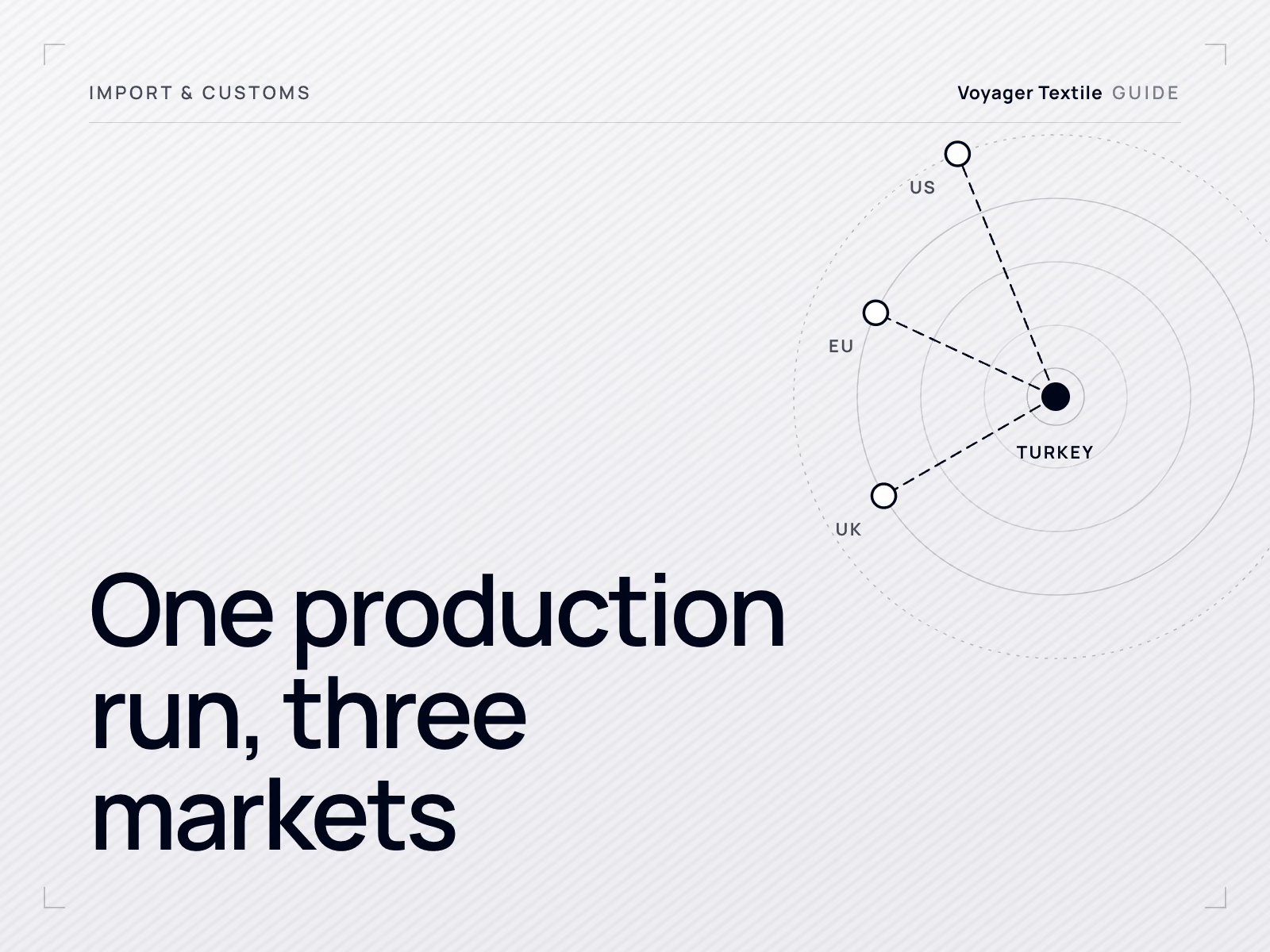
One production run can serve all three markets, but each border asks a different question. The EU asks whether the goods are in free circulation, shown by an A.TR. The UK asks whether the garment meets the UK–Türkiye preferential origin rule, which for most garments means the fabric was also made in Türkiye, the UK or the EU. The US asks where the garment was assembled, then charges its general rate plus 12.5% under Section 301. Plan fabric and labels for all three before cutting.
Last reviewed:
Contents
The common mistake is to take the answer for one market and apply it to the others. "Duty free from Türkiye" is true for the EU under conditions, true for the UK under different conditions, and false for the US. The difference sits in the fabric and in the paperwork, and both are decided before production starts.
Confirm product classification, origin and documentation with your customs representative for the destination market and date of import.
The three answers at a glance
| European Union | United Kingdom (Great Britain) | United States | |
|---|---|---|---|
| Legal basis | EU–Türkiye Customs Union: Decision No 1/95 of the EC–Turkey Association Council of 22 December 1995 | UK–Türkiye Free Trade Agreement, applied from 1 January 2021; origin protocol revised from 14 April 2021 | No trade agreement: HTSUS general rate plus the Section 301 action in USTR notice 91 FR 47318 |
| Test at the border | Free-circulation status of the goods | Preferential origin of the garment | Country of assembly and HTSUS subheading |
| Customs duty when the condition is met | None | None: Türkiye preference of 0%, against a third-country rate of 12% on UK commodity 6109100010 (T-shirts) | No condition removes it: general rate plus 12.5% (16.5% + 12.5% on HTSUS 6109.10.00) |
| Document | A.TR movement certificate, endorsed by Turkish customs at export | Origin declaration by the exporter on the invoice or another commercial document | Entry by the importer of record; no preference document applies |
| Effect of fabric origin on duty | Not as an origin test: the A.TR concerns customs status, see A.TR and origin | Yes: the product-specific rule requires the fabric to be knitted or woven in the FTA area, or the fabric printed there | No: 19 CFR 102.21 gives origin to the country where the garment was wholly assembled |
| Additional duty on Turkish origin | None | None | 12.5% under heading 9903.05.79, under challenge at the US Court of International Trade |
| Who pays | The EU importer | The UK importer | The importer of record |
European Union: the customs union and the A.TR
Apparel moves from Türkiye into the EU without customs duty when it is in free circulation and the movement is evidenced. Decision No 1/2006 of the EC–Turkey Customs Cooperation Committee of 26 September 2006 names the A.TR movement certificate as that evidence, requires it to be endorsed by the customs authorities of the exporting state, and requires it to be submitted to the importing state's customs within four months of issue. The A.TR is used for goods transported directly between the two parts of the customs union, with transit through third countries allowed under conditions.
An A.TR is a statement of customs status, not of origin, and it does not remove import VAT. Both points are set out in does an A.TR certificate prove Turkish origin, and the shipping side in shipping apparel from Türkiye.
United Kingdom: origin rules, not free circulation
Great Britain gives Turkish-made apparel duty-free entry only when it meets the preferential origin rules of the UK–Türkiye Free Trade Agreement. The UK government's guidance describes the agreement as a traditional free trade agreement that replaced the customs union relationship the UK had as an EU member, and states that goods not meeting the rules of origin pay the UK's standard tariff. From 14 April 2021 the agreement's origin protocol follows the general provisions and product-specific rules of the UK–EU Trade and Cooperation Agreement.
| Garments | Rule | What it means for fabric sourcing |
|---|---|---|
| Knitted garments sewn from two or more cut or formed pieces (chapter 61, headings 61.01-61.17) | Knitting or crocheting combined with making-up including cutting of fabric | The fabric must be knitted in the FTA area and the garment cut and sewn there |
| Woven garments (chapter 62, for example heading 62.03) | Weaving combined with making-up including cutting of fabric; or making-up including cutting of fabric preceded by printing as a standalone operation | The fabric must be woven in the FTA area, or imported fabric printed there before it is cut and sewn |
Article 3 of the protocol lets materials originating in Türkiye and the UK count for each other, and Article 3(4) lets materials originating in the EU count as well, provided the work in Türkiye goes beyond the insufficient operations listed in Article 6. Article 5 allows limited tolerances for non-originating materials. In practice, a garment sewn in Türkiye from fabric knitted or woven outside Türkiye, the UK and the EU generally does not qualify for the UK preference, even though it moves under an A.TR into the EU and counts as Turkish for US duty.
Entitlement rests on a declaration on origin made out by the exporter on the invoice or another commercial document, using the wording the protocol sets. For imports into the UK the declaration is valid for 24 months from the date it was made out. Turkish exporters do not need a Registered Exporter (REX) number under this agreement; an approved exporter enters its authorisation number. The UK and Türkiye are negotiating an enhanced agreement, with a fifth round held in Ankara from 15 to 23 June 2026; until a new text enters into force, the existing origin rules apply.
United States: assembly decides origin, then two duty layers
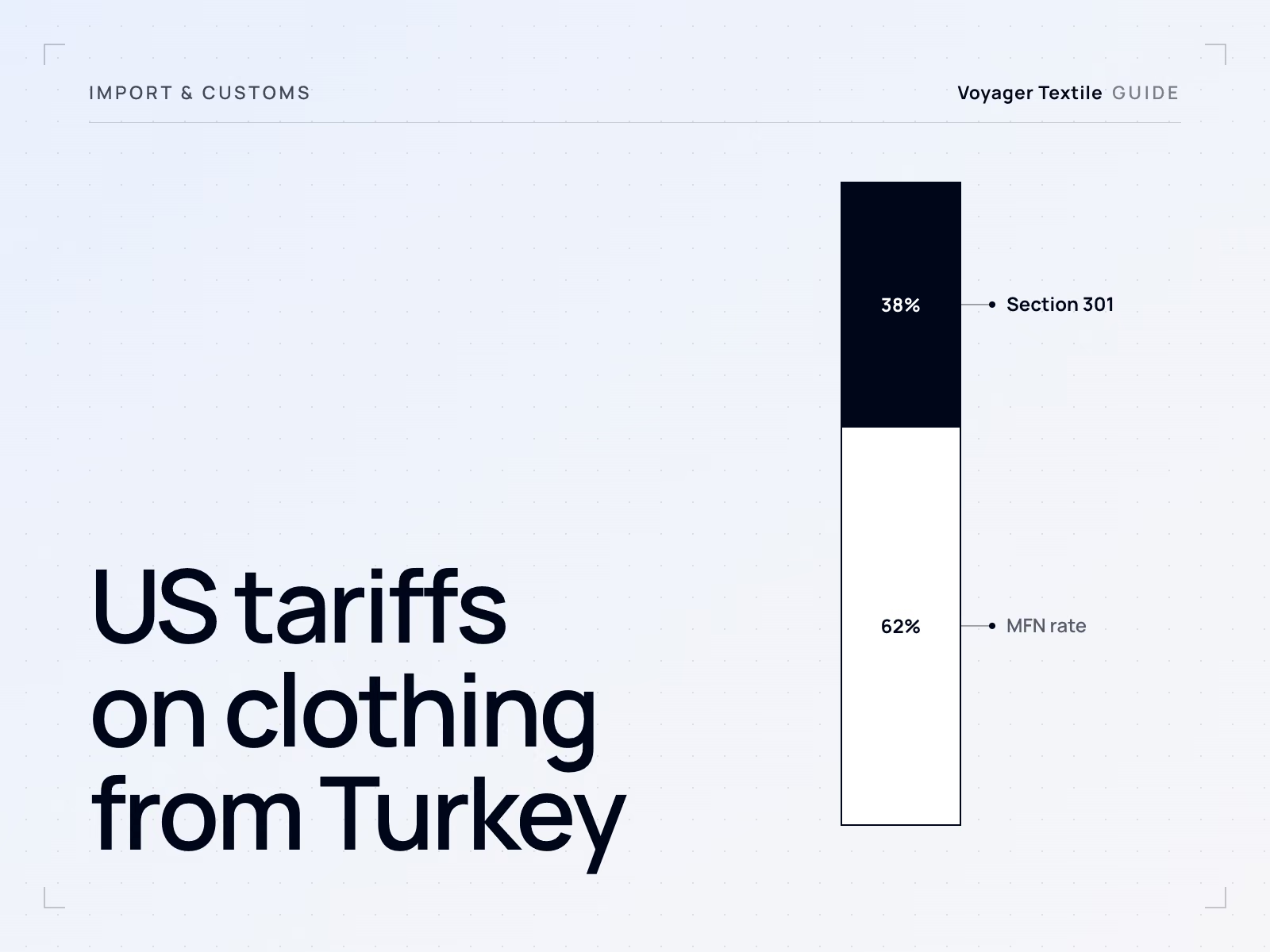
The US charges duty on Turkish-made apparel whatever its fabric: the HTSUS general rate for the garment's subheading plus 12.5% under Section 301, heading 9903.05.79, for goods entered from 24 July 2026. Origin follows the country of assembly under 19 CFR 102.21, and the action is under challenge at the US Court of International Trade. How the layers stack, who pays and how to state them in a quotation is in US tariff on clothing from Turkey.
Labelling: one label set for three markets
The US asks for the most on the label, so a label set designed for the US covers most of what the EU and Great Britain need, apart from language and the EU product-safety contact details. The table sets the three side by side; the detail for each market is in EU apparel labelling and US apparel labelling and import requirements.
| Requirement | European Union | Great Britain | United States |
|---|---|---|---|
| Fibre composition | Required: names and percentages by weight of all fibres in descending order, Regulation (EU) No 1007/2011 | Required: Regulation (EU) No 1007/2011 as it applies in Great Britain, enforced under the Textile Products (Labelling and Fibre Composition) Regulations 2012 | Required: generic fibre names and percentages by weight, Textile Fiber Products Identification Act and 16 CFR Part 303 |
| Language | Official language or languages of the Member State where the product is sold (Article 16(3)) | English (Article 16(3) as it applies in Great Britain) | English (16 CFR 303.4) |
| Country of origin | Not required by the fibre-labelling regulation | Not required by the fibre-labelling regulation | Required for imported products (16 CFR 303.33), on the inside centre of the neck for garments with a neck (16 CFR 303.15(b)), using the English name of the country |
| Care instructions | Not required by EU textile-labelling law | Not required by the fibre-labelling regulation | Required: permanent care label, FTC Care Labeling Rule, 16 CFR Part 423 |
| Business identity | Manufacturer's and importer's name and postal and electronic address, and an EU-established responsible economic operator (Regulation (EU) 2023/988, Articles 9(6), 11(3) and 16) | General Product Safety Regulations 2005 apply in Great Britain; Regulation (EU) 2023/988 applies in Northern Ireland | Company name or FTC registered identification number (RN) on the label (16 CFR Part 303) |
The label content is set by the buyer, and Voyager produces it to that specification. Physical space for every required language and a care label that survives washing are decided with the label set, as covered in clothing labels and packaging. Product safety obligations in the EU are covered in GPSR for apparel.
Planning one run for all three markets
Decide the markets before the fabric is bought, because the UK origin rule is the one that depends on it. Voyager accepts buyer-supplied fabric, including imported fabric; which origin evidence is available for a given fabric is confirmed per project at the quotation stage.
Before the fabric is ordered
- List the markets and the share of the run going to each.
- For Great Britain, confirm where the fabric is knitted or woven and whether the product-specific rule can be met, or accept the UK third-country rate.
- For the EU, confirm the A.TR will be issued at export and that the importer's broker expects it.
- For the US, agree the importer of record and have the broker confirm the HTSUS subheading and current rates.
- Design one label set with US origin and care content, plus the language versions the EU and Great Britain need.
- Put the origin assumptions, documents and delivery term for each market into the order.
Questions buyers ask
Is clothing made in Turkey duty free in the EU?
Clothing made in Turkey enters the EU without customs duty when it is in free circulation under the EU–Türkiye Customs Union and accompanied by an A.TR movement certificate. Import VAT still applies. The A.TR shows customs status, not origin.
Is clothing made in Turkey duty free in the UK?
Clothing made in Turkey is duty free in the UK only if it meets the UK–Türkiye FTA origin rule and the importer holds an origin declaration. For most garments the fabric must be knitted or woven in Türkiye, the UK or the EU. Otherwise the UK third-country rate applies.
Does an A.TR work for exports from Turkey to the UK?
No. An A.TR belongs to the EU–Türkiye Customs Union. For the UK, preference under the UK–Türkiye FTA rests on a declaration on origin made out by the exporter on the invoice or another commercial document, valid for 24 months for UK imports.
What duty does the US charge on clothing made in Turkey?
The US charges the HTSUS general rate for the garment's subheading plus 12.5% under Section 301 heading 9903.05.79 on clothing made in Turkey, for goods entered from 24 July 2026. There is no preferential rate for Türkiye.
Can one label set be used for the EU, UK and US?
One label set can serve the EU, UK and US if it carries US country of origin and care content, fibre composition in the required form, English for the UK and US, and the official languages of each EU country where the garment is sold.
Plan one run for several markets
Tell us which markets the run is for and how it splits. We will confirm at quotation the fabric we would use, where it is made, and which export documents the order includes.
Discuss a programme