Compliance and shipping
US Apparel Labelling and Import Requirements
A garment sold in the United States must carry three things on its label under the Textile Act: fibre content, country of origin, and the name or registered identification number of the business responsible for it. A separate rule requires care instructions. At the border, the importer of record is responsible for classification, duty and proving the supply chain is clean.
Contents
The United States separates two things that buyers often merge: what the label must say, which the Federal Trade Commission enforces, and what happens when the goods arrive, which US Customs and Border Protection controls. They have different rules, different responsible parties and different consequences. This guide takes them in that order.
Part one: the label
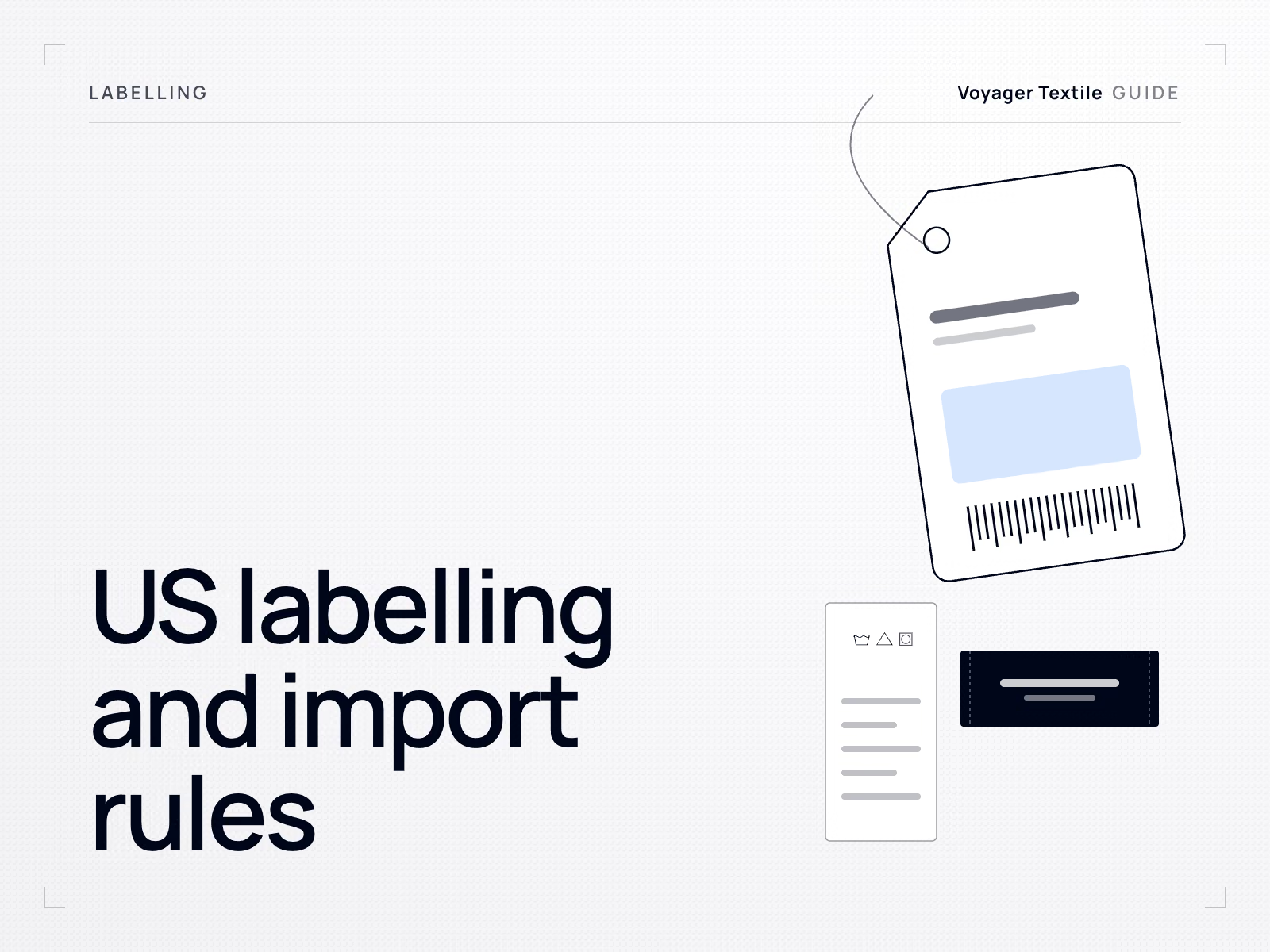
Under the Textile Fiber Products Identification Act and the FTC's rules, most textile and wool products must carry a label with three pieces of information: the fibre content, the country of origin, and the identity of the manufacturer or the business responsible for marketing or handling the product. A separate rule requires care instructions.
Fibre content
- List the generic name of each fibre making up 5 percent or more of the product's weight, in order of predominance, with its percentage.
- Fibres below 5 percent are generally grouped as other fiber, unless the fibre has a definite functional significance, in which case it may be named with its function disclosed.
- Certain components are excluded from the calculation, including trim, linings that are not used for warmth, small amounts of ornamentation and the threads holding the garment together. The label may need to state that the fibre content is exclusive of decoration.
- Use the generic fibre names the rules recognise. Marketing names do not substitute for them, and the declared content must match the fabric actually used, which is worth verifying by laboratory test as described in the quality control guide.
Country of origin
Imported garments must be marked with the country where they were made. For a garment with a neck, the origin must appear on the inside centre of the neck, midway between the shoulder seams. Where a garment has no neck, it must appear in another conspicuous and readily accessible position. This is a placement rule as much as a content rule, and it is a common reason a first shipment is questioned.
Who is identified on the label
The label must carry either the full company name of the business responsible for the product, or a registered identification number issued by the FTC. Registered identification numbers, known as RN numbers, are issued only to businesses in the United States, so a Turkish or other non-US factory cannot hold one. In practice, the US importer or brand appears on the label, using its own name or its own RN.
Care instructions
The FTC's Care Labeling Rule requires manufacturers and importers to attach care instructions to garments. In outline, the label must be permanently attached and legible for the useful life of the garment, must provide regular care instructions covering the appropriate method, and must include warnings where a normal care procedure would harm the product. There must be a reasonable basis for the instructions given, meaning evidence rather than assumption. How that evidence is produced for a finished garment is covered in how care instructions are determined.
This is a clear difference from the European Union, where care labelling is voluntary at EU level. If you sell in both markets, design the label set for both from the start, as covered in the labels and packaging guide.
The FTC publishes plain-language guidance for businesses, including its guide to labelling under the Textile and Wool Acts, on the FTC apparel labelling pages.
Part two: the border
At import, responsibility sits with the importer of record. That party is accountable for correct classification, valuation, duty payment and for the legality of the goods, regardless of what the factory told them.
| Requirement | What it means in practice |
|---|---|
| Classification | Every garment is classified under the Harmonized Tariff Schedule. Apparel classification is detailed and depends on construction, fibre and gender, and it determines the duty rate |
| Duty | Apparel duty rates are among the higher rates in the tariff, and additional tariff measures have changed repeatedly since 2025. Check the current rate for your specific code before building a landed cost |
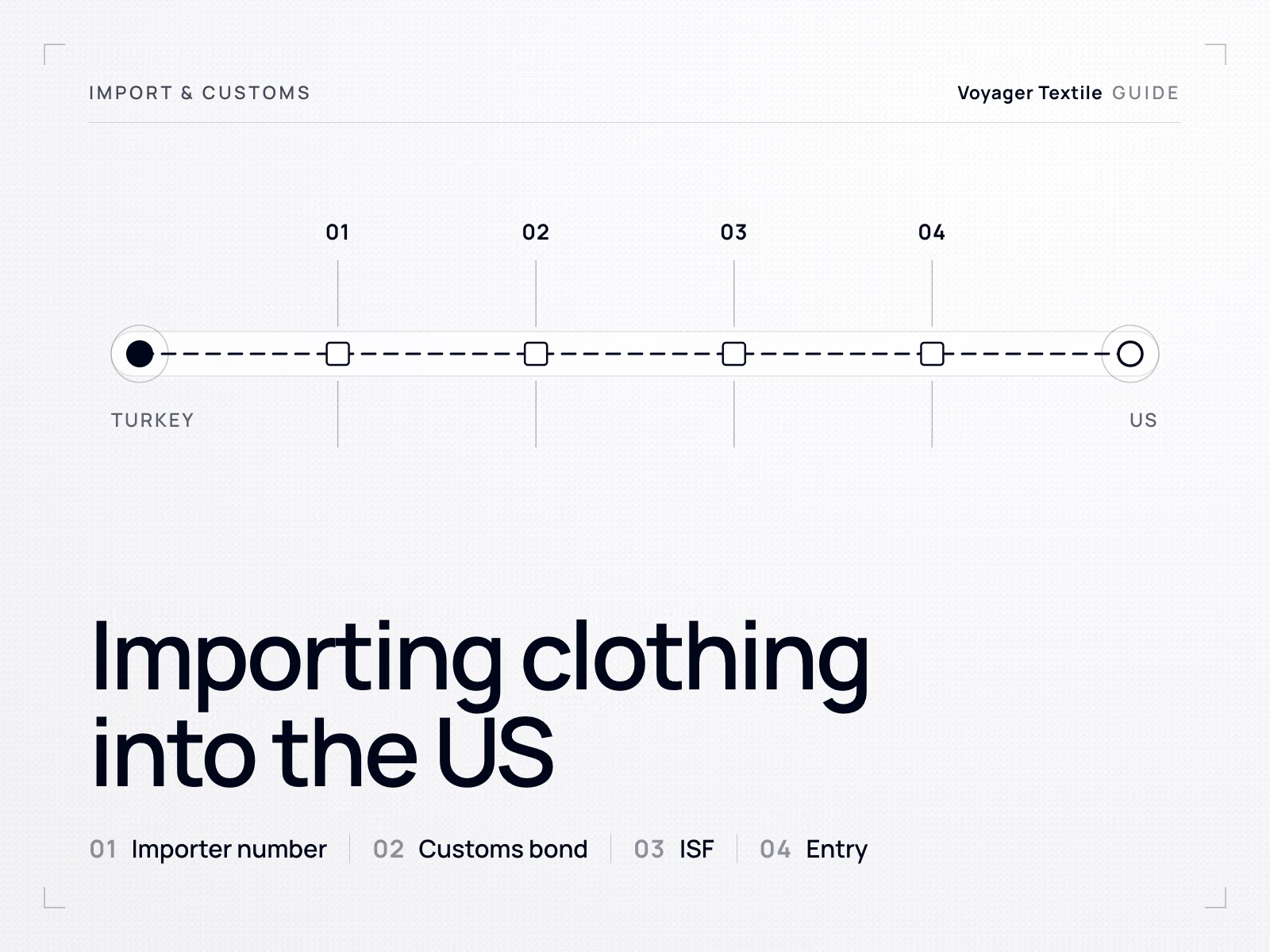
| Formal entry | Shipments above the formal entry threshold, currently 2,500 US dollars, must use formal entry procedures |
| Customs bond | A bond is required for formal entries, either single transaction or continuous |
| Marking | Country of origin marking must satisfy customs marking requirements as well as the FTC label rules |
| Documentation | Commercial invoice, packing list, bill of lading or air waybill, and any product-specific documentation your broker requests, as set out in the shipping guide |
Low-value shipments no longer offer a shortcut. Duty-free de minimis treatment for shipments valued at or below 800 US dollars was suspended for all countries with effect from 29 August 2025, so low-value consignments are subject to applicable duties, taxes and fees. CBP publishes a fact sheet on the suspension.
Forced labour due diligence
Under the Uyghur Forced Labor Prevention Act, CBP applies a rebuttable presumption that goods mined, produced or manufactured wholly or in part in the Xinjiang Uyghur Autonomous Region, or by entities on the UFLPA Entity List, are prohibited from entry. Cotton is one of the sectors where enforcement is most active.
CBP states that it is the importer's responsibility to know its supply chain. In practice that means being able to trace the cotton or other inputs back through fabric, yarn and raw material with ordinary business records: purchase orders, invoices, production records, transport documents and proof of payment. This obligation applies wherever the garment was sewn, so it is not resolved simply by choosing a country of assembly outside China.
Ask any supplier, before the first order, where the yarn and fabric originate and what documentation can be provided. CBP's operational guidance for importers describes the documentation typically expected.
State-level and product-specific rules
Federal labelling rules are not the whole picture. Individual states impose additional requirements, for example California's Proposition 65 warning obligations for certain substances, and some product categories such as children's sleepwear carry their own safety requirements. Confirm what applies to your specific product and where you will sell it, rather than assuming a federal-only checklist is sufficient.
A practical checklist for a US private label programme
- Confirm the exact fibre composition of the fabric used, and verify it by laboratory test where the programme justifies it.
- Draft the fibre content statement using generic names and percentages in order of predominance, with the 5 percent rule applied.
- Confirm the country of origin and specify its placement, including the inside centre of the neck for garments with a neck.
- Decide whose name or RN number appears on the label, and register for an RN if you are the responsible US business and do not have one.
- Develop care instructions with a reasonable basis, ideally supported by wash testing, and specify a permanent label.
- Appoint a customs broker and confirm classification of every style before shipment.
- Check the current duty rate for those classifications close to your shipping date.
- Arrange a customs bond appropriate to your import volume.
- Collect and retain supply-chain documentation for fibre origin.
- Check state-level and category-specific requirements for your product.
Voyager Textile produces label sets to the customer's specification and prepares the export documentation international shipments require. Confirming that the label content and the import classification are correct for the United States remains the importer's or brand's responsibility, which is why the specification should be agreed before production rather than at packing.
Questions buyers ask
What must appear on a clothing label sold in the US?
Fibre content, country of origin, and the name or registered identification number of the manufacturer or the business responsible for marketing or handling the product. A separate FTC rule requires permanently attached care instructions.
What is an RN number and can my factory have one?
A registered identification number issued by the FTC that a business may use on labels instead of its full company name. RNs are issued only to businesses in the United States, so a foreign manufacturer cannot hold one. The US importer or brand normally appears on the label.
Where does the country of origin have to appear on a garment?
On a garment with a neck, at the inside centre of the neck, midway between the shoulder seams. Where the garment has no neck, in another conspicuous and readily accessible location. Placement is part of the requirement, not only the wording.
Are care labels mandatory in the United States?
Yes. The FTC Care Labeling Rule requires manufacturers and importers to attach care instructions, permanently and legibly, with a reasonable basis for the instructions given. This differs from the EU, where care labelling is voluntary at EU level.
Do fibres below 5 percent have to be listed?
Generally they are grouped as other fiber rather than named, unless the fibre has a definite functional significance, in which case it may be identified along with that function. Trim, some linings, small ornamentation and construction threads are excluded from the calculation.
Is there still a duty-free allowance for small shipments?
No. Duty-free de minimis treatment for shipments valued at or below 800 US dollars was suspended for all countries with effect from 29 August 2025, so low-value shipments are subject to applicable duties, taxes and fees.
What documentation do I need for forced-labour compliance?
Ordinary business records tracing the raw material through the supply chain: purchase orders, invoices, production and transport records and proof of payment, showing the origin of cotton or other inputs. CBP places this responsibility on the importer regardless of where the garment was sewn.
Who is responsible if the label is wrong?
The business whose name or RN appears on it, which for a private label programme is the brand or importer rather than the factory. Specify the label content precisely and verify the fibre composition before production.
Get the label set right before production
Send us the label content your US programme requires, including placement and care instructions. We will produce it to specification and tell you if anything will not fit or will not survive washing.
Discuss a US programme