Compliance and shipping
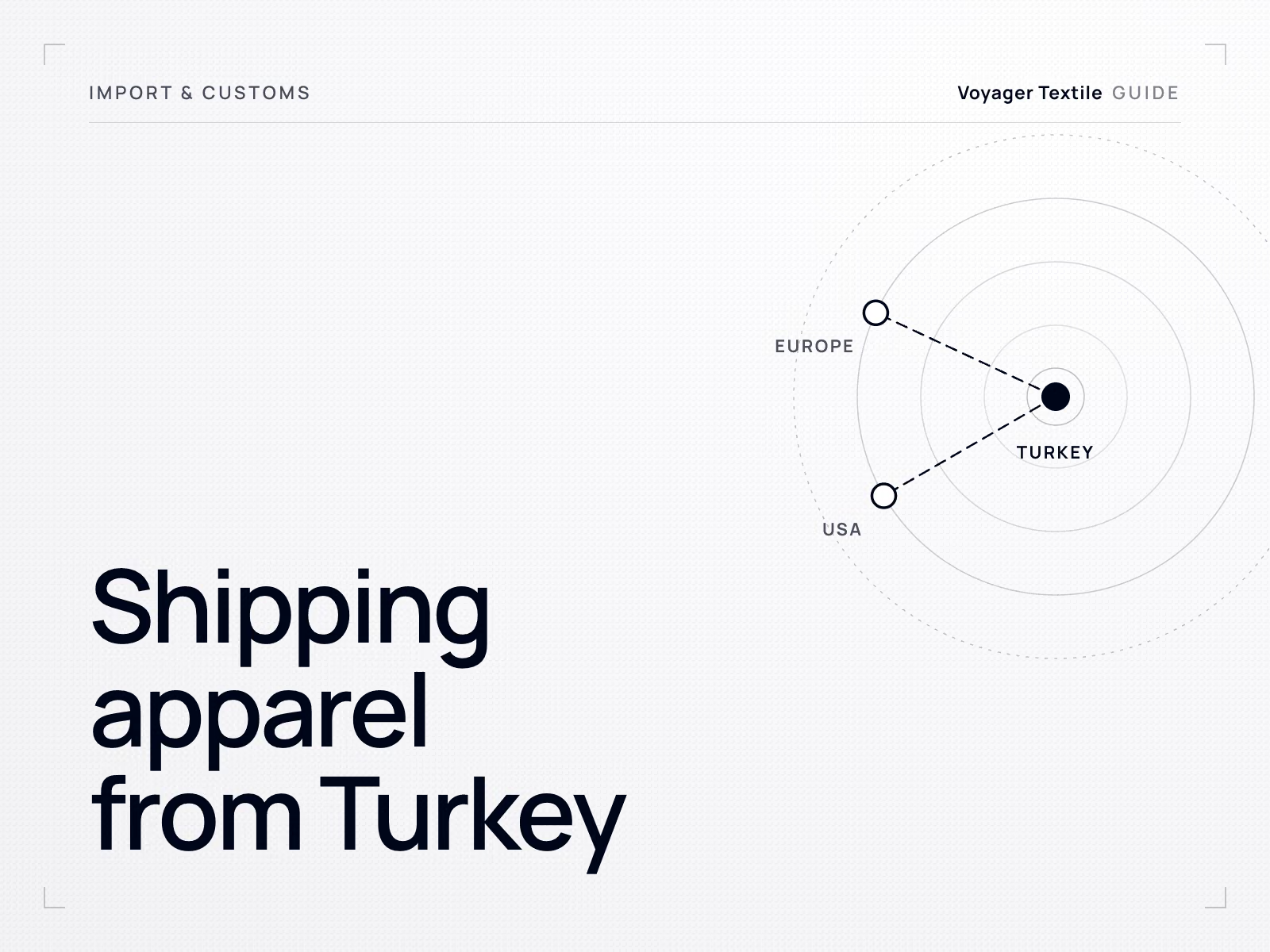
Shipping Apparel from Turkey to Europe and the USA
Two decisions govern everything else: which Incoterm applies, which sets where the seller's responsibility ends, and who is the importer of record in the destination country. Settle both at quotation stage, because a price without an Incoterm cannot be compared with anything.
Contents
- Incoterms: what you are actually agreeing
- Never compare two prices on different terms
- Routes and modes from Turkey
- Shipping into the European Union
- Shipping into the United States
- The documents a shipment needs
- What the buyer is responsible for
- Practical points that save time
- How this works with Voyager Textile
- Questions buyers ask
Production ends at the factory gate. Your deadline is at your warehouse, and the distance between the two is a series of decisions that are much easier to make before an order than after it. This guide covers how apparel actually moves out of Turkey, what has to be agreed, and what the buyer is responsible for.
Incoterms: what you are actually agreeing
Incoterms are standard trade terms published by the International Chamber of Commerce, currently in the Incoterms 2020 edition. They define where the seller's responsibility ends and the buyer's begins: who arranges transport, who bears the cost at each stage, where risk transfers, and who handles export and import formalities. They do not decide payment terms or transfer of ownership.
| Term | Seller's responsibility ends | Suits |
|---|---|---|
| EXW, ex works | When goods are made available at the factory | Buyers with their own forwarder and full control of the route |
| FCA, free carrier | When goods are handed to the buyer's carrier at the named place, export cleared | Road and container shipments, including from Turkey into Europe |
| FOB, free on board | When goods are on board the vessel at the named port | Sea freight only, not road or air |
| CFR and CIF | Carriage to the destination port, with insurance in CIF | Sea freight where the seller books the main carriage |
| CPT and CIP | Carriage to the named destination, with insurance in CIP | Any mode, including multimodal shipments |
| DAP and DPU | Delivery at the named destination, unloaded in DPU; import clearance is the buyer's | Buyers who want door delivery but will clear customs themselves |
| DDP, delivered duty paid | Delivery with import clearance and duties paid by the seller | Buyers wanting a fully landed price, where the seller can act in the destination country |
Two practical points. FOB, CFR and CIF are written for sea and inland waterway transport, so using FOB for a truck leaving Turkey by road or for an air shipment is a common and avoidable error. FCA is normally the correct term for container and road movements. And DDP places import clearance on the seller, which requires the seller to be able to act as importer in your country; many manufacturers cannot, so do not assume DDP is available simply because it is convenient.
The current rules are published by the International Chamber of Commerce.
Never compare two prices on different terms
An EXW price and a DDP price for the same garment are not comparable, because one excludes transport, export handling, freight, insurance, duty and clearance and the other includes them. This is a frequent error in supplier comparison, and it can reverse the apparent ranking of two quotations.
State the Incoterm and the named place in every request for quotation, and convert every reply to the same basis before comparing. The RFQ guide includes it in the list of things to send.
Routes and modes from Turkey
| Mode | Typical use | Considerations |
|---|---|---|
| Road freight to Europe | The standard route into the EU and the UK | Fast, usually a few days across the continent; full or part loads |
| Sea freight | Larger volumes, and many shipments to the United States | Lowest cost per piece, longest transit, plus port handling and inland delivery |
| Air freight | Urgent shipments and high-value or low-volume goods | Fastest and most expensive; charged on the greater of actual or volumetric weight |
| Rail and multimodal | Specific corridors and combinations | Availability and transit depend on the route; confirm with your forwarder |
Air freight is where packing decisions become expensive. Because charges are based on volumetric weight where that exceeds actual weight, bulky garments such as heavyweight hoodies cost more to fly than their weight suggests. If air is likely, discuss carton sizes and compression before packing is finalised, as covered in the labels and packaging guide.
Shipping into the European Union
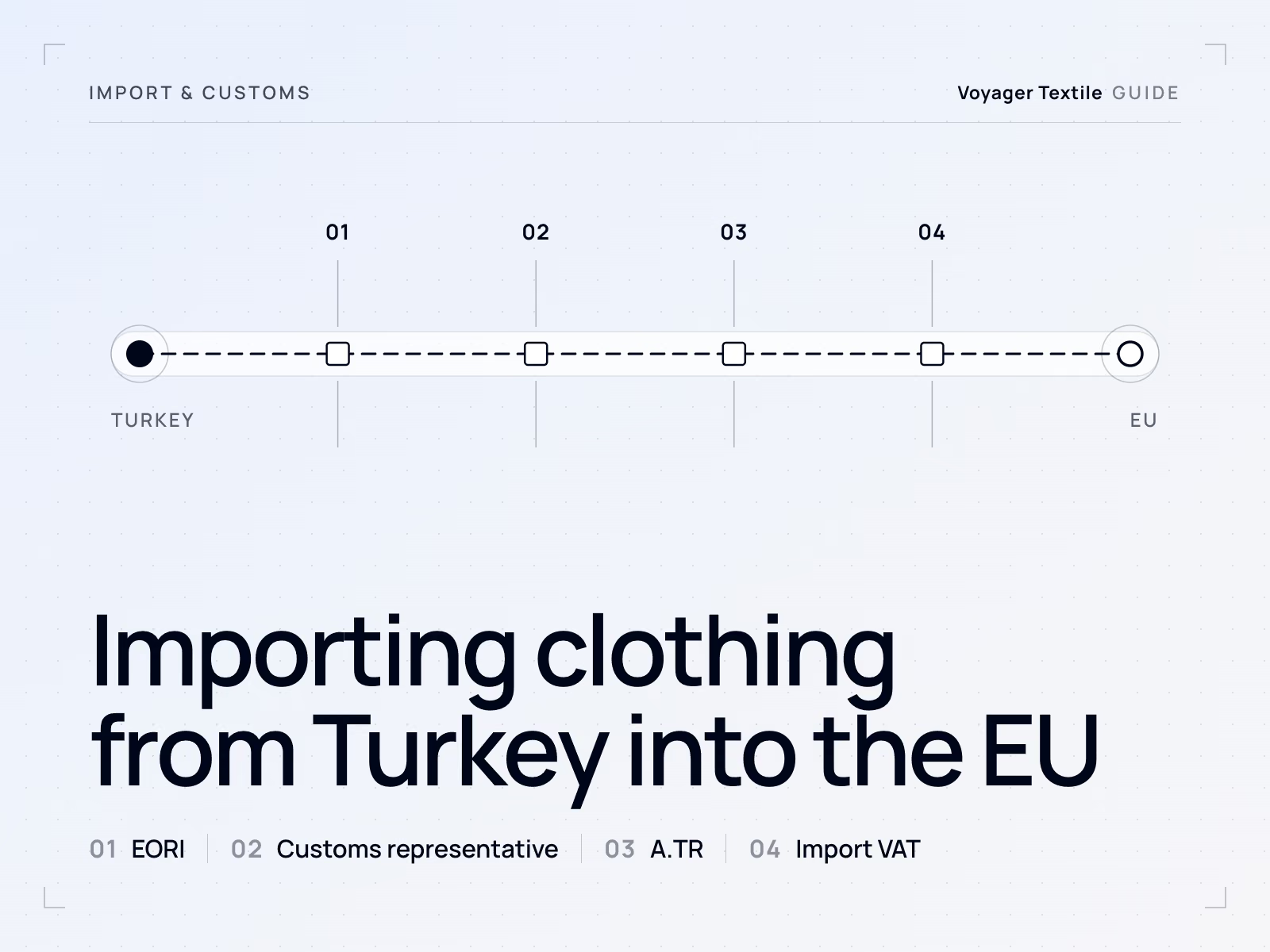
Industrial goods, including apparel, circulate free of customs duty between the EU and Türkiye under their customs union, provided the goods are in free circulation and the shipment is accompanied by an A.TR movement certificate. This is a genuine structural advantage for European buyers and one of the reasons Turkish production is competitive on landed cost, as discussed in the Turkey and China comparison and in the wider view of apparel manufacturing in Türkiye.
- Confirm that an A.TR will be issued for your shipment, and that your forwarder and broker know to expect it. It evidences free circulation rather than origin, a distinction set out in what an A.TR proves.
- Import VAT and any national charges still apply, even where customs duty does not.
- Keep in mind that the customs union covers industrial products; other categories follow different arrangements.
- For the United Kingdom, a separate arrangement applies and preferential treatment depends on rules of origin and correct documentation. Confirm the position for your product with your customs broker.
Official information on the customs union is published by the European Commission through Access2Markets.
Shipping into the United States
There is no equivalent duty-free arrangement, so apparel from Turkey is a dutiable import. The importer of record is responsible for classification, valuation, duty and compliance.
- Classify every style under the Harmonized Tariff Schedule before shipping, since apparel classification is detailed and drives the duty rate.
- Check the current rate close to your shipping date, because tariff measures have changed repeatedly since 2025.
- Arrange a customs bond for formal entries, either single transaction or continuous.
- Ensure country of origin marking meets both customs and labelling requirements, as covered in the US labelling guide.
- Hold supply-chain documentation for fibre origin, since forced-labour due diligence rests with the importer.
The documents a shipment needs
- Commercial invoice, with an accurate description, quantities, values and the Incoterm.
- Packing list, with carton contents, counts, dimensions and gross and net weights.
- Transport document: a CMR for road, a bill of lading for sea, an air waybill for air.
- A.TR movement certificate for goods in free circulation moving between Türkiye and the EU.
- Certificate of origin where the destination or your customer requires it.
- Export declaration on the Turkish side.
- Any product-specific documentation your broker or customer requires, such as test reports or material certificates.
Errors in the invoice and packing list are a common cause of delay at clearance, and they are entirely preventable. Check descriptions, quantities and values against the actual shipment before it leaves.
What the buyer is responsible for
- Choosing the Incoterm and named place, and stating it in the order.
- Appointing a freight forwarder and a customs broker, unless the term places that on the seller.
- Acting as importer of record, or appointing someone who will.
- Paying duties, import VAT and clearance charges as the term allocates them.
- Arranging insurance where the term does not include it. Do not assume goods are insured because they are in transit.
- Confirming that labelling and marking meet the destination country's requirements before shipment, not on arrival.
- Providing the delivery address and receiving constraints, including any unloading limitations.
Practical points that save time
- Agree packing and carton marking before production ends. Repacking at origin is expensive and repacking at destination is worse.
- Ask for carton dimensions and weights before booking freight, so the forwarder quotes on real figures.
- Decide flat-packed or hanging garment shipment early, since it changes packing, carton and transport requirements.
- For programmes with several deliveries, plan shipments alongside production rather than treating each as a separate exercise, as covered in the scaling guide.
- If your date is tight, ask what the realistic transit and clearance time is for your destination rather than only the production time. See the lead time guide.
How this works with Voyager Textile
Voyager Textile prepares the commercial documentation international shipments require and coordinates handover to your forwarder or your agreed logistics arrangement. The applicable Incoterm and delivery arrangement are agreed per project rather than fixed, so raise your preferred term at quotation stage and it will be priced on that basis. Export preparation is part of the standard production sequence described in how we work.
Questions buyers ask
Which Incoterm should I use for apparel from Turkey?
FCA is normally the right term for road and container shipments, since it covers handover to your carrier with export clearance completed. FOB applies to sea freight only. DDP gives a fully landed price but requires the seller to handle import clearance in your country, which is not always possible.
Is FOB correct for a truck shipment?
No. FOB, CFR and CIF are written for sea and inland waterway transport. For road freight or air freight, FCA, CPT or CIP are the appropriate terms. Using FOB for a truck is a frequent source of confusion about where risk transfers.
Do I pay customs duty on apparel imported from Turkey into the EU?
Industrial goods including apparel circulate free of customs duty under the customs union between the EU and Türkiye when accompanied by an A.TR movement certificate and in free circulation. Import VAT and national charges still apply. Confirm documentation with your forwarder for each shipment.
What is an A.TR certificate?
A movement certificate evidencing that goods are in free circulation between Türkiye and the EU under their customs union, which is what allows industrial goods to move without customs duty. Confirm it will be issued for your shipment and that your broker expects it.
How long does shipping from Turkey take?
Road freight into Europe typically takes a few days, depending on destination and border crossing. Sea freight to the United States takes weeks, plus port handling and inland delivery. Air freight is fastest and most expensive. Add clearance time at the destination in every case.
Who is the importer of record?
The party responsible for the customs entry in the destination country, including classification, valuation, duty and compliance. It is normally the buyer, unless the Incoterm is DDP and the seller can act as importer there. Establish this before the order rather than at arrival.
Are goods insured during transit?
Only if someone arranged it. Some Incoterms require the seller to provide insurance, others do not. Check which applies to your term and arrange cover yourself if it does not, rather than assuming it is included.
Why is my air freight quote higher than the weight suggests?
Air freight is charged on the greater of actual weight and volumetric weight. Bulky garments such as heavyweight hoodies take up more space than their weight implies. If air freight is likely, discuss carton sizes and packing density before packing is finalised.
Agree the delivery terms with the quotation
Tell us your destination and preferred Incoterm when you enquire, and the quotation will be built on that basis. We prepare the export documentation and coordinate handover to your forwarder.
Request a delivered quotation