Compliance and shipping
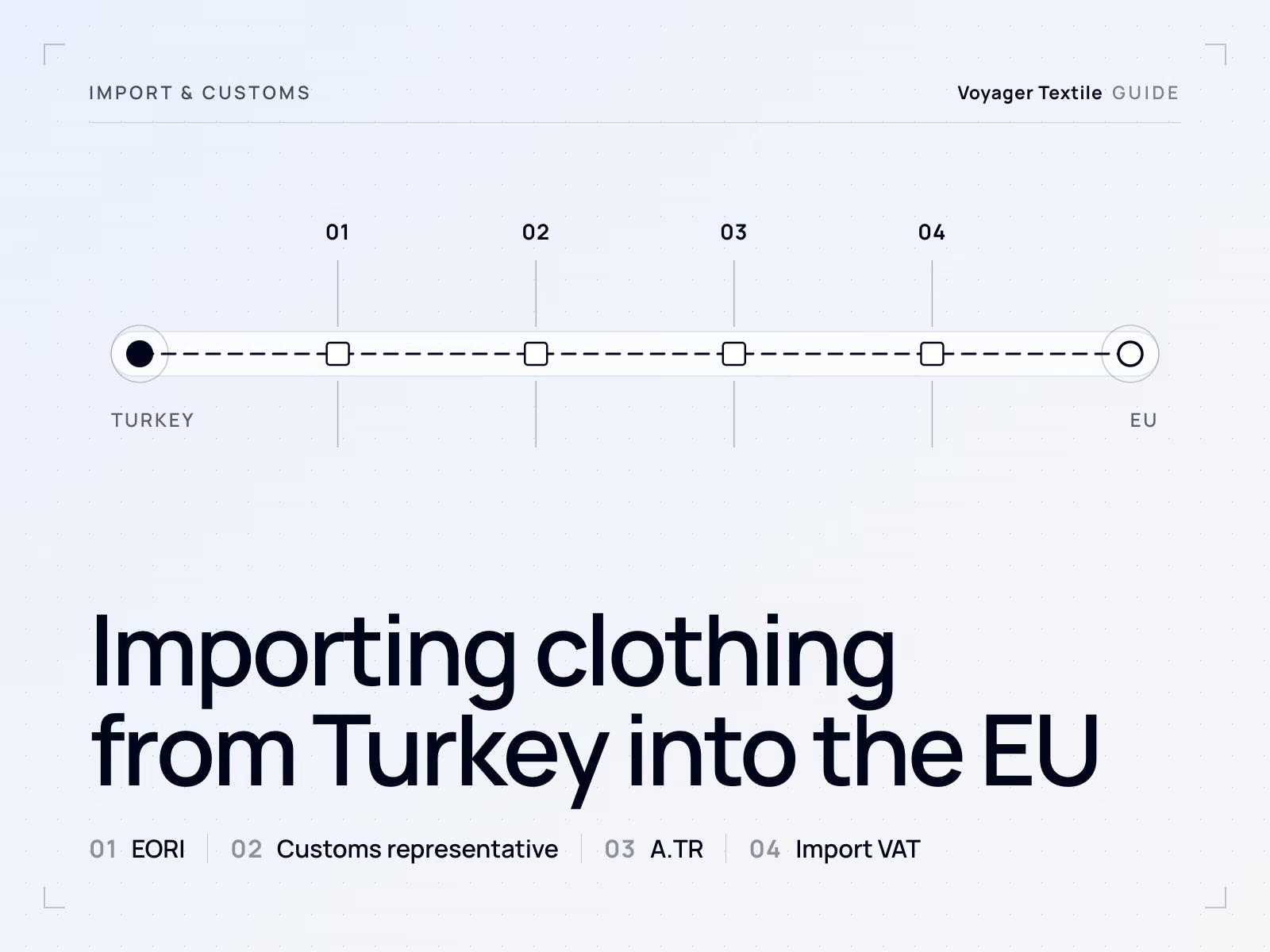
Importing Clothing from Turkey into the EU: EORI, Customs Representative, A.TR and Import VAT
Clothing from Türkiye in free circulation, travelling with an A.TR movement certificate, pays no EU customs duty. It is still an import: the goods need a customs declaration lodged by a declarant established in the EU with an EORI number, often through a direct or indirect customs representative, and import VAT is due in the Member State of import, deductible for a business that is entitled to deduct it.
Last reviewed:
Contents
- What the customs union removes, and what it leaves
- Step 1: an EORI number
- Step 2: who lodges the declaration: direct or indirect representation
- Step 3: the A.TR, and why the EUR.1 is not the document for garments
- Step 4: import VAT and how it is accounted
- Import to Austria
- Packaging licensing: pointers only
- The importer's product-compliance duties
- How a Turkish manufacturer's documents fit
- Questions buyers ask
Confirm product classification, origin and documentation with your customs representative for the destination market and date of import.
What the customs union removes, and what it leaves
The customs union removes the duty, not the import. The Commission's Taxation and Customs Union service describes it as covering goods wholly produced in, or put into free circulation in, Türkiye or the EU, under Decision No 1/95 of the EC–Turkey Association Council of 22 December 1995; agricultural products and coal and steel products stay outside it and trade under separate agreements. Garments are industrial products, so they move without customs duty when the goods are in free circulation and an A.TR accompanies them.
What remains is the customs formality and the tax. The goods are declared for release for free circulation, import VAT is charged in the Member State of import, and the party placing them on the EU market takes on product-compliance duties. How the EU, UK and US answers differ for the same production run is set out in one production run, three markets.
Step 1: an EORI number
Anyone who lodges a customs declaration in the EU needs an EORI number. Under Article 9 of the Union Customs Code (Regulation (EU) No 952/2013), economic operators established in the EU register with the customs authorities where they are established; operators not established in the EU register where they first lodge a declaration or apply for a decision. The Commission's EORI guidance adds that one number is used across the whole customs territory.
Germany. The EORI number is issued free of charge by the Generalzolldirektion, Dienstort Dresden. Zoll states that from 1 October 2026 applications must go through the Zoll-Portal, and that the paper form 0870 is accepted only in exceptional cases after 30 September 2026. The Austrian procedure is in the Austria section below.
Step 2: who lodges the declaration: direct or indirect representation
The declarant must be established in the EU. Article 170(2) of the Union Customs Code says so, with narrow exceptions for transit, temporary admission, occasional declarations the authorities accept, and declarants from adjacent countries at the border. A Turkish exporter therefore cannot declare the goods into free circulation itself as a matter of routine, and an EU buyer usually hands the work to a customs representative.
| Direct representation | Indirect representation | |
|---|---|---|
| The representative acts | In the name of and on behalf of the importer | In its own name but on behalf of the importer |
| Declarant | The importer | The representative |
| Debtor for any customs debt | The importer (the declarant) | The representative and the person represented, both (Article 77(3)) |
| Typical use | An EU buyer that is itself importer, using a broker | A seller or importer not established in the EU, for example under a DDP sale |
Under Article 18(2) the representative must itself be established in the EU. Under Article 19 it must state whether it acts directly or indirectly, and a person who acts without being empowered is treated as acting in its own name. The choice matters beyond duty, because Germany and Austria apply customs rules correspondingly to import VAT (§ 21(2) UStG in Germany, § 26(1) UStG 1994 in Austria), so the representation you pick also decides who answers for the import VAT.
Step 3: the A.TR, and why the EUR.1 is not the document for garments
The A.TR movement certificate is the document that lets garments cross without duty. Turkish customs issue it at the exporter's request under Decision No 1/2006 of the EC–Turkey Customs Cooperation Committee, and it evidences that the goods are in free circulation, which is a customs status. It does not certify where the goods were made. Since 8 July 2024 EU Member States accept A.TR certificates issued electronically by the Turkish authorities with a QR code and without a wet-ink signature. A 2026 Commission proposal (2026/0270 (NLE)) would replace Decision No 1/2006 with a new decision, so confirm the current rules with your representative.
The EUR.1 is a proof of preferential origin. It belongs to preferential arrangements with their own rules of origin, which in EU–Türkiye trade means the products outside the customs union, such as agricultural and coal and steel products. For garments, the A.TR is the document your representative expects. Origin is still declared on the import and can matter for other measures and for any origin claim on the label, as the A.TR guide explains.
Step 4: import VAT and how it is accounted
Import VAT is due even when customs duty is nil. Under the VAT Directive (Council Directive 2006/112/EC), VAT becomes chargeable when goods are imported (Article 70). The taxable amount is the customs value (Article 85) plus taxes, duties and charges due by reason of the import and incidental costs such as commission, packing, transport and insurance up to the first place of destination in the Member State of import (Article 86). The Member State of import designates who pays (Article 201).
- Where it is due. The Member State where the goods enter the EU (Article 60). If they travel under external transit, for example by truck through Bulgaria, it is the Member State where they leave transit (Article 61).
- How it is paid. Member States may let businesses enter import VAT in the VAT return instead of paying it at the border (Article 211). Each country sets its own rule, which is why the German and Austrian methods below differ.
- How it comes back. A business deducts import VAT on goods used for its taxed transactions (Article 168(e)) in the Member State of import, which in practice needs a VAT registration there.
Germany. Einfuhrumsatzsteuer is assessed and collected by customs together with any duty. A business deducts it as input tax under § 15(1) no. 2 UStG, with the customs import duty notice or the electronic ATLAS notice as proof. An importer with a deferment account (Zahlungsaufschub, Article 110(b) UCC, applied for on form 0580) pays deferred import VAT by the 26th day of the second following month (§ 21(3a) UStG), and deferment without security is available only for import VAT that is fully deductible.
Import to Austria
Austria collects import VAT through the tax office account rather than by deferment. Under § 26(3) no. 1 UStG 1994 the Zollamt Österreich assesses the Einfuhrumsatzsteuer, but under § 26(3) no. 2 the tax office collects it when three conditions are met: the debt arose under Article 77 of the Union Customs Code and is not a later correction; the debtor is a business registered for VAT in Austria importing for its business; and the debtor declares in the customs declaration that it uses this rule.
- Timing. Import VAT booked this way falls due on the 15th of the month after booking, and at the earliest on the 15th of the second month after the VAT period in which it arose (§ 26(5)(a)). It is booked together with the VAT account, so it can be deducted in the same return.
- Indirect representation. The declarant acting as indirect representative is not liable for the import VAT if it holds the importer's written instruction to use the account method (§ 26(5)(e)).
- From 1 January 2027. An amendment (BGBl. I Nr. 62/2026) lets the authorities require collection by customs for up to two years where a financial offence is suspected.
- EORI. Since 6 June 2024 Austrian businesses self-register through the Portal Zoll, which legal persons reach through the Unternehmensserviceportal (USP) and natural persons through FinanzOnline.
Where Austria differs from Germany: Austria's route is the tax office account under § 26(3) no. 2, Germany's is payment to customs with an optional deferment account, and the EORI portals differ. The Union Customs Code rules on declarants, representation and the A.TR are the same in both.
Packaging licensing: pointers only
Polybags, cartons and hangtags can make the importer a packaging producer. The EU Packaging and Packaging Waste Regulation (EU) 2025/40 applies from 12 August 2026, and the national schemes continue alongside it. In Austria, the ministry's June 2026 fact sheet on the regulation confirms that the Verpackungsverordnung 2014 still applies, that household packaging is licensed with a collection and recovery system (Sammel- und Verwertungssystem), and that the importer of packaged goods is the primary obligated party. In Germany, a producer under the regulation registers in the LUCID Packaging Register and joins a system for packaging that ends up with private final consumers; a foreign company selling directly to German consumers without a branch appoints an authorised representative. The packing specification itself is covered in folding and polybagging.
The importer's product-compliance duties
The party that places the garments on the EU market carries duties that a customs representative does not. Three sets apply to consumer clothing, and each has its own guide.
- Product safety. Under Article 11 of the General Product Safety Regulation (EU) 2023/988, an importer checks before placing a product on the market that it meets the general safety requirement and that the manufacturer has done its part, puts its name, registered trade name or trade mark and postal and electronic address on the product, packaging or an accompanying document, and keeps the technical documentation for 10 years. See GPSR for apparel.
- Fibre labelling. Under Article 15(1) of Regulation (EU) No 1007/2011, when the manufacturer is not established in the EU, the importer ensures the fibre label is supplied and accurate; a distributor selling under its own brand counts as manufacturer (Article 15(2)). See EU apparel labelling compliance.
- Textile EPR. Directive (EU) 2025/1892 requires every Member State to set up extended producer responsibility for textiles, with registration and fees set nationally. See EU textile EPR and who is the producer.
How a Turkish manufacturer's documents fit
| Document | Comes from | Used for |
|---|---|---|
| Commercial invoice | The manufacturer or exporter | Customs value and the import VAT base |
| Packing list | The manufacturer or exporter | The declaration and any physical check |
| A.TR movement certificate | Exporter, endorsed by Turkish customs | Duty-free release as goods in free circulation |
| CMR, bill of lading or air waybill | The carrier or forwarder | Transport and, where used, the transit movement |
| Turkish export declaration | Turkish customs | Export from Türkiye only |
Routes, Incoterms and transit times are covered in shipping apparel from Turkey. If the A.TR is missing or does not match the invoice, the representative cannot claim the duty-free treatment on that declaration, so check the certificate against the invoice before the goods leave.
Before the first shipment leaves Türkiye
- Confirm the EORI number of whoever will be declarant.
- Appoint a customs representative and agree in writing whether it acts directly or indirectly.
- Decide how import VAT will be paid: at the border, by deferment in Germany, or through the tax office account in Austria.
- Ask the exporter to confirm that an A.TR will be issued and that it will match the invoice.
- Check the product-safety, fibre-label and packaging obligations that come with being the importer.
Questions buyers ask
Do I need an EORI number to import clothing from Turkey?
Yes, the declarant needs an EORI number to import clothing from Türkiye. Under Article 9 of the Union Customs Code, EU businesses register where they are established. In Germany it is free and applied for through the Zoll-Portal; in Austria through the Portal Zoll.
Is clothing from Turkey duty-free in the EU?
Clothing from Türkiye in free circulation, accompanied by an A.TR movement certificate, enters the EU without customs duty under the EU–Türkiye customs union. Import VAT is still charged in the Member State of import.
What is the difference between direct and indirect customs representation?
A direct representative acts in the importer's name, so the importer is declarant and debtor. An indirect representative acts in its own name on the importer's behalf, and both are debtors (Union Customs Code Articles 18 and 77(3)).
Do I need an A.TR or an EUR.1 for garments from Turkey?
Garments from Türkiye need an A.TR movement certificate, which shows free-circulation status under the customs union. The EUR.1 is a proof of preferential origin used for products outside the customs union, such as agricultural and coal and steel products.
How is import VAT paid on clothing imported into Austria?
Import VAT on clothing imported into Austria is assessed by the Zollamt Österreich. A business registered for VAT in Austria can opt in the customs declaration to have it booked to its tax office account and deducted in the same VAT return (§ 26(3) no. 2 UStG 1994).
Who is responsible for the label and product safety when importing clothing?
The importer is responsible when the manufacturer is outside the EU. It must ensure an accurate fibre label (Regulation (EU) No 1007/2011, Article 15) and meet the GPSR importer duties, including its name and address on the product or packaging (Regulation (EU) 2023/988, Article 11).
Ship with the documents your representative expects
We prepare the commercial invoice and packing list and arrange the export side so the A.TR matches them, and we confirm the document set at quotation. The EU declaration, the import VAT and the importer's compliance duties stay with you and your customs representative.
Discuss an EU order