Compliance and shipping
Who Is the Producer Under Textile EPR?
The factory that made the garment is not automatically the producer, and the brand is not automatically the producer either. The definition turns on establishment, on whose name the product carries, and on who first makes it available in a specific Member State, so the answer changes with the market and the structure, not with the sewing.
Contents
- Start with the market, not with the company
- The definition, limb by limb
- The physical factory
- Private label does not answer the question
- Distance selling, and authorised representatives
- National definitions sit on top of the EU one
- What a contract can and cannot do
- What to actually ask the factory for
- Keeping the answer per market
- Questions buyers ask
The question usually arrives in the wrong shape. A buyer asks a factory whether its garments are EPR compliant, or a factory is asked to confirm it is registered somewhere. Neither question has an answer, because extended producer responsibility does not attach to a garment and it does not attach to whoever manufactured it. It attaches to an entity, in a market, in a particular commercial structure.
Start with the market, not with the company
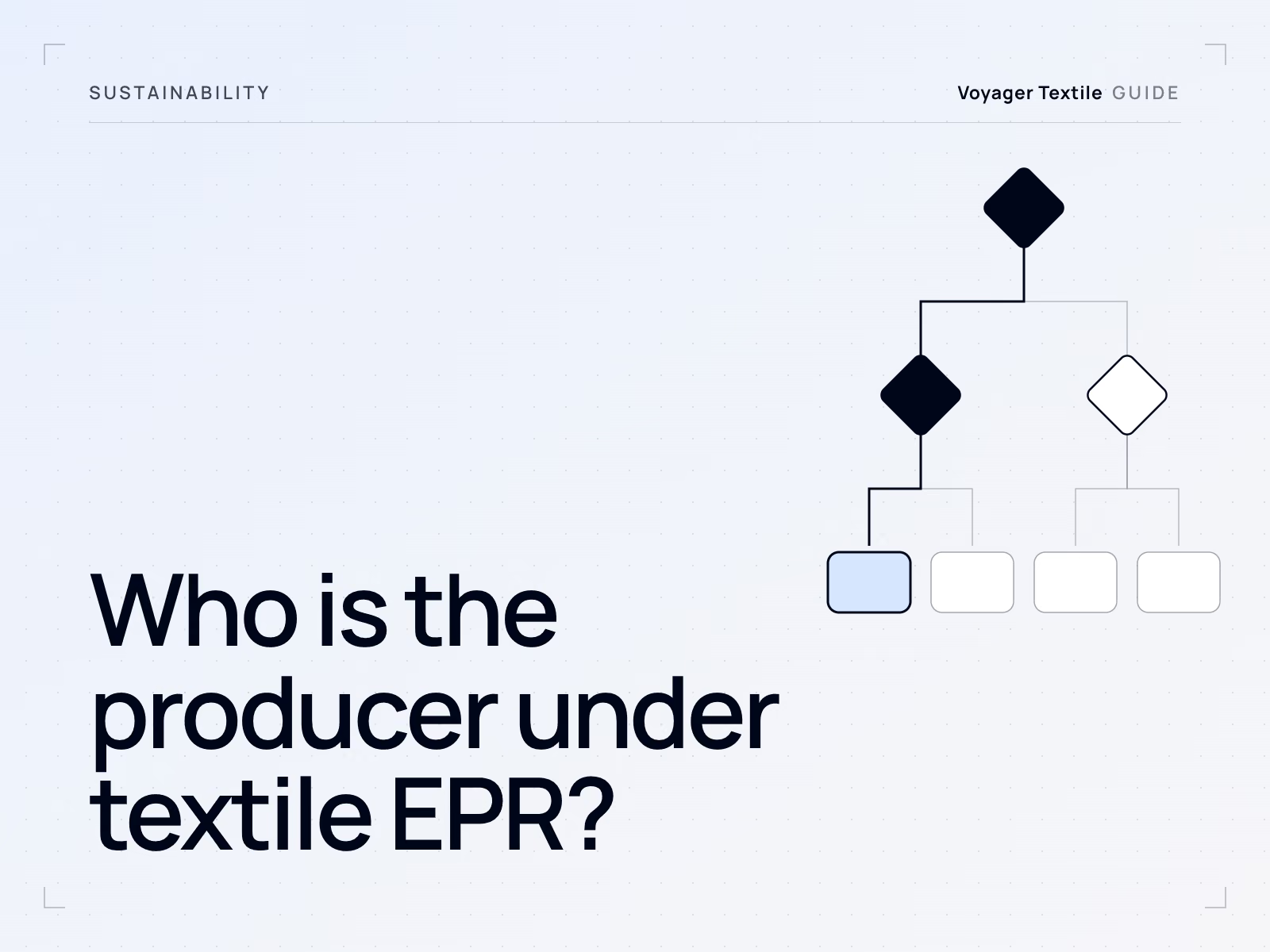
The order the questions have to be asked in
Conceptual role-assessment flow, not a legal determination. Question two is often skipped.
Working from the company outwards produces the wrong answer, because the same company can be the producer in one Member State and not in another. Working from the market inwards produces a question that can actually be answered: for this product, placed in this Member State, by this entity, under this arrangement, does the definition catch it?
There is no such thing as being an EPR producer in the EU. There is being a producer in the Netherlands, or in France, or in Poland, and the analysis has to be repeated for each. Which products are in scope at all is set by the framework's product list, described in EU textile EPR.
The definition, limb by limb
The Directive inserts a textile-specific definition into the waste directive. It covers any manufacturer, importer, distributor or other natural or legal person that, irrespective of the selling technique used, including distance contracts, meets any one of four descriptions. They are worth reading separately, because they catch different entities.
| Limb | Who it catches |
|---|---|
| (a) Own name or trademark | An entity established in a Member State that manufactures covered products under its own name or trademark, or has them designed or manufactured and supplies them for the first time under its own name or trademark, in that Member State |
| (b) Rebranded resale | An entity established in a Member State that resells there, under its own name or trademark, products made by others whose name, brand or trademark does not appear on them |
| (c) First professional supply | An entity established in a Member State that supplies covered products there for the first time on a professional basis, from another Member State or from a third country |
| (d) Distance selling in | An entity established in another Member State or in a third country that sells covered products by distance contract directly to end users in a Member State, whether or not those end users are private households |
Note also what the framework means by making a product available: any supply for distribution or use on a Member State's market in the course of a commercial activity, whether in return for payment or free of charge. Giving garments away commercially is still making them available, which matters for promotional and staff programmes.
The physical factory
Supplying the data is not carrying the obligation
Which entity carries the right-hand column depends on the market and the structure, not on who sewed the garment.
A Turkish factory manufacturing to a European brand's specification is not the producer by virtue of having manufactured. It is not established in a Member State, so three of the four limbs are closed to it before any other fact is considered. The remaining limb requires selling by distance contract directly to end users in a Member State, and supplying a brand that resells is not a sale to an end user.
That is the ordinary case and it is not a universal exemption. A manufacturer that sells directly into a Member State, its own web shop, its own direct sales to companies that will use the garments rather than resell them, is doing something the fourth limb describes, and the answer changes. What decides it is the commercial structure, not the country the sewing happened in.
Private label does not answer the question
It is tempting to treat private label as a rule: our label is on it, so we are the producer. That gets the right answer often enough to be dangerous, because it works by coincidence rather than by reasoning, and it fails as soon as the structure is slightly unusual.
- Whose name or trademark is on the product? That is the hinge of the first two limbs.
- Which entity is established where? A group with an EU entity and a non-EU entity has two different answers available depending on which one contracts.
- Which entity first makes the product available in that Member State? Not which one owns the brand, and not which one paid for it.
- Is it an import into that market, and by whom on a professional basis?
- Is any of it a distance sale to an end user in that market from outside it?
- Is this the same in the next Member State? Usually it is, and where the route to market differs, it is not.
The related question buyers ask, whether the importer is the producer, has the same shape. Sometimes, and specifically where that importer is the entity established in the Member State supplying the product there for the first time on a professional basis. Importing is relevant because of what the definition says about first supply, not because importer is a status that carries over from somewhere else.
Distance selling, and authorised representatives
The framework treats selling into a market from outside it as a distinct case, and the drafting distinguishes two situations that are often reported as one.
| Where the distance seller is established | What the framework says |
|---|---|
| Another Member State | Member States shall ensure it appoints, by written mandate, an authorised representative established in the market it sells into, to fulfil the producer obligations there |
| A third country | Member States may provide that it is to appoint such an authorised representative |
So for third-country sellers this is a national choice rather than an EU-wide requirement, and whether a representative is needed has to be checked market by market. Where one is appointed, the obligations can be met on the producer's behalf by a scheme organisation appointed under written mandate.
There is also a practical enforcement route that makes the question unavoidable for anyone selling online. Online platforms allowing consumers to conclude distance contracts must obtain a producer's registration details and registration number in the Member State where the consumer is located before allowing that producer to use the service, along with a self-certification about compliance. Equivalent information has to reach fulfilment service providers. Whatever a seller concludes about its own status, the marketplace will ask.
National definitions sit on top of the EU one
The EU definition is what Member States must implement. What a producer deals with day to day is the national version, and those can be expressed in local terms that do not look like the Directive at all.
France is the clearest example. Its long-established scheme describes the responsible party through a national test, the company invoicing French VAT for the first time on a covered product intended for end consumers, and lists manufacturers or principals selling under their own name or brand, importers, private-label distributors, and online sellers or marketplaces including those established abroad. That test is a workable proxy in French practice. It is not the EU definition, and applying it to another Member State would be a mistake.
Scope differs too, not just the role test. The Dutch scheme covers consumer clothing, workwear and household textiles; the French scheme gives products intended exclusively for professional use as excluded. Both positions are current and both are national. The comparison is set out in EU textile EPR.
What a contract can and cannot do
Two shortcuts are worth closing off, because both appear regularly in sourcing conversations.
Commercial arrangements against statutory status
What the parties can agree
- Who provides which product data, and by when
- Who bears the cost of a contribution commercially
- Who completes an operational task
- What happens if data is late or wrong
- Which records are kept, and for how long
What agreement does not change
- Which entity the definition treats as the producer
- Which market's register that entity must appear in
- Whether registration precedes the first sale
- Whether a representative is required
- Who the authority will look for
The first shortcut is the delivery term. An Incoterms rule allocates delivery, cost and risk between seller and buyer, and it is not a statement about environmental producer status. A DDP shipment does not make the seller the producer, and an EXW shipment does not make the buyer one; the definition asks who is established where and who first makes the product available, and the delivery term answers neither. What Incoterms actually allocate is in payment terms and Incoterms.
The second is the purchase order. An order is a good place to record that a supplier will provide net weight per unit, composition and category mapping with each shipment, and that is worth doing. It is not a place to reassign a statutory role, and a clause saying the supplier is responsible for EPR does not make the supplier the producer. How an order should carry requirements by reference is in apparel purchase orders.
What to actually ask the factory for
The productive version of this conversation is not a compliance statement. It is a data request, made early enough that it costs nothing.
- Product category and classification, mapped to your own SKU structure, since registration and reporting are classification-based
- Fibre composition, which you already hold for labelling
- Net weight per unit of the product itself, because contributions are weight-based
- Quantities shipped, per style and per destination
- Country of manufacture and the production records behind the above
None of this makes the supplier the producer. Providing accurate data is exactly what a supplier should do and exactly what it does not transfer. A factory that measures net garment weight per size and reports it consistently is being useful; it is not thereby registered anywhere and cannot confirm anything about your obligations.
Keeping the answer per market
Because the analysis is repeated for each Member State, the useful artefact is a short record rather than a conclusion. One row per market, filled in from the questions above.
| Column | What it records |
|---|---|
| Member State | The market the product is placed on |
| Legal entity | Which of your entities supplies it there, and where that entity is established |
| Route to market | Domestic supply, import, or distance sale to end users from outside |
| Producer position | Which limb applies, if any, and the reasoning |
| Scheme status | Whether a national scheme is live today or still being transposed |
| Registration | Whether it is required before first sale, and the national identifier once held |
| Representative | Whether one is required for this route, and who |
| Reporting | What data is due, at what frequency, and who owns it internally |
| Contribution basis | What it is calculated on, and which supplier data feeds it |
The value is in the fourth column carrying reasoning rather than a verdict. A record that says the French entity is the producer because it is established there and supplies first under its own brand can be checked by somebody else. A record that says France: yes cannot.
Questions buyers ask
Is the clothing factory the EPR producer?
Not automatically. Producer status is tied to how the covered product is made available on a specific market under the applicable legal definition, not to who sewed the garment. Three of the four limbs of the definition require establishment in a Member State, which a non-EU factory does not have. The fourth catches distance selling directly to end users, which supplying a brand for resale is not. Equally, it is not correct to say a factory can never be the producer, the analysis depends on the structure.
Is the brand the producer?
Often, and for a specific reason rather than because it owns the label. An entity established in a Member State that has products designed or manufactured and supplies them there for the first time under its own name or trademark falls squarely within the first limb of the definition. If the brand is not established in that Member State, or is not the entity making the goods available there first, the answer can be different.
Is the importer the producer?
Sometimes, where the importer is the entity established in that Member State that supplies the products there for the first time on a professional basis from another Member State or a third country. Importing is relevant because of that first-supply test, not because importer status carries across from other legislation. The importer definitions used in product safety law are written for a different regime and do not transfer.
Does a non-EU seller need an authorised representative?
It depends on where the seller is established and what the Member State has decided. For a distance seller established in another Member State, the framework requires the appointment of an authorised representative in the market sold into. For a seller established in a third country, Member States may provide for that requirement rather than being obliged to, so it has to be checked market by market. Where appointed, the obligations can be discharged on the producer's behalf by a scheme organisation under written mandate.
Does selling only to businesses avoid producer status?
No. The distance-selling limb of the definition applies to sales directly to end users whether or not they are private households, so business customers are inside it. Separately, making available is defined as any supply for distribution or use on a market in the course of a commercial activity, whether paid for or free of charge, so promotional and staff distribution counts too. Whether a particular national scheme covers professional-use products is a further question that Member States currently answer differently.
Does an Incoterm like DDP determine who the producer is?
No. Incoterms rules allocate delivery obligations, cost and risk between a seller and a buyer. They say nothing about which entity is established where, whose name the product carries, or who first makes it available on a market, which is what the definition actually asks. A DDP shipment does not make the seller the producer, and an EXW shipment does not make the buyer one.
Can a contract move EPR responsibility to the supplier?
A contract can allocate who provides data, who bears a cost commercially and who performs an operational task, and recording that is sensible. It does not change which entity the legislation treats as the producer, which market's register that entity must appear in, or who an authority will approach. A clause stating that the supplier is responsible for EPR is a commercial arrangement, not a transfer of statutory status. Anything turning on this is a question for the parties' own legal advice.
What should a buyer ask its factory for?
Product data, not compliance statements: category and classification mapped to your SKUs, fibre composition, net weight per unit of the garment itself, quantities shipped per style and destination, and the production records behind them. Ask for it in the specification rather than a year later. Keep garment weight separate from packaging weight, because packaging is a different regime reported separately.
Is there an EPR certificate a supplier can provide?
There is no general EPR certificate and no single EU registration identifier. What exists, where an entity is registered, is national evidence, a registration entry in that Member State's producer register, an identifier issued there, membership of an authorised scheme organisation, and the declarations made to it. Those belong to the registered producer for that market, not to a supplier, and asking a factory for an EPR certificate will not produce a meaningful document.
Do we need to redo this analysis for every country?
Yes, and that is the framework working as intended rather than a defect. Registration is required in each Member State where covered products are first made available, national scope and role tests currently differ, and some markets have live schemes while others are still transposing ahead of the 2027 deadline. The efficient approach is to keep a short per-market record showing the reasoning, so it can be checked and updated rather than rebuilt.
Work out the role before you brief the range
What we can do is make sure the product data your own declaration will need, category, composition, net garment weight, quantities by destination, is defined in the specification instead of reconstructed afterwards.
Talk to us about a programme