Quantities, cost and timing
Payment Terms in Apparel Manufacturing
Payment in an apparel order has two separate axes that are constantly confused: when money becomes due, and through what mechanism it is paid and controlled. Neither is decided by the Incoterm, and neither settles who owns the goods. This guide explains the structures that exist, what each one does to the exposure on both sides, and what has to be agreed before anyone sends anything.
Contents
- Two questions, not one
- Incoterms are not payment terms
- The structures that exist
- What the risk actually looks like
- Open account, and the trigger problem
- Bank instruments, without the textbook
- Credit assessment, insurance and financing
- What payment terms do not protect
- What to settle before anyone pays anything
- Questions buyers ask
At some point in every new supplier relationship the conversation moves off the product and onto the money. It is often one of the less prepared-for parts of sourcing: a brand that can specify a hoodie to the millimetre will accept a payment line in a quotation without knowing what it commits them to, and a factory that measures everything will state terms without explaining why they are what they are.
This guide explains the mechanics. It does not tell you which structure to use, because that depends on the order, the relationship and what each side can carry. It also does not give legal advice: commercial documents create obligations, and what a particular clause means in a particular jurisdiction is a question for a lawyer, not a manufacturer's website.
Two questions, not one
Much of the misunderstanding in this area comes from collapsing two separate questions into a single phrase called payment terms.
The two axes
Timing: when money becomes due
- In full before production starts
- Part at order, the remainder at a defined milestone
- In full before the goods are shipped or released
- After shipment, or a stated period after a defined event
- The event that starts the clock matters as much as the number of days
Mechanism: how the obligation is executed
- An ordinary bank transfer, which is how most commercial payments settle
- A documentary credit, where a bank undertakes to pay against compliant documents
- A documentary collection, where banks pass documents but give no payment undertaking
- The mechanism can change the control and the evidence without changing the timing
The same timing can run through different mechanisms, and the same mechanism can carry different timings. Writing both down separately is a useful habit in this subject.
Incoterms are not payment terms
A quotation line reading FCA Izmir, part payment at order and the balance before shipment contains two entirely unrelated commercial concepts sitting next to each other. The delivery term settles where the seller's responsibility ends. The payment structure settles when money moves. Neither determines the other, and it is common to see a buyer assume that agreeing one has settled the other.
There is a third thing that neither of them settles. The International Chamber of Commerce is explicit that the Incoterms rules do not deal with the transfer of property, title or ownership in the goods, nor with the time, place, method or currency of payment of the price, and that the rules are not in themselves a contract of sale. Ownership is a matter for the contract and the law that governs it. Nor does a delivery term decide which party carries a regulatory role: producer status for textile end-of-life obligations is worked out from establishment and market placement, not from who paid the freight.
Three separate questions
Naming a delivery term settles the first column and nothing in the other two. Which Incoterm suits which shipment is covered in the shipping guide; this page is only about the boundary between them.
Which delivery term to use, why FOB is written for sea freight and FCA for road and container movements, and why a named place is required, are all covered in shipping and Incoterms. The current rules are published by the International Chamber of Commerce, currently in the Incoterms® 2020 edition.
The structures that exist
The following are the arrangements a buyer will actually meet in apparel. It is not an exhaustive list, and combinations are normal: a first order and a fifth order in the same relationship are frequently structured differently.
| Structure | How it works | What it does to the exposure |
|---|---|---|
| Payment in advance | The buyer pays in full before production begins | The buyer funds the whole order and holds the performance risk; the seller carries none of the receivable |
| Deposit and balance | Part paid at order or at material booking, the remainder at an agreed milestone | Splits the exposure. The deposit typically covers the supplier's committed material spend rather than being a fee |
| Payment before shipment | The balance falls due before the goods are released or shipped | The buyer pays without having received the goods; the seller does not release them without payment |
| Open account | The goods are shipped and payment falls due later, on agreed credit terms | The seller finances production and carries buyer-credit risk until the due date |
| Documentary collection | Banks pass shipping documents according to a collection instruction, against payment or against acceptance | Gives the seller control of the documents without a bank undertaking to pay |
| Documentary credit | A bank undertakes to pay against a compliant presentation of specified documents | Substitutes a bank's undertaking for the buyer's promise, at a cost and with strict document discipline |
What the risk actually looks like
It helps to stop thinking about payment terms as a question of trust and start seeing them as a question of who funds the gap. Between the moment a factory commits to materials and the moment money arrives, somebody is carrying the order. Payment timing decides who.
Who carries the order, and when
The earlier the payment, the more the buyer is exposed to performance. The later it is, the more the seller is exposed to non-payment. Instruments change how that exposure is carried and evidenced; none of them removes it.
Neither end of that line is unreasonable, and neither side is being difficult by preferring one. A buyer paying in advance for a first order from an unknown factory is taking a real risk and knows it. A factory shipping goods against a promise to pay in two months is financing that buyer's business and is entitled to say so plainly.
Why material commitments drive the deposit
A common misunderstanding about a deposit is that it is the supplier's margin taken early. Usually it is not. By the time production begins the factory has committed to things it cannot unwind: fabric bought or booked, yarn ordered, a dye lot scheduled, custom trims and labels produced to your brand, screens made or a logo digitised. Much of that spend has no value to anyone else, because it is specific to your product.
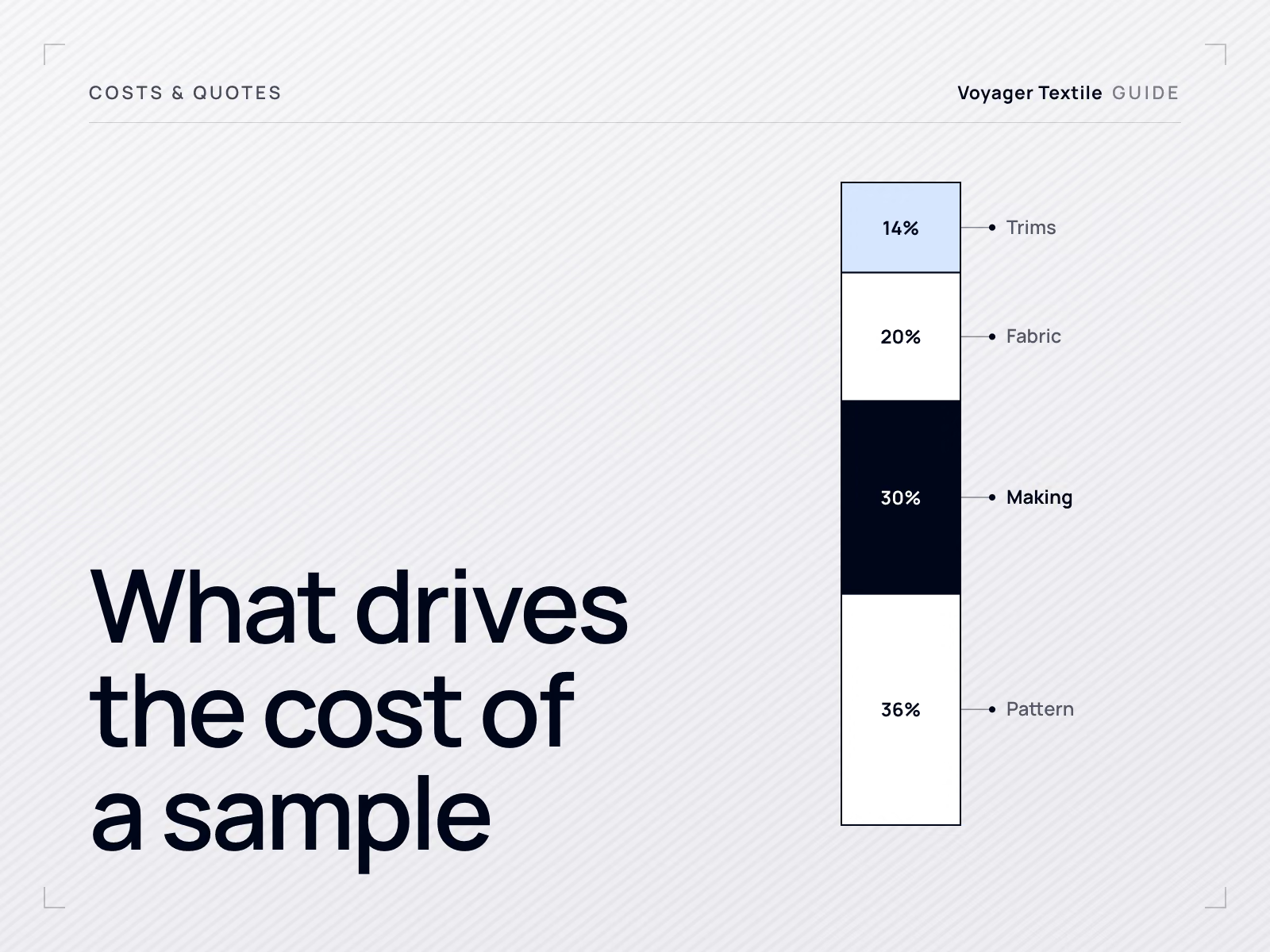
That is also why the deposit conversation and the sample conversation are separate. Development is its own economics, covered in what determines the cost of a sample, and sample payments and bulk payments are frequently handled as separate arrangements.
Why terms change with a track record
Payment structures are not a fixed property of a supplier. They typically reflect the exposure of the particular transaction: the order value, the material commitment, the length of the production and shipping cycle, the payment history between the two companies, and whatever credit assessment or insurance capacity sits behind the seller's decision. All of those change over time, which is why terms that were right for a first order are often revisited later.
The useful way to raise it is the one set out in the scaling guide: rather than asking once and accepting the first answer, ask what would need to be true for the terms to change. That question has an answer, and it is usually a specific one.
Open account, and the trigger problem
Open account means the goods ship and payment falls due later under an agreed credit term. It is the normal arrangement in a great deal of established trade, and it is not the same thing as paying when convenient. It is a defined due date, and defining it properly is where many disputes in this area start.
Consider a buyer asking for payment 30 days after delivery. That phrase looks precise and is not, because delivery is not one event.
- The date the goods were handed to the carrier at the factory
- The date they were loaded, or the date on the transport document
- The date they arrived at the destination port or terminal
- The date they cleared customs
- The date they were received at the buyer's warehouse
- The date somebody signed a proof of delivery
On a sea shipment those dates can be weeks apart, and on a delayed clearance they can be further apart than the credit period itself. The same ambiguity applies to the invoice: a term running from the invoice date behaves differently from one running from a delivery event, particularly if invoices are issued at shipment.
What extending credit actually costs a supplier
When a manufacturer agrees to post-shipment terms it is extending trade credit. Concretely: it has already paid for fabric, trims, labour and freight, and it now waits, carrying the receivable and the risk that it is not paid at all. For a business running several orders at once, that working-capital position is real and finite, and it is the honest reason a factory can decline terms it would otherwise be happy to give.
None of that is an accusation about a particular buyer. A supplier can think a customer is entirely good for the money and still not be able to carry three orders of it simultaneously.
Bank instruments, without the textbook
Two instruments come up in cross-border apparel trade often enough to be worth understanding properly. They are frequently spoken about as though they were the same thing with different names, and they are not.
Documentary credit, or letter of credit
A documentary credit is an undertaking given by a bank, at the buyer's request, to pay the seller against a presentation of specified documents that complies with the terms of the credit. The framework banks apply is the International Chamber of Commerce's UCP 600, with eUCP Version 2.1 as its supplement for presentation in electronic form. A second bank may in some arrangements add its own undertaking, which is a separate service with its own conditions.
The essential thing to understand is what the bank is actually looking at.
One practical principle worth carrying into any credit: every document the credit requires is another compliance obligation for the seller. Conditions that are unnecessary, or that require a document the seller cannot realistically obtain in time, create discrepancy risk without adding protection. What documents a particular credit should call for is a matter for the parties and their banks.
If a credit calls for an inspection certificate, that is a separate control that happens to be evidenced through the credit. The bank still does not inspect anything. How inspection itself works is covered in apparel quality control.
Documentary collection
A documentary collection is a different instrument that is often confused with a credit because banks appear in both. Under a collection, banks handle the shipping documents according to the collection instruction they are given. What they do not give is the independent undertaking to pay that an issuing bank gives under a documentary credit. The ICC framework here is URC 522, with eURC Version 1.1 as its electronic supplement.
| Documentary credit | Documentary collection | |
|---|---|---|
| Bank's role | Undertakes to pay against a compliant presentation | Handles and presents documents according to instructions |
| Payment undertaking | Yes, from the issuing bank, on the terms of the credit | No independent undertaking from the collecting banks |
| What the seller relies on | The bank's undertaking | The buyer's willingness to pay or accept, plus control of the documents |
| Relative cost and administration | Higher | Lower |
Within collections, two arrangements are common enough to name. Documents against payment releases the documents to the buyer when payment is made. Documents against acceptance releases them against acceptance of a term draft, meaning the buyer takes the documents now and the obligation falls due later. The second is naturally weaker security for the seller than the first.
Credit assessment, insurance and financing
Where a supplier is asked for post-shipment terms, three things sit behind whether it can say yes. None of them is about how much the parties like each other.
- Credit assessment. An internal view, or one taken from a credit reference agency, of what exposure to this buyer is acceptable. Frequently expressed as a limit rather than a yes or no.
- Trade credit insurance. A policy under which a seller can insure receivables. Cover is granted per buyer, up to a credit limit the insurer assigns after assessing that buyer, subject to the policy's conditions. Limits are monitored during the policy period and can be reduced. It insures approved exposure within its terms, it does not guarantee every invoice, and a limit that has been withdrawn is not cover.
- Receivables financing. Arrangements under which a seller obtains funds against outstanding invoices, on terms agreed with the provider. It changes when the seller has the money; it does not make the underlying risk disappear.
What payment terms do not protect
This is worth stating plainly, because both sides get it wrong in mirror image.
Two different sets of controls
Payment structure controls
- Who funds the order, and when
- What evidence is required before money moves
- How much either side is exposed if the other fails
- It does nothing for fit, quality, compliance or delivery date
Product controls
- A complete specification and an approved pre-production sample
- Inspection against the approved standard
- Documentary and compliance requirements stated in the order
- None of it makes an invoice more likely to be paid
A secured payment method and a well-run approval process protect against completely different failures. A cross-border order that works generally has both, plus clear documentation, and neither side relying on goodwill to cover a gap the other one is carrying.
What to settle before anyone pays anything
The payment questions, in the order they cause problems
None of these needs a lawyer. All of them cause arguments when they are assumed rather than written down.
- What amount is due, and against what: the whole order, a stage or a specific shipment.
- When it is due, expressed as a period from a specific event, not from delivery in the abstract.
- Which event starts the clock, and which document evidences that the event happened.
- Which currency the order is invoiced in.
- Which mechanism is used: transfer, documentary credit, or collection.
- Where a documentary instrument is used, which documents are required and who prepares each one.
- Who bears bank charges, where the arrangement makes that a live question.
- What has to be complete before production starts, and whether a payment milestone is one of those conditions.
- What happens to the arrangement if quantities, specification or dates change after the order is placed.
These answers belong in the order documentation itself, which is covered in what an apparel purchase order should contain. A payment term agreed in a message thread and never written into the order is a common way a clear agreement becomes an unclear one.
Questions buyers ask
Are Incoterms the same as payment terms?
No. Incoterms allocate delivery-related responsibilities, costs and risk between seller and buyer. Payment terms define when the buyer pays and through what arrangement. The ICC is explicit that the Incoterms rules do not deal with the time, place, method or currency of payment, and they are not a contract of sale.
Do Incoterms decide who owns the goods?
No. The ICC states that the Incoterms rules do not deal with the transfer of property, title or ownership. Risk transfer and ownership are different concepts, and ownership is a matter for the contract of sale and the law governing it rather than for the delivery term.
What is open account payment?
The goods are shipped and payment falls due later on agreed credit terms. It is a defined due date rather than an informal arrangement, and the term is only complete when the event that starts the credit period is named, whether an invoice date, a shipment date or a specific, evidenced delivery event.
What does payment 30 days after delivery actually mean?
It depends entirely on what delivery means in that agreement, and it can mean carrier handover, the transport document date, port arrival, customs clearance, warehouse receipt or a signed proof of delivery. On a sea shipment those dates can be weeks apart, so the trigger event and the document evidencing it should be named rather than assumed.
Does a letter of credit guarantee the garments will be correct?
No. A documentary credit is a documentary instrument: the bank examines documents against the terms of the credit and does not inspect the goods. Quality, fit, fabric and compliance are controlled through specification, sample approval and inspection, which are separate from the payment mechanism entirely.
Is a documentary collection the same security as a letter of credit?
No. Under a collection, banks handle and present documents according to the collection instruction but give no independent undertaking to pay. Under a documentary credit the issuing bank does undertake to pay against a compliant presentation. The collection is cheaper and lighter to administer, and it is weaker security for the seller.
Why would a factory refuse payment after delivery?
Because post-delivery terms mean the supplier has already paid for materials, labour and freight and then finances the order until payment arrives, carrying the risk of non-payment in the meantime. That working-capital capacity is finite, so a supplier can regard a customer as entirely creditworthy and still be unable to carry the exposure on that order.
Can payment terms change after several successful orders?
They often do. Terms usually reflect the exposure of the transaction and the history between the two companies, so payment record, order size, material commitment and any credit limit or insurance capacity behind the supplier's decision all move over time. Asking what would need to be true for terms to change is more productive than asking once.
Does trade credit insurance guarantee that a supplier gets paid?
No. Cover is granted per buyer, up to a credit limit the insurer assigns after assessing that buyer, and it is subject to the policy's conditions. Limits are monitored and can be reduced or withdrawn, and exposure above an approved limit is generally not covered. It manages risk within its terms rather than guaranteeing every invoice.
Terms are agreed per order, in writing
Payment structure depends on the order, the materials committed and the relationship, and it is settled as part of the commercial agreement rather than published as a policy. Send your enquiry and we will set out what we propose for that order and why.
Start an enquiry