Quantities, cost and timing
What an Apparel Purchase Order Should Contain
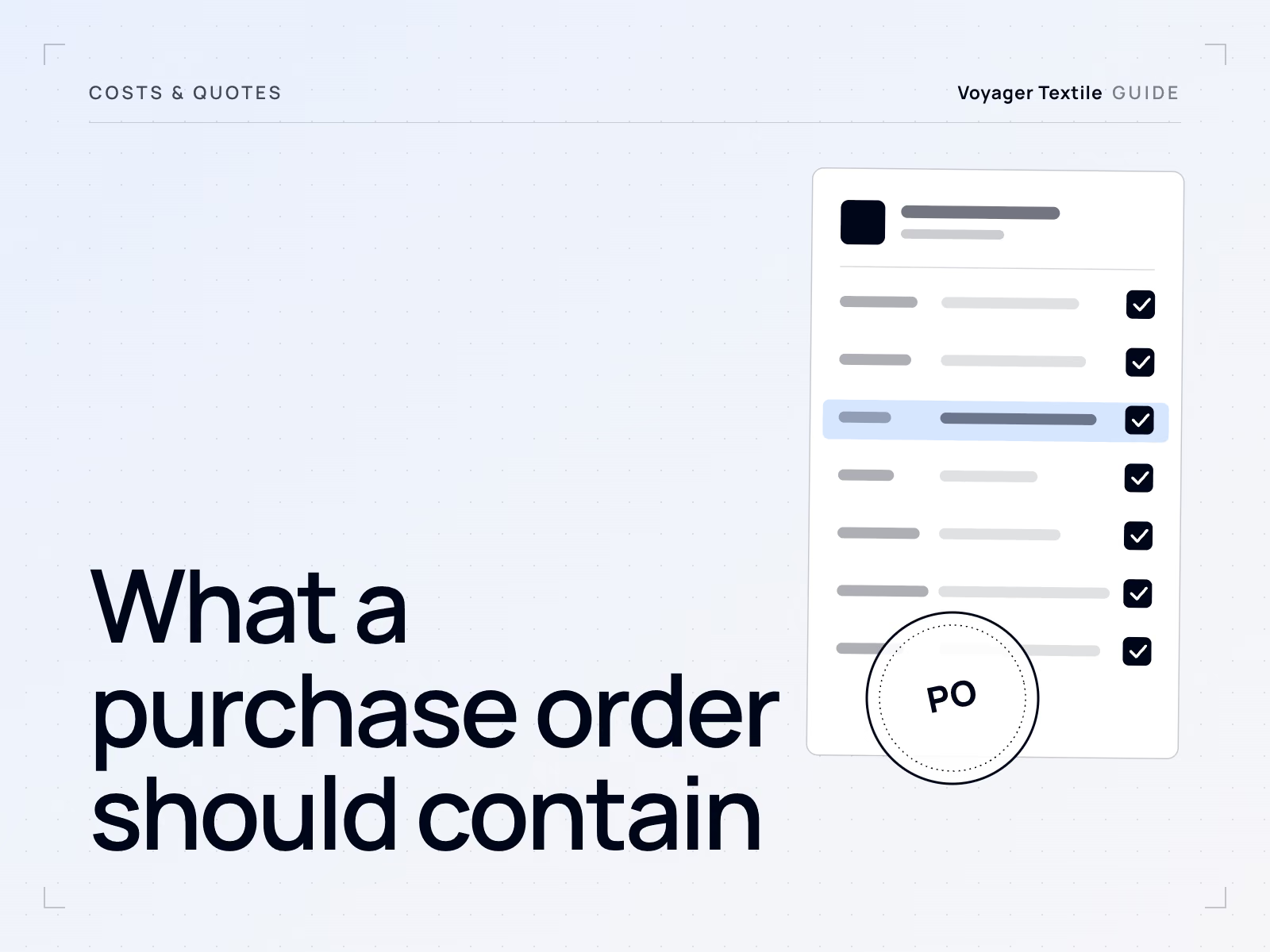
A purchase order is the buyer's commercial instruction: what is being ordered, on what terms, to arrive when. It is not the technical specification and it does not replace one. Many apparel order problems that look like factory errors start as a purchase order that named a quantity without naming the size breakdown, or a delivery date without naming which milestone it referred to.
Contents
Purchase orders get treated as administration. In a garment programme they are closer to a control document: they are what production is planned against, what goods are received against, what an invoice is checked against and what everyone refers back to when two people remember an agreement differently.
This guide covers what belongs in one and how it relates to the other documents in an order. It is about operational completeness, not legal completeness. Whether a document creates a binding contract, and what any clause in it means, depends on the contract and its governing law, and those are questions for a lawyer.
Which document is which
Four documents circulate in the same email thread and are routinely used as though they were interchangeable. Keeping them apart makes the rest of this straightforward.
| Document | Issued by | What it does |
|---|---|---|
| Quotation | The supplier | Offers a price and terms against a stated specification and quantity |
| Purchase order | The buyer | Instructs the supplier to supply stated goods on stated commercial terms |
| Order confirmation | The supplier | Confirms acceptance and the terms the supplier is working to. Common practice rather than a universal step |
| Proforma invoice | The supplier | A pre-transaction commercial document setting out the details of the intended transaction, frequently used to arrange payment. It is not the commercial invoice, which belongs to the actual shipment |
How the documents usually sequence
A typical order of events, not a required one. Some transactions merge steps and some add their own; what matters is that each step has a document behind it rather than a recollection.
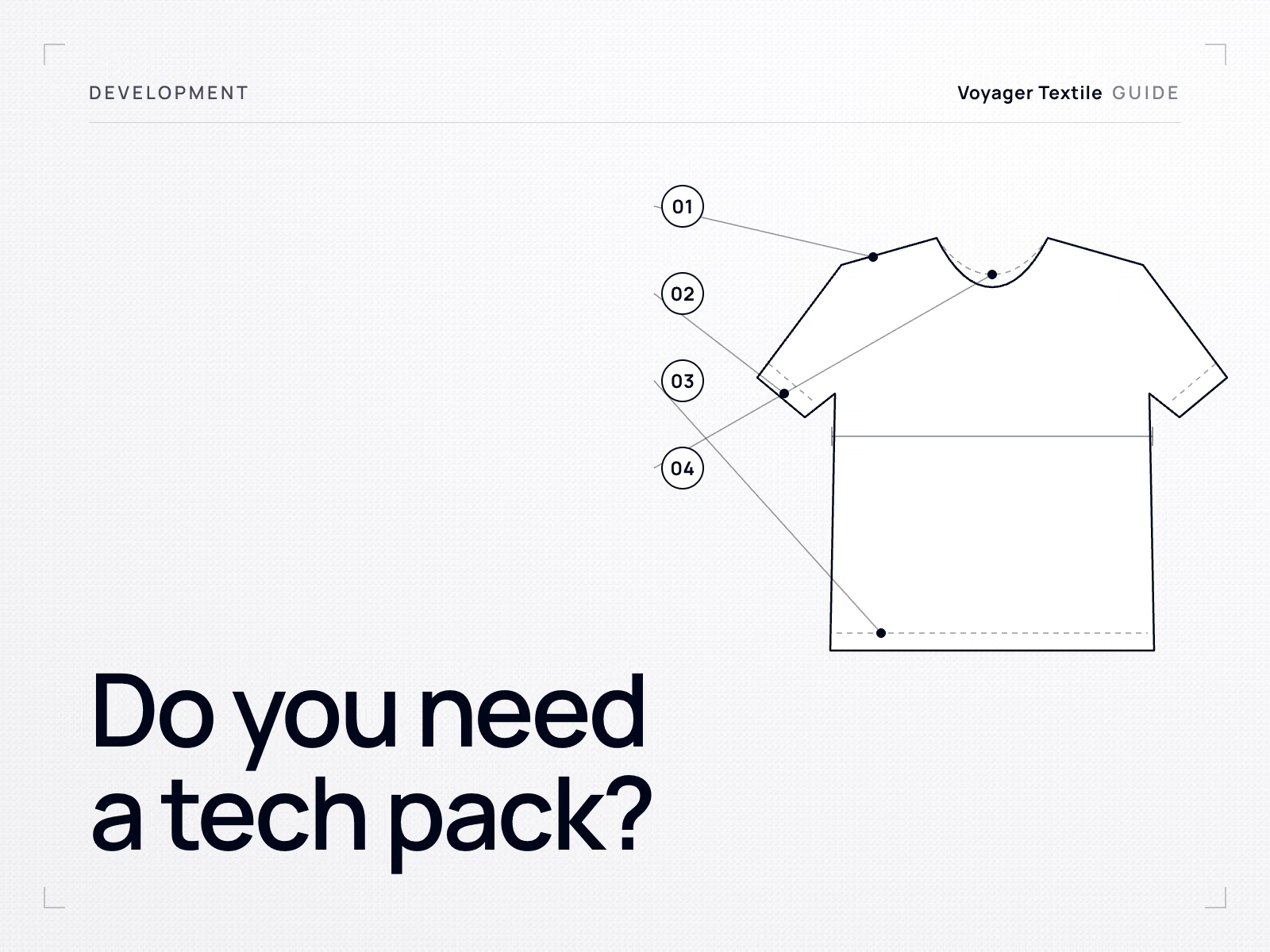
A purchase order is not a tech pack
This distinction causes expensive confusion. A purchase order saying five hundred hoodies, black, is a complete commercial instruction and a useless manufacturing instruction. It does not say which fabric, at what weight, in which construction, to which measurements, with which decoration, in which sizes, with which labels, packed how.
Two documents, two jobs
Commercial documents
- Quotation and purchase order
- Order confirmation and proforma invoice
- Price, currency and payment terms
- Delivery term and named place
- Required dates and required documents
- Commercial invoice and packing list at shipment
Technical documents
- Tech pack and bill of materials
- Measurement chart and grading
- Artwork files and placement
- Colour standards and approved lab dips
- Pack-out specification
- The approved pre-production sample
The two sets should reference each other rather than duplicate each other. A purchase order that reproduces the whole specification will drift out of step with it the first time the specification is revised; a purchase order that names the specification and its revision stays correct.
The fields an apparel purchase order needs
Not every field applies to every order, and no list of fields makes a document legally complete. What follows is what a manufacturer needs in order to plan, produce, pack, ship and invoice an order without going back with questions.
| Field | Why it is there |
|---|---|
| Buyer and supplier | The legal entities transacting, with addresses. Not simply a brand name |
| PO number and date | The reference everything else in the order is filed under |
| Style or product reference | What is being made, matched to the specification |
| Specification revision | Which version of the tech pack this order is against |
| Quantity matrix | Quantities by colour and size, not a total. See below |
| Unit price and currency | Per style and colour where they differ, in a stated currency |
| Delivery term and named place | The Incoterm with its place, and the edition where used |
| Required date and milestone | Which milestone the date refers to, named unambiguously |
| Payment terms | The structure agreed, with the event that triggers any due date |
| Artwork reference | Which artwork version and placement applies |
| Label and packaging reference | The labelling and packing specification, by revision |
| Destination | Where the goods are going, which can differ from the buyer's address |
| Required documents | What has to accompany the shipment or the payment |
| Compliance requirements | Restricted-substance, certification or testing requirements with versions |
Why a total quantity is not enough
Apparel is the reason purchase orders have matrices. A single style exists in several colours and every colour exists in several sizes, and the factory cannot cut anything from a total. The size breakdown drives the marker, the fabric consumption, the cutting plan and the packing, so a quantity that is not broken down is a quantity that cannot be produced.
| Style | Colour | S | M | L | XL | Total |
|---|---|---|---|---|---|---|
| Reference A | Black | 60 | 120 | 120 | 60 | 360 |
| Reference A | Ecru | 40 | 80 | 80 | 40 | 240 |
| Total | 100 | 200 | 200 | 100 | 600 |
Two practical points. Give the matrix per colour rather than per style, because colours are cut separately and a colour with an unusual breakdown affects consumption. And state the size range in the same designations as the approved measurement chart, so nobody has to interpret whether your L is the chart's L. Where those designations come from is covered in size charts for production.
Naming the date properly
A delivery date on a purchase order can mean several different things, and the ambiguity is entirely avoidable. Ex-factory, the date goods are ready and available at the factory, is a different milestone from the date they ship, and both differ from arrival at a destination. Which one your date refers to determines whether transit time sits inside or outside the deadline.
Name the milestone, and make sure it is consistent with the delivery term. It is also the date the whole production calendar is planned backwards from. See time-and-action calendars. It matters twice over, because the milestone the order names is the one any delivery measure should later be calculated against. See building a supplier scorecard. A date described as delivery on a DDP order and on an EXW order refers to two different moments. What controls the production timeline itself is covered in production lead times; the purchase order's job is only to state the agreed milestone without ambiguity.
Referencing rather than restating
Packing is the clearest example. A purchase order should not carry every carton dimension, fold instruction and label placement. It should point at the packing specification by name and revision, and let that document carry the detail. The same applies to artwork, labelling and any compliance requirement. What a packing specification itself contains is covered in pack-out specification.
Quantity variance, and what happens if it moves
Cut quantities and delivered quantities are not always identical. Fabric behaves, cutting produces loss, and pieces are rejected at inspection, so some programmes agree a tolerance and some require exact quantities. What matters is that this is agreed rather than discovered.
- There is no universal tolerance. Any allowable variance above or below the ordered quantity is a commercial term and should be stated in the order if it applies.
- A buyer does not automatically have to accept extra pieces, and a supplier does not automatically have the right to ship them. If overmake is contemplated, say so and say on what basis it is invoiced.
- A buyer does not automatically have to accept a shortage either. Whether a short shipment is acceptable, and what happens if it is not, depends on what was agreed.
- Say it once, in the order. A tolerance discussed verbally and not written down is not a tolerance.
When the order changes
Orders change. Quantities move, a colour is added, a delivery date is pulled forward, a label changes, artwork is revised. The failure mode is not that changes happen; it is that they accumulate across a message thread until nobody can say what the current order is.
A material commercial change should end up in updated order documentation, whether a revised purchase order, a revised confirmation or whatever the two companies use, rather than only in the conversation that produced it. What counts as material is a judgement, but the list below is a reasonable starting point.
- Quantity, or the size and colour breakdown within the same total
- Price, currency, payment terms or delivery term
- The required date or the milestone it refers to
- Material, colour or any change to the specification revision the order points at
- Artwork, decoration method or placement
- Labelling, packing or destination
The same discipline applies on the technical side, where a specification carries its own revision history, which is the reason a purchase order references a revision rather than restating content. Version control in the specification itself is covered in the tech pack guide.
When does production actually start?
There is no single trigger, and pretending otherwise is how programmes end up with a factory waiting on an approval the buyer thought had been given. What starts production is whatever the two sides agreed has to be true first, and that list is worth writing down at the beginning.
The prerequisites usually come from two directions at once.
Two kinds of prerequisite
Commercial
- The order placed and accepted
- Any payment milestone that is a condition of starting
- Materials committed, which may itself be the milestone
- Delivery term, destination and dates agreed
Technical
- The specification approved at a stated revision
- Artwork approved, and colour standards signed off
- The pre-production sample approved
- Labels, packing and any compliance requirement settled
A commercial order can legitimately exist before every technical detail is closed. That is normal, and it is often how material is booked in time. What should not happen is bulk production running ahead of an unresolved critical approval. Which approvals genuinely gate production is covered in the pre-production sample reference, and what happens when bulk is produced against something unapproved is covered in when bulk differs from the sample.
Before you send the order
Order readiness, not legal completeness
Everything here is something a factory would otherwise have to ask about, and every question costs time.
- The legal entities on both sides, not just brand names.
- The style reference, and the specification revision this order is against.
- The quantity matrix by colour and size, in the size designations the approved chart uses.
- Unit price and currency, per style and colour where they differ.
- The delivery term with its named place.
- The required date, and which milestone that date refers to.
- The payment terms, including the event that triggers any due date. See payment terms.
- Artwork version, placement and decoration method.
- Label set and packing specification, by revision rather than in full.
- Destination, and any consignee that differs from the buyer.
- Any compliance requirement with its version, as covered in chemical compliance.
- The documents required at shipment or for payment.
- Any agreed quantity tolerance, if one applies.
None of this is bureaucracy for its own sake. An order that carries these answers is one a factory can plan, cut, make, pack and invoice without a single clarifying email, and the time saved lands directly in the delivery date.
Questions buyers ask
What should an apparel purchase order contain?
The buyer and supplier entities, a PO number and date, the style reference and the specification revision it is against, a quantity matrix by colour and size, unit price and currency, the delivery term with its named place, the required date and which milestone it refers to, payment terms, artwork and packing references, the destination, and any required documents or compliance requirements.
Is a purchase order the same as a tech pack?
No. A purchase order is a commercial instruction: what is ordered, at what price, on what terms, for when. A tech pack is the technical instruction: materials, construction, measurements, artwork and finishing. The order should reference the specification and its revision rather than restate it, and neither document can do the other's job.
Why is a total quantity not enough on an apparel purchase order?
Because a factory cuts by colour and size, not by total. The size breakdown drives the marker, the fabric consumption, the cutting plan and the packing, so an order stating only a total cannot be planned or produced. Give the matrix per colour, in the size designations used by the approved measurement chart.
Is a proforma invoice the same as a commercial invoice?
No. A proforma invoice is a pre-transaction document setting out the intended transaction, frequently used to arrange payment before goods exist. The commercial invoice belongs to the actual shipment and forms part of its documentation. They serve different purposes at different points and should not be substituted for one another.
Does a purchase order have to say which delivery milestone the date refers to?
It should. Ex-factory, the date goods are ready at the factory, is a different milestone from the ship date and from arrival at a destination, and which one applies decides whether transit time falls inside or outside the deadline. The milestone should also be consistent with the delivery term used on the order.
Does a buyer have to accept more or fewer pieces than ordered?
Not automatically, in either direction. Whether any variance above or below the ordered quantity is acceptable is a commercial term rather than an industry rule, so it should be stated in the order if it applies. There is no universal tolerance percentage in apparel.
What has to be agreed before production starts?
It depends on what the two sides agreed, which is why it is worth writing down. Commercially, that the order is placed and accepted, materials are committed and any payment milestone that is a condition has been met. Technically, that the specification revision, artwork, colour standards, labels, packing and the pre-production sample are approved.
What should happen when an order changes after it is issued?
The change should end up in updated order documentation rather than only in the conversation. Quantity and breakdown, price, terms, dates, specification revision, artwork, labelling, packing and destination are all material enough to reissue for, because otherwise the current state of the order exists only in a message thread.
Send the order with its references attached
An order that names the specification revision, the size breakdown, the delivery milestone and the packing reference can go straight into planning. Send yours, or ask us what is missing before you issue it.
Start an enquiry