Choosing a manufacturer
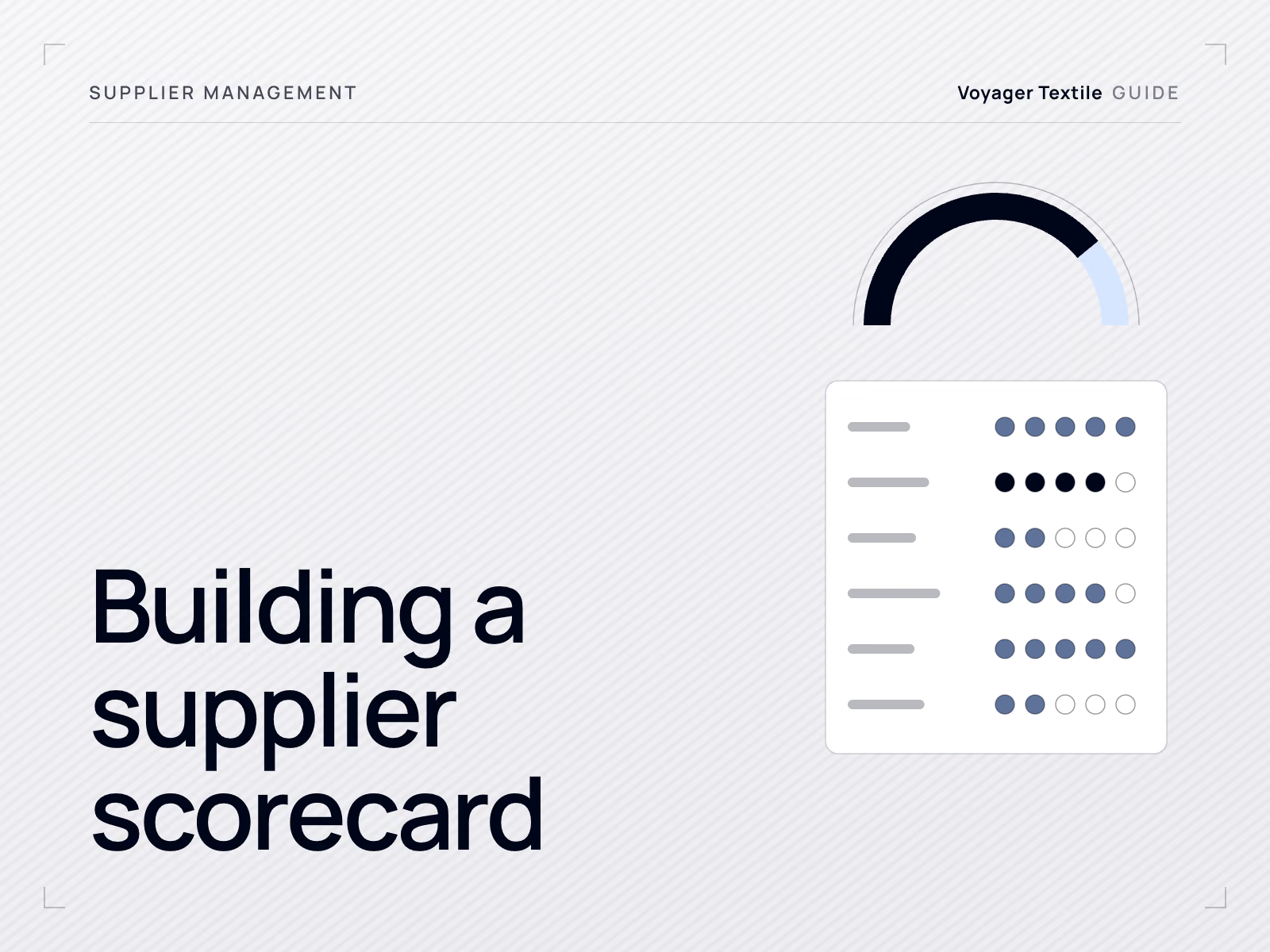
How to Build an Apparel Supplier Scorecard
A scorecard is only as good as its definitions. Many of them fail not because the wrong things were measured but because nobody said which event on-time refers to, what the defect denominator is, or what happens when a number is missed. This is how to define the metrics so both sides can read the same result the same way.
Contents
- A scorecard is not a selection model
- The anatomy of a single metric
- Delivery: on-time delivery and on-time in-full
- Quality: the denominator decides the answer
- Development, documentation and commercial measures
- Windows, and the small-numbers problem
- Trend, not snapshot
- Weighting, and what it hides
- An illustrative structure
- Where scorecards go wrong
- Using it in a review
- Questions buyers ask
The first scorecard many buyers build has quality, delivery and communication down one side, percentages across the top and a weighted total at the bottom. It rarely survives long. Then a supplier disputes a number, nobody can reconstruct how it was calculated, and the file quietly stops being updated.
The problem is rarely the choice of categories. It is that the definitions underneath them were never written down. This guide is about the definitions. How the system around them works, meaning reviews, corrective action, escalation and the vendor manual, is in managing supplier performance.
A scorecard is not a selection model
These get confused constantly, and the confusion produces metrics that measure nothing. Selection asks whether a factory can do the work: capability, machinery, minimums, price, compliance status, development fit. That question is answered before the first order, and it is a different exercise, covered in choosing a manufacturer and factory audits.
A scorecard asks what actually happened afterwards. It has no opinion about whether a supplier is the right kind of supplier. This is why a low minimum order quantity does not belong on one: a supplier offering lower minimums is not thereby performing better, it is a different commercial fit, and scoring it rewards suppliers for a characteristic rather than for behaviour.
The anatomy of a single metric
Before a metric goes on a scorecard it should survive six questions. Many candidate metrics fail at the second or third, which is a useful filter in itself.
| Property | The question it answers |
|---|---|
| Definition | What exactly is being counted, in words both parties would write the same way |
| Event | Which moment or milestone it refers to |
| Denominator | Counted against what, and with what excluded |
| Source | Which record it comes from, and who can see that record |
| Attribution | How cause is assigned when more than one party contributed |
| Consequence | What changes when it is missed, the question that decides whether the metric is worth collecting |
A seventh test is worth applying afterwards: would a different result change a decision? If a metric can move in either direction without anyone doing anything differently, it is reporting. Number of emails exchanged, number of samples produced, meetings held, total order value: all measurable, none of them performance.
Delivery: on-time delivery and on-time in-full
On-time against which event
On-time delivery is a fraction of orders meeting an agreed timing. Everything contentious about it is in the word agreed. An apparel order passes several distinct milestones and a supplier's control over them is not the same at each.
| Event | What it actually tests |
|---|---|
| Sample or lab dip ready | Development responsiveness, before bulk exists |
| Material in house | Whether the supplier's own sourcing was planned in time |
| Ex-factory ready | Production execution, ending at the factory gate |
| Cargo handed over | Execution plus the supplier's shipping coordination |
| Loaded on the booked sailing | Includes booking, which may not be the supplier's responsibility |
| Arrival at destination | Includes transit, customs and everything outside both parties |
| Warehouse receipt | Includes the buyer's own receiving capacity |
Measuring ex-factory and calling it delivery performance flatters the supply chain. Measuring warehouse receipt and attributing the whole result to the supplier is unfair under most delivery terms. Either is defensible; measuring one and describing it as the other is not. Which milestone the order names is settled in the purchase order.
In full is a second, separate condition
On-time in-full requires both: the delivery met the agreed timing and it was complete. The two are separate because an order can be perfectly punctual and still be missing a size, a colourway or a proportion of the quantity. In apparel that matters more than in many categories, because an assortment with one size missing is often not sellable at all.
- A size broken out of the size run and shipped later
- One colourway held back because a dye lot failed
- A short shipment against the ordered quantity
- Cartons missing from a consignment that otherwise arrived
- A prepack that does not contain the agreed assortment
There is no universal formula. Businesses differ on whether completeness is judged per order or per line, whether an agreed quantity tolerance counts as full, and whether a split shipment is one late delivery or one on-time and one late. Those are decisions to write down, not facts to look up. Whether a quantity tolerance exists at all is a commercial term, covered in the purchase order.
Quality: the denominator decides the answer
There is no such thing as the defect rate. There are at least four different measures that all get called that, and they produce different numbers from the same shipment. A scorecard that does not say which one it means is generating an argument for later.
| Measure | What it tells you |
|---|---|
| Defective units over units inspected | How much of the inspected product was unacceptable |
| Defects over units inspected | Severity of workmanship, since one garment can carry several |
| Rejected lots over lots inspected | How often shipments fail at the inspection gate |
| Claims over units shipped | What escaped and reached the buyer or its customer |
The first two are a pair often confused, and the distinction is real: a single garment with a broken stitch, a loose thread and a crooked label is one defective unit and three defects. A supplier can look worse on defects per unit and better on defective units than a competitor, or the reverse, depending on whether its problems cluster.
How defects are classified as critical, major or minor, and how inspection sampling works, belong to quality control and should not be redefined on a scorecard. What a scorecard adds is the time axis: the same measurement point failing on three consecutive orders is the finding, and no single-order percentage will surface it.
Categories worth keeping separate rather than merging into one quality number: workmanship defects, measurement failures against the specification's own points of measure, decoration defects in print or embroidery, shade against the approved standard, packing and assortment errors, and label or barcode errors. They have different causes and different owners, and merging them destroys exactly the information that would tell you what to fix.
Development, documentation and commercial measures
These are cheaper to collect than many buyers assume, because the evidence already exists in the approval trail and the shipping file.
- Sample delivered against the agreed date, using the date the supplier committed to rather than the one you hoped for.
- First-pass approval rate, recorded together with the reason for each rejection. Without the reason it measures the specification as much as the supplier.
- Avoidable revision rounds, meaning rounds caused by something already specified being missed.
- Documentation accuracy, meaning whether packing lists, carton data and commercial documents match the order and each other.
- Documentation timeliness, which is a separate measure and often the one that actually delays a shipment.
- Quotation and invoice adherence, meaning whether what was agreed is what was billed, with any change explained beforehand.
Documentation deserves its place. It is a named component of order reliability in the standard supply-chain reference models rather than an afterthought, for the practical reason that goods with incorrect paperwork have not usefully arrived.
Windows, and the small-numbers problem
A measurement window is a choice, not a convention. Per order suits programmes with few, large orders; a rolling period suits frequent small ones; a quarter suits a review rhythm but can hide a bad month inside a good one. Nothing about apparel makes one correct, and the right answer follows the order frequency rather than the calendar.
New suppliers raise the same issue from the other direction. First orders carry learning that established programmes have already absorbed, and it is reasonable to look at a qualification period differently from mature production. Reasonable does not mean excusing: a first order that fails on something the specification stated plainly is a finding whenever it happens. The difference is which conclusions you are entitled to draw from it.
Trend, not snapshot
One period is a data point, and much scorecard damage comes from reacting to one. What a period tells you depends entirely on what preceded it, and four patterns matter more than any single figure.
- Stable. Predictable, even at a level you would like to improve. Predictability has its own value in planning.
- Deteriorating. An important pattern to catch, and an easy one to miss, because each individual period looks survivable.
- Improving after an action. The clearest evidence that a corrective action worked.
- Recurring. The same failure returning at intervals, which usually means the earlier fix was a correction rather than a corrective action.
Context belongs beside the trend. A supplier with a higher defect rate on a complex embellished style is not straightforwardly worse than one running a simple jersey repeat, and a difficult launch is not comparable with a fourth reorder of the same product. This does not need a complexity-adjusted model. It needs the order type recorded next to the number, so nobody compares the two by accident.
Weighting, and what it hides
The temptation is to weight the dimensions and produce a total: quality this much, delivery that much, communication the rest. It feels rigorous. Its actual effect is to make a specific failure disappear into an average, and the failures most likely to disappear are the ones that matter most.
A supplier with a serious product-safety or compliance failure and excellent scores everywhere else can arrive at a respectable total. That total is not merely unhelpful. It is misleading, because it was produced by a method that treats a safety failure as offsettable by responsiveness.
If a weighted total is used, two rules keep it honest. The weights are an explicit statement of your priorities, so write down why they are what they are. And the total never appears without the components visible beside it, so that anyone reading it can see which dimension moved. A number nobody can decompose is a number nobody should act on.
An illustrative structure
The shape below is deliberately empty of results. Any figures printed here would be invented, and invented benchmarks are exactly what makes scorecards untrustworthy. The columns are the point.
| Column | What goes in it |
|---|---|
| Dimension | Development, quality, delivery, documentation, corrective action or commercial |
| Metric | The name both parties use for it |
| Definition | What is counted, and what is excluded |
| Event or denominator | The milestone measured, or the base it is counted against |
| Source | The record it comes from, visible to both sides |
| Period | The window, stated with the number of observations in it |
| Result | The value, or the events themselves where the count is too small for a rate |
| Trend | Direction against the previous comparable period |
| Attribution | Supplier, buyer, shared or external, where a cause is in question |
| Open action | The corrective or improvement action referencing this row, if any |
Two columns do much of the work and are often left out. The number of observations, because it is the difference between a result and an anecdote. And the open action, because a row with a poor result and no action beside it is the clearest possible sign that the scorecard is not being used.
Where scorecards go wrong
- The date was never named. On-time is measured against whichever milestone was convenient that month.
- Delivery and completeness are mixed. An incomplete but punctual shipment is scored as a success, or a complete but late one is scored twice.
- Committed dates are overwritten. The current date is the only one kept, so a supplier is permanently on time.
- All defects count the same. A safety-relevant defect and a loose thread arrive at the same place in the arithmetic.
- Buyer delays are attributed to the supplier, usually because the approval trail is not in the same system as the order dates.
- The denominator is unstated, so two people calculate the same metric differently and both are right.
- Too few observations, producing percentages that swing wildly and mean nothing.
- Price is treated as performance, which rewards the wrong behaviour and confuses selection with management.
- A weighted total hides a critical failure behind strengths in unrelated dimensions.
- Nothing follows from the result. Metrics are collected, circulated and never used, which is the failure that ends the whole exercise.
Using it in a review
The scorecard is not the agenda. It is one item on it, and probably not the first. A review that walks down a table of numbers produces defensiveness; one that opens with what changed since last time and uses the table as evidence produces information.
- The trend across the last few periods, not the latest figure
- The exceptions, and what actually happened in each
- Open corrective actions, and whether the effectiveness check has produced anything yet
- What is coming that could go wrong, such as a new fabric, a peak season or a material change
- What the buyer owes and when it will arrive
- Actions out, each with an owner and a date
The fifth item is the one that changes the character of the meeting. Reviews where the buyer's own dependencies are on the agenda tend to produce honest answers about the supplier's, which is the entire purpose of measuring anything.
Questions buyers ask
What should an apparel supplier scorecard measure?
Separately: development, meaning sample timing and first-pass approval; quality, meaning defects, measurement conformity and repeat issues; delivery, meaning a named milestone and completeness; documentation, meaning accuracy and timeliness; corrective action, meaning closure and whether it worked; and commercial adherence, meaning whether what was agreed is what was billed. Each needs a written definition, an event or denominator, a source and an attribution rule before anything is recorded.
What is the difference between OTD and OTIF?
On-time delivery asks whether an agreed milestone was met. On-time in-full asks whether it was met and the delivery was complete, under whatever completeness rule the parties agreed. They are separate because an order can be perfectly punctual and still be missing a size, a colourway or part of the quantity, which in apparel often makes the assortment unsellable. Neither has a single universal formula, so both need writing down.
What is a good supplier defect rate?
There is no universal percentage, and any figure offered as one is somebody else's programme requirement. The answer depends on the product and its complexity, the inspection method and sampling plan, which of the four possible denominators is being used, how severity is classified, and what the buyer's own requirement is. Before asking what is good, establish what is being counted: defects, defective units, rejected lots and claims are four different measures.
Should every defect count equally?
No. A defect with a safety or compliance dimension is not comparable with a cosmetic one, and averaging them produces a number that describes neither. The classification into critical, major and minor already exists in the inspection framework and should be used rather than reinvented on the scorecard. What this guide does not do is publish weights for those categories, because the right weighting is a function of the product and the buyer's risk position.
How often should supplier performance be reviewed?
It follows order frequency rather than the calendar. A programme with a handful of large orders a year is better reviewed per order; one shipping every week supports a rolling window. Quarterly reviews suit a management rhythm but can conceal a bad month inside an acceptable quarter, so the underlying periods should stay visible. There is no correct cadence to copy.
How do you compare a new supplier with an established one?
Carefully, and often not by percentage. A supplier with two orders cannot be compared statistically with one that has fifty, and converting two events into a rate produces false precision. Report the events themselves at low volumes. It is also reasonable to read a qualification period differently from mature production, provided that does not become a way of excusing failures against requirements that were stated clearly.
Should price be on a supplier scorecard?
Price level belongs to selection, not performance. What belongs on a scorecard is adherence: whether quotations hold for the agreed period, whether unexplained surcharges appear, whether invoices match the order, and whether cost changes were agreed in advance. A price that moved because the buyer changed the specification is the buyer's change and should be recorded that way.
Can a scorecard become misleading?
Easily, and usually in one of three ways. An undefined metric lets two people calculate different results and both be correct. A weighted total lets strong performance in one dimension mathematically cancel a serious failure in another. And a percentage built on very few observations swings on a single event. All three are avoided by writing the definitions down, keeping the components visible next to any total, and reporting counts rather than rates when the denominator is small.
Should compliance be a scored line on the scorecard?
Responsiveness in providing documents can be measured. Whether the documents are valid, in scope and current is not a performance score at all. It is a condition of doing business, and treating it as a weighted line invites a valid-looking but irrelevant certificate to be filed as a pass. Keeping eligibility outside the arithmetic is the common approach; what the specific gate should be is a matter for the buyer's own risk position and legal advice.
What data do you need to run one?
Almost entirely records a sourcing operation already produces: order dates and any agreed revisions, the approval trail for samples and colour, inspection reports, shipping and receiving records, the documentation file, complaints or claims, and corrective action records. No new system is required to start. What is required is that both parties can see the same source for any number that is discussed.
Send the definitions, not just the targets
If your scorecard measures ex-factory, says what counts as in full and defines the defect denominator, a factory can plan against it. If it arrives as a set of percentages with no definitions, everyone finds out what they meant during the first dispute.
Talk through a programme