Production problem
Why does fabric shade vary between dye lots?
Dyeing is a batch process, so two lots dyed to the same standard will be close rather than identical. Shade variation becomes a defect when it is visible between garments that will be worn or displayed together, or when it exceeds a tolerance that was agreed before production. The assessment has to be done against a physical standard under controlled lighting, not on a screen.
What you are seeing
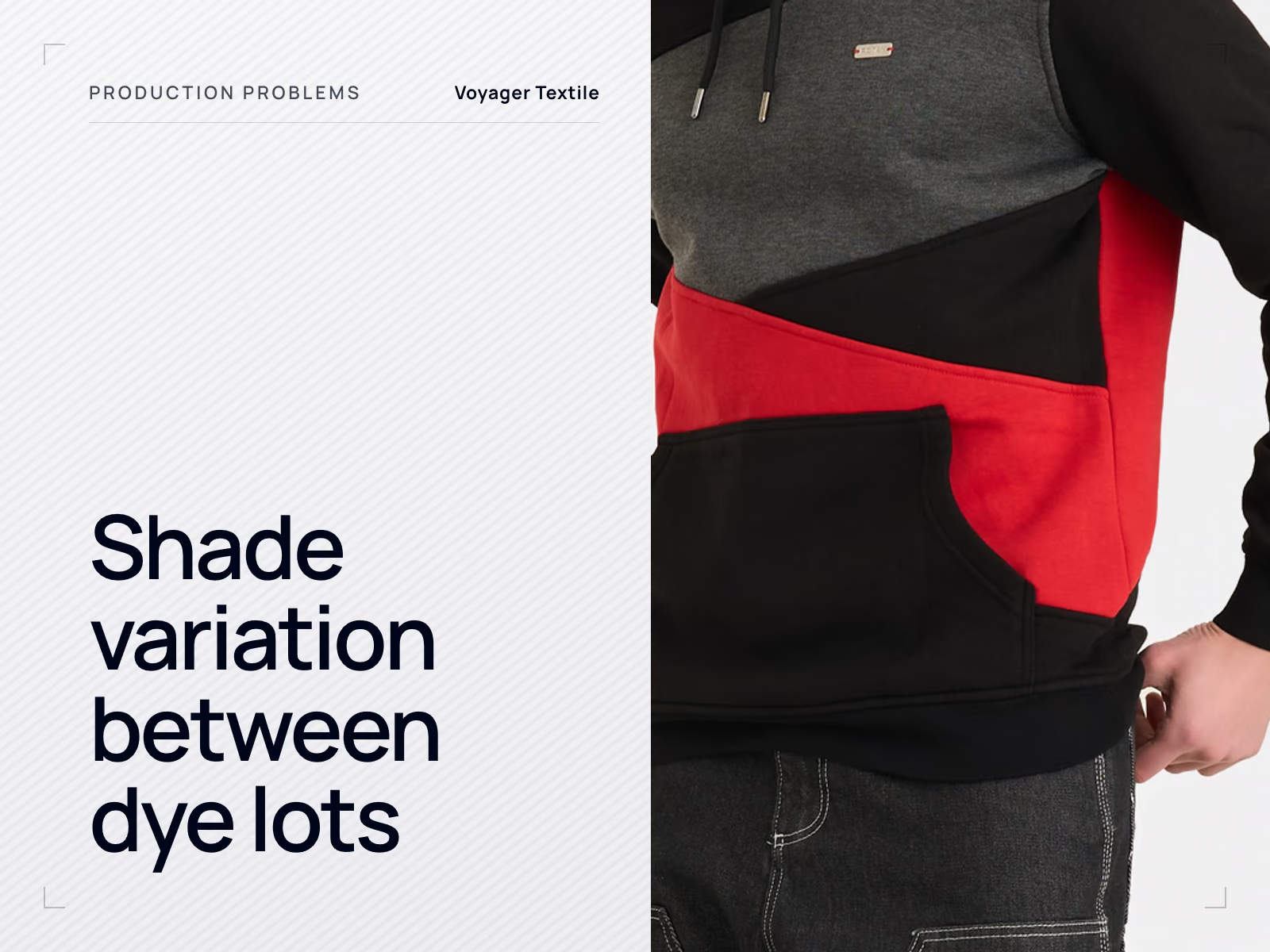
Garments from the same order do not match each other, or a repeat order does not match the previous delivery. The difference is often only visible when two pieces are held side by side, and it can appear or disappear depending on the light in the room.
Contents
Colour is the area where buyer expectation and textile physics diverge sharply. A brand colour is a fixed reference. A dyed fabric is the output of a chemical process with a temperature profile, a liquor ratio, a dye batch and a specific machine, run on a specific day. Repeating that process exactly is not possible, which is why the industry manages shade variation rather than eliminating it.
Where variation actually appears
Naming the location narrows the cause quickly, because these four types have different owners.
| Type | What it looks like | Usual cause |
|---|---|---|
| Within one roll | A gradual change along the length, or a difference between the selvedge and the centre of the width | Uneven dye penetration or uneven heat and airflow in finishing |
| Between rolls of one dye lot | Rolls that are individually even but differ slightly from each other | Position in the dyeing machine and normal process tolerance |
| Between dye lots | Two deliveries that are each internally consistent but do not match one another | A separate batch, a different dye lot, sometimes a different fabric production run |
| Between components | Body, rib, collar or a second fabric not matching each other in the same garment | Separate dyeings on different substrates, which take dye differently |
The last row is the one buyers underestimate. A jersey body and a rib collar dyed to the same reference will rarely match perfectly, because the two structures reflect light differently even when the colour measurement is close. That is why rib, collar and trim colours are approved against the approved body fabric rather than against a paper reference.
A garment-dyed product behaves differently again, because the colour belongs to the assembled garment and its load rather than to a roll of cloth.
Assessing it objectively
Many shade disputes are conducted in the wrong conditions. Three controls make the assessment repeatable.
- A physical standard. The approved lab dip, not the Pantone chip, is the production reference. It should be retained, protected from light, and used for every subsequent order.
- Controlled lighting. Assessment is done in a light booth under specified illuminants rather than under whatever light the office has. Two fabrics can match under one light source and differ under another, an effect called metamerism, so the agreed lighting conditions are part of the specification.
- A grading scale. Change in colour is assessed against the grey scale described in ISO 105-A02, which runs from grade 5 for no perceptible change down to grade 1 for severe change, with half steps. Expressing a difference as a grade rather than as too dark makes it a measurement.
What a factory does about it in cutting
Because some variation is inevitable, the control moves into the cutting room. Incoming rolls are checked and grouped into shade bands, and garments are cut so that all the panels of one garment come from the same roll, as described in incoming fabric inspection. This is why a well-run order can contain a small shade difference between cartons and still be entirely acceptable: no individual garment mixes shades, even though the order does.
The failure mode is a garment whose sleeve came from a different roll than its body. That is a cutting and bundling control failure rather than a dyeing problem, and it is one of the few shade faults that is unambiguously the factory's.
Defect or accepted variation
The line is drawn by what was agreed, and by how the product is used.
- A difference within the agreed tolerance, consistent per garment, on a product sold individually is normally acceptable.
- The same difference on a uniform programme, where two people stand side by side in garments from different deliveries, is a real problem even if it is technically inside tolerance.
- A visible difference between components inside one garment is a defect regardless of tolerance.
- A difference between the delivered goods and the approved standard, rather than between deliveries, is a defect.
This is why the intended use belongs in the specification. A factory that knows garments will be worn as a set will plan fabric and cutting differently from one producing individual retail pieces.
Controlling it on the next order
Buyer decisions
- Approve a physical colour standard and keep a copy
- State the assessment conditions and the acceptable grade of difference
- Say whether garments will be worn or displayed together
- Order the full programme quantity in one booking where possible
- Approve component colours against the approved body fabric, not against paper
Factory controls
- Lab dip submission and approval before bulk dyeing
- Incoming roll inspection and shade banding
- Cutting so that one garment uses one roll
- Bundling and carton control so shade bands are not mixed inside a pack
- Flagging when a repeat order requires a new dyeing
The approval mechanics, including lab dips and lighting, are covered in the Pantone colour matching guide. The programme-level controls that keep a colour stable across years are in the reorder consistency guide.
Questions this raises
Can a factory guarantee that a reorder will match the first delivery?
No factory can promise an identical match across separate dye lots, and one that does is overselling. What can be agreed is a physical standard, an assessment method and a tolerance. For programmes where matching genuinely matters, dyeing the full quantity in one lot is the only reliable answer.
Why do the body and the rib not match?
They are different structures, usually dyed separately, and they reflect light differently even at the same colour measurement. Approve the rib against the approved body fabric under the agreed lighting rather than against a colour reference on paper.
The colour looks right in the office and wrong in the shop. What is happening?
Metamerism: two samples matching under one light source and differing under another. It is a genuine physical effect, not a perception error. If the product will be seen under retail lighting, include that illuminant in the assessment conditions.
Is shade variation inside one order acceptable?
It depends on the agreement and the product. Small variation between cartons, with each garment internally consistent, is normal in bulk production. Variation between components of a single garment is not, and neither is variation on a product intended to be worn as a matched set.
Running a programme where colour has to hold?
Tell us the colour, the fabrics it has to appear on and whether the garments will be worn together. We will propose the standard, the approval route and whether the quantity can be dyed in one lot.
Discuss colour continuity