Production problem
Why does printed colour change on polyester?
Two different problems produce colour that is not what was approved. Dye migration is the fabric's own dye moving into a print after it has been applied, driven by heat and continuing for days afterwards. Sublimation colour shift is the printed colour itself landing differently because transfer conditions or the fabric changed. Both are specific to polyester, and both are prevented before bulk rather than corrected after.
What you are seeing
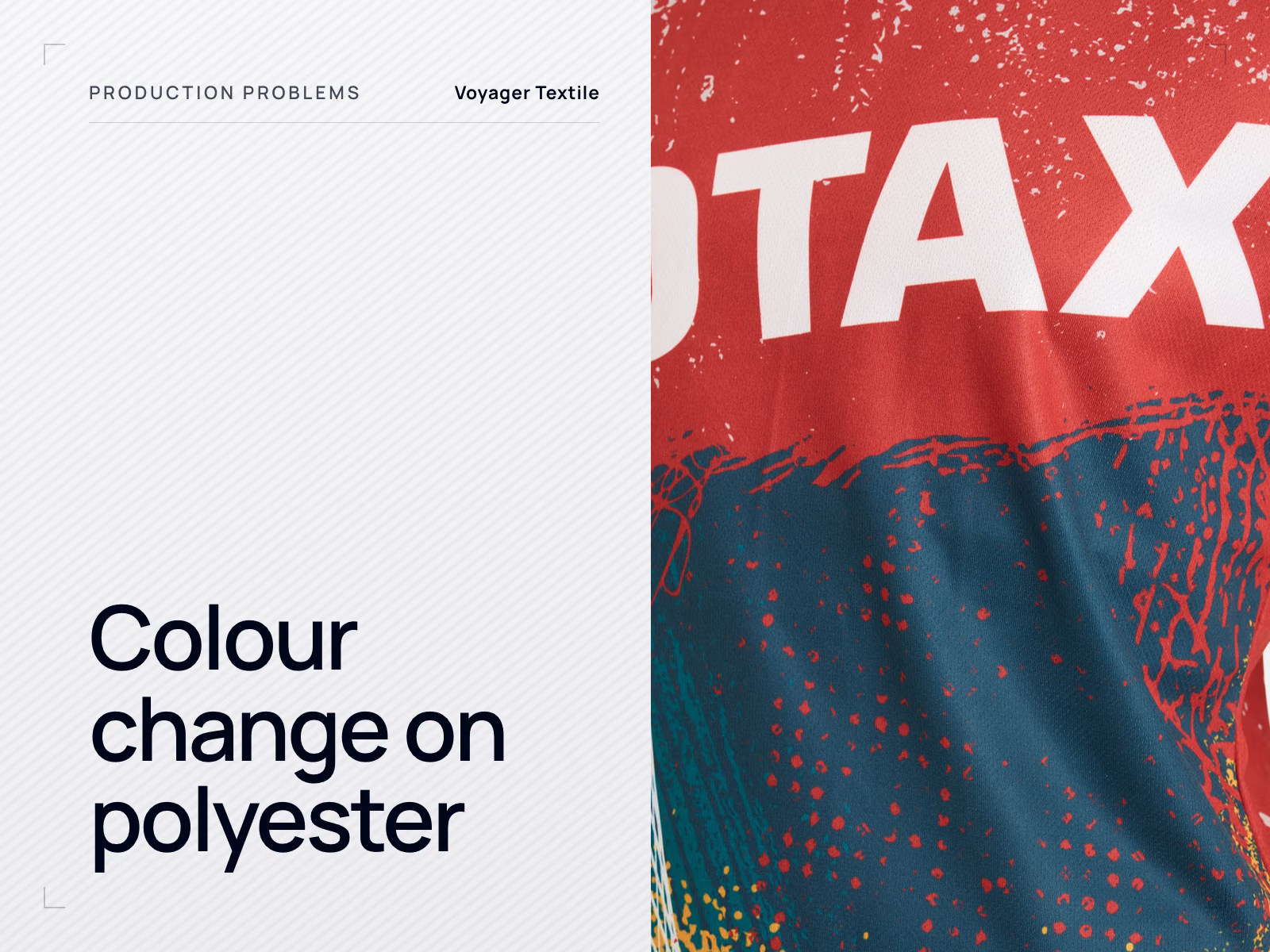
A white or light print on a coloured polyester garment has taken on a tint of the garment colour, sometimes days or weeks after production. Or a sublimated garment has arrived a visibly different shade from the approved strike-off, with colours reading duller, warmer or less saturated.
Contents
Polyester is coloured with disperse dyes, and disperse dyes move when they are heated. That single fact explains many colour problems on polyester garments, and it also explains why they are so often discovered after the goods have shipped: migration is a slow process that continues after the garment leaves the factory.
Dye migration: the fabric colouring the print
When a polyester garment is heated, the dye already in the fibre can mobilise. If a print sits on top, the dye moves into the ink film, and a white print on a red garment gradually becomes pink. Industry technical guidance places the onset of this behaviour above roughly 138 degrees Celsius, and notes that it continues after the garment has cooled, which is why the print can look correct at inspection and wrong a week later.
That creates a genuine conflict in screen printing, and it is worth understanding because it explains why polyester printing costs more. Plastisol needs the whole ink film to reach roughly 154 degrees Celsius to cure, while the fabric's own dye starts moving below that. Printing polyester therefore means working in a narrow window and using materials designed for it.
- Low-bleed or blocker inks, formulated to resist dye passing into the film.
- A blocker underbase, a barrier layer printed first so the dye cannot reach the visible colours.
- Low-cure ink systems, which fuse at lower temperatures and reduce how much heat the garment receives.
- Controlled heat exposure overall, including at any later heat press stage, because every additional heating event is another opportunity for migration.
Darker and more saturated garment colours carry more dye and therefore more risk. Red, royal blue and black polyester are the classic problem grounds, and a white or pastel print on any of them should be treated as a migration risk from the start.
Sublimation colour shift: a different mechanism
Sublimation has no ink film sitting on the fabric, so migration into a print is not the issue. The colour problem here is that the printed result depends on a chain of variables, and changing any one of them changes the outcome.

| Variable | What it changes | How it shows |
|---|---|---|
| Transfer temperature and dwell | How much dye transfers and how deeply it penetrates | Under-transfer reads pale and washes out; over-transfer blurs detail |
| Pressure | Contact between paper and fabric | Uneven density, patchy areas, soft edges |
| Fabric | Polymer type, weight, structure and whiteness of the ground | The same file printing differently on interlock and on mesh |
| Paper and printer profile | How much ink is laid down and how it is colour managed | A systematic shift across the whole design rather than in one area |
| Fabric roll or supplier change | A different base white or a different polymer | A repeat order that no longer matches the first |
This is why sublimated production is approved on a printed strike-off on the actual fabric rather than on a screen or a digital proof, and why a new strike-off is worth requesting whenever the fabric changes. The process itself is described in the all-over sublimation guide and in the sublimated jersey manufacturing process.
Ghosting and edge blur
A faint double image, usually offset slightly from the design, is ghosting. It happens when the transfer paper moves against the fabric while dye is still transferring, or when dye continues to gas after the press opens. It is a handling and parameter issue rather than an artwork one, and it is fixed at the press rather than in the file.
How to prevent both before bulk
For printing onto polyester
- State the exact fabric composition and colour when requesting the print, not just polyester
- Ask which ink system will be used, and whether a blocker underbase is included
- Approve the print on a sample kept for several days after production
- Wash-test the sample as well, since migration and cure are separate failures
- Reconsider a white print on a heavily dyed ground if the risk is not worth it
For sublimated products
- Approve a printed strike-off on the actual production fabric
- Include mesh and contrast panels in the strike-off, not only the main body
- Keep the approved strike-off for future orders
- Request a new strike-off if the fabric supplier or roll changes
- Agree that sponsor and brand colours are checked specifically, since those are the ones scrutinised
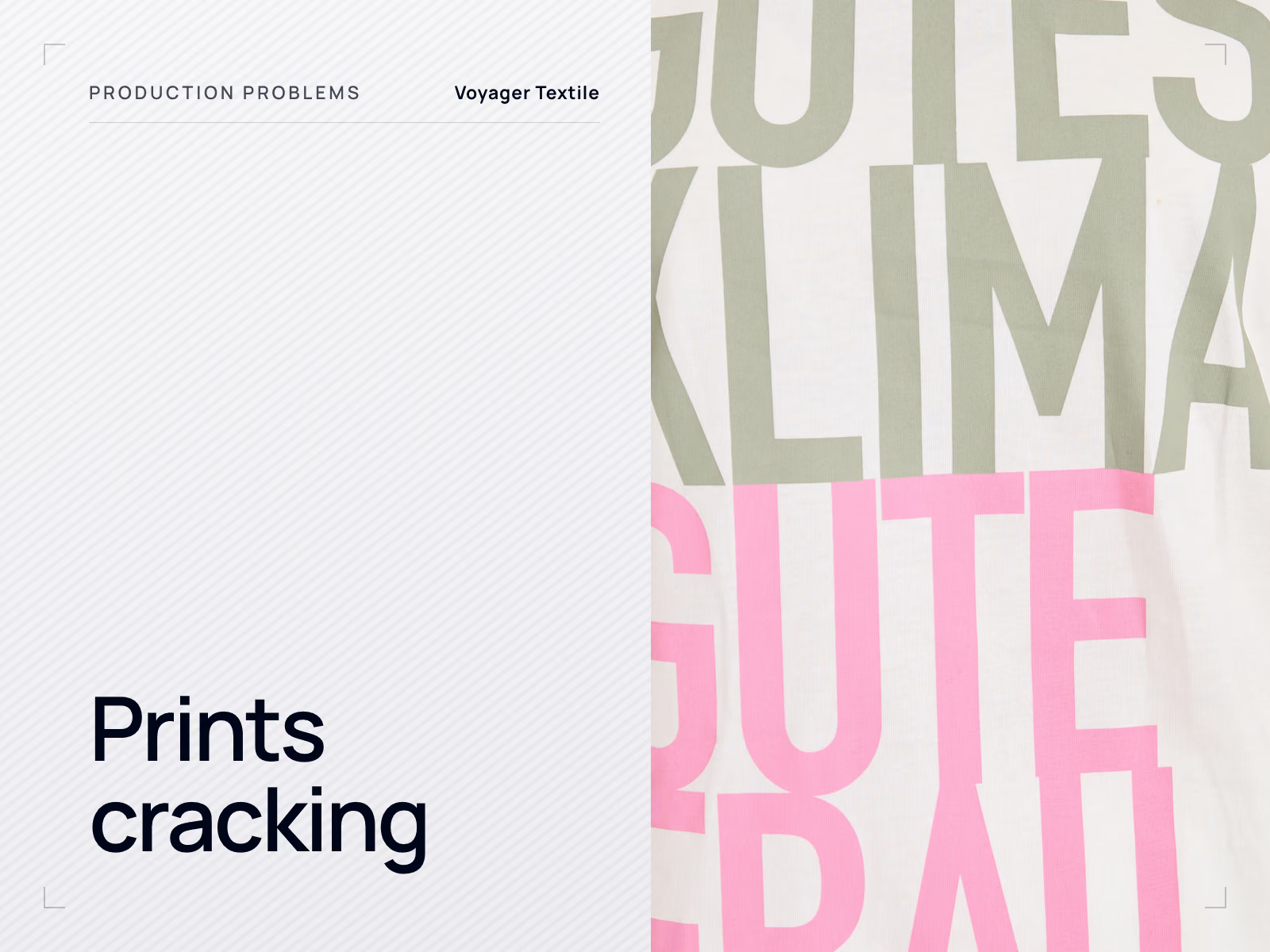
If the print is failing physically rather than shifting in colour, the mechanism and the fix are different, and are covered in why prints crack.
Questions this raises
Why has our white print on red polyester turned pink?
That is dye migration. The garment's own disperse dye has mobilised under heat and moved into the ink film. It is prevented with low-bleed inks, a blocker underbase and controlled heat, and it cannot be reversed once it has happened.
Can dye migration be fixed after it appears?
No. The dye is in the print film. The affected garments have to be replaced, and the next run has to use a blocking system. This is why a polyester print should be approved on a sample that has been kept for a few days rather than straight off the press.
Why does the same design look different on two polyester fabrics?
Because sublimation colour depends on the fabric as well as the file: polymer type, structure, weight and how white the base is all change the result. Approve colour on a strike-off on the actual fabric, and include every fabric used in the garment.
Does sublimation fade in washing?
A correctly transferred sublimation print does not wash out, because the colour is inside the fibre rather than on the surface. Pale or patchy results after washing usually indicate under-transfer rather than poor wash fastness, which points back at temperature, time and pressure.
Is cotton affected by any of this?
No. Both mechanisms are specific to polyester and polyester-rich fabrics, because both depend on disperse dye behaviour. Cotton has different printing problems, principally cure and mechanical durability.
Printing on polyester for the first time?
Send the fabric and the artwork. We will confirm the ink or transfer route, produce a strike-off on the actual fabric and hold it for a few days before you approve it, so migration shows up before bulk rather than after.
Ask about a polyester print