Production problem
Why do printed designs crack after washing?
A print that cracks in washing has usually failed to cure properly. Plastisol fuses rather than drying, and the entire thickness of the ink film has to reach the manufacturer's stated temperature, commonly cited around 154 degrees Celsius, for the print to be washfast. A dryer that reads the right number at the belt does not prove the ink film reached it.
What you are seeing
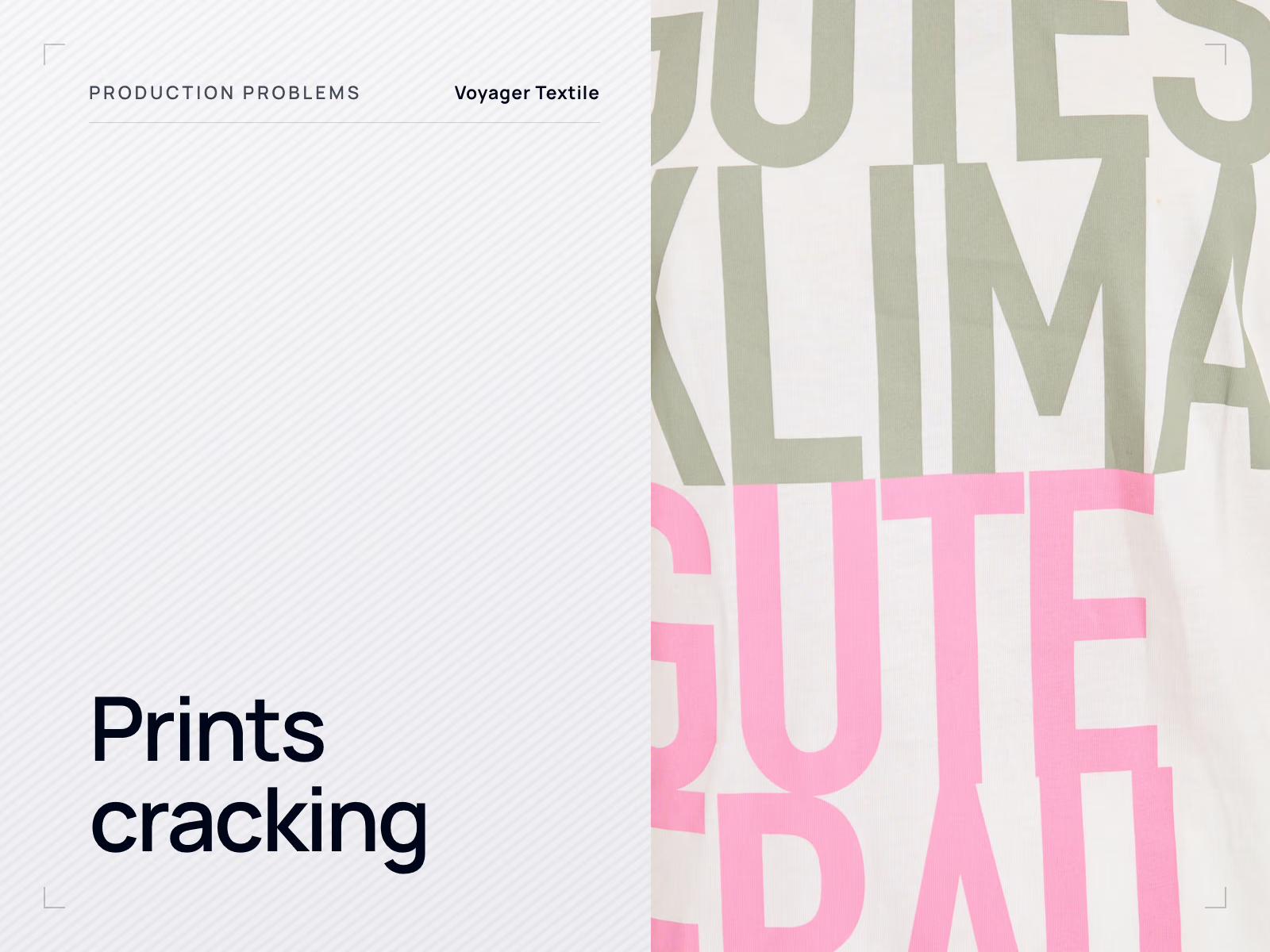
After a handful of washes the print shows fine cracks, and pieces of the ink begin to lift or flake, usually starting in the areas that flex most. A print that is already cracking when the garment is folded firmly has failed before it ever reached a washing machine.
Contents
Print failure is unusual among production defects because it is largely a process parameter problem rather than a materials one. The same ink, the same screen and the same garment will produce a print that lasts for years or one that fails in a month, depending on whether the ink film was fully fused. Everything below follows from that.
Curing is a temperature the whole film has to reach
Plastisol does not dry by evaporation. It fuses: the particles coalesce into a continuous flexible film once the ink reaches its fusion temperature. Ink manufacturers state that the entire thickness of the ink deposit must reach that temperature, commonly cited around 310 degrees Fahrenheit or 154 degrees Celsius, for full cure and washfastness, with typical dryer settings quoted around 320 degrees Fahrenheit for something in the region of 60 to 90 seconds depending on the dryer and the thickness of the deposit.

The important word is thickness. Heat reaches the surface of the ink first. A thick deposit, a heavy white underbase or a print run through a dryer at too high a belt speed can leave the surface fused and the layer underneath unfused, and the print will pass a visual inspection and fail in the wash. Under-cure is explicitly described by ink manufacturers as producing cracking and wash failure, which is exactly the symptom.
Testing whether a print is cured
- The stretch or fold test. Stretch the print firmly across its width, or fold it hard. A fully cured print flexes and returns. One that cracks or shows the fabric through fine splits is not cured. This takes seconds and catches most failures.
- A wash test. Wash the printed sample several times at the temperature the product will actually receive, tumble dry it if the customer will, then repeat the stretch test. This is the check that predicts the complaint.
- Ask what temperature the ink film reached. Not the dryer setting, and not the belt reading: the temperature measured in the ink itself, which is how printers verify cure.
Other causes worth ruling out
| Cause | How it presents | What to change |
|---|---|---|
| Ink deposit too thick | Heavy, stiff print that cracks along fold lines rather than across the whole area | Mesh count, squeegee pressure and the number of print strokes |
| Wrong ink for the fabric | Cracking specifically on stretch fabrics, or on polyester and blends | A stretch-capable ink for elastane fabrics, or a low-bleed system for polyester |
| Printing across a seam or a bulky area | Cracking localised at the seam or at the pocket edge | Move the artwork, or print on the panel before assembly |
| Fabric moving under the print | Distortion and cracking on very stretchy knits | Platen adhesive, print sequence and, where possible, printing before assembly |
| Wet or damp garments entering the dryer | Inconsistent failures within one production run | Storage and handling before printing |
Transfers crack for related but different reasons
Transfer printing, including direct-to-film, sits on the surface as a film rather than fusing into it, and it fails when the application parameters are wrong rather than when curing is incomplete. Application temperature, pressure and dwell time all have to match the transfer system and the fabric, and the peel timing matters: peeling hot when the system requires a cold peel, or the reverse, weakens the bond. Where a transfer is applied to a stretch fabric, the transfer film itself has to be one designed to extend.
The practical implication for a buyer is the same in both cases. Ask which system is being used, ask for a physical sample in the actual fabric, and wash it before approving. What that result then contributes to the label is covered in decoration and care instructions.
What to specify
In the specification
- The washing regime the product must survive, including temperature and drying method
- That print approval is on a washed sample rather than a fresh one
- The fabric composition, so the correct ink system is selected
- Whether the print area will be stretched in wear
- Placement away from seams and bulky construction where the design allows
What the printer controls
- Ink system selection for the fabric
- Deposit thickness through mesh, squeegee and stroke count
- Dryer temperature, belt speed and dwell
- Verifying the temperature reached in the ink film rather than at the belt
- Consistency across a long run as the dryer heats and the line speeds up
Method selection against artwork, fabric and quantity is covered in the decoration comparison guide, and where printing falls in the production sequence is explained in the T-shirt manufacturing process. If the print is not cracking but changing colour, that is a different mechanism, covered in colour change on polyester.
Questions this raises
How many washes should a print survive?
That is a commercial decision rather than a technical constant, and it should be stated in the specification. A promotional tee worn a few times and a uniform polo washed weekly for two years are different requirements, and the ink system and print construction follow from the answer.
Does a thicker print last longer?
No, and it often lasts less. A thicker deposit is harder to cure right through, stiffer in wear and more likely to crack along fold lines. Durability comes from full cure and the right ink, not from more ink.
Why did the print crack only on the dark garments?
Dark garments usually carry a white underbase, which makes the total ink deposit substantially thicker and harder to cure through. It can also indicate dye migration, which discolours rather than cracks, so check both.
Can a cracked print be repaired?
No. An under-cured print cannot be re-cured usefully once the garment has been washed, and a cracked film cannot be restored. The affected pieces have to be replaced, which is why the fold test on a pre-production sample is worth the five seconds it takes.
Planning a printed programme that has to survive washing?
Tell us the fabric, the artwork and how often the product will be washed. We will confirm the print method, produce a sample and wash it before you approve it.
Discuss a print specification