Jersey and fleece knitwear
T-Shirt Manufacturing Process
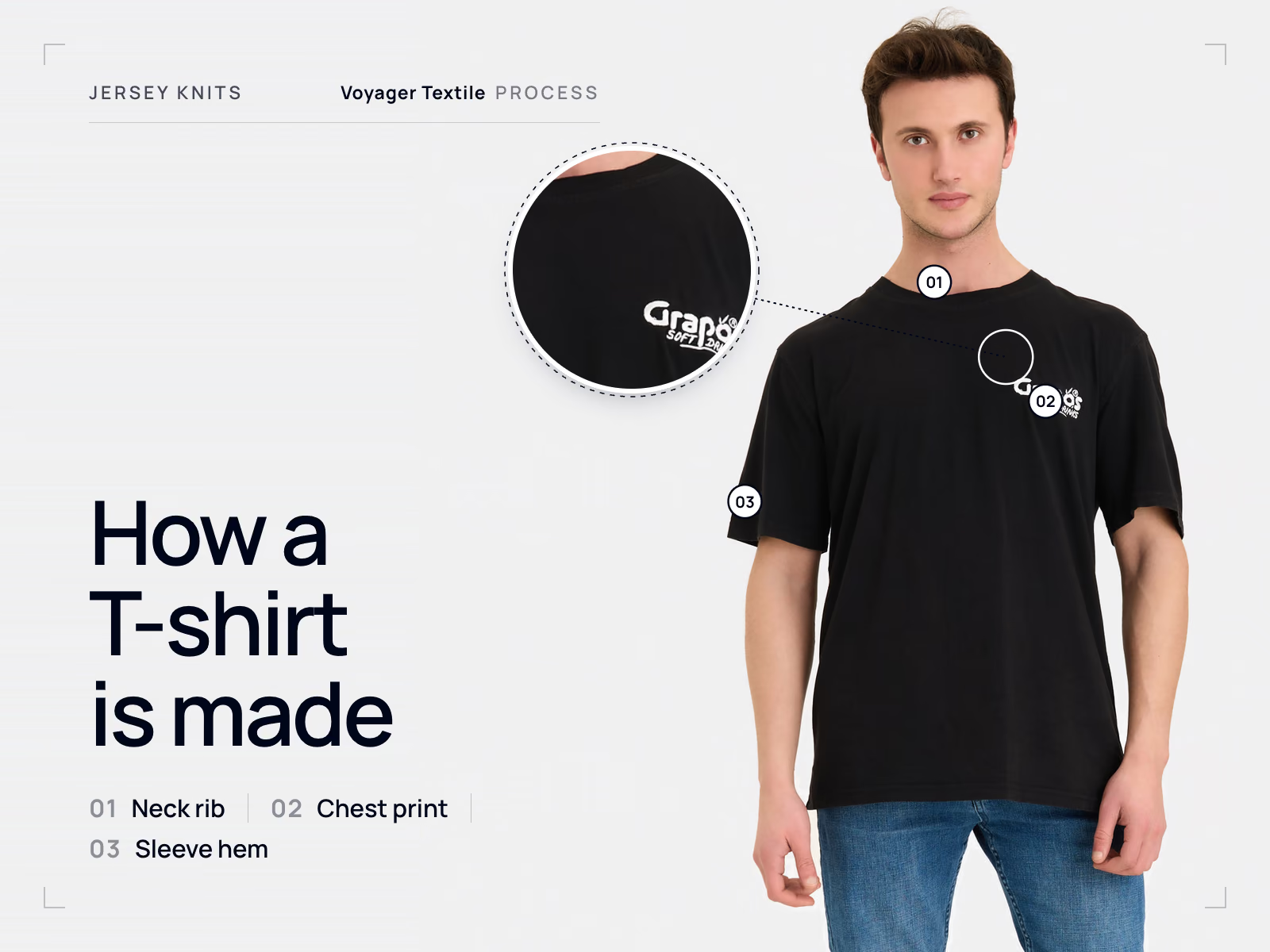
A T-shirt is made from circular-knitted single jersey. The fabric is inspected and relaxed, spread and cut to a marker, decorated at panel stage where the artwork requires it, then assembled: shoulders joined and taped, neck rib attached, sleeves set, side seams closed and hems coverstitched. Many quality problems in T-shirt production come from the fabric stage, not the sewing room.
Contents
- What a T-shirt is, in manufacturing terms
- Fabric: single jersey and its relatives
- Fabric relaxation and why it decides the measurements
- Spirality: the twist that appears after washing
- Patterns and what to approve
- Cutting
- When printing and embroidery are applied
- Sewing: the construction sequence
- The neck rib, in detail
- Labels, hangtags and branding
- Finishing, pressing and packing
- Quality control and the defects that actually occur
- What to put in a T-shirt tech pack
- Sampling before bulk
- What drives cost and complexity
- Buyer questions
A T-shirt looks like the simplest garment a factory can make, and in terms of sewing operations it very nearly is. What makes it difficult is the fabric. Single jersey moves: it relaxes, it shrinks, it can twist, and every one of those behaviours shows up in a garment that was cut correctly and measures wrong two weeks later. This page follows the process a factory actually runs, and points out where the decisions are made.
T-shirt production sequence
What a T-shirt is, in manufacturing terms
A T-shirt is a weft-knitted garment, normally cut from single jersey, with a set-in or dropped sleeve, a ribbed or bound neckline and hemmed sleeve and bottom edges. It typically consists of a front, a back, two sleeves and a neck rib, which is why sewing is fast and why the fabric decision carries much of the quality risk.
Fabric: single jersey and its relatives
Single jersey is the standard T-shirt fabric: a plain weft knit with a smooth face and a looped back. It is produced on circular knitting machines, either as an open-width roll or as a tube. The tube matters commercially, because a tubular fabric can be cut so the body has no side seams, which changes both the look and the cutting.
| Structure | Typical composition | Indicative GSM range | Suited to | Key consideration |
|---|---|---|---|---|
| Single jersey, fine yarn | 100% combed cotton, 30/1 or finer | Around 140 to 160 | Lightweight and promotional tees, hot climates | Check opacity in white and pale shades before approving |
| Single jersey, standard | 100% combed cotton, around 24/1 | Around 165 to 190; one mill lists 24/1 at 175 g/m² | Everyday retail and corporate T-shirts | The common compromise between hand-feel and cost |
| Single jersey, heavyweight | 100% combed cotton, coarser yarn or tighter structure | Around 200 to 250 | Premium and boxy fits | More fabric per piece, so unit cost and carton weight rise |
| Single jersey with elastane | Around 95% cotton with 5% elastane | Around 150 to 200; one mill lists a brushed 40/1 with 5% elastane at 150 g/m² | Fitted women's tees, closer silhouettes | Elastane changes shrinkage behaviour and needs its own fit sample |
| Interlock | 100% combed cotton | Around 170 to 200; one mill lists 40/1 at 170 g/m² and 36/1 at 190 g/m² | Smoother, more stable tees and children's wear | More stable than single jersey and does not curl at the edge |
| Blends and tri-blends | Cotton with polyester, sometimes with viscose | Around 150 to 200 | Durability, reduced shrinkage, heathered appearance | Fibres take dye differently, which is what creates the heathered look |
Merch, promotional textiles, corporate wear and workwear programmes for T-shirts are covered on the T-shirt manufacturer page.
Composition and weight are only part of the specification. Yarn quality decides how the fabric looks after ten washes: combed cotton has the short fibres removed, so it is smoother and pills less than carded, and ring-spun yarn is finer and softer than open-end. State those alongside the GSM, because two fabrics with the same weight and composition can behave very differently. Fabric weight in general is covered in the GSM guide and fibre behaviour in the composition guide.
Fabric relaxation and why it decides the measurements
Knitted fabric leaves the knitting machine, the dye house and the finishing line under tension. If it is cut in that state, the panels contract afterwards and the finished garment measures short, usually in length. Relaxation is the deliberate step of opening the rolls and letting the fabric recover before spreading, and it is one of the most effective controls on T-shirt measurements.
Two related decisions belong here. First, whether measurements in the specification apply before or after washing, since a garment can be inside tolerance at inspection and outside it after a customer's first wash. Second, whether the fabric is compacted during finishing, a mechanical process that pre-shrinks the fabric and reduces later movement. Agree both at specification review rather than at inspection.
Spirality: the twist that appears after washing
Spirality is the effect where the side seams of a T-shirt rotate around the body after washing, so the garment appears twisted. It is a fabric and yarn phenomenon rather than a sewing fault. Textile research attributes it primarily to residual torque in the yarn: a twisted yarn knitted into a loop tries to untwist as the fabric relaxes, and the loops skew as a result.
The practical levers are all upstream of the sewing room, and the full diagnosis, including how to tell spirality apart from off-grain cutting, is in why T-shirts twist after washing. Finer yarns and slacker structures increase it, while a tighter knit restricts loop movement and reduces it. Plied yarns, plaiting, and alternating S-twist and Z-twist yarn packages on the knitting machine can substantially reduce or eliminate it. Compacting during finishing helps. Cutting direction interacts with it as well, since cutting all parts in the same direction can reinforce the effect while opposing directions can partly cancel it.
Patterns and what to approve
A T-shirt pattern is cut with little ease, because the fabric stretches. The measurements that decide the character of the garment are body length from the high point of the shoulder, chest width, shoulder width, sleeve length and opening, and the neck opening and drop. Each needs a target value and a tolerance; without tolerances the inspector has no standard to apply.
Fit intent has to be written down as well, because the same chest measurement produces a regular tee or an oversized one depending on where the shoulder sits and how deep the armhole is. Grading then extends the base size, and neck width in particular should not grow at the same rate as the body. The mechanics are covered in the pattern and grading guide.
Cutting
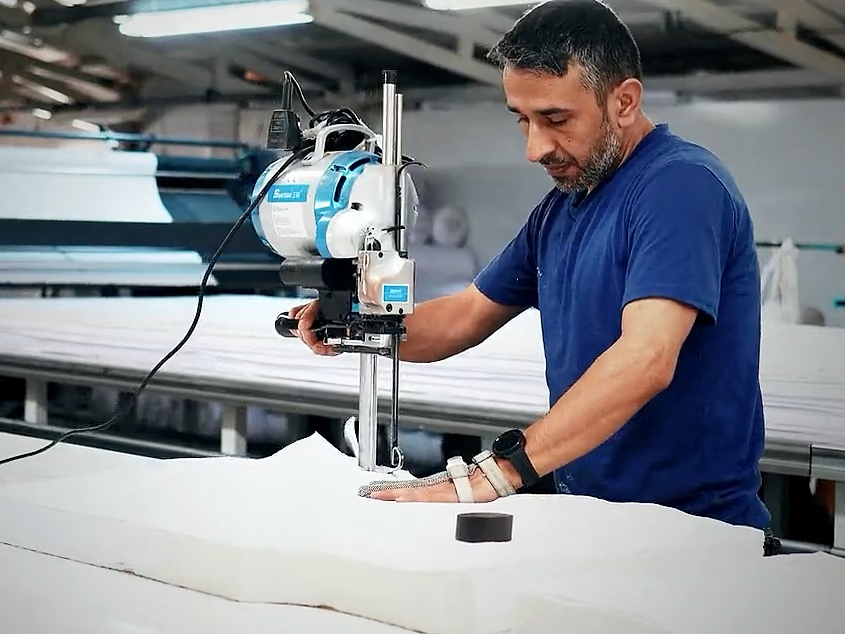
Relaxed fabric is spread in plies to a marker that arranges every panel for every size in the lay. The wider cutting-room picture, including directional fabric, shade groups and pattern matching, is in the cutting room. Three points matter for T-shirts specifically. Panels must follow the grain, since an off-grain body twists regardless of the fabric's own spirality. Shade continuity is checked across rolls so that a single garment never combines panels from two different dye lots. And cut parts are bundled by size and colour so panels stay together through decoration and assembly.
When printing and embroidery are applied
This is where T-shirt production differs from decorating finished blanks. A large body print is normally applied to the cut front panel before assembly, because a flat panel lies evenly on the press, the print can extend to the seam line, and there is no back of the garment to protect. Screen printing and transfer printing both work this way in bulk production.
- Screen printing on panels. Efficient for designs with a limited number of solid colours; each colour is a screen and a set-up, so colour count drives cost.
- Transfer printing, including DTF. Handles photographic and multi-colour artwork with little set-up, applied to panels or to finished garments depending on the placement.
- Embroidery. Worked on the panel before assembly for chest positions. On light single jersey it needs appropriate backing, since dense stitching distorts an unsupported knit.
- Printed neck labels. Applied instead of a sewn label, which affects how the neckline is finished, so it must be decided before construction.
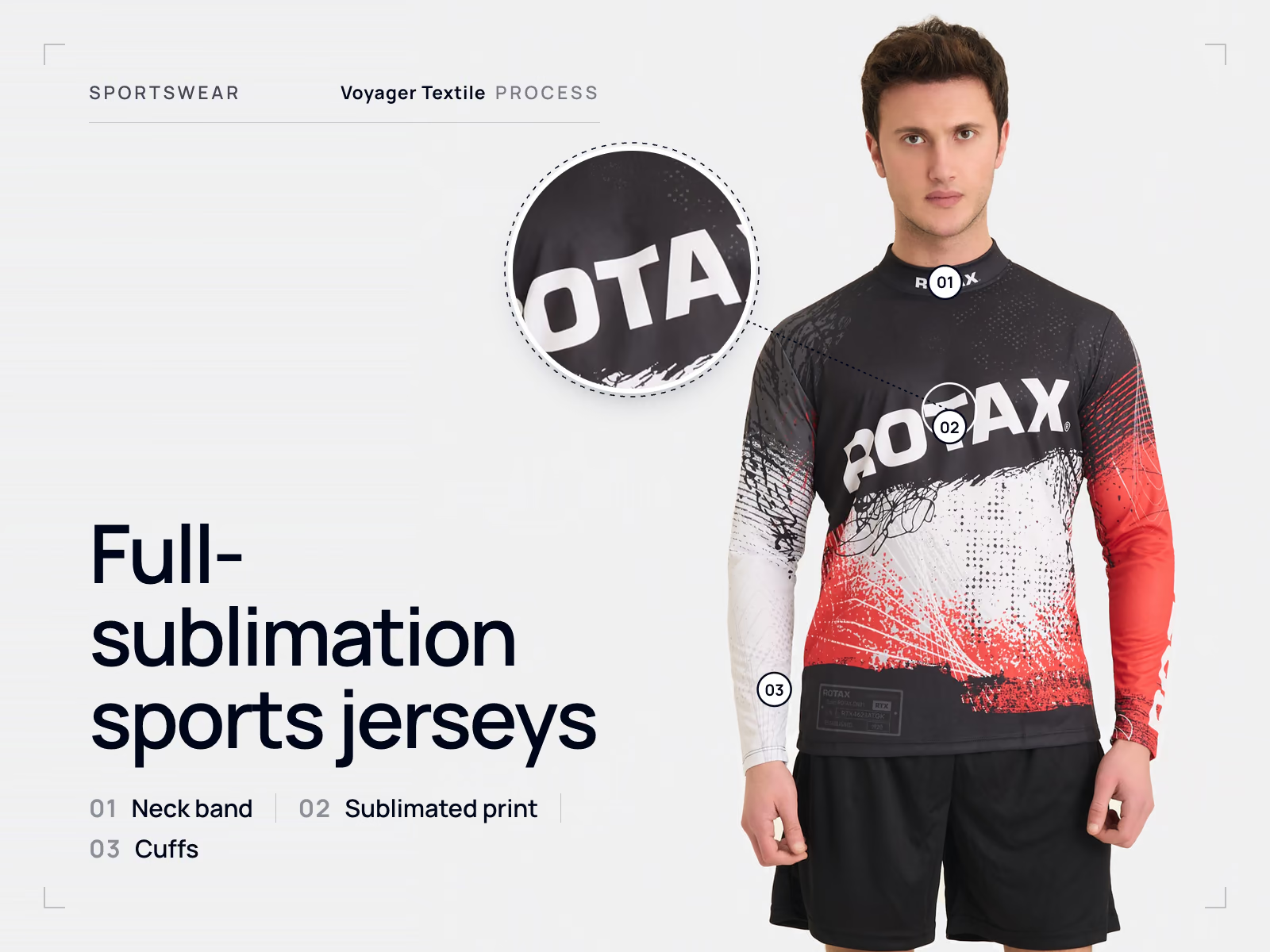
- Sublimation. Not applicable to cotton T-shirts. For polyester performance tees see the sublimated performance T-shirt process.
Which method suits which artwork and quantity is compared in the decoration guide, and what the files need to contain is set out in the artwork guide.
Sewing: the construction sequence
A basic crew-neck tee is assembled in a short, fixed order, mostly on overlock and coverstitch machines, and what those stitch types do differently is worth knowing before reading the sequence.
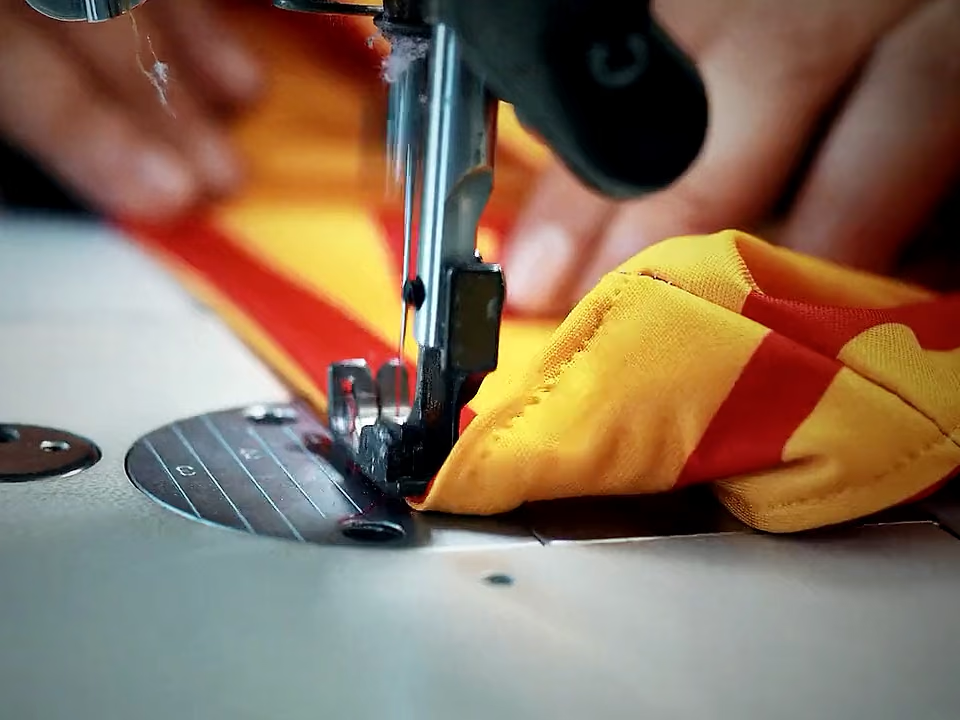
- Join the shoulders. Front and back are overlocked at the shoulder seams.
- Tape the shoulders. A narrow tape is stitched into the shoulder seam to stop it stretching in wear. On light jersey this is what keeps the shoulder line straight over time.
- Attach the neck rib. The rib is joined into a ring, attached around the neckline and closed, then the seam is topstitched or covered. This is the operation with the least margin for error.
- Set the sleeves. Sleeves are attached flat before the side seams are closed, which is faster and gives a cleaner armhole on jersey.
- Close the side and underarm seams. A single continuous overlock from cuff to hem.
- Hem the sleeves and the bottom. Coverstitch, which stretches with the fabric instead of breaking.
- Attach labels. Neck, size and care labels, positioned as specified, unless a printed neck label replaces them.
A tubular body changes step five: there are no side seams to close, so the body is cut from the knitted tube. It is cheaper and it removes a seam, but it also removes the shaping a side seam allows, so it suits straight-cut styles rather than fitted ones.
The neck rib, in detail
More T-shirt complaints trace back to the neckline than to anything else. The rib is a separate fabric, usually a 1x1 or 2x2 rib, sometimes with a small elastane content for recovery. Three specification points decide whether the neckline holds its shape.
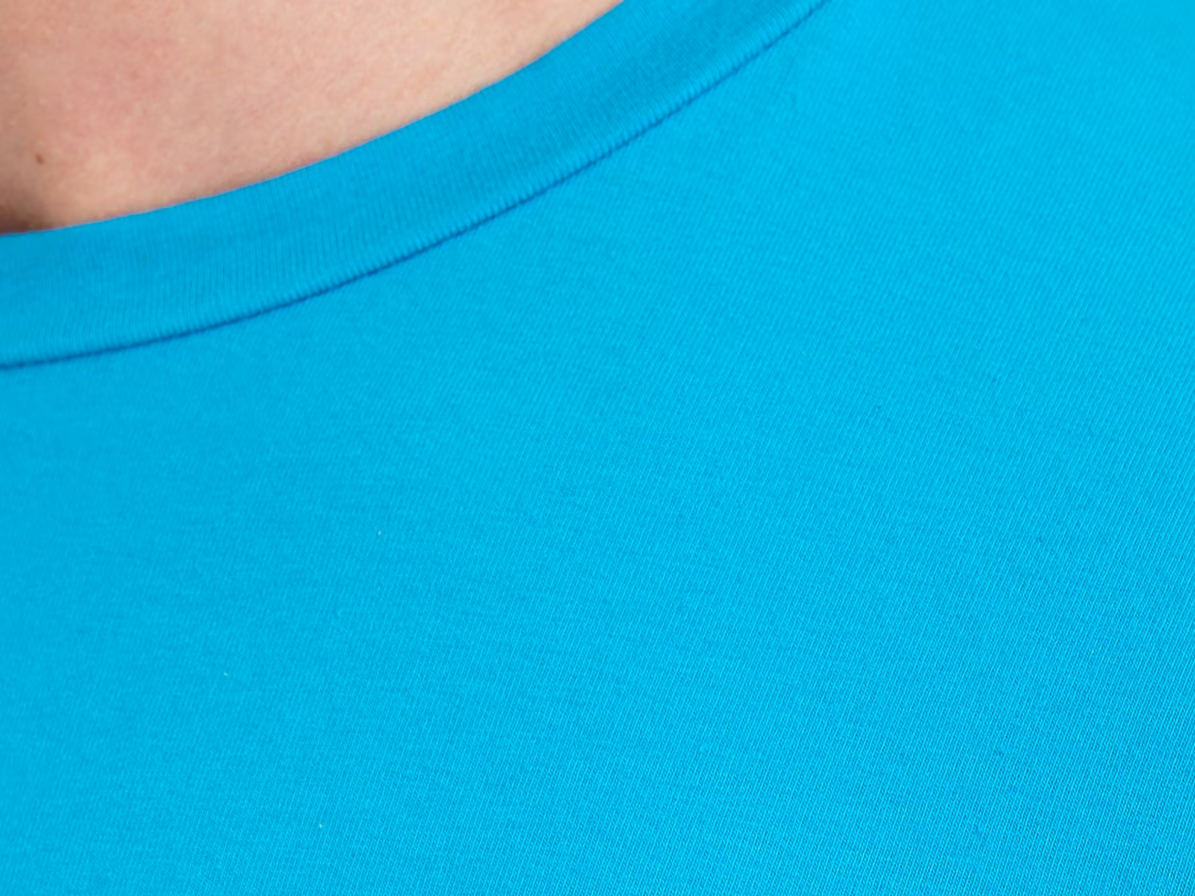
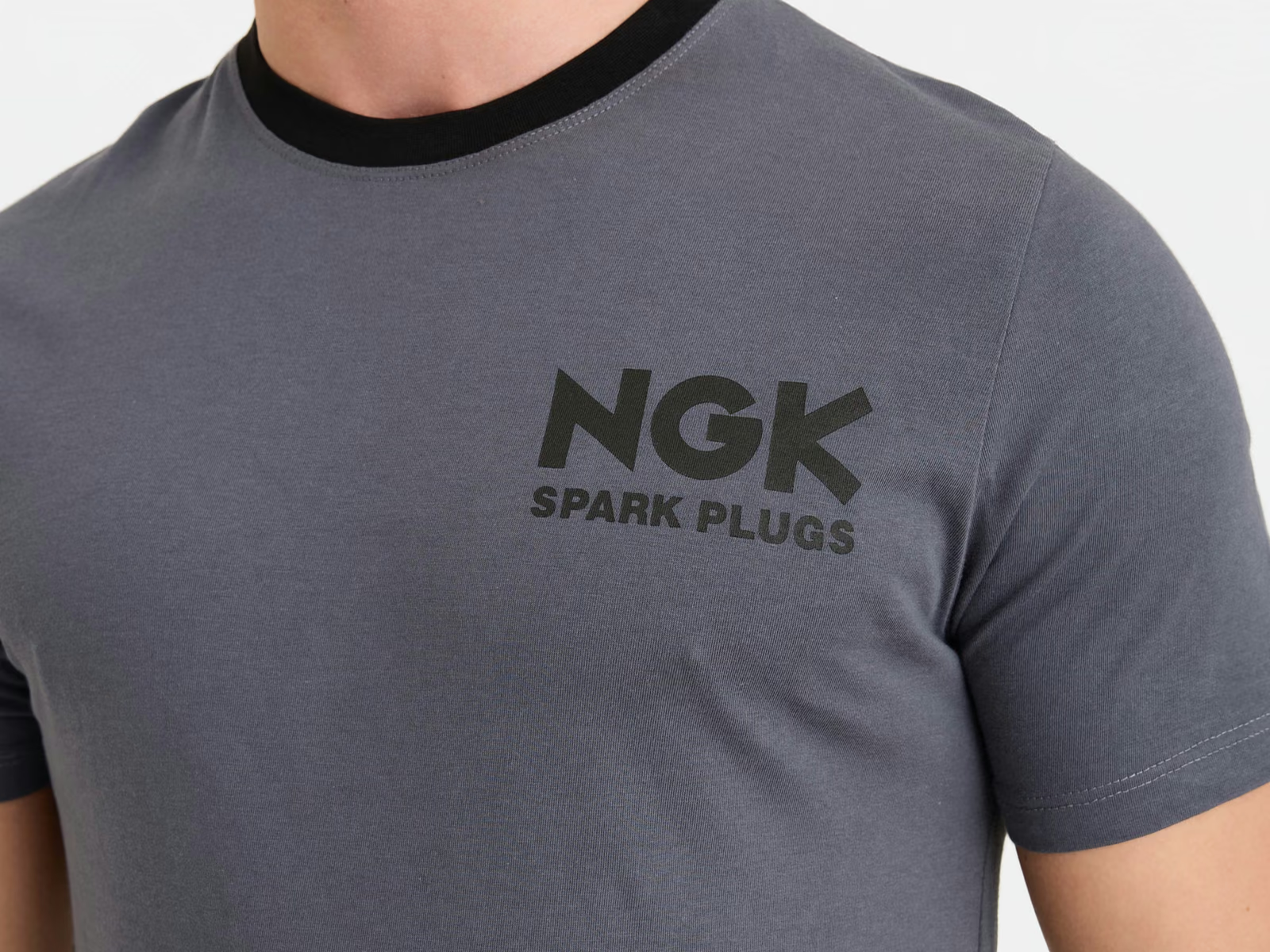
- Rib quality and recovery. A rib that stretches when the garment is pulled over the head and does not return is the classic failure. Check recovery on the sample by stretching the neckline and releasing it.
- Rib width and the ratio it is attached at. The rib ring is cut slightly shorter than the neckline and stretched as it is sewn. Too little tension gives a wavy neckline; too much gives a puckered one.
- Neck opening measurement. It should be measured on the sample and given a tolerance, since it is the measurement customers notice first.
Colour is a further trap. Rib and body are different structures, and even when both are dyed to the same standard they can read slightly differently. Approve the rib against the approved body fabric rather than against a paper reference, as explained in the colour matching guide.
Labels, hangtags and branding
- Woven or printed main label at the inside back neck, or a printed neck label applied directly to the fabric.
- Size label, either separate or combined with the main label.
- Care and composition label, carrying the content your market requires, usually at the inside back neck or the side seam.
- Optional hem or sleeve labels for branding.
- Hangtags attached at the neck label or a buttonhole, with the attachment method specified.
Label content is a legal matter in most markets, and the responsibility normally sits with the brand or importer rather than the factory. See the EU and US labelling guides, and the labels and packaging guide for the physical components.
Finishing, pressing and packing
T-shirts are trimmed of loose threads, checked, and normally steamed rather than hard-pressed. Heavy pressing on cotton jersey can glaze the surface and stretch the panel, which is why a light steam and a controlled fold is the usual treatment. Printed panels are handled so the print is not pressed directly at high heat.
Folding, individual bagging, size stickers and carton assortment are specified before the order reaches packing, because repacking finished goods is slow. Solid cartons by size and colour suit distribution centres; mixed cartons suit direct delivery to individual locations.
Quality control and the defects that actually occur
| Check | What it catches |
|---|---|
| Measurements against the tolerance table | Shrinkage and cutting drift, most often in body length |
| Neckline recovery and appearance | Wavy or puckered rib attachment, poor rib quality |
| Spirality after a wash test | Yarn torque and finishing problems that only appear after washing |
| Shade continuity within and between garments | Panels cut from different rolls or dye lots |
| Print position, size and cure | Placement drift and under-cured ink that cracks in washing |
| Shoulder tape presence and seam integrity | The seam that fails first in wear |
| Label content and position | Compliance and returns |
Inspection levels, defect classification and laboratory tests worth specifying are covered in the quality control guide. For T-shirts the tests that repay their cost most often are dimensional stability after washing and colourfastness to washing and rubbing.
What to put in a T-shirt tech pack
- Fabric: structure, composition, yarn quality where it matters, target GSM with a range, and finish.
- Body measurements: length from the high point of the shoulder, chest, bottom width, shoulder, with tolerances.
- Sleeve measurements: length, opening and armhole.
- Neckline: rib type and width, neck opening and drop, and whether the seam is topstitched or covered.
- Shoulder taping: whether it is required and its width.
- Hems: sleeve and bottom hem depth and stitch type.
- Body construction: side seams or tubular.
- Print or embroidery: artwork files, physical size, and placement measured from the high point of the shoulder.
- Labels: main, size and care, with content and position, or a printed neck label instead.
- Colours: Pantone references or approved swatches, including the rib.
- Packing: fold, bag, hangtag, carton assortment.
Sampling before bulk
T-shirts are simple enough that sampling is often short, but it still has to happen. A first sample proves the construction and the measurements. A revision usually adjusts fit or neckline. A pre-production sample in the actual bulk fabric, with the real rib, the final print and the final labels, is the one that protects the order, because it is the sample bulk is inspected against.
Where custom colour is involved, a lab dip is approved on the actual fabric before bulk dyeing. Where a print is involved, a strike-off on the actual fabric confirms colour and ink behaviour. Neither can be judged from a screen. The stages and what to check at each are set out in the sampling guide.
What drives cost and complexity
- Fabric weight and quality. Usually the largest single line, and a direct multiplier: a 240 g/m² tee uses roughly a third more fabric than a 180 g/m² one.
- Fabric consumption. Longer bodies and wider oversized patterns consume more fabric per piece before anything else changes.
- Colour approach. Stock colour, or custom dyeing with its own approval and minimum.
- Print colours and placements. Each screen and each placement is a set-up.
- Quantity. Set-up costs are spread over the order, which is why unit price falls fastest just above the minimum.
- Labels and packing. Small per piece, easy to underestimate across a programme.
The full cost anatomy is in the cost guide, and how minimums are built in the MOQ guide. Voyager Textile produces custom apparel from 300 pieces, with custom Pantone colour production also from 300 pieces.
Before you send a T-shirt RFQ
Anything you cannot answer yet can be marked to be confirmed; a stated unknown is easy to work with.
- Fabric structure, composition and target GSM, or the intended use
- Fit intent: regular, fitted, oversized
- Size range and the split per size
- Measurement chart for the base size, or a reference garment
- Colours, with Pantone references if custom
- Neck rib type and whether a printed neck label is wanted
- Print or embroidery artwork, size and placement
- Label set and care content for your market
- Quantity per style and colour
- Packing requirements and destination
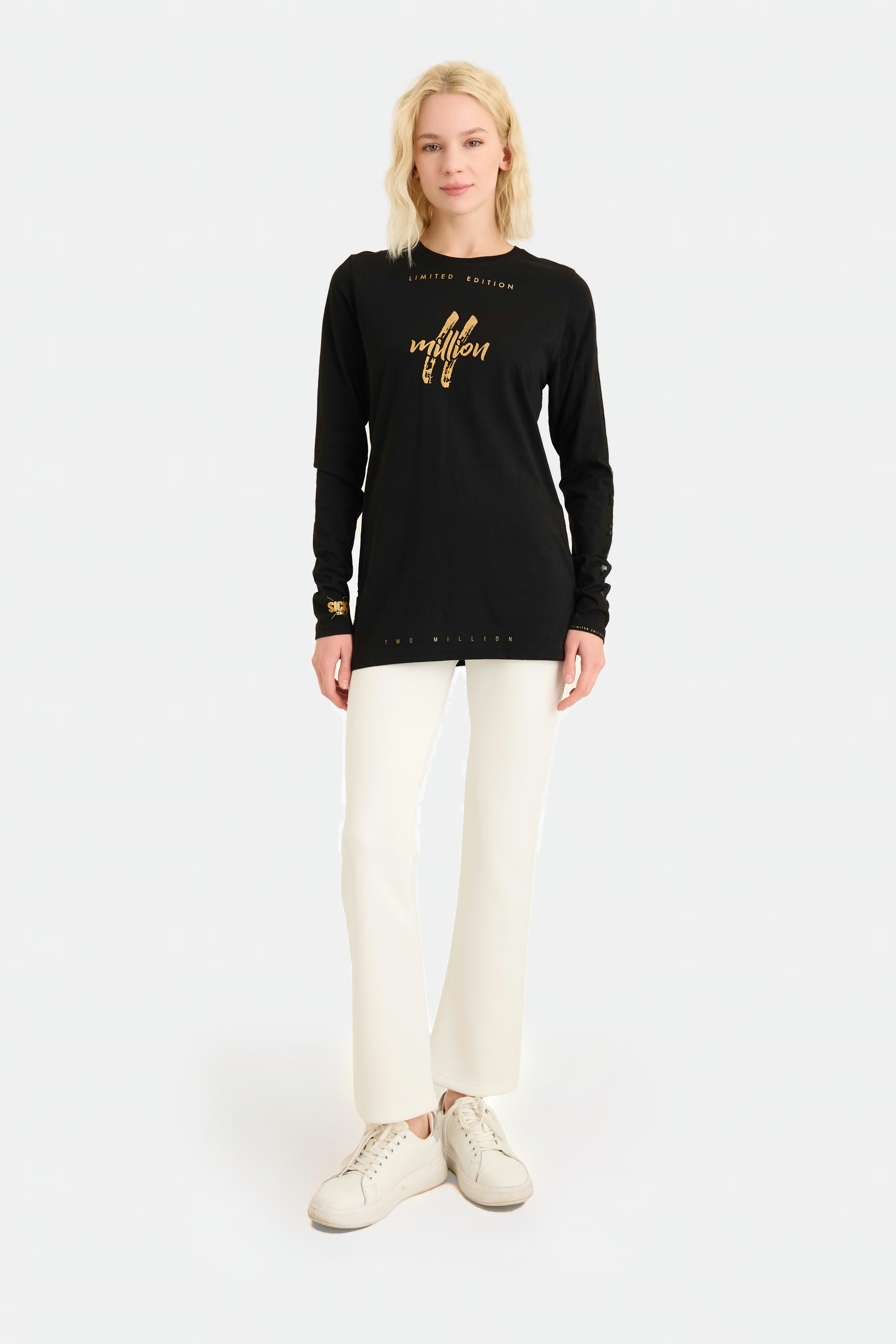
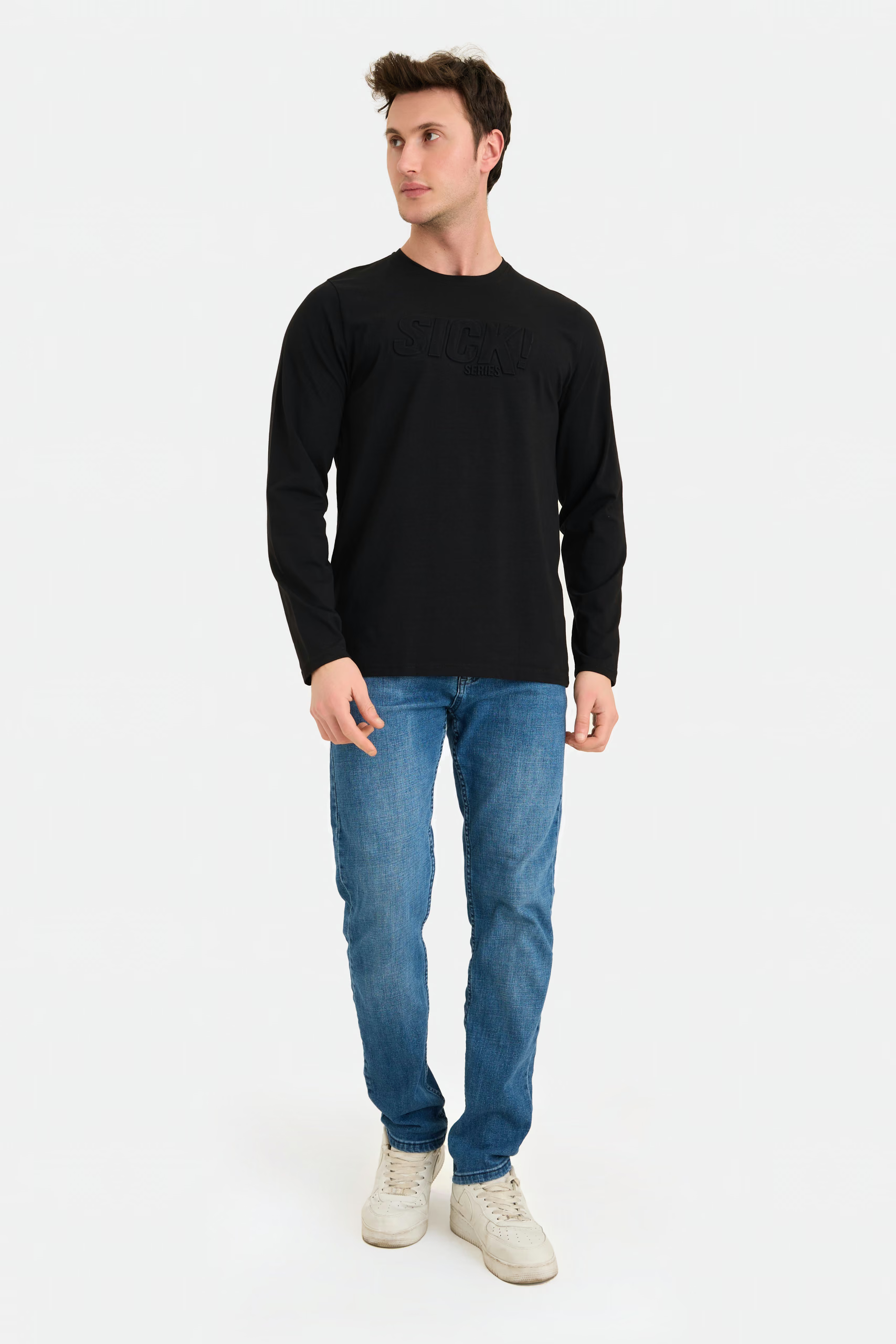
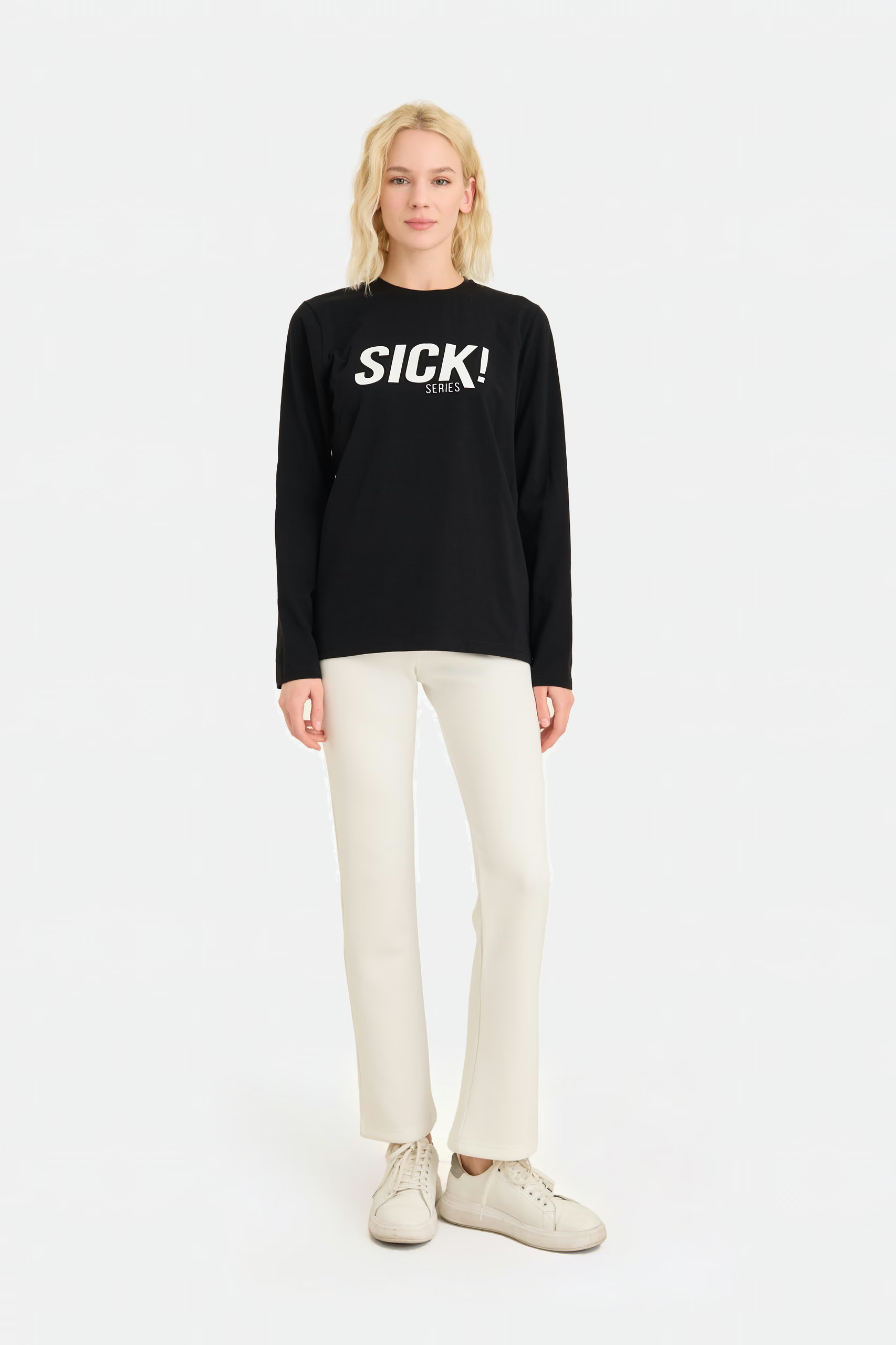
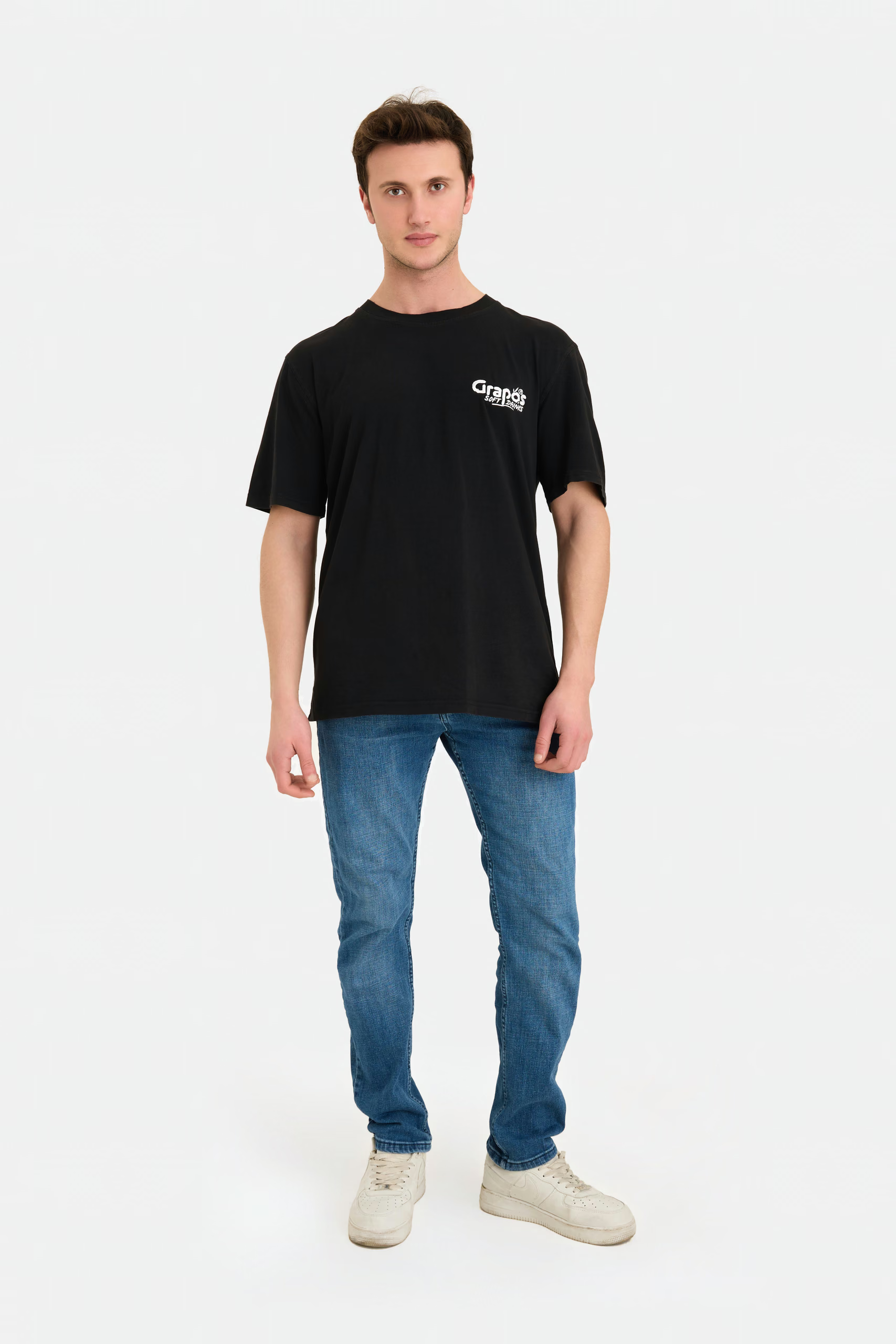
T-shirt references produced by Voyager Textile
Previously produced to customer specification. Nothing shown is stock; quote an article code to start from an existing construction.
Buyer questions
How is a T-shirt manufactured?
Single jersey fabric is inspected and relaxed, spread and cut to a marker, and decorated at panel stage where the artwork requires a flat surface. The panels are then assembled: shoulders joined and taped, neck rib attached, sleeves set, side seams closed and hems coverstitched. The garment is finished, measured against the approved sample, labelled and packed.
What fabric is used for T-shirts?
Single jersey is the standard, most often in combed cotton. Cotton with a small elastane content is used for fitted styles, cotton and polyester blends for durability and reduced shrinkage, and interlock where a smoother, more stable fabric is wanted.
What GSM is right for a T-shirt?
Around 165 to 190 g/m² suits most retail and corporate T-shirts. Roughly 140 to 160 g/m² is common for lightweight and promotional programmes, and 200 to 250 g/m² for premium or boxy fits. These are sourcing ranges rather than standards, and yarn, structure and finishing change how a given weight feels.
Why do T-shirts twist after washing?
That is spirality, caused mainly by residual torque in the yarn releasing as the fabric relaxes. It is influenced by yarn twist and count, knit tightness, finishing and cutting direction, so it is addressed at fabric selection rather than in the sewing room. Ask for a wash test on the sample if your programme is sensitive to it.
Is printing done before or after the T-shirt is sewn?
Large body prints are usually applied to the cut panel before assembly, because a flat panel presses evenly and the print can run to the seam line. Smaller placements are often printed on the finished garment. The decision is made at specification review because it affects the production sequence.
How do you stop the neckline losing its shape?
By specifying the rib quality and its recovery, controlling the ratio at which the rib ring is attached, and taping the shoulder seams so they do not stretch in wear. Check recovery on the sample by stretching the neckline and releasing it rather than judging it visually.
Can a T-shirt be dyed to a custom Pantone colour?
Yes. Fabric is dyed to your reference and a lab dip is approved on the actual fabric before bulk dyeing. At Voyager Textile custom Pantone colour production starts at 300 pieces. See the colour matching guide.
Does the tech pack need to state whether measurements are before or after washing?
Yes, and it is one of the most useful lines in the document. Cotton jersey moves in washing, so a chart that does not say which state it refers to can produce a garment that passes inspection and fails the customer's first wash.
How long does T-shirt production take?
Bulk production at Voyager Textile typically takes 4 to 5 weeks after sample approval, depending on the product and the project. Fabric sourcing, custom dyeing, sampling and transport are additional, and fabric availability is usually what moves the date rather than sewing time.
Ordering this garment from Voyager Textile
- Every garment is made to order, to your own design.
- The minimum order is 300 pieces per colour and per style. Sizes can be split inside the 300, and a custom Pantone colour carries the same minimum of 300 pieces. Polyester-based fabrics are assessed separately.
- A sample takes 5–7 business days. Bulk production takes 4–5 weeks after sample approval; development, sampling and shipping are additional.
- Cutting, sewing, embroidery, transfer printing and sublimation printing are done in our own factory in Türkiye. Screen printing and garment washing are coordinated with partner facilities.
Quantities, timing and any open point are confirmed per project at the quotation stage, once we have your specification or tech pack.
Request a quoteHave a T-shirt specification ready?
Send the fabric, weight, measurements and artwork, or a reference garment you want matched. We review it for manufacturability, confirm what is missing and sample before anything goes into bulk.
Send a T-shirt brief