

Garment stitch types: lockstitch, chainstitch, overlock, coverstitch and flatseam
Apparel uses a small number of stitch types for almost everything, and each one exists because it solves a different problem: holding two plies precisely, stretching with a knit, enclosing a raw edge, covering a hem, or joining two edges without overlapping them. Choosing between them is a decision about stretch, strength, appearance and thickness.
Contents
Stitch types are numbered under ISO 4915, and the numbering is not arbitrary. The first digit is the class, and the class tells you the mechanism: 100 single-thread chain, 300 lockstitch, 400 multi-thread chain, 500 overedge chain, 600 covering chain. Once you know the class you already know most of what the stitch will do in a garment.
The numbers are worth learning because they are unambiguous in a way that names are not. "Flatlock" in particular is used loosely in the trade for at least two different stitches. A tech pack that says 607 says exactly one thing.
Lockstitch, ISO 301
301 lockstitch
A needle thread and a bobbin thread interlock in the middle of the fabric. The stitch looks the same from both faces.
The lockstitch is the stitch most people picture when they think of sewing. One needle thread passes through the fabric and interlocks with a bobbin thread, with the interlock sitting in the centre of the seam. American & Efird's ISO stitch reference describes it as the most common of all stitches, used for topstitching, single-needle stitching and straight stitching.
Its virtues are precision and appearance. It is the same on both faces, it holds a line accurately, and it does not unravel if a thread breaks, because each stitch is locked independently. Its limitation is that it has very little extension. Stretch a 301 seam in a knit garment and the thread reaches its limit before the fabric does, and the thread breaks. This is a common construction mistake in knitwear: a lockstitched shoulder or side seam in a jersey garment that fails the first time someone pulls it over their head.
Chainstitch, ISO 401
401 two-thread chainstitch
The needle thread interloops with a looper thread that forms a chain on the underside of the seam.
A chainstitch replaces the bobbin with a looper. One needle thread passes through the fabric and interloops with a looper thread that is pulled up to the underside, forming a visible chain. A&E lists it as the standard for main seams on wovens.
The chain gives it two properties a lockstitch does not have. It extends, because the loop structure can open under load, which makes it acceptable on seams that need some give. And it runs from a cone rather than a bobbin, so a machine does not stop to be rewound, which matters on long seams in high-volume production. Its weakness is the mirror of the lockstitch's strength: a broken chainstitch can run, unpicking itself along the seam, which is why the chain end is usually secured.
Chainstitch is the basis of several composite constructions. Felled seams on jeans and shirts are typically sewn with two- or three-needle 401. Waistbanding on jeans and chinos is commonly 401 or 301 through a binding folder.
Overedge and safety stitches, ISO 500 class
504 three-thread overedge
Seen from above. One needle thread stitches back from the cut edge, and two looper threads run out to the edge and wrap it as the seam is sewn.
Overedge stitches, widely known as overlock or serging, do two jobs in one pass: they join the plies and they wrap the cut edge. That is why they dominate knit garment assembly. The edge is enclosed as the seam is made, so a jersey side seam does not need a separate edge finish and cannot curl out of the seam.
| ISO | Threads | Common name | Typical use |
|---|---|---|---|
| 503 | 1 needle, 1 looper | Two-thread overedge | Serging a raw edge and blindhemming, edge finishing only rather than seaming |
| 504 | 1 needle, 2 loopers | Three-thread overlock | The common overedge seaming stitch for knits |
| 512 | 2 needles, 2 loopers | Mock safety stitch | Seaming stretch knits and wovens |
| 514 | 2 needles, 2 loopers | Four-thread overedge | Seaming stretch knits and wovens; A&E notes it is preferred over 512 because it chains off better |
| 515 | 401 + 503 | Four-thread safety stitch | Woven and knit seaming; uses less thread than 516 |
| 516 | 401 + 504 | Five-thread safety stitch | Woven and knit seaming; a chainstitch seam and an overedge finish formed at the same time |
The safety stitches are worth understanding as a buyer because they are two stitches in one operation. A 516 is a 401 chainstitch holding the seam plus a 504 overedge finishing the edge, sewn simultaneously. It is a strong, clean and productive way to build a woven seam, and it is why a trouser inseam does not need a separate serging pass.
Overedge seams consume noticeably more thread than lockstitch seams, and stitch density and the width of the bite change both the strength and the appearance. A wider bite takes more seam allowance and therefore affects finished measurements, which is one of the details worth pinning down in fit development.
Coverstitch, ISO 600 class
406 bottom coverstitch
Two needle threads on the face and a looper thread on the underside that covers the raw edge between them.
Coverstitches are the reason knitwear hems look the way they do. Two or three needle threads run parallel on the face of the garment, and a looper thread on the underside zig-zags between them, covering the raw edge. The result stretches, lies flat and finishes the edge in one operation.
| ISO | Structure | Typical use |
|---|---|---|
| 406 | 2 needle threads, 1 bottom looper | Hemming t-shirts and polos, attaching elastic, binding, making belt loops |
| 407 | 3 needle threads, 1 bottom looper | Attaching elastic on knit underwear |
| 602 | 2 needles, top cover and bottom looper | Binding, where the stitch has to look finished on both faces |
| 605 | 3 needles, top cover and bottom looper | Lap seaming, coverseaming and binding on knits |
The visible signature of a coverstitch is two or three parallel lines on the outside of a hem with a looped, covered structure inside. If a knit hem shows one line of straight stitching instead, it was lockstitched, and it will have far less extension. On a fitted sleeve cuff or a t-shirt hem that difference is felt immediately in wear.
Flatseam, ISO 607
607 flatseam
Four needle threads with a top cover and a bottom looper thread, joining two butted edges so the seam has almost no thickness.
A flatseam does something the other stitches do not: it joins two edges that are butted together rather than overlapped. There is no seam allowance folded to one side, so the join has almost no thickness and no ridge. A&E lists 607 as the flatseamer or flatlock stitch, formed with four needle threads plus a top cover thread and a bottom looper thread, used for flat and lap seaming on knit underwear and fleece, and preferred over 606 because the machines are easier to maintain.
This is the construction used where a seam sits against the skin under load, which in practice means base layers, performance underwear, and some activewear. It removes the ridge that causes chafing. The trade-off is that a butted seam has no seam allowance to absorb a pattern correction, so the pattern has to be right, and the operation is slower and more specialised than an overlock seam.
Choosing between them
| Requirement | Usual answer | What you give up |
|---|---|---|
| Precise line and clean appearance | 301 lockstitch | Extension; unsuitable for stretch seams |
| Woven main seam with edge finished in one pass | 516 safety stitch | The seam cannot be pressed fully open |
| Knit seam that stretches | 504 or 514 overedge | The seam allowance sits to one side and adds a little thickness |
| Knit hem that stretches and looks finished | 406 coverstitch | A separate machine and operation from the seaming line |
| No ridge against the skin | 607 flatseam | Slower, more specialised, less pattern tolerance |
| Long woven seam run at speed | 401 chainstitch | Can run if the chain is broken and not secured |
Two practical rules cover most decisions. If the seam has to stretch, it needs a looper-based stitch rather than a lockstitch. If the fabric frays, the edge needs either an overedge stitch, an enclosing seam or a separate finish, and it is cheaper to get that from the seaming operation than from a second pass.
Stitch choice also interacts with defects. Puckering along a seam is often blamed on the fabric when the cause is stitch density, thread tension or thread choice on that particular stitch type, which is why seam puckering is diagnosed from the seam rather than the swatch.
How to write this in a tech pack
Stitch specification lines
Short, unambiguous, one line per seam or group of seams.
- The ISO stitch number, or the common name plus thread count if you prefer words
- Stitches per inch or per centimetre, since density changes both strength and appearance
- Needle spacing where the stitch has more than one needle, for example a 406 hem
- Overedge bite width where an overedge stitch is used
- Thread type and colour, and whether topstitch thread differs from seaming thread
- Which seams are exceptions, rather than restating the default on every line
Machine settings beyond this are the factory's responsibility and depend on the specific machine, needle, thread and fabric in front of the operator. How needle, thread and fabric interact, and how to read a seam that has failed, are covered in thread and needles. A buyer specification that tries to set tensions or needle sizes usually creates an argument rather than a better garment.
References built with these stitches
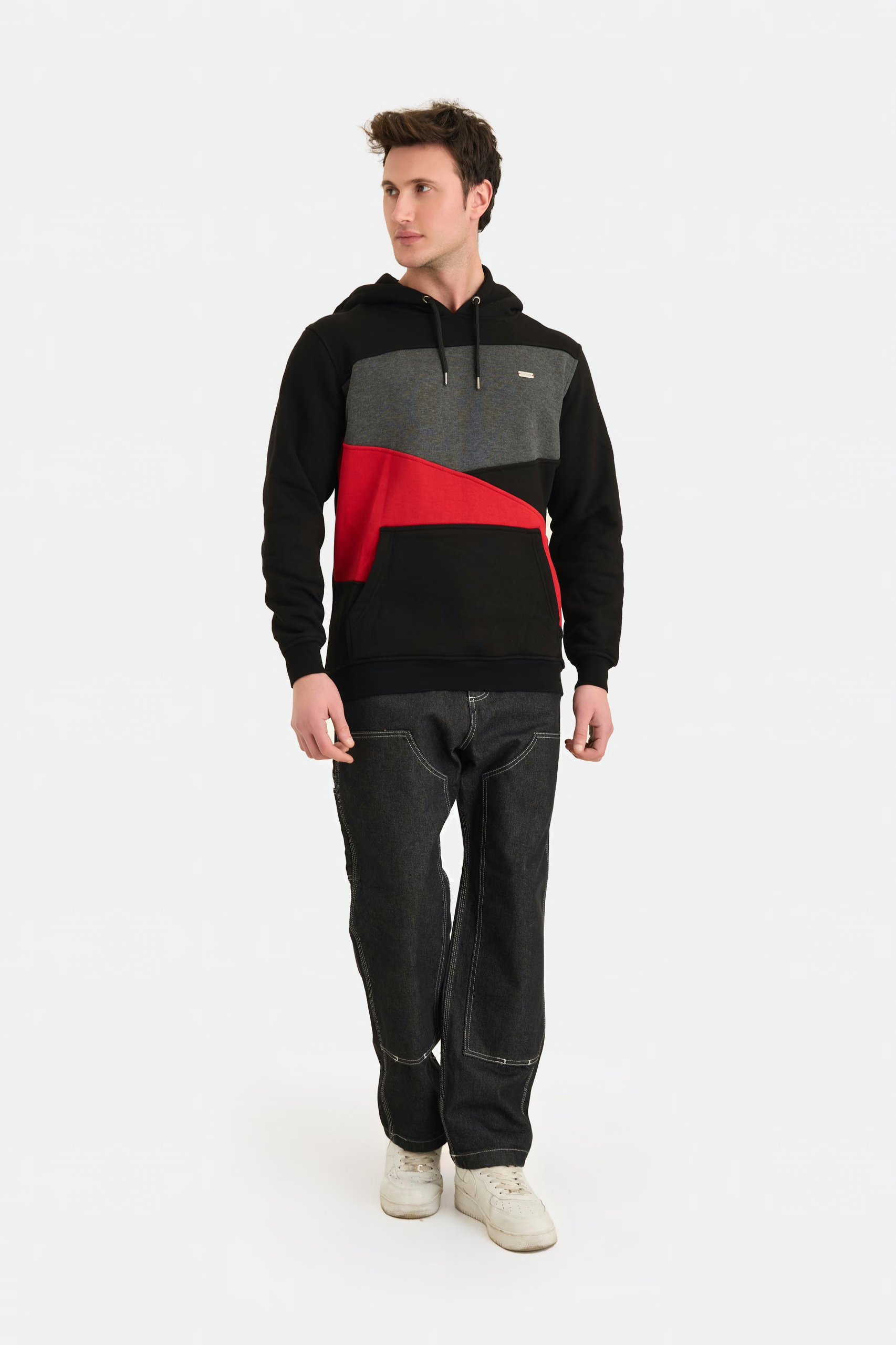
Knit garments previously produced to customer specifications, where overedge seaming and coverstitched hems are the standard construction.
Questions this raises
Why does a lockstitch break on a knit garment?
Because the stitch has very little extension. When a jersey seam is stretched in wear, the fabric can extend well beyond what a locked thread can, so the thread reaches its limit first and snaps. Knit seams are normally sewn with overedge, chainstitch-based or coverstitch constructions for this reason.
Is an overlock the same as a serger?
Yes. Serger is the common North American word for an overlock machine, and both terms describe machines running ISO 500-class overedge stitches. A&E's reference lists 503, 504 and 505 as the usual serging stitches.
What is the difference between a coverstitch and a flatlock?
A coverstitch, such as 406, covers a raw edge on a hem where the plies overlap. A true flatseam, ISO 607, joins two butted edges with no overlap at all, so there is no ridge. The word flatlock is used for both in casual speech, which is why the ISO number is the safer thing to write.
Which stitch is strongest?
There is no single answer, because strength depends on the fabric, the thread, the stitch density and the direction of load. A five-thread safety stitch is a very strong woven seam construction. A 607 flatseam is strong in the direction it is designed for and would be the wrong choice on a woven trouser inseam. Strength is a property of the seam and the material together, not of the stitch on its own.
Specify the stitch, not just the seam
Send the construction detail with your enquiry and we will quote against it. If you are not sure which stitch a product needs, a sample garment or a conversation with the production team is usually faster than a written guess.
Start a project