Specification, sampling and quality
Sewing Thread and Needles: The Needle, Thread and Fabric System
Needle, thread and fabric are not three decisions. They are one system, and many sewing faults are a mismatch between them rather than a fault in any of the three. Knowing how that system works is what lets a buyer specify the right things, recognise a real defect from a sample, and stop asking for a stronger thread when the thread was never the problem.
Contents
- One system, not three choices
- Thread: the number on the tech pack is not a specification
- Needles: what the point does to the cloth
- Why skipped stitches and thread breakage are the same problem
- Three ways a seam fails, and only one is the thread
- Knits and wovens ask different questions
- What a buyer should and should not put in the specification
- Questions buyers ask
Two garments come back from the same factory. One has a run opening along a shoulder seam, the other has a seam that has simply come apart. Both look like sewing faults and both get reported as one, and the useful question is the one nobody asks first: which of the three things involved actually failed? Because the fabric, the thread and the needle fail in different ways, and the fix for each is different.
One system, not three choices
The needle makes a hole and carries the thread through it. The thread has to form a loop at the right moment for the machine to catch. The fabric has to survive the hole and hold the stitch afterwards. Change any one of the three and the other two are affected, which is why sewing faults so rarely have a single culprit and why adjusting one variable at a time usually chases the problem around the garment.
This site's seam puckering page already makes the point from the other end: a needle too large for the fabric both damages yarns and increases the space the stitch demands, so needle, thread and stitch density are chosen together rather than adjusted one at a time. What follows is the system behind that sentence.
| Component | What it has to do | How it typically fails |
|---|---|---|
| Needle | Open a passage through the fabric and carry the thread through cleanly | Damages the fabric, or is the wrong size for the thread so the loop forms badly |
| Thread | Form a loop the machine can catch, then hold the seam in service | Breaks in sewing, or holds in sewing and fails in wear |
| Fabric | Survive penetration and hold the stitch under load | Yarns cut at the needle hole, or pull out of the seam under tension |
Thread: the number on the tech pack is not a specification
This is the main thing to understand about sewing thread, and it catches out people who have specified garments for years.
Thread size is expressed in several different systems, and they do not run in the same direction. Some are fixed-length systems, a weight for a set length, so the number gets bigger as the thread gets coarser. Others are fixed-weight systems, a length for a set weight, so the number gets bigger as the thread gets finer. Two people quoting a number in good faith can mean opposite things.
Which way the number runs
The direction reverses between families, and a ticket number belongs to neither family.
Construction matters as much as size. The main families are staple spun thread, made from short fibres; corespun, built on a continuous filament core wrapped in staple cotton or polyester; continuous filament; and textured filament. They differ in strength for a given thickness, in surface and appearance, in how they behave in the machine, and in how they take colour, which is why garment dyeing has its own thread problem, and why a corespun cotton-wrapped thread behaves differently in a dye bath from a filament polyester one.
And strength is not the only property that matters. How far a thread stretches before it breaks varies enormously between fibres, a polyester thread extends far more than a cotton one, and that extension is part of what lets a seam move with the garment instead of resisting it. A thread chosen only for breaking strength can produce a seam that is strong on paper and cracks in wear.
Needles: what the point does to the cloth
A sewing needle for fabric is not designed to cut. The points used for woven, knitted and felted materials are cloth points, and their job is to displace the material on entry so that the fabric is not damaged, the yarns are pushed aside and close again behind the needle. Cutting points exist, but they are for leather, where cutting is the intention.
Displaced or severed
The difference is invisible at inspection and obvious a few wears later, which is why the pull-and-shear check is worth doing on a sample.
Within cloth points there is a range, and it is not decorative. Manufacturers publish distinct point geometries for different materials: rounder ball points for fine single jersey and rib, different geometries again for knitwear with a higher elastane content, and others for warp-knitted fabrics and bare elastane yarns, where a yarn cut by the needle does not simply weaken the fabric but releases a structure that unravels. Round points suit straight lockstitch seams on wovens.
Needle size matters in both directions, which is the part that surprises people. Too large a needle damages the cloth and demands more space for the stitch. Too small a needle for the thread being used is equally a problem: manufacturers note that where the needle size is too low compared to the thread size, the thread will not pass through the needle eye unaided, and a needle too thin for the work lacks the stability to stay straight, which brings its own failures.
None of that makes needle size a buyer decision. It makes it a decision that has to be made deliberately for this fabric and this thread, which is a different thing, and a reasonable subject for a conversation about a problem sample.
Why skipped stitches and thread breakage are the same problem
These two get reported separately and chased separately, and they share a mechanism.
Every stitch depends on the needle thread forming a loop as the needle begins to rise, large enough and early enough for the hook, looper or spreader to enter it. Thread manufacturers describe the three possible outcomes precisely: the device enters the loop and the stitch forms; or the loop is poor and the device snags the thread, which breaks it; or the loop is poor and the device misses it altogether, which is a skipped stitch.
Where both symptoms come from
Two names for two outcomes of one failure. A factory chasing them as separate problems is chasing the same thing twice.
The mechanism explains why thread choice matters beyond strength. As the needle reaches the bottom of its travel the thread is stretched, and it recovers as the needle rises. The more it stretched, the later the loop appears and the smaller the target the machine has to find, so a thread that resists stretching forms its loop on time, and one that does not produces exactly these two symptoms.
Note how little of that list is about the operator, and note where the faults cluster: at seam crossings. The extra thickness where one seam crosses another raises thread tension and can deflect the needle away from the stitch-forming device, which is why skips and breaks so often appear at exactly those points on a garment. That is a construction and specification observation, not an inspection finding.
Three ways a seam fails, and only one is the thread
When a seam gives way, the reflex request is a stronger thread. It is the right answer in only one of the three failure modes.
What actually broke
Look at the garment before deciding. The three are visually distinct and lead to three different conversations.
| Mode | What you see | Where the answer usually lies |
|---|---|---|
| Stitch failure | The threads in the seam have ruptured, leaving a hole in the stitchline | Stitch type for the application, thread strength and size, stitch density |
| Fabric failure | The stitchline is intact and the yarns of the cloth have ruptured beside it | Reinforcement at stress points, pattern and fit, seam construction, the fabric |
| Seam slippage | Nothing has ruptured, the fabric yarns have pulled out of the seam from the edge, leaving a gap | Seam construction, seam width or bite, stitch density; common on smooth filament and loosely built cloth |
Two related observations. On knits, a seam that fails as a stitch failure is often described as stitch cracking, the stitch has run out of extension before the fabric has, which points at stitch density, thread choice or the stitch type rather than at thread strength alone. And seam grin, where a seam gapes open under gentle tension without failing, is checked simply by opening the seam and looking: it is a warning about how much load that seam is carrying rather than a defect in itself.
Knits and wovens ask different questions
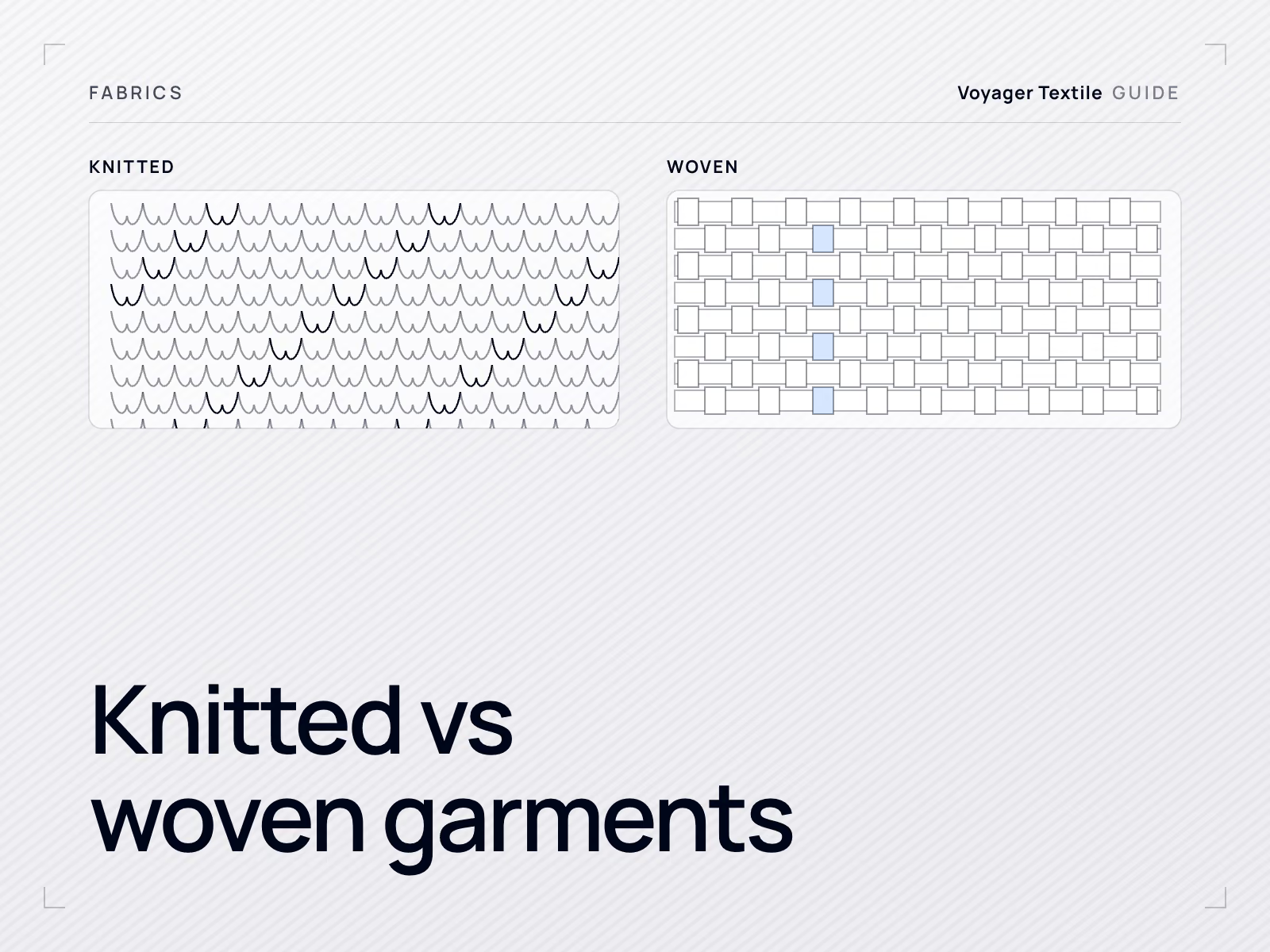
The distinction runs through everything above. A woven fabric holds its yarns in place by interlacing, so a cut yarn weakens the cloth locally. A knitted fabric holds itself together as a chain of loops, so a cut loop can release and travel, which is why needle point selection is treated far more carefully on knits, and why manufacturers publish separate geometries for fine jersey, for rib, for elastane-rich knitwear and for bare elastane yarns.
The stitch side of the same distinction is already covered: a seam that has to stretch needs a looper-based stitch rather than a lockstitch, which is the stitch types guide's territory. The point here is that the needle and thread decision follows the same logic and is made at the same time, a stretch seam sewn with a stitch that extends, a thread that extends and a needle that displaces rather than cuts is one decision, not three.
Where fabric behaviour is the constraint rather than the sewing, the fabric pages carry it: single jersey for structure and finishing, rib knit for recovery, and knitted versus woven for the broader difference.
What a buyer should and should not put in the specification
The temptation, once this is understood, is to specify all of it. That produces a document the factory has to work around rather than to.
Where the line usually sits
Reasonable to specify
- The stitch type and density, per seam or seam group
- Thread fibre and construction, not only a ticket number
- Topstitch thread where it differs from seaming thread, and its colour
- That thread colour is approved against the approved fabric standard
- The performance the seam has to deliver, and how it will be verified
- That the intended post-sewing processing is known before thread is chosen
Better left to the factory
- Needle size and point style for a given fabric and machine
- Machine thread tensions and take-up settings
- Sewing speed
- Needle change intervals
- Which specific machine runs which operation
- Lubrication and threading practice
The right-hand column is not a list of things that do not matter, everything on it can cause the failures described above. It is a list of things a buyer cannot usefully set from outside, because the correct answer depends on the machine, the operator, the fabric lot and the operation. What a buyer can do is describe the outcome required, recognise the failure modes when they appear, and ask the specific question rather than the general one.
Questions worth asking about a problem sample
Conceptual, and not an inspection protocol. The value is in asking about the system rather than about the symptom.
- Which of the three failed, the stitch threads, the fabric, or neither because the yarns slipped?
- Do small holes appear beside the stitchline when the fabric is pulled and sheared?
- Are the skips or breaks clustered where seams cross, or spread along a seam?
- Is the thread specified by fibre and construction, or only by a number?
- Does the thread's extension suit a seam that has to move, or only its breaking strength?
- Was the sample sewn on the machine and at the speed bulk will run on?
- Will the garment be washed, dyed or otherwise processed after sewing, and was the thread chosen for that?
- If a test is being commissioned, does it measure the failure mode actually observed?
That last question is one that saves time. A great deal of testing in apparel measures something real about a garment that was failing for a different reason entirely.
Questions buyers ask
What does a thread ticket number actually tell you?
Less than many tech packs assume. Ticket numbering is a commercial system and ticket numbers are the manufacturer's own reference numbers for a thread size. A ticket number in one thread type is not the same as in another, ticket 40 cotton is not ticket 40 corespun. The fibre and construction have to be specified alongside it.
Does a higher thread number mean a thicker thread?
It depends which system the number belongs to. In fixed-length systems such as Tex and denier, where the number is a weight for a set length, a higher number means a coarser thread. In fixed-weight systems such as metric and English count, where the number is a length for a set weight, a higher number means a finer one. The number alone is ambiguous without the system.
What are the main sewing thread constructions?
Staple spun thread made from short fibres; corespun, built on a continuous filament core wrapped in staple cotton or polyester; continuous filament; and textured filament. They differ in strength for a given thickness, in surface and appearance, in how they run on the machine and in how they take colour.
Is a stronger thread always a better thread?
No. How far a thread extends before breaking matters as much as how much force it takes, because a seam has to move with the garment. A thread chosen only for breaking strength can produce a seam that is strong in a test and cracks in wear. Its behaviour during stitch formation matters too, a thread that stretches too much in the machine causes skipped stitches and breakage.
What does a needle point do to the fabric?
A cloth point displaces the material on entry so the yarns are pushed aside and close again behind the needle, which is what keeps the fabric intact. Cutting points, which sever the material, exist for leather rather than for cloth.
Why do knits need different needle points from wovens?
A woven fabric holds its yarns by interlacing, so a cut yarn weakens the cloth locally. A knit is a chain of loops, so a cut loop can release and run. Manufacturers publish distinct point geometries for fine jersey and rib, for knitwear with higher elastane content, and for warp knits and bare elastane yarns, precisely because the consequence of severing a yarn is different.
What is needle cutting, and how do I spot it?
Needle cutting is damage to the fabric caused by the needle severing yarns instead of displacing them. On a knit it shows as small holes along the stitchline that later open into a run. It usually passes inspection because the holes are tiny at that stage. The check needs no equipment: pull and shear the fabric gently beside the seam and look for small holes appearing next to the stitchline.
Is a bigger needle a stronger needle?
Not usefully. Too large a needle damages the cloth and increases the space the stitch demands, which makes puckering worse. Too small a needle for the thread means the thread will not pass through the eye unaided, and too thin a needle for the work lacks the stability to stay straight. There is no direction in which bigger is simply better.
Why do skipped stitches and thread breakage happen together?
Because they are the same failure at two severities. Every stitch depends on the needle thread forming a loop for the hook, looper or spreader to enter. If the loop is poor, the device either misses it, a skipped stitch, or snags the thread and breaks it. Chasing the two as separate problems means chasing one problem twice.
Why do faults cluster where seams cross?
The extra thickness at a seam crossing raises thread tension and can deflect the needle away from the stitch-forming device, so the loop is not caught. It is a predictable consequence of construction rather than a random defect, which is why it appears in the same places on the same style.
What causes skipped stitches and thread breakage?
Published technical guidance lists many contributors: the wrong thread for the application, defects in the thread, the needle and thread size relationship, worn thread guides and machine parts, machines out of adjustment, excessive tension, improper threading, a defective or bent needle, needle heat, feeding problems, and flagging where the fabric lifts with the needle instead of being held down. Very little of that list is the operator.
Can the needle get hot enough to matter?
Yes. Needle temperature rises with sewing speed, the number of layers, and the fabric and thread being used. On natural fibres it causes damage; on synthetics the fibres can soften or melt, weakening or stiffening the seam and leaving deposits in the needle eye that then cause thread breakage. It produces failures that look like a thread or needle fault and are neither.
What are the different ways a seam can fail?
Three. In stitch failure the seam threads rupture and leave a hole in the stitchline. In fabric failure the stitchline is intact and the yarns of the cloth have ruptured beside it. In seam slippage nothing ruptures at all, the fabric yarns pull out of the seam from the edge, leaving a gap. Only the first is a thread problem.
Will a stronger thread fix a failing seam?
Only if the seam is failing as a stitch failure. If the fabric ruptured, the answer lies in reinforcement, pattern and fit, seam construction or the fabric. If the yarns slipped out of the seam, it lies in seam construction, seam width and stitch density. Identify what actually broke before deciding.
What is seam slippage?
A failure where the fabric yarns pull out of the seam from the edge, leaving a permanent gap without anything rupturing. It is most common on fabrics built from smooth continuous-filament yarns and on loosely constructed cloth, and it is addressed through seam construction and seam width rather than through thread.
What is seam grin?
A seam that gapes open under gentle tension without failing. It is checked by opening the seam and looking at how far it parts. It is a signal about how much load the seam carries and how much extension the stitch has, rather than a defect on its own.
Should a buyer specify needle size and thread tension?
Generally no. The correct needle and tension depend on the machine, the operator, the fabric lot and the operation, and a specification that sets them from outside usually creates an argument rather than a better garment. Specify the stitch type and density, the thread fibre and construction, and the performance required, then ask specific questions when a sample shows a problem.
What should be in the tech pack about thread?
Enough to identify the thread rather than a supplier's catalogue reference: the fibre and construction, the colour and how it is approved, whether topstitch thread differs from seaming thread, and any requirement that follows from what happens to the garment after sewing. A number alone is not a thread specification.
Diagnosing a seam problem?
Send the style, the fabric and a description of how the seam failed, and we will tell you which of the three is the likely cause and what would need to change.
Send an enquiry