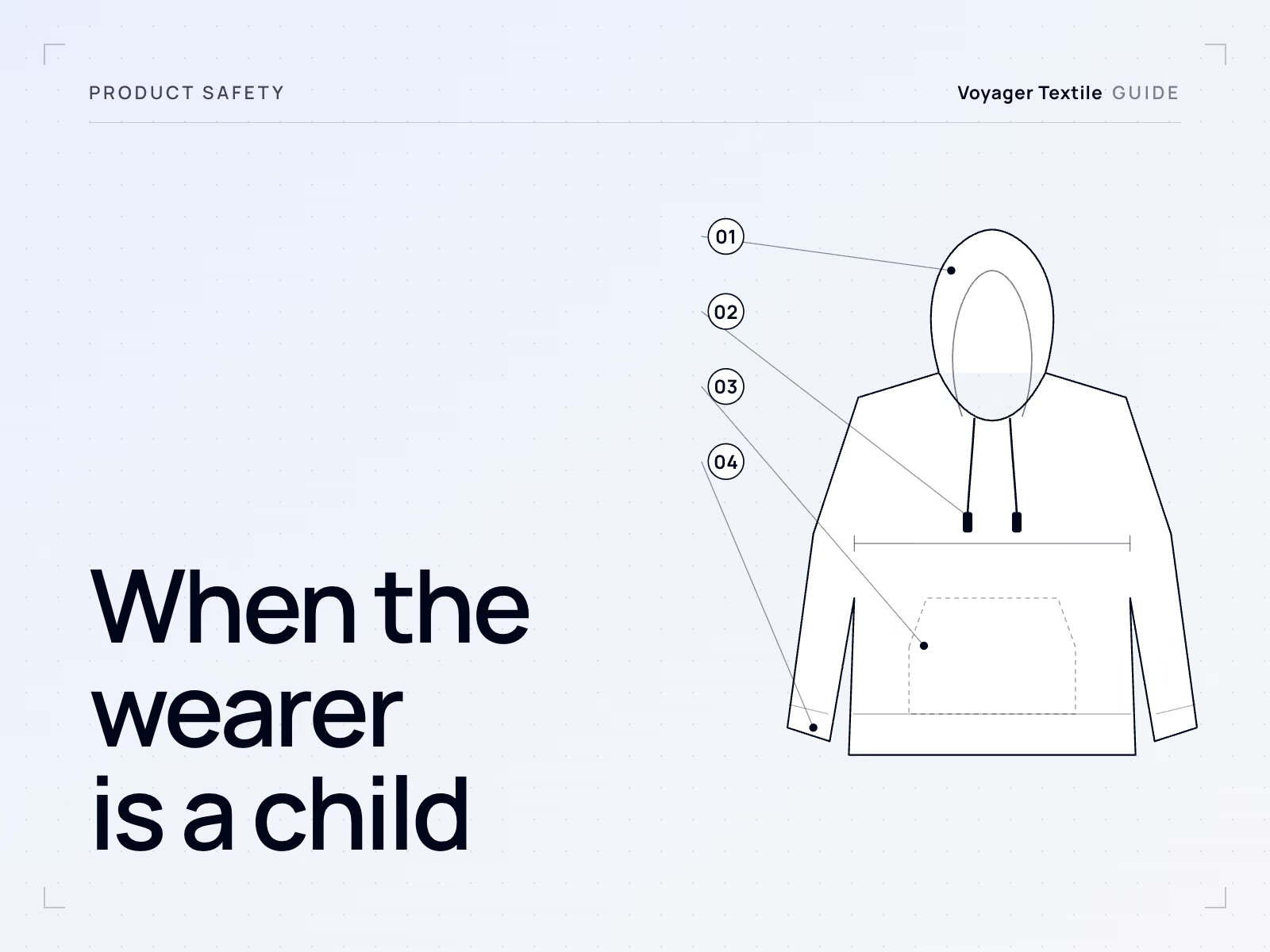
Specification, sampling and quality
How to Specify and Approve Trims, Hardware and Components
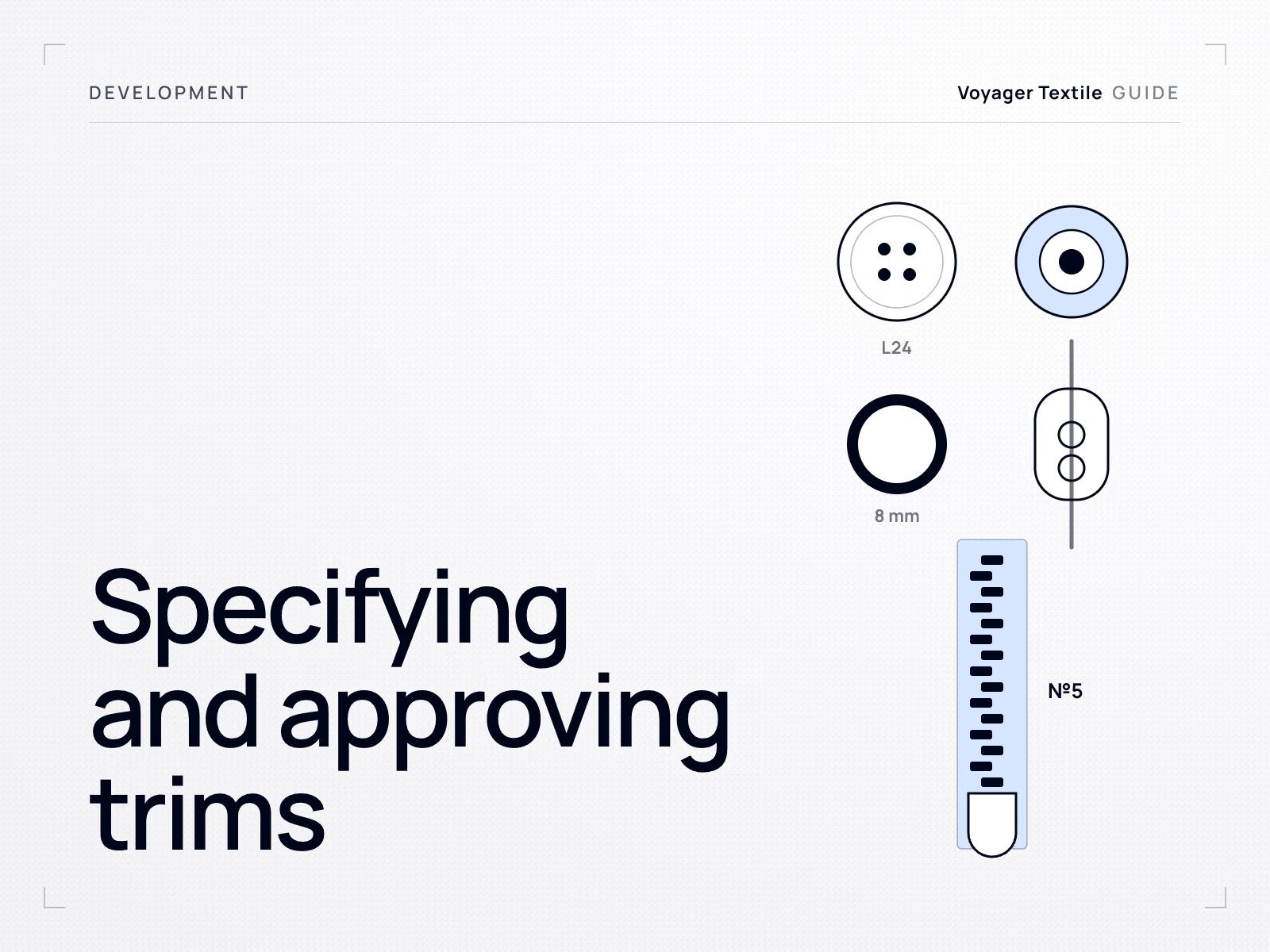
A zipper, a button or an elastic is a category, not a specification. Getting the intended part into bulk means knowing which actual component was approved, what defines it, how it functions and attaches, what happens to it during the garment's real processing, what evidence applies to its particular risks, and what has to be looked at again if the source changes.
Contents
- The category is not the specification
- Four approvals, and none implies another
- Looking right is not the same as being right
- The component and its attachment are separate questions
- What actually identifies an approved component
- Which state was the component approved in?
- Evidence: which document answers which question
- Nickel: a restriction with a narrow, specific scope
- Children's products are a different assessment
- Substitution: similar is not the same
- Repeat orders
- Questions buyers ask
Every pre-production meeting reaches the same slide. Fabric approved. Zipper approved. Button finish approved. Elastic received. Everything on the list has a tick against it, and the question nobody asks is the one that matters: do we actually know these are the parts that will be in the bulk, and will they still be right once the garment has been assembled and finished?
The category is not the specification
"Black zipper" identifies a category and a colour word. It does not identify a part. Depending on what the component has to do, reproducing it may need some combination of source and article, construction, material, dimensions, colour and finish, function, branding, placement, attachment method, compatibility with the garment's processing, and whatever evidence its particular risks call for.

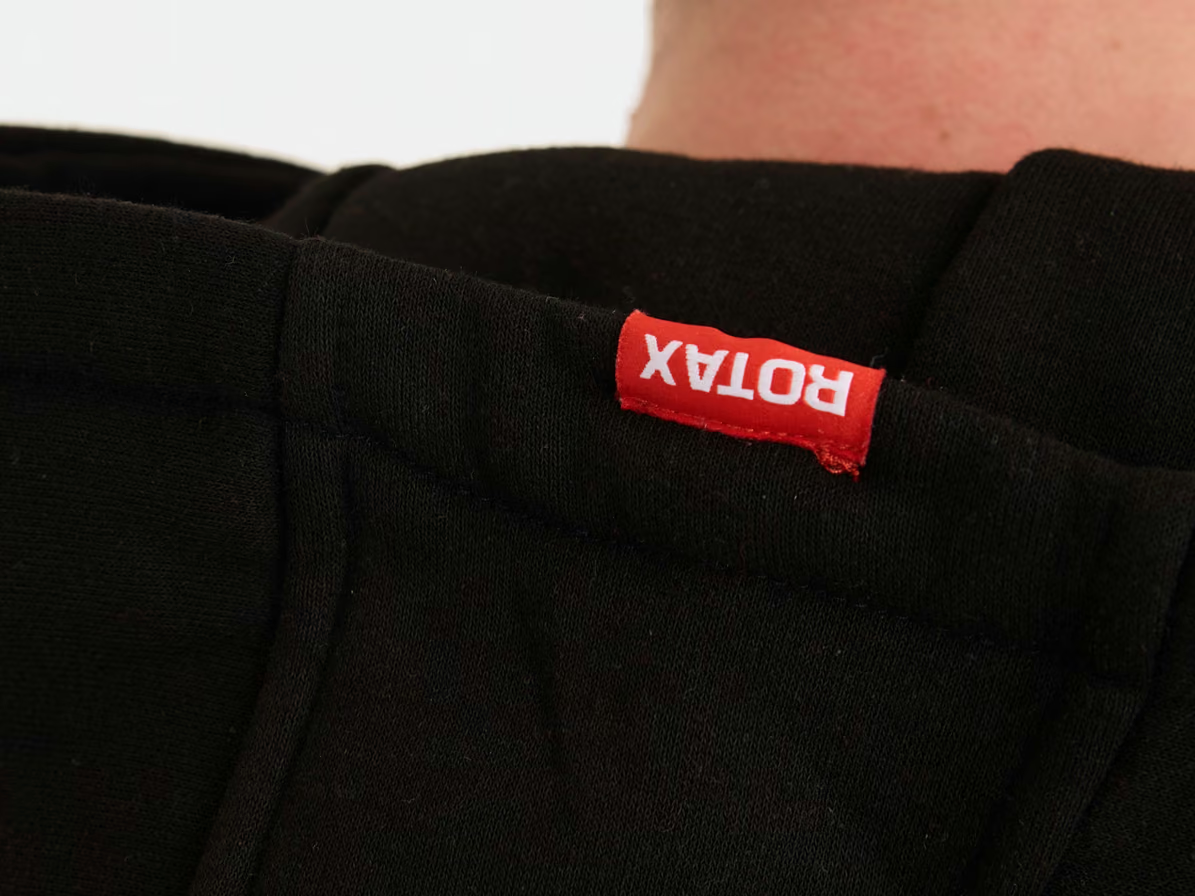

Not all of that applies to everything. A plain woven size label and a load-bearing buckle are not the same problem, and treating them the same produces either a specification nobody reads or a component nobody controls. The useful question is narrower: what would somebody need to know to buy this part again and get the same thing?
| Component | What a generic name leaves undefined | Where it usually shows up |
|---|---|---|
| Zip | Construction, size, finished length, end configuration, tape colour, slider and puller, whether it locks | A zip that works but is wrong for the style, or a tape colour that reads differently from the body |
| Button | Material, dimensions, shank or hole construction, finish, branding, how it is attached | A button that looks right and behaves differently in the wash, or pulls off |
| Snap, rivet, eyelet | The component set rather than the visible face, dimensions, finish, and what the substrate behind it is | A fastener that pulls through an unreinforced fabric, or a set that will not stay closed |
| Elastic | Construction, how much it stretches and how it recovers, behaviour under heat and wash, how it is applied | A waistband of the right width that has no hold, or grows after the first wash |
| Drawcord | Material and construction, diameter, length, tips, retention, whether it suits the channel | A cord that will not feed, will not stay put, or is not permitted in the product at all |
| Label | Material, dimensions, fold, weave or print quality, placement, attachment, legibility after processing | A label that is physically correct and legally wrong, or legally correct and unreadable |
| Interlining | Base, weight, adhesive system where fusible, and whether it suits this particular face fabric | Bubbling, delamination or a hand nobody approved |
Several of those already have proper technical treatment on this site and this guide does not repeat it: zips, snaps and buttonholes in zip and closure construction, interlinings in linings, facings and interlinings, the label set in labels and packaging, and drawcords in children's clothing in EN 14682. What follows is the part none of them covers: how a component gets approved and stays approved.
Four approvals, and none implies another
This is a common structural mistake, and it is easy to make because all four are described with the same word.
The four layers
Each answers a different question about a different object. Being able to say which one you actually hold is much of the discipline.
An approved supplier is not an approved component. A trim vendor can be approved for a defined scope and still introduce an article nobody has evaluated. What supplier approval does and does not establish is set out in supplier qualification, which makes the same point from the other direction: approval is a state with a scope, not a badge.
An approved component is not an approved garment. A zip approved on a card can still be the wrong length for the style, inserted badly, or unsuitable for the wash the product will receive. Product approval is the pre-production sample's job and stays there.
Looking right is not the same as being right
A component can be visually indistinguishable from the approved one and still be the wrong part. Appearance says nothing about how it opens and closes, how it stretches and recovers, how it behaves in the garment's processing, whether it corrodes, whether it stays attached, or whether any regulated property applies to it.
This cuts both ways, and the second direction is the one that gets missed. Two elastics of the same width and stated composition can hold a waistband quite differently, because width is a dimension and hold is a function of construction, stretch and recovery. Two zips of the same nominal size and length can differ in element construction, slider, tape and finish. The same button diameter covers an enormous range of buttons.
The component and its attachment are separate questions
A garment fails at a component in more ways than one, and the trim card only answers one of them.
Three ways to fail around one component
Approving the part answers the first question. The others are construction and specification questions, and they are answered elsewhere.
The substrate case is often left unspecified. The closure construction guide already makes the point in practical terms: an unreinforced snap will pull through a knit or a light woven, and a hook-and-bar closure needs the waistband interlined enough to carry it. The component was never the problem in either case.
How components are attached is a construction operation and belongs with construction. What belongs here is the consequence: a component approval that does not consider the attachment and the substrate has approved an object, not a garment.
What actually identifies an approved component
Two things are commonly used to hold a component, and each is good at what the other is bad at.
| Bill of materials line | Approved physical reference | |
|---|---|---|
| What it is | A controlled written record of the intended component | The actual part, retained as the approved appearance |
| Good at | Identity: source, article, dimension, colour reference, placement, quantity | Appearance, surface, finish, feel, everything a description approximates badly |
| Bad at | Proving that the part that arrived is the part described | Saying what the part was, so it can be bought again |
| Fails when | The description fits several different parts | It exists without a source and article behind it, or it has aged |
A trim card, a board or set holding the approved components for a product, is a widely used working practice, not a requirement of any standard or regulation, and there is no single format. It is very good at settling appearance arguments and very bad on its own at repeat orders, because a year later it shows a button and not which supplier's article that button was.
A supplier article code closes some of that gap and not all of it. It can fail to capture an approved colour, a specific finish, a custom modification, branding, or which version of an order the approval was taken against. The workable position is neither document alone: an approved physical reference tied to a controlled identity. What a BOM line should carry is covered in the bill of materials.
Which state was the component approved in?
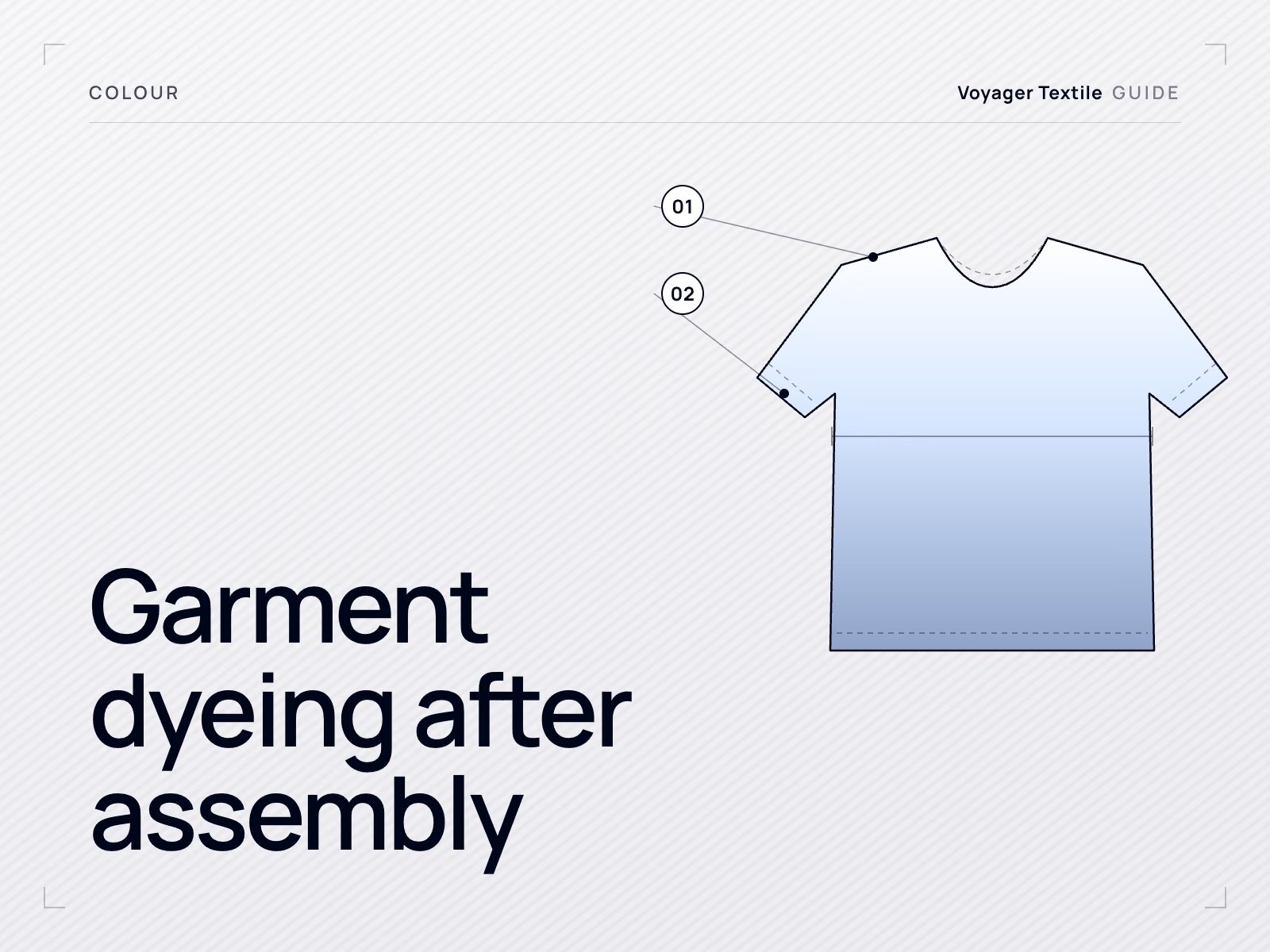
This is where component approval often quietly goes wrong, and it follows directly from garment washing and finishing. If the product is washed, dyed or otherwise finished after it is sewn, the component is processed along with the garment, and the version the customer receives is not the version that was approved loose on a card.
Four states, one component
Where a garment is finished after assembly, approving the component in its as-received state approves a different object from the one that ships.
Published technical guidance on garment dyeing is specific about which components this reaches, and garment dyeing sets it out in full: thread that dyes to nearly but not exactly the body shade, blended interlinings that can pill and mat, zips where dye acceptance is the issue rather than function, metal parts that can damage the vessel and abrade other garments in the load, delicate trims that can be damaged, and labels where the concern is legibility. Some components are deliberately attached after the process rather than sent through it.
None of that makes re-approval universal. Plenty of products have no post-sewing process at all, and plenty of components are unaffected when they do. The point is narrower and harder to argue with: if the garment is finished after assembly, the approval has to have been taken in a state that represents the finished product, for the components where the process actually changes something.
Evidence: which document answers which question
Component approval accumulates paperwork quickly, and the paperwork is only useful if everyone knows what each piece can and cannot establish.
Five layers, five questions
Programmes get into trouble by holding one layer and believing they hold another. Not every product needs all five.
| Evidence | What it can establish | What it does not establish |
|---|---|---|
| BOM line | Which component is intended, and enough identity to buy it | That the part received or used is that part |
| Approved physical component | The approved appearance, finish and feel | The source and article, unless recorded alongside it |
| Supplier technical sheet | What the supplier states about the product they sell | That this delivery matches it, or that it suits your garment and process |
| Test report | One question, about one tested sample, under one method, on one date | Dimensions, function, colour, attachment, or anything about a different sample, see chemical test reports |
| Approved garment sample | That the complete configuration, with these components in it, is correct | That bulk will continue to use the same components |
| Incoming or bulk check | That what arrived matches what was ordered, on the attributes checked | Any functional or regulated property that was not tested |
There is no universal testing battery for components and no universal frequency, and this guide invents neither. What gets tested, and how often, follows from what the component has to do, where the product is used, what processing it goes through, what regulation applies to it, and what the customer requires. Planning testing by risk sets out that logic for chemical work and the same shape applies here.
Nickel: a restriction with a narrow, specific scope
Metal garment hardware is the one place where a component-specific legal requirement is routinely relevant in EU-facing programmes, and it is also routinely overstated. It is worth being exact about what the restriction says.
REACH Annex XVII, entry 27 restricts nickel in *articles intended to come into direct and prolonged contact with the skin*. It gives examples, and the garment examples are named specifically: rivet buttons, tighteners, rivets, zippers and metal marks, when these are used in garments. The restriction is expressed as a limit on the rate of nickel release from the parts of these articles coming into direct and prolonged contact with the skin.
| Claim heard | What is actually the case |
|---|---|
| Every metal trim needs nickel testing | No such conclusion follows from a component being metal. Entry 27 turns on whether the article is intended for direct and prolonged skin contact |
| It contains nickel, so it fails | The restriction concerns release rate from the contacting parts, not whether nickel is present in the material |
| It is coated, so it is fine | Coating is addressed as a condition with a durability requirement, not as an exemption. That is what the accelerated wear and corrosion method exists to examine |
| The nickel test passed, so the garment is REACH compliant | It establishes one result for one property of one tested part. REACH reaches other substances, other components and other conditions, see REACH for apparel |
One further discipline carries over from chemical compliance: there is no such thing as a generic REACH certificate, and there is no trim compliance certificate either. What exists is a test report with a defined scope, or a supplier declaration whose value depends on what it actually says. And nothing here supports marketing language, nickel-free and hypoallergenic are claims with their own evidential burden, and a passed release test is not that evidence.
Children's products are a different assessment
Component attachment carries more product-safety weight in children's apparel than in adult apparel, and an adult-garment component decision does not transfer across unchanged. That subject has its own page and this one does not duplicate it.
Two things are worth carrying here. There is no universal pull-force figure for buttons and small components, the figures that circulate as though they were law are not, and what a programme requires is set by its own specification or by the applicable product requirement. And cords and drawstrings in children's clothing are governed by their own standard rather than by general component judgement. Both are covered properly in children's apparel safety and EN 14682, including which methods exist and what status they actually hold.
Beyond children's products, component choices are part of a finished product's safety characteristics generally, sharp edges and detachment are product-safety matters, not only quality ones. That framework belongs to GPSR for apparel, and the separate hazard of unintended sharp metal reaching the product to needle control and metal detection. And where a garment is protective equipment, changing a component can affect the conformity evidence the product depends on, which is a much larger consequence than it looks.
Substitution: similar is not the same
Components become unavailable. Articles are discontinued, plating lines change, a vendor stops making a size. Substitution is normal, and treating every substitution as a failure is not a workable position.
What is not workable is treating similar as equivalent. A replacement can match on appearance, dimensions and stated composition and still differ in how it functions, how it behaves in the garment's processing, what attachment it needs, how long it lasts, or whether the evidence held for the original still describes it.
| Change | Why it can matter | Worth reconsidering |
|---|---|---|
| New component supplier | The same description can be a different part built differently | The approved reference, and whatever evidence was specific to the old source |
| New article from the same supplier | Vendors revise articles; the description often does not change with them | Identity in the BOM, and the appearance against the approved reference |
| New metal finish or plating | Tone, gloss, ageing and corrosion response can all move | Appearance approval, and whether contact-related evidence still applies |
| New elastic or narrow fabric | Width matches easily; hold and recovery do not | Function in the actual garment rather than the component alone |
| A garment wash or dye is added or changed | Components are processed with the garment and can change with it | The state the component approval was taken in |
| A new manufacturing or component production site | Custom parts in particular can differ between sites and processes | Whether the approved result is reproducible there, see moving production |
Repeat orders
Component continuity is where repeat orders quietly diverge, and it usually turns on a question nobody can answer: what exactly was approved last time? Not which supplier, which article, in which finish, against which reference.
Same supplier does not mean same component indefinitely. Articles are revised, finishes drift between runs, sub-suppliers change behind a description that stays the same. Where a component defines the look of a product, the honest position is that continuity is maintained deliberately rather than inherited. Reorder consistency covers the general case, and why bulk differs from the approved sample covers what it looks like when it fails.
Before approving a component
A conceptual list, not a mandatory procedure. Not every line applies to every part, and how deep to go should follow the component's function, its end use and the consequence of it failing.
- Which exact component is intended, source, article and version, not only a description
- What physical attributes define it, and which of them actually matter for this product
- What it has to do: open, close, retain, adjust, stretch and recover, reinforce, identify
- How it is attached, and whether the substrate behind it can carry it
- What appearance is approved, and what physical reference holds it
- Whether the garment is washed, dyed, pressed or otherwise processed after assembly
- Whether the component is still right in that final state, and whether it should be attached afterwards instead
- Whether any safety or regulatory requirement applies to this component in this end use
- What specific evidence answers those requirements, and what its scope is
- Whether the component is represented in the tech pack and BOM accurately enough to reorder
- Whether the complete garment has been approved with the intended component in it
- What is agreed to happen if the source, article or finish changes
Questions buyers ask
What counts as a trim or component in apparel manufacturing?
Broadly, the non-fabric items incorporated into or attached to a garment, zips, buttons, snaps, rivets, eyelets, elastic, cords, tapes, labels and hardware, plus supporting materials such as interlinings and sewing thread whose specification shows in the finished product. Classification varies between organisations and there is no universal taxonomy. Whether the item is controlled matters more than which column it sits in.
Is "black zipper" enough for a tech pack?
Usually not, if the zip matters to how the garment looks or works. Reproducing it typically needs the construction, size, finished length, end configuration, tape colour, slider and puller, and enough source identity to buy the same article again. What that list should contain for a zip specifically is set out in the closure construction guide.
Is a trim card the same as a bill of materials?
No, and they are good at opposite things. A BOM is a controlled written record of which components are intended and enough identity to purchase them. A trim card is a physical reference showing what the approved components actually look and feel like. A BOM struggles to convey a finish; a trim card struggles to say what the part was.
If a component is on the BOM, is it approved?
Not automatically. The BOM identifies the intended component. Approval may also require confirming that the physical part matches the intention, that it suits the product and its processing, and that whatever evidence its function or end use calls for actually exists.
Does an approved supplier mean every component from them is approved?
No. Supplier approval has a scope, and a newly introduced article sits outside it until it is evaluated for the product it will be used in. The reverse is also true: approving a component says nothing about the supplier, the production site or the programme.
Is a nominated component the same as an approved component?
No. Nomination means the buyer has required a particular source. It is a commercial instruction and it settles nothing technical, the nominated part still has to suit the product, the construction and the processing. It also concentrates supply on one source, which is a separate continuity question.
Does visual approval prove the component will perform?
No. Appearance says nothing about how a component opens and closes, stretches and recovers, corrodes, behaves in the garment's processing, or stays attached. A component can be visually identical to the approved one and be the wrong part.
Is the same elastic width enough to define an elastic?
No. Width is a dimension; hold is a function of construction, stretch and recovery, and of how the elastic responds to heat and washing. Two elastics of the same width and stated composition can behave quite differently in the same waistband.
Is the same button diameter enough to define a button?
No. Diameter covers an enormous range of buttons that differ in material, shank or hole construction, thickness, finish, branding and how they behave in the garment's processing.
Can a factory substitute an equivalent trim during production?
Potentially, if the programme allows it and the alternative is properly assessed. What should not happen is treating a match on appearance, dimensions or stated composition as proof of equivalence, those are the attributes least likely to reveal a difference in function, processing behaviour or applicable evidence.
What should happen when a component supplier changes?
The same description from a different source can be a different part. Worth reconsidering are the approved physical reference, the identity recorded in the BOM, whether the component still functions as required in the actual garment, and whether any evidence held for the original still describes the new part.
Does a supplier notifying a change mean the change is approved?
No. Notification is information. Whether a given change needs assessment, formal approval or neither is a programme rule that should be agreed in advance, because a rule requiring sign-off on everything gets it on nothing.
Do components need to be checked again after garment washing?
Where the finished garment is washed, dyed or otherwise processed after assembly, the component goes through that process with it, so an approval taken on the loose component was taken on a different object from the one that ships. That does not apply to every product or every component, but where the process changes something, the approval needs to have been taken in the final state.
Can garment dyeing affect zips, labels and thread?
Yes, and published technical guidance is specific about it: thread dyes to nearly rather than exactly the body shade, some blended interlinings can pill and mat, nylon and polyester zips raise a dye-acceptance question, metal parts can damage the vessel and abrade other garments in the load, delicate trims can be damaged, and labels raise a legibility concern. Some components are deliberately attached after dyeing instead.
Does every metal zipper, rivet or button need nickel-release testing?
No such conclusion follows from a component being metal. REACH Annex XVII entry 27 turns on whether the article is intended to come into direct and prolonged contact with the skin, and it restricts release from the parts actually in that contact. Establish whether the component and its use fall within that scope before treating the referenced test method as applicable.
What does "direct and prolonged contact with the skin" mean here?
It is the condition that governs the scope of the nickel restriction. The entry lists examples, including rivet buttons, tighteners, rivets, zippers and metal marks when used in garments, but the contact condition is what determines applicability, and the limit is expressed against the parts of the article that come into that contact rather than the component as a whole.
Is nickel content the same as nickel release?
No. The restriction is framed around the rate at which nickel is released from the contacting parts under the specified conditions, not around whether nickel is present in the material. A component containing nickel is not thereby non-compliant, and "nickel-free" is a claim with its own evidential burden rather than a conclusion drawn from a passed release test.
Are coated metal components exempt?
No. The entry addresses coated articles as a condition rather than an exemption: the coating has to be sufficient to keep release below the limit for at least two years of normal use. That is why the standards published under the entry include a method simulating accelerated wear and corrosion for coated items.
Which test standards are currently referenced for nickel release?
The Regulation itself requires that standards adopted by CEN be used, and the references are published separately by the Commission. The current publication lists EN 1811:2023 as the reference test method for nickel release from post assemblies inserted into pierced parts of the body and from articles in direct and prolonged skin contact, and EN 12472:2020 as the method for simulating accelerated wear and corrosion on coated items. EN 1811 is not a zipper standard, its scope is the contact condition, not a component type.
Does passing a nickel test mean the garment is REACH compliant?
No. It establishes one result for one property of one tested part under one method on one date. REACH reaches other substances, other materials and other conditions, and there is no generic REACH certificate for a garment or for a trim.
Is there a universal pull-force requirement for buttons and snaps?
No, and the figures circulating as though there were one are not a legal requirement. What a programme requires is set by its own specification or by the applicable product requirement. If attachment strength matters, state the method and the requirement rather than asking whether components are securely attached.
Do children's garments need different component decisions?
Component attachment and detachment carry more product-safety weight in children's apparel, and an adult-garment component decision does not transfer across unchanged. Cords and drawstrings have their own standard. Both are covered on the children's apparel safety and EN 14682 pages, including what status each method actually holds.
Is a physical trim card enough to reorder a component next season?
Often not on its own. A physical reference captures appearance and feel well, but it does not say which supplier's article it was or which finish specification produced it. Repeatability improves when the reference is tied to a controlled identity, source, article, dimensions, colour and finish, and the functional requirements that matter.
Working out what to specify for a component?
Send the product, the components you have in mind and any processing the garment will receive after sewing, and we will tell you what needs establishing before bulk.
Send an enquiry