Choosing a manufacturer
How to Manage Supplier Risk in Apparel Sourcing
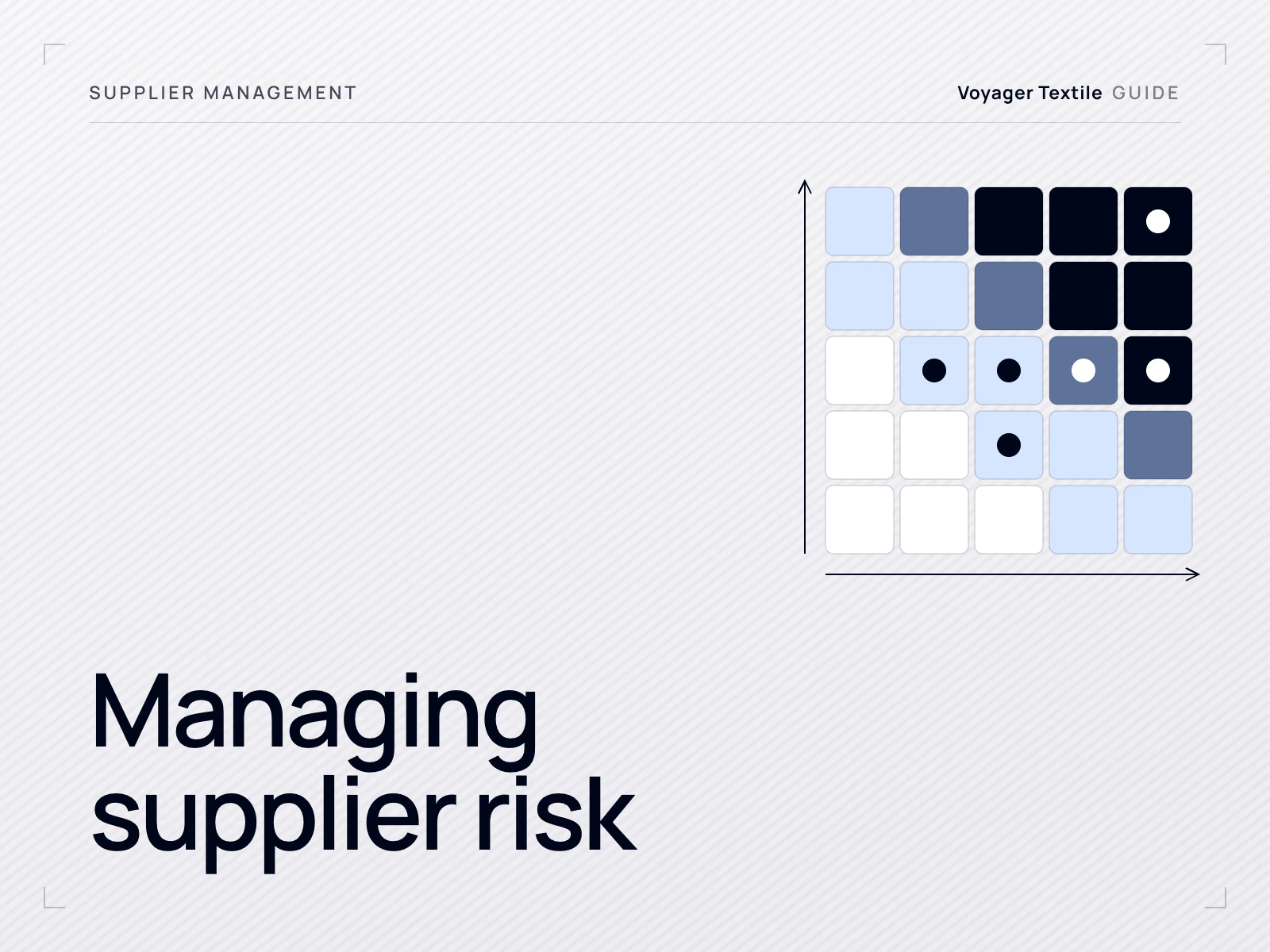
Supplier risk is not a worse version of supplier performance. It asks a different question: if this factory, mill or specialist process became unavailable, where would supply actually stop, and what alternative route could genuinely produce an acceptable product? Many programmes that believe they are dual-sourced are not.
Contents
- Risk is not performance
- Where supply actually stops
- Two suppliers, one dependency
- Capacity is a description, not a reservation
- Can the product actually move?
- What makes an alternative supplier real
- Materials, substitutes and equivalence
- Compliance can block activation
- How long would it actually take?
- When to activate, and what else to do instead
- A register worth keeping
- Before calling a supplier a backup
- Questions buyers ask
The question that exposes this fastest is not a strategic one. It is: what happens if your factory calls tomorrow and says it cannot ship your next order? Many sourcing operations have an answer for that, and many of the answers turn out to be a name rather than a route.
Risk is not performance
These get merged constantly and they answer different questions. Performance is what has already happened against agreed requirements: quality, delivery, documentation, corrective action and commercial execution. It is measurable because the events are in the past, and it is covered in managing supplier performance.
Risk is about what could interrupt or degrade supply next. It is not measured from history and it does not improve because last quarter went well. A supplier with an immaculate record can sit on a single custom mill, one nominated trim and one print house, and be one phone call from stopping. The record tells you nothing about that.
Where supply actually stops
The useful analysis is not "how risky is this supplier" but "which specific thing would have to fail, and what would we do". Eight families cover many apparel programmes, and they are separate because each one fails differently and none of them is fixed by the answer to another.
| Dependency | What actually fails | What would have to already exist |
|---|---|---|
| Product | Only the incumbent knows how this garment is really made | Enough documented and transferable knowledge to reproduce it |
| Material | One mill, one yarn, one dyehouse, one trim source | A qualified alternative material, or a second route to the same one |
| Process | One specialist operation, a wash, a print house, a digitising setup | An alternative capable of the same result, tested |
| Capacity | No alternative site can take the volume when it is needed | A supplier whose availability was checked recently, not once |
| Geographic and logistics | Sites, materials or routes concentrated in one place | Exposure understood, and an alternative that does not share it |
| Information | The current approved specification is not portable | The live revision, held where you can reach it |
| Commercial | MOQ, setup cost, terms or exclusivity make switching impractical | Terms understood in advance rather than negotiated in a crisis |
| Compliance | The alternative lacks evidence the programme requires | Applicability of the evidence assessed before activation |
Two suppliers, one dependency
This is a central point about apparel sourcing risk, and it is why supplier counts are a poor proxy for resilience.
What duplication does and does not solve
Duplicating the cut-and-sew supplier does nothing about the layer beneath it.
Two factories making the same hoodie look like diversification on a supplier list. If both buy the same custom-dyed fabric from one mill, both use the same nominated zipper, or both send the same garment to one print house, the programme has one point of failure with two invoices attached to it.
| Looks like | May actually be | What to verify |
|---|---|---|
| Two garment factories | One fabric mill | Where each factory buys the fabric, and whether the quality was developed at one mill |
| Two countries | One nominated component | Whether the zipper, membrane, licensed trim or yarn is specified to a single source |
| Two sewing sites | One print or embroidery house | Whether decoration is done in-house at each site, or subcontracted to the same specialist |
| Two fabric qualities | One yarn supplier or one dyehouse | Where the yarn is spun and where the fabric is dyed, not just who sells the cloth |
| Two suppliers | One owner or one production site | Whether two legal entities are in fact one manufacturing operation |
| Two packing configurations | One packaging converter | Where cartons, hangtags and printed components are actually made |
Geographic diversification deserves the same scepticism. Two factories in different countries are genuinely less exposed to a regional disruption, and are not less exposed at all to a component that both of them import from one supplier. Country diversification also brings its own costs: different lead times, different minimums, different quality baselines, and a changed customs position. Moving production across a border can change the garment's origin entirely, as set out in country of origin.
Capacity is a description, not a reservation
A factory that states a monthly capacity is describing what the site can run. It is not holding that volume for you, and a supplier being technically capable is not the same as a supplier being available in the month you need it.
- The order book decides availability, and it changes constantly. A supplier with room in March may have none in August.
- Capacity is product-specific. A basic tee and a decorated technical jacket do not run at the same rate on the same line, so a headline figure says little about your programme.
- Material lead time is usually the real constraint, not sewing minutes. A factory free tomorrow with no fabric is not available. What actually controls a schedule is in production lead times.
- Readiness lapses. A supplier qualified last year may have changed staff, materials, pricing or compliance evidence since, so a contingency confirmed once is not a contingency confirmed.
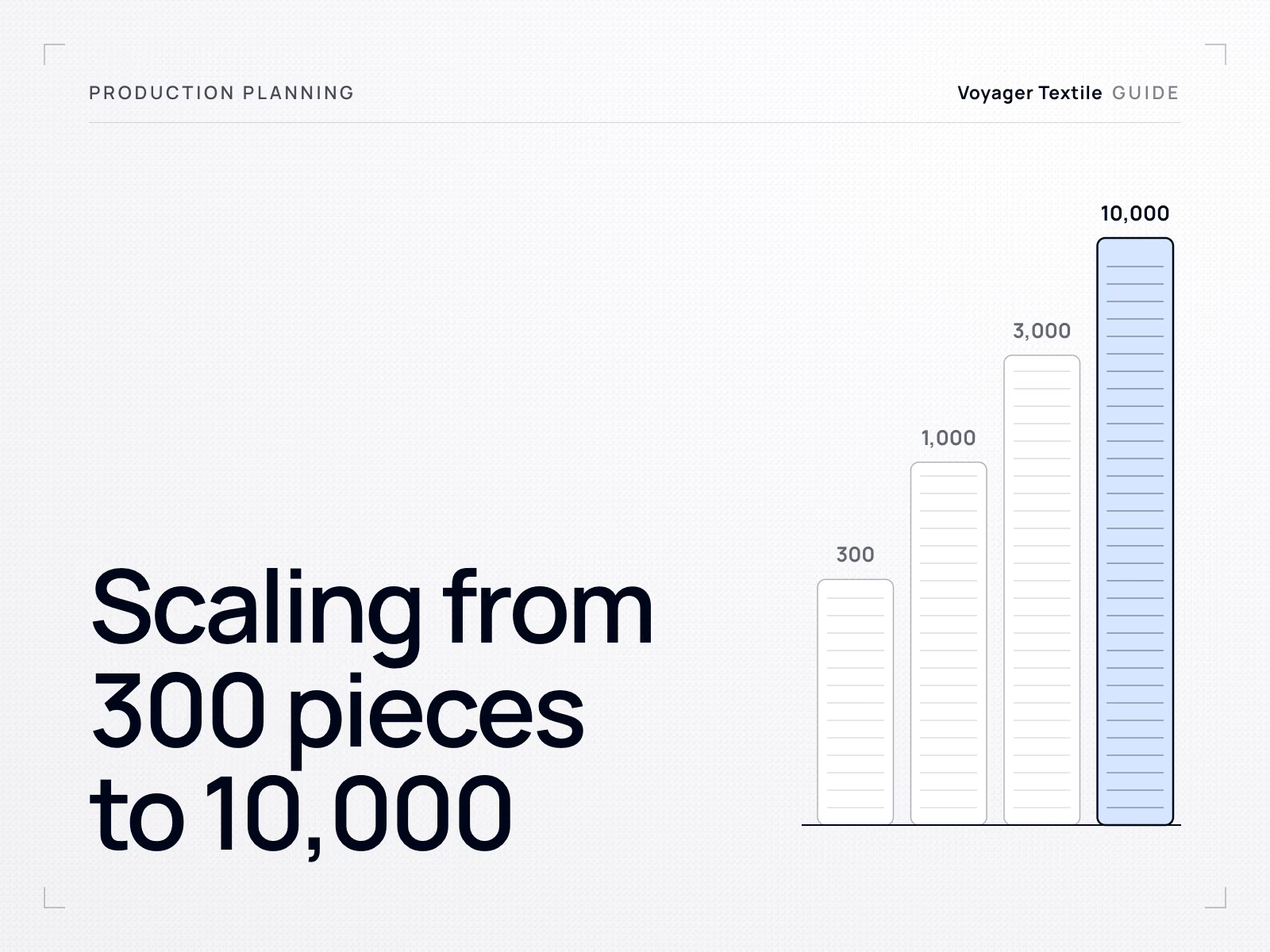
Some buyers address this commercially, through allocation or reservation arrangements agreed in advance. Whether that is available and what it costs is a negotiation, not a standard product, and this guide does not prescribe one. What growth does to capacity generally is covered in scaling production.
Can the product actually move?
The cheapest resilience available to many buyers has nothing to do with suppliers. It is knowing whether the information needed to make the product again exists somewhere you can reach, in its current version.
What to establish about your own documentation
Not a claim that a buyer owns all of these. It is a list of things to know the answer about before a disruption rather than during one.
- The current tech pack, at the revision actually in production rather than the one from launch
- The approved bill of materials, with the real material and trim references
- The graded measurement specification, with tolerances
- The colour standard, as a physical reference and not only a code
- Artwork in its production-ready form, and the decoration setup that goes with it
- The approved sample or sealed reference, and where it physically is
- Packaging and labelling specifications, including carton and assortment data
- Test or compliance evidence, and what it actually covers
- The revision history, what changed, when, and why
Two practical traps sit inside this. The first is version drift: a backup supplier working from a two-year-old tech pack will faithfully reproduce a product you stopped selling. The second is what the incumbent knows that no document holds: how that fabric behaves, where the measurements move, and the construction sequence that finally fixed a recurring problem. A new supplier does not inherit any of it, which is why real qualification involves making something rather than receiving a file.
What makes an alternative supplier real
Five states, and many backups are on the first two
Conceptual buyer framework, not an industry standard or a certification.
The gap between the second rung and the fourth is where contingency plans quietly fail. A supplier that quoted, answered an email or appears in a database is identified. That is a starting point and it is not a backup.
- Approved in general is not approved for this. A factory can be a perfectly good supplier and never have made this fabric, this fit, this decoration or this regulatory category. What approval actually rests on is in supplier qualification.
- Development work is what closes the gap. Depending on the product that might be a sample, a size set, a material trial, a decoration sew-out or a packing check. See the sampling process for what each stage proves.
- A pilot order proves more than a sample, because it exercises the bulk line rather than the sample room. It also costs real money, and it is not proportionate for every programme.
- Standby and active are different arrangements. A supplier holding readiness without current orders drifts; one running real volume stays familiar with the product but splits the programme, with the consequences set out in dual sourcing.
Materials, substitutes and equivalence
Material dependency is the one that survives supplier duplication, so it is worth resolving separately. Some buyers pre-evaluate an alternative fabric or trim while there is no pressure. That is sensible for some programmes and disproportionate for others, and it is not a universal recommendation.
Custom-developed and stock fabrics fail differently too. A custom quality carries mill minimums, development time and colour matching, so replacing it is a project. A stock fabric is easier to re-source and still is not automatically interchangeable between suppliers. Colour is its own dependency: a custom shade reproduced at a different mill is a new matching exercise, with the mechanics in dye-lot shade variation.
Compliance can block activation
A contingency that cannot legally or contractually ship is not a contingency, and this is usually discovered late because it is nobody's obvious job.
- A social or ethical audit says nothing about product readiness. It addresses the site's labour and management systems, not whether this garment can be made correctly. See reading a factory audit report.
- Certified material chains do not transfer with the order. If a programme depends on a certified material, the alternative route needs its own valid evidence; see verifying certification claims.
- Test evidence is tied to what was tested. A report on one supplier's fabric does not automatically cover another's, and whether it still applies has to be assessed rather than assumed.
- Regulated products carry more. Where conformity evidence exists for a protective or otherwise regulated product, changing the production route can reach that evidence.
How long would it actually take?
A useful framing is a comparison rather than a number: how long the business could keep supplying while a source is down, against how long an alternative would really take to start. Supply continues where the second is shorter than the first. Neither figure needs to be calculated precisely for the comparison to be useful. What matters is that both have been thought about.
Six questions that produce a realistic restart date
No durations shown: every one of them is specific to the programme.
Keep logistics separate from production in this analysis. A supplier can finish on time and still miss the delivery because of a port, a carrier or a customs problem, and treating every transport event as a supplier continuity failure produces a distorted picture and an unfair one.
When to activate, and what else to do instead
Three responses, and they are not alternatives
One late order is usually the left-hand box. The middle box only works if the preparation already happened.
There is no universal trigger, and inventing thresholds here would be worse than having none. What genuinely points toward activation is a confirmed inability to meet a required volume, a material that cannot be obtained, a site that has stopped, or a pattern of unresolved failure that corrective action has not moved. A single missed delivery points somewhere else entirely. That escalation is set out in supplier performance, and this guide picks up where it ends.
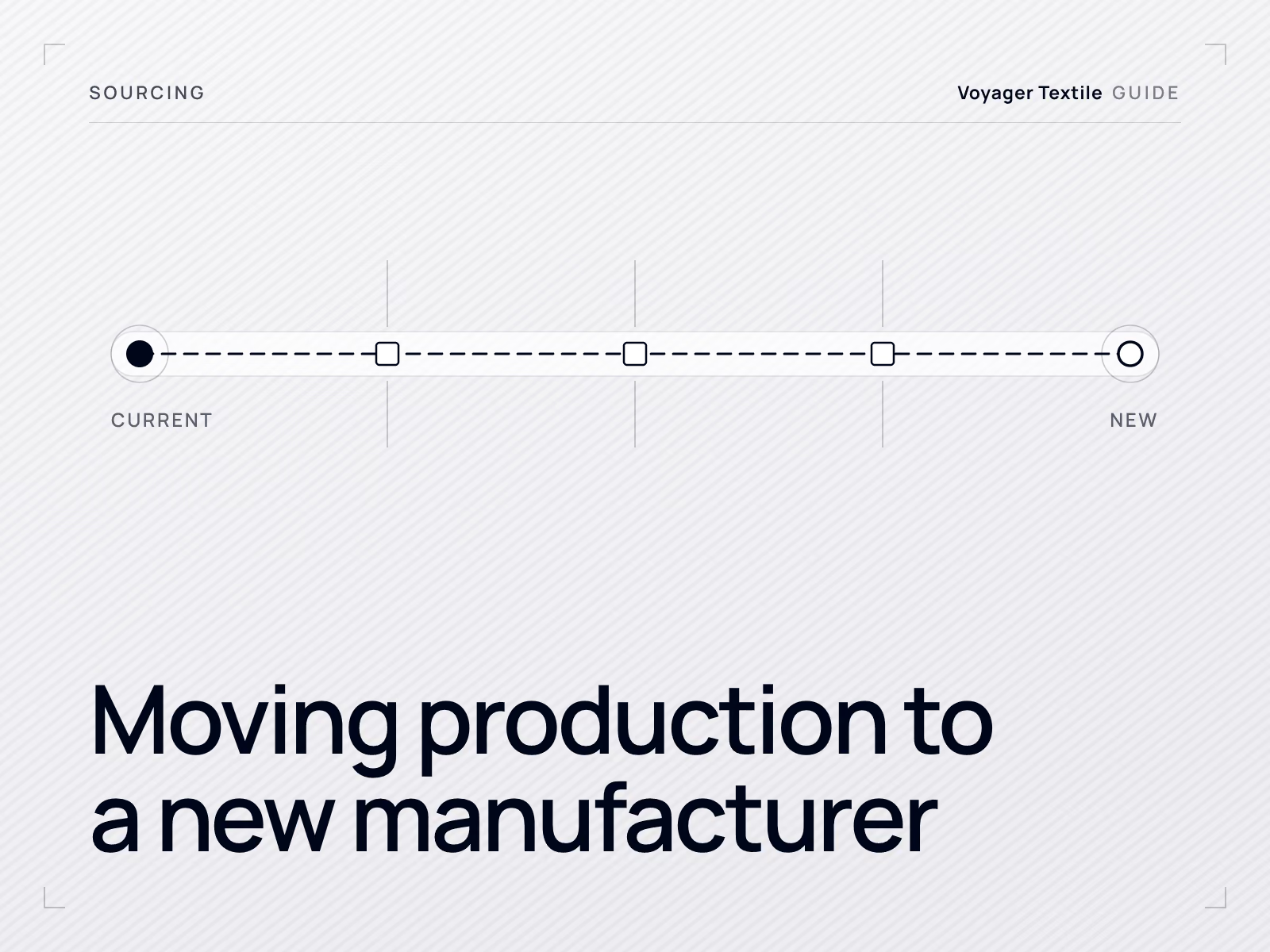
A framing that causes real damage is treating improvement and contingency as a choice. They are separate activities with separate purposes, and a buyer can develop the incumbent while quietly qualifying an alternative. Where activation does become a permanent reassignment rather than a temporary one, the transfer itself is a different exercise with its own sequence, covered in moving production to a new manufacturer.
A register worth keeping
The artefact that makes this real is short. One row per dependency that would actually stop supply, with what exists against it. No scores, no probabilities, no colour coding.
| Column | What it records |
|---|---|
| Dependency | The specific thing, such as a mill, a trim, a process, a site or a document |
| Failure scenario | What stopping would actually look like, in plain terms |
| What it affects | Which products or programmes, and how commercially exposed each is |
| Current control | What exists today, such as a second source, a buffer, an alternative material or nothing |
| Alternative route | What would be used instead, and at which readiness state |
| Readiness gap | What still has to happen before that route could be used |
| Owner | Who is responsible for closing the gap |
Criticality is not only volume. A fixed launch date, a seasonal window, a contractual delivery, a regulated product or a difficult-to-replace material can all make a small programme more exposed than a large evergreen one. An event or promotional programme where the date cannot move is the clearest case: recovery time matters especially there, because being late is indistinguishable from not delivering.
Before calling a supplier a backup
Twelve questions
An operational screening checklist, not a determination. If several answers are unknown, the honest description is candidate rather than contingency.
- Is the supplier technically capable of this product, not just of this product category?
- Has it seen the current approved specification, at the revision in production?
- Can the required materials actually be sourced for it?
- Are the upstream material and process suppliers genuinely independent of the incumbent's?
- Are the pattern, artwork and decoration setup assets transferable under the actual agreement?
- Has any development work been completed, such as a sample, a size set, a trial or a sew-out?
- Does the compliance evidence the programme requires apply to this route?
- Are packaging, labelling and documentation requirements defined for it?
- Is real capacity likely to be available in the window it would be needed?
- What development steps would still remain before a bulk order could run?
- How would cost, minimum quantity and lead time change?
- What event would trigger activation, and who decides?
The useful outcome of that list is often not a plan but an honest reclassification. A supplier that fails half of it is a candidate worth developing, and calling it a contingency in the meantime is the thing that creates the exposure.
Questions buyers ask
What is supplier risk in apparel sourcing?
The exposure created by dependencies that could interrupt or degrade future supply: a single mill, a nominated trim, one specialist process, insufficient alternative capacity, geographic concentration, a specification you cannot move, commercial terms that make switching impractical, or compliance evidence that does not transfer. It is a different question from supplier performance, which measures what has already happened.
How is supplier risk different from supplier performance?
Performance looks backwards at what a supplier has actually done against agreed requirements, and can be measured. Risk looks forward at what could stop supply, and is not improved by a good record. A supplier with an excellent scorecard can still sit on one custom mill and one print house, and the scorecard will never show it.
Is single sourcing always risky?
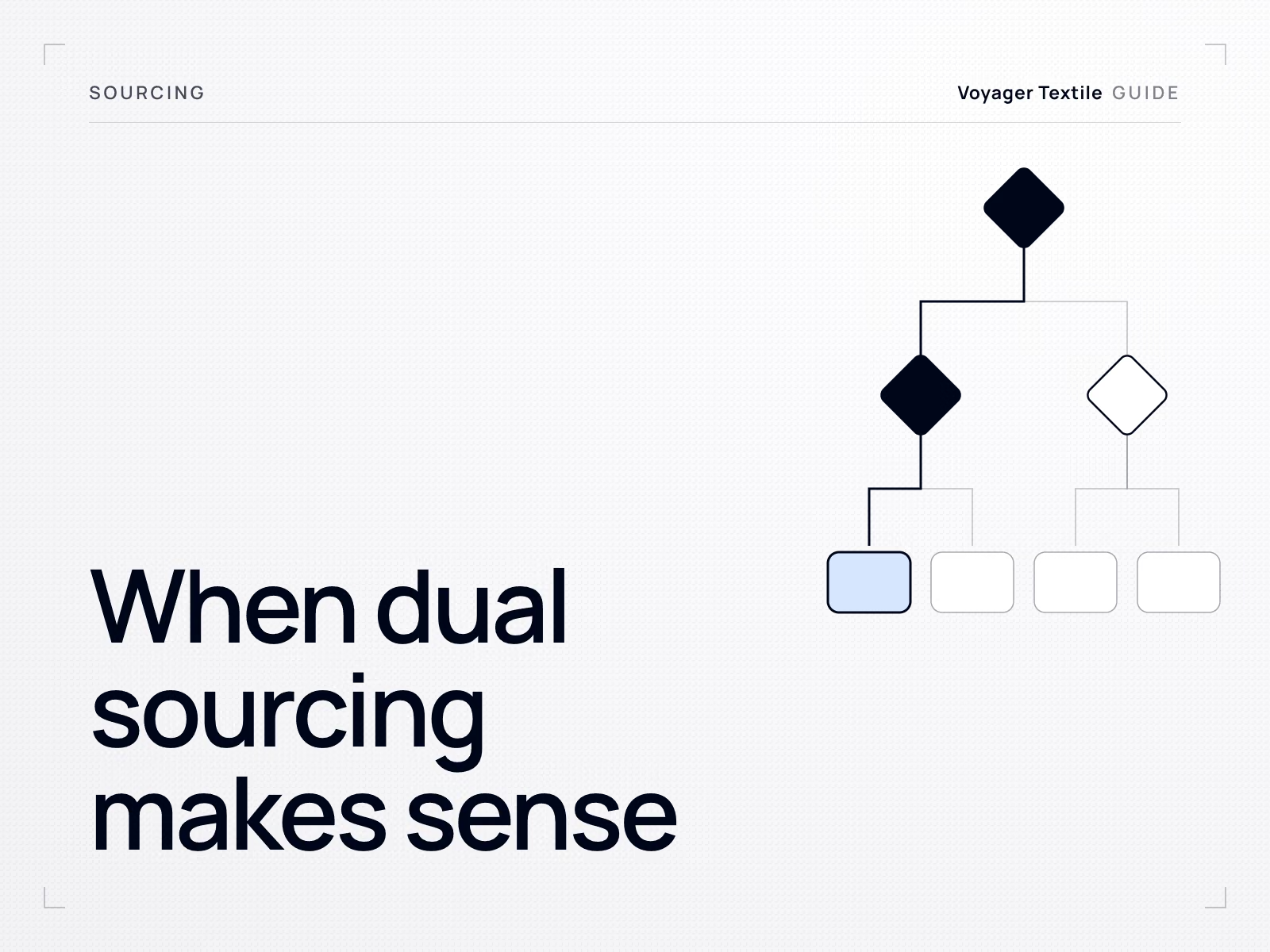
No, and treating it as automatically wrong leads to expensive duplication that helps nobody. A single specialist supplier can be the rational answer where volume is small, setup or development cost is high, the process is genuinely specialised, splitting production would create visible inconsistency, or the programme is short-lived. The question is not how many suppliers you have but what would happen if this one stopped.
If I have two factories, am I dual sourced?
Not necessarily. If both factories buy the same custom fabric from one mill, use the same nominated zipper or membrane, or send garments to the same print or embroidery house, the programme still has one point of failure. It simply has two invoices attached to it. Real diversification requires the layer beneath the cut-and-sew supplier to differ too.
Is a factory that quoted us a backup supplier?
No. Quoting, replying to an enquiry or appearing in a supplier database makes a factory identified, which is the first of several states and a long way from usable. A supplier that has not seen the current specification, has not made anything, has no confirmed material route and has unverified capacity cannot take over production, however willing it is.
Can I move production immediately if I have the tech pack?
Not necessarily. A current, detailed tech pack is one of the best portability investments available, and it is not sufficient on its own. The incumbent may hold the production pattern, the machine setup, the decoration setup, knowledge of how that fabric behaves and the accumulated fixes for problems solved years ago. What can legally be transferred is also agreement-dependent rather than automatic.
Should I pre-approve alternative fabrics or trims?
It is worth doing for some programmes and disproportionate for others. Where a custom fabric or a nominated component is the real dependency, evaluating an alternative while there is no pressure is often valuable preparation. Where the product is simple and the material widely available, the effort may be better spent elsewhere. There is no rule that every programme should hold approved alternates.
Does a supplier's stated capacity mean it is available to us?
No. A stated monthly capacity describes what a site can run, not what is reserved for any buyer. Actual availability depends on the current order book, the specific product, machine and process availability, labour and, usually the real constraint, material lead time. Availability also changes month to month, so a contingency confirmed once is not confirmed.
Does holding stock solve supplier risk?
It buys time, which is valuable, but it does not create the ability to produce. A buffer extends how long you can keep supplying while a source is down; it does nothing about restarting production, and it carries its own cash, obsolescence and disposal costs. Buffer and contingency are complements rather than substitutes.
What should trigger activating a contingency?
There is no universal trigger, and a number invented here would be worse than none. What points toward activation is a confirmed inability to meet required volume, a material that cannot be obtained, a site that has stopped, or a pattern of unresolved failure that corrective action has not shifted. A single late delivery is normally a corrective-action question rather than a continuity one.
Should I improve the current supplier or find a new one?
Usually both, and framing it as a choice is a common error. Developing the incumbent and quietly qualifying an alternative are separate activities with separate purposes and can run at the same time. Where activation becomes a permanent reassignment rather than a temporary measure, the transfer itself is a distinct exercise with its own sequence and timeline.
Does moving production to another country change anything besides cost?
Yes, and one of the changes is easy to miss. Different countries bring different lead times, minimums and quality baselines, and they can change the garment's customs origin and the documentation that goes with it. Geographic diversification also does not remove a dependency on a component that both routes import from the same supplier.
Ask where the dependency actually sits
What we can tell you plainly is where a programme's real dependencies are in our own route: which fabric is custom, which trim is nominated and which process is subcontracted, so the map you build reflects the production rather than the org chart.
Discuss a programme