Choosing a manufacturer
How to Qualify and Approve an Apparel Supplier
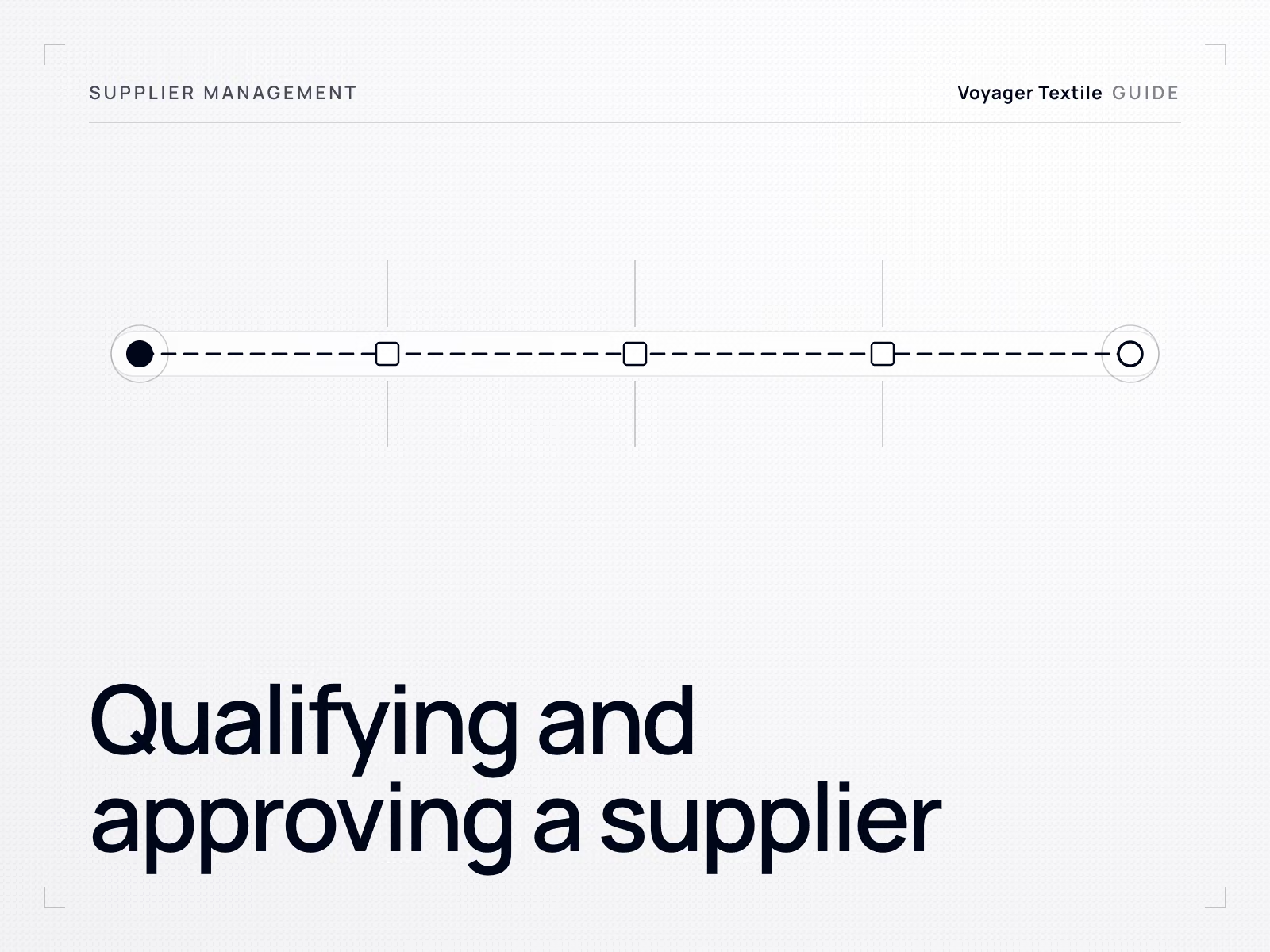
Supplier approval is a decision about scope, not a status a factory holds. An audit answers what an audit asks, a certificate describes a management system, a sample shows what could be made once, and none of them, alone or together, establishes that a supplier can produce your programme in bulk. Approval says what this supplier may make, on what evidence.
Contents
- Six stages that are not each other
- What each kind of evidence actually proves
- Approved for what?
- What is actually made where
- Capacity: verified, not reserved
- Development, and where product approval sits
- Approval is a state, not a badge
- Onboarding: making an approval operational
- What a register should record
- Before the first bulk order
- Questions buyers ask
The question that exposes how a supplier was really approved is boring and effective: what evidence do we have, and what is it evidence of? Very often the answer is an audit report about labour conditions, a certificate about a management system, and one sample that came back nicely, three documents that between them say almost nothing about whether ten thousand pieces will arrive correct in eleven weeks.
Six stages that are not each other
Where approval sits, and what surrounds it
Conceptual buyer framework, not an industry standard. Onboarding operationalises an approval; it does not create one.
| Qualification | Onboarding | |
|---|---|---|
| The question | Can we use this supplier, and for what? | How will we actually work together? |
| What it looks at | Capability, controls, materials, capacity, compliance, development work | Contacts, document routes, approval workflow, order process, escalation |
| Output | A decision, with a scope and any open conditions | A working relationship that both sides can operate |
| Proves capability? | That is its purpose | No. A supplier can complete every form and still be unable to make the product |
| When | Before approval | After it, or alongside a conditional one |
Two more distinctions are worth making at the start. Selection is deciding which candidate looks best; approval is deciding whether the evidence supports using them, and for what. And the activities that produce evidence, such as an audit, a visit, a sample or a document review, are not themselves approval. They are inputs to a decision somebody still has to make.
What each kind of evidence actually proves
Six inputs, one decision
Each source answers only the question inside its own scope. None of them is the decision.
| Evidence | What it can tell you | What it does not establish |
|---|---|---|
| Social or ethical audit | What the assessment found about the site, within its own methodology and scope, on the date it was done | Product capability, fit execution, quality consistency, capacity, materials, packing or delivery |
| Management-system certification | That a certified quality-management system exists, within the certificate's stated entity, site and scope | That this garment can be made, that the buyer has approved anything, or that orders will conform |
| Development sample | That the supplier produced that item, under development conditions, in a sample room | Repeatability in bulk, capacity, material continuity, or capability in other product categories |
| Capacity statement | What the site says it can run in general terms | That your style, quantity and dates can be produced, or that anything is held for you |
| Inspection report | Whether one shipment met agreed criteria at one point | That the supplier's system is broadly sound, or that the next order will pass |
| Factory visit | A great deal that documents miss, such as cleanliness, organisation and what is actually running | Anything measurable on its own; it is context rather than proof |
| Reference customers | That others have worked with them | Current capability, current capacity, or suitability for your product |
None of this is an argument against audits or certification. An audit report is genuinely informative once you know what its scope was, and how to read one is covered in reading a factory audit report. The point is narrower: each source answers the question it was designed for, and stacking several of them does not produce an answer to a question none of them asked.
Approved for what?
"Approved supplier" used without a scope is close to meaningless. It is not an independent certification and no third party issues it. It is an internal status one buyer grants for its own purposes. The same factory can be approved by one buyer and not another, and approved by one buyer for one thing and not another. Nor does approving an organisation approve the parts it supplies: that is a separate layer, described in trims and components. Product-safety controls such as needle and foreign-metal control are a further capability to assess on their own terms.
Four levels, narrowing
Approval at a wider level does not carry down to a narrower one. Not every approval needs every level.
- Company is not site. A supplier may operate several factories, a separate sampling room, an external finishing unit and subcontracted sewing. Approving the legal entity does not establish that every physical site is equivalent, though requiring formal site-by-site approval everywhere is disproportionate for most programmes.
- Site is not product. A facility that runs jersey cut-and-sew well is not thereby qualified for seam-sealed outerwear, structured tailoring or certified protective equipment. Those are different machines, different operators and different process control.
- Product is not process. A factory can make the garment and send the embroidery, the printing, the dyeing, the washing or the seam sealing somewhere else. Where a critical process sits outside the approved site, it is worth knowing.
- Programme adds requirements. A buyer's own compliance requirements ride on top of all of it, and they are the layer most likely to be discovered late.
What is actually made where
Subcontracting is normal and is not a problem in itself. Very few apparel factories knit their own fabric, dye it, and run every decoration and finishing process in-house, and a supplier that manages good external partners may produce better results than one insisting on doing everything badly. The issue is visibility, not outsourcing.
- Where is cutting done, and where is sewing done?
- Is decoration in-house, and which techniques?
- Where is fabric knitted or woven, and where is it dyed?
- Is washing, seam sealing or any specialist finishing subcontracted?
- Where is final packing done?
- Which of those sit at a different site from the one you assessed?
The reason this belongs in qualification rather than in a questionnaire is that the answers define what was actually approved. If a programme depends on a particular site, process or compliance status, and production later moves elsewhere without that being reviewed, the approval no longer describes what is happening. How that is handled once production starts belongs in the written arrangement, covered in supplier quality agreements.
Capacity: verified, not reserved
A stated monthly output is a description of a factory. Qualification adds a second question to it, not merely whether the volume exists, but whether it exists for this product.
- Product-specific throughput. A basic tee and a lined, decorated jacket do not run at the same rate on the same floor, so a headline figure says little about your style.
- Relevant machine and process availability, rather than total machine count.
- The normal load, and what the seasonal peak looks like, since capacity in a quiet month is not capacity in the month you need.
- Upstream material dependency, which is usually the real constraint rather than sewing minutes.
- Subcontracted capacity, which may be shared with other customers in ways nobody has visibility of.
Development, and where product approval sits
For custom apparel, some development work is almost always part of qualification, but it is worth being precise about what it demonstrates. A sample proves that this supplier, in its sample room, produced this item once. That is real information and it is not bulk readiness.
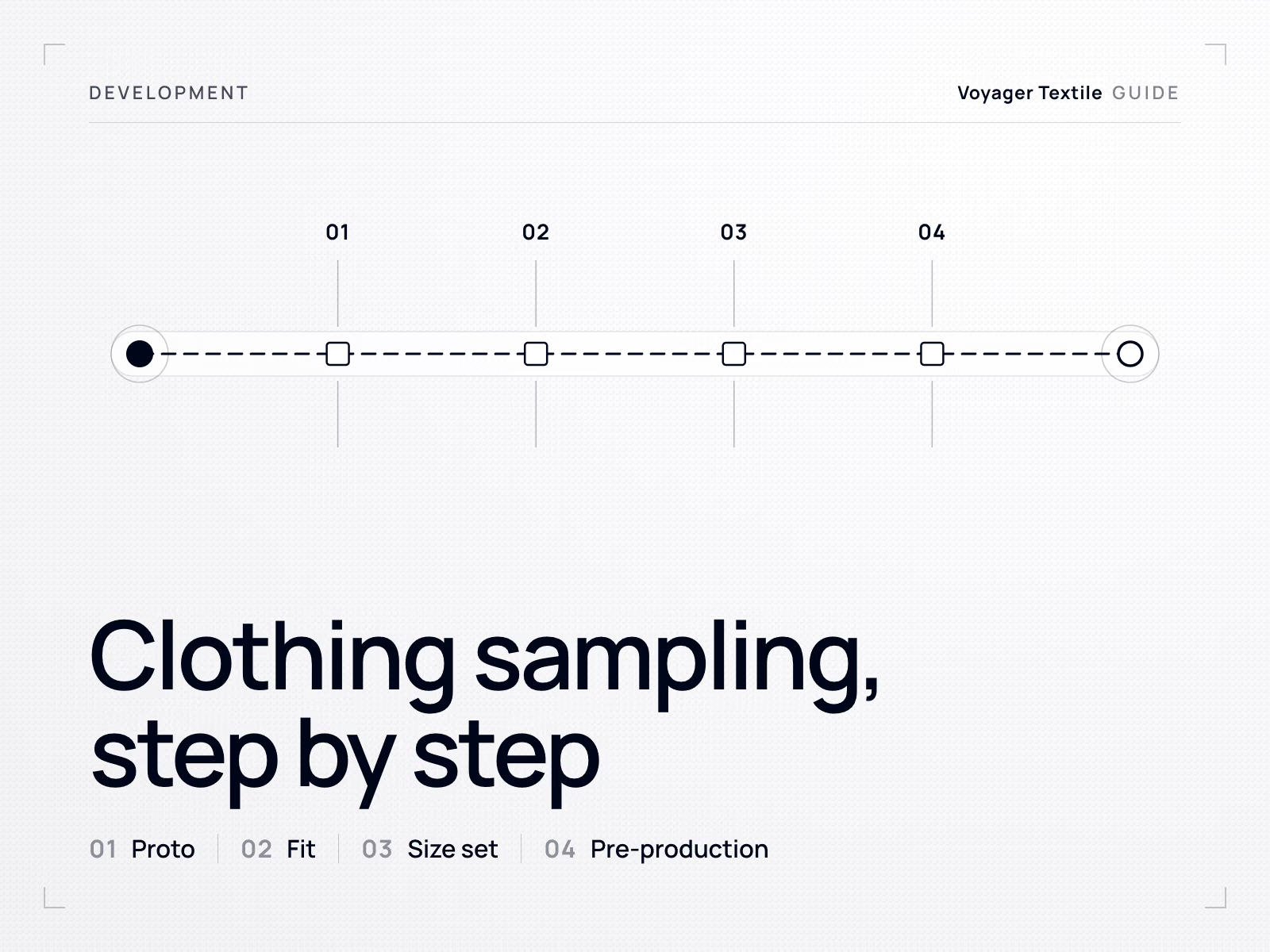
- What each sample stage proves is already defined in the sampling process, and this guide does not redefine it.
- A pre-production sample is closer to the truth than a development sample, because it is made in bulk materials on the intended route.
- A pilot or first small production run exercises the bulk line rather than the sample room, and tells you more about repeatability than any sample can. It also costs real money and is not proportionate for every programme.
- Some buyers treat a first bulk order as a higher-monitoring phase. That is a reasonable approach and it is not a rule, and this guide does not prescribe an inspection level for it.
Approval is a state, not a badge
It helps to have language for the fact that suppliers sit at different points. The set below is a conceptual buyer framework rather than an industry standard, and nothing about it should be styled as a certificate.
- Not assessed. Known, but nothing has been established.
- Under qualification. Evidence is being gathered; not yet a decision.
- Conditionally approved. Usable within a defined scope with specific open items, such as a material evidence gap, a packaging validation or an agreed action. Whether production may proceed under a condition depends on what the condition is; some conditions should stop an order and some should not.
- Approved for a defined scope. The normal state, and the scope is the substance of it.
- Suspended or under review. Something changed, or performance did.
None of these should imply a permanent property of the factory. Approval goes stale, and usually because something changed rather than because time passed: a production site moves, ownership or management changes, a critical process is subcontracted differently, a material source changes, a compliance document lapses, the product scope expands, or performance deteriorates in a way that has not been resolved.
Onboarding: making an approval operational
Once a supplier is approved, a separate and much more mundane job begins: making sure both sides know how to work together correctly. This is not a capability question and it should not repeat qualification.
What onboarding usually has to settle
Operational rather than evaluative. None of it proves a supplier can make anything, and all of it prevents avoidable failures in the first orders.
- Named contacts for commercial, development, quality, production and shipping matters, and who to escalate to
- Where the current approved tech pack, bill of materials, artwork and packaging specification are obtained, and how revisions are notified
- The approval workflow, what is submitted, to whom, and what counts as approved
- How orders are placed and confirmed, and what an order confirmation is expected to contain
- Inspection arrangements: who inspects, at what stage, and what is reported
- Packaging, labelling and shipping document requirements
- How problems are raised, and how quickly
- Any open conditions from the approval, with an owner and a resolution route
What a register should record
If approvals are written down at all, the useful version records the scope rather than a status flag. A list of supplier names against a tick answers no question anybody actually has.
| Field | What it records |
|---|---|
| Supplier and site | The legal entity, and the manufacturing site the approval actually concerns |
| Approved scope | Product families and processes, in terms specific enough to test |
| Basis | What evidence the decision rests on |
| Restrictions and open conditions | What is excluded, and what remains outstanding |
| Critical processes and where they happen | Including anything subcontracted that the scope depends on |
| Review trigger | What would prompt looking again, a change, not a date |
| Status | Where the supplier currently sits |
Before the first bulk order
Twelve things to have settled
An operational checklist, not a universal requirement. Which items matter depends on the product, the programme and the risk. A simple repeat order and a regulated first launch do not need the same work.
- The supplier and the specific manufacturing site are confirmed
- The intended product and process scope is written down in testable terms
- Capability evidence relevant to that scope has been reviewed
- Any audit or certification the programme actually requires has been checked, including its entity, site and scope
- The development stages the product needs have been defined and completed
- The route to the current tech pack, bill of materials and artwork is agreed
- Rules for changes and deviations are understood on both sides
- Inspection responsibilities and stages are agreed
- Packaging, labelling and documentation requirements are communicated
- Contacts and escalation routes exist
- The order confirmation process is understood
- Any conditions attached to the approval are recorded with owners
After the first order ships, the question changes again. Performance management takes over, meaning what actually happened against agreed requirements, and it is covered in managing supplier performance. Approval is what let the supplier start; performance is what tells you whether the decision was right, and it should feed back into the scope rather than sitting in a different file.
Questions buyers ask
What does it mean to approve an apparel supplier?
It is a buyer's own decision that the evidence gathered supports using that supplier for a defined scope, specific products, processes, sites and programmes. It is not a certification, nobody external issues it, and the same factory can be approved by one buyer and not another. The scope is the substance: approval without one is close to meaningless.
Does passing a factory audit mean a supplier is approved?
Not by itself. An audit answers the questions inside its own methodology and scope, on the date it was carried out. Approval can also depend on product and process capability, quality controls, material access, realistic capacity, applicable compliance evidence, completed development work and operational readiness. An audit is one input to a decision, not the decision.
Does ISO 9001 certification make a factory an approved supplier?
No. A valid certification is useful evidence that a certified quality-management system exists within the entity, site and scope the certificate states. It is not a buyer's approval, it does not establish that this particular garment can be produced, and it does not guarantee that any given order will conform. Buyer approval is a separate decision.
Does an approved sample mean the supplier is qualified for bulk?
Not automatically. A sample shows that the supplier produced that item under development conditions, usually in a sample room with experienced staff and without bulk time pressure. Bulk readiness also involves repeatability on the production line, material continuity, real capacity, in-process controls and the actual production setup, which is why a pre-production sample or a pilot run tells you more.
What is the difference between supplier qualification and onboarding?
Qualification asks whether you can use the supplier and for what, and looks at capability, controls, materials, capacity, compliance and development work. Onboarding asks how the two sides will work together and settles contacts, document routes, approval workflow, order process, inspection arrangements and escalation. A supplier can complete every onboarding step and still be incapable of making the product, which is why the two are not interchangeable.
Can a supplier be approved for some products but not others?
Yes, and that is usually the honest position. A factory that runs knitted jersey well is not automatically qualified for seam-sealed outerwear, structured tailoring, certified protective equipment or a children's range with its own safety controls. Those involve different machinery, different process control and often different compliance evidence, so each is a fresh question rather than an extension of an existing approval.
Is approval tied to the factory location?
It should reflect where the work actually happens. A supplier may run several sites, a separate sampling room, an external finishing unit and subcontracted sewing, and approving a legal entity does not establish that every site is equivalent. That does not mean every programme needs formal site-by-site approval. The depth of scope should follow the risk of the product.
What happens if a supplier changes subcontractor or moves a site?
It can affect what was approved, because the approval described a particular configuration. Whether it needs review depends on what the change touches, such as the process, the personnel, the equipment, the compliance scope or the product risk. That is why change notification and review rules belong in the written arrangement before production rather than being discovered afterwards.
How often should an apparel supplier be re-evaluated?
Re-evaluation should follow risk, programme, actual performance, and what has changed, such as a site move, an ownership change, a different subcontractor, a material change, a lapsed compliance document or an expansion of product scope. Re-evaluating also does not mean repeating the original qualification from zero.
Does supplier approval expire?
Not on a date, but it does go stale. What makes it stale is usually change rather than the passage of time: production moves, processes are subcontracted differently, materials change, documents lapse, the product scope grows, or performance deteriorates without being resolved. Treating approval as a permanent property of a factory is how buyers end up relying on a decision that no longer describes reality.
What is conditional approval?
A supplier judged usable within a defined scope while specific items remain open, such as a material evidence gap, a packaging validation or an agreed corrective action. Whether production may proceed while a condition is open depends entirely on what the condition is: some are administrative and some go to whether the product can be made correctly. It is a working state with an owner and a resolution route, not a softer permanent status.
Is an approved supplier automatically a backup supplier?
No. Approval says the supplier may be used for a defined scope. Whether it could take over production at short notice is a separate question involving current capacity, material access, the specification it actually holds and how recently any of that was checked. That analysis sits in supplier risk and contingency rather than in qualification.
Ask what we are being approved for
What we can do is answer the qualification questions precisely: which processes run in our own facility, which are subcontracted and where, what we have actually produced in a category, and what evidence exists for it.
Discuss a programme