Choosing a manufacturer
What Is a Supplier Quality Agreement in Apparel?
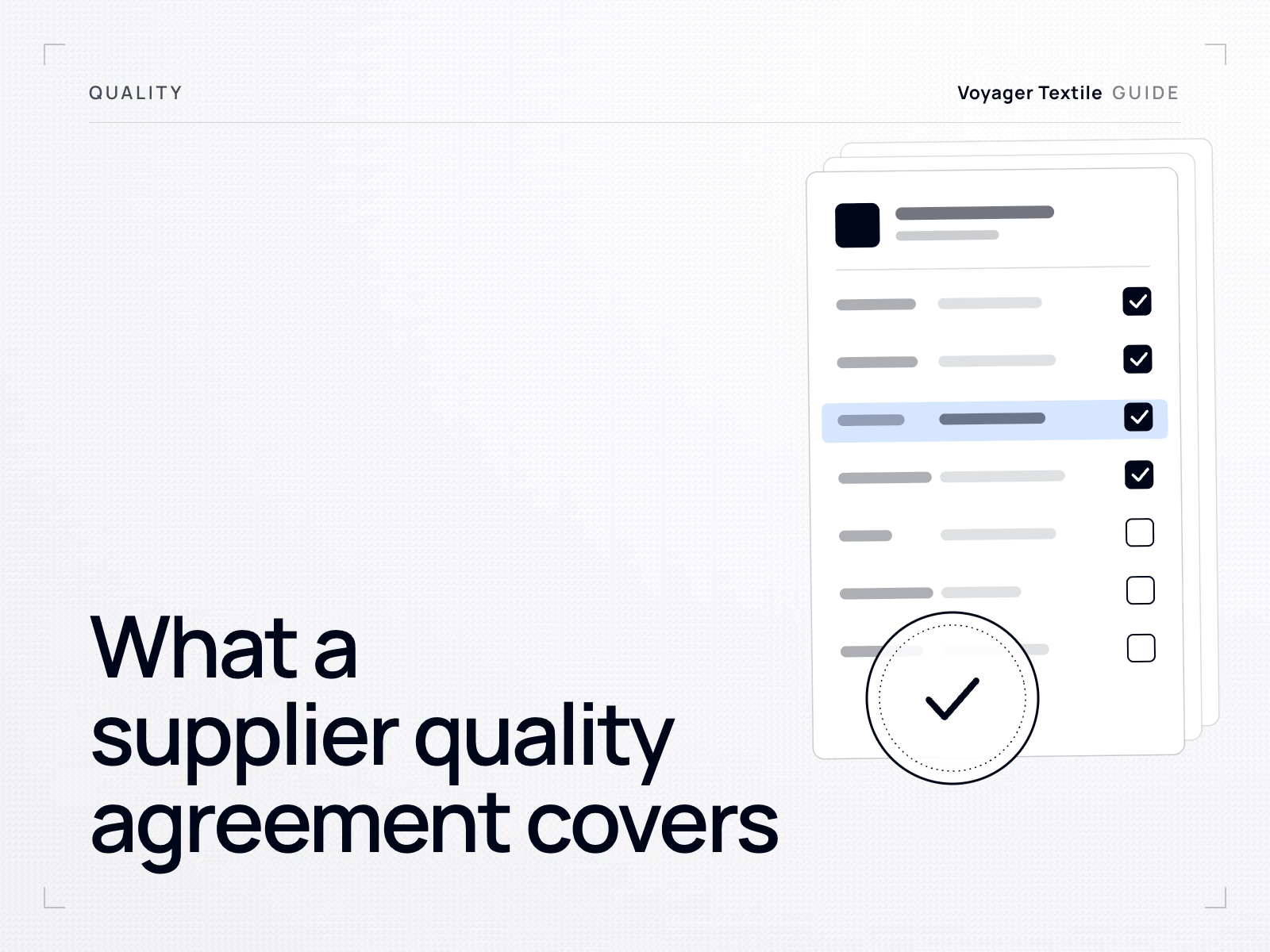
No standard requires a document with this title, and plenty of apparel relationships work without one. What matters is that recurring quality responsibilities are controlled somewhere, which changes need notifying, which need approving, how deviations are handled, who inspects, and what happens when production does not conform.
Contents
Many quality problems in apparel are not caused by a factory that cannot make the garment. They come from nobody having agreed, in advance, what happens when the fabric supplier changes, when a trim is unavailable, when a lot fails inspection, or when somebody sends a revised measurement by email on a Friday.
Have the agreement reviewed for the relevant jurisdiction and project. General guidance cannot determine the rights or obligations of the parties to a specific contract.
Four documents, four different questions
The confusion is structural rather than careless. All four of these documents contain requirements, all four are sent to suppliers, and each one is regularly asked to do another one's job.
| Document | Answers | Scope | Not a substitute for |
|---|---|---|---|
| Vendor manual | How do we work with suppliers generally? | Buyer-wide, every supplier, every order | Product detail, or supplier-specific quality responsibilities |
| Quality agreement | Who is responsible for what, in quality terms, with this supplier? | One supplier or programme, recurring across orders | The product specification, or the commercial contract |
| Tech pack and BOM | What is this product, exactly? | One style, one revision | Governance. It describes the garment, not the relationship |
| Purchase order | What are we buying, when, on what terms? | One order | Anything recurring; it should reference the others rather than restate them |
The vendor manual belongs to the buyer's whole supply base and is covered in supplier performance management; the purchase order is set out in apparel purchase orders; the specification layer is in tech packs and the bill of materials. A quality agreement sits between the manual and the specification: more specific than the first, more permanent than the third.
Supplier-level requirements, not style-level ones
A common drafting error is copying the tech pack into the agreement. Measurements, seam types, artwork placement and material references belong to the style and change with it; an agreement that restates them creates two sources of truth that will disagree within a season.
- Reference, do not restate. The agreement should point at the current controlled specification by name and revision, and let that document carry the detail.
- Keep what recurs. Responsibilities that apply across styles and orders, such as who inspects, what gets notified and how deviations work, are exactly what a style specification cannot hold.
- Say where the current version lives. An agreement that governs revisions but does not say where they are obtained is missing the point of itself.
| Topic | What it settles |
|---|---|
| Applicable specifications | Which documents govern, how revisions are issued, and where the current version is obtained |
| Change notification | Which changes must be told to the buyer, and which need approval before use |
| Deviations | How a temporary departure from specification is requested, scoped and recorded |
| Nonconformity | What the supplier does when production does not meet requirements |
| Inspection and verification | Who inspects, at what stage, against what, and what is reported |
| Materials and components | How approved materials are controlled, and what happens when one is unavailable |
| Subcontracting | Which processes may be subcontracted, and what has to be told to the buyer |
| Site scope | Which manufacturing site the arrangement covers |
| Records | What each side keeps, and what can be produced on request |
| Communication and escalation | Who is told what, and how quickly |
Change control: notification is not approval
This is the section that does much of the work in practice, and the distinction it turns on is simple enough to be overlooked. Requiring a supplier to tell you about a change is not the same as requiring your permission before making it, and an agreement that fails to separate them either drowns the buyer in approvals or lets significant changes pass silently.
One route, three possible outcomes
Notification is not approval, and the agreement is what says which changes need which.
The useful approach is to sort changes by what they touch rather than by how large they seem. A change that affects the approved product, the approved process, the compliance position or the site the approval was based on is a different category from an internal adjustment that leaves all four untouched.
- Manufacturing site, production moving to another facility, including one belonging to the same company
- Subcontracting, a critical process moving in or out, or to a different partner
- Fabric, a different mill, a different construction, or a different finish
- Trims and components, substitution of anything named in the bill of materials
- Decoration, a different technique, setup or subcontractor
- Construction or pattern, anything that changes how the garment is made or how it measures
- Packaging, where it affects labelling, assortment or how goods are received
- Compliance evidence, a certificate, test report or audit status that lapses or changes scope
Deviations, and the trap inside them
A deviation, sometimes called a concession, is an explicit, reviewed exception allowing production or shipment outside the normal specification in defined circumstances. Used properly it is a practical tool that keeps a season on track. Used loosely it quietly rewrites the product.
The same logic applies to how deviations are recorded. A verbal approval on a factory visit is not a controlled record, and neither is an email that names no style, quantity or duration. What matters is not a form, and this guide prescribes none, but that the affected product, the difference, the approval and its limits are all recoverable afterwards.
When production does not conform
An agreement is most valuable at the moment something has gone wrong, because that is when improvisation is most expensive. What it usually settles is sequence rather than blame.
- Tell the buyer, within a timeframe that reflects how serious it is
- Identify the scope, which lots, which quantities, and whether anything has shipped
- Hold what is affected rather than letting it move while the question is open
- Agree the disposition, which might be rework, repair, acceptance under a deviation, or rejection depending on the facts
- Follow with corrective action where the problem warrants it
What happens after the immediate problem is handled belongs elsewhere. The distinction between correction, containment, root cause and corrective action, and what makes a corrective action actually effective, is set out in supplier performance management. A quality agreement's job is to establish that the supplier will do those things and how it will communicate about them, not to re-teach them.
Who inspects, and against what
Inspection is a recurring responsibility, which is why it belongs at this level rather than in a style specification. The agreement settles who does it and when; the mechanics belong to the quality-control layer.
- Which stages are inspected, incoming materials, in-line, final, or some combination
- Who performs each one, whether the factory, the buyer or a third party
- What the criteria are, by reference to the agreed sampling and defect classification rather than by restating them. Those sit in quality control and, for materials, incoming fabric inspection
- What is reported, to whom, and by when
- What happens on a fail, connecting back to the nonconformity route above
When documents disagree
A real and under-discussed failure mode: the tech pack says one thing, the purchase order says another, the vendor manual implies a third, and somebody emailed a fourth. The factory has to build something, so it picks, usually the most recent message, which is usually the least controlled one.
- Decide which document governs for which kind of requirement, and make sure both sides know.
- Keep the specification as the specification. A quantity on a purchase order and a measurement in a tech pack are not competing claims about the same thing; conflicts usually arise where one document restates content owned by another, which is the argument for referencing rather than duplicating.
- Treat email as a request, not an instruction, unless the buyer's own process says otherwise. A message asking for a change is the start of change control rather than the end of it.
- Make revisions unambiguous. A revision number and a date are worth more than any amount of wording about precedence.
Formal precedence clauses are a legal drafting matter and this guide does not attempt them. The operational point stands on its own: ambiguity between documents produces defects and disputes, and the cheapest fix is to stop the same requirement living in two places.
Do you need one?
Often not. The question is whether the responsibilities above are controlled somewhere, not whether a particular document exists.
Where it earns its place, and where it does not
Probably worth having
- Regulated or safety-relevant products
- Programmes running across many seasons
- Complex products with many controlled inputs
- Where several sites or subcontractors are involved
- Where no vendor manual exists
Probably unnecessary
- A single short-run order
- Simple products with few controlled inputs
- Where a thorough vendor manual already covers it
- Where the same points are already in the commercial agreement
- Where it would be signed and never referred to again
The worst outcome is a document that exists to be pointed at. If an agreement is written, the test of whether it was worth writing is whether anybody consults it the first time a fabric is unavailable or a lot fails, and whether what it says is specific enough to settle the question.
Questions buyers ask
What is a supplier quality agreement?
A document setting out recurring quality responsibilities between a buyer and a supplier, which specifications govern, which changes must be notified and which approved, how deviations are handled, what happens when production does not conform, who inspects and against what, and what records each side keeps. It sits between a buyer-wide vendor manual and the product-specific specification.
Is a quality agreement legally required?
No general requirement makes one mandatory for apparel. Whether one is contractually required in a particular relationship is a matter for the parties and their own agreements, and whether it is enforceable is a legal question this guide does not answer.
Does ISO 9001 require a supplier quality agreement?
No. Quality-management frameworks require that applicable requirements are communicated to external providers and that control is proportionate to what is supplied. That can be satisfied through a vendor manual, controlled specifications, purchase orders or a quality plan. A separate document with this title is one way of doing it, not a requirement.
How is it different from a vendor manual?
A vendor manual is buyer-wide: the standing rules that apply across every supplier and every order regardless of product. A quality agreement is specific to one supplier or programme and allocates quality responsibilities within it. They coexist comfortably, and a buyer with a thorough vendor manual may not need a separate agreement at all.
How is it different from a tech pack?
A tech pack describes one product at one revision: measurements, construction, materials and artwork. A quality agreement describes the relationship and recurs across styles and seasons. The agreement should reference the current controlled specification rather than restate its content, because two documents carrying the same requirement will eventually disagree.
How is it different from a purchase order?
A purchase order is order-specific: what is being bought, how much, when, and on what commercial terms. A quality agreement is recurring. An order can and usually should reference the agreement rather than repeating its content, in the same way it should reference the specification rather than restating measurements.
What changes should a supplier notify?
Sort them by what they touch rather than by size. Changes affecting the approved product, the approved process, the compliance position or the site the approval rested on are the ones that matter, such as a different mill or fabric construction, a substituted trim, a different decoration technique or subcontractor, a construction or pattern change, production moving to another facility, or a lapsed certificate. Ordinary internal adjustments that touch none of those are the supplier's to manage.
Does every production change need buyer approval?
No, and requiring it would produce an agreement nobody follows. Notification and approval are different things, and a workable agreement says which changes need only to be told, which need review, and which need approval before use. Demanding sign-off on everything is a reliable way of getting sign-off on nothing.
What is a deviation?
An explicit, reviewed exception permitting production or shipment outside the normal specification in defined circumstances, sometimes called a concession. It should be scoped to particular styles and orders, describe the departure specifically, state how long or how many pieces it covers, and record who approved it.
Can a deviation become the new standard?
It should not, and preventing that is one of the main reasons to record deviations properly. A temporary exception that quietly persists becomes an unwritten standard, which surfaces the day another supplier makes the garment to the written specification and it no longer matches what customers have been receiving. If a change is permanent, the controlled specification is updated and the deviation ends.
Can a supplier change manufacturing sites without review?
Where an approval was based on a particular site, moving production elsewhere, including to another facility of the same company, can mean the approval no longer describes what is happening. Whether it needs review depends on what the move touches: process, equipment, personnel, compliance scope and product risk. Setting that expectation in advance is more useful than discovering it after a delivery.
Send the rules before the first order, not after the first problem
What is genuinely useful to receive early is the specific part: which changes you want told, which you want to approve, who inspects and against what. Those answers change how a programme is planned, not just how it is documented.
Talk to us about a programme