Compliance and shipping
Children's Apparel Safety: What Changes When the Wearer Is a Child
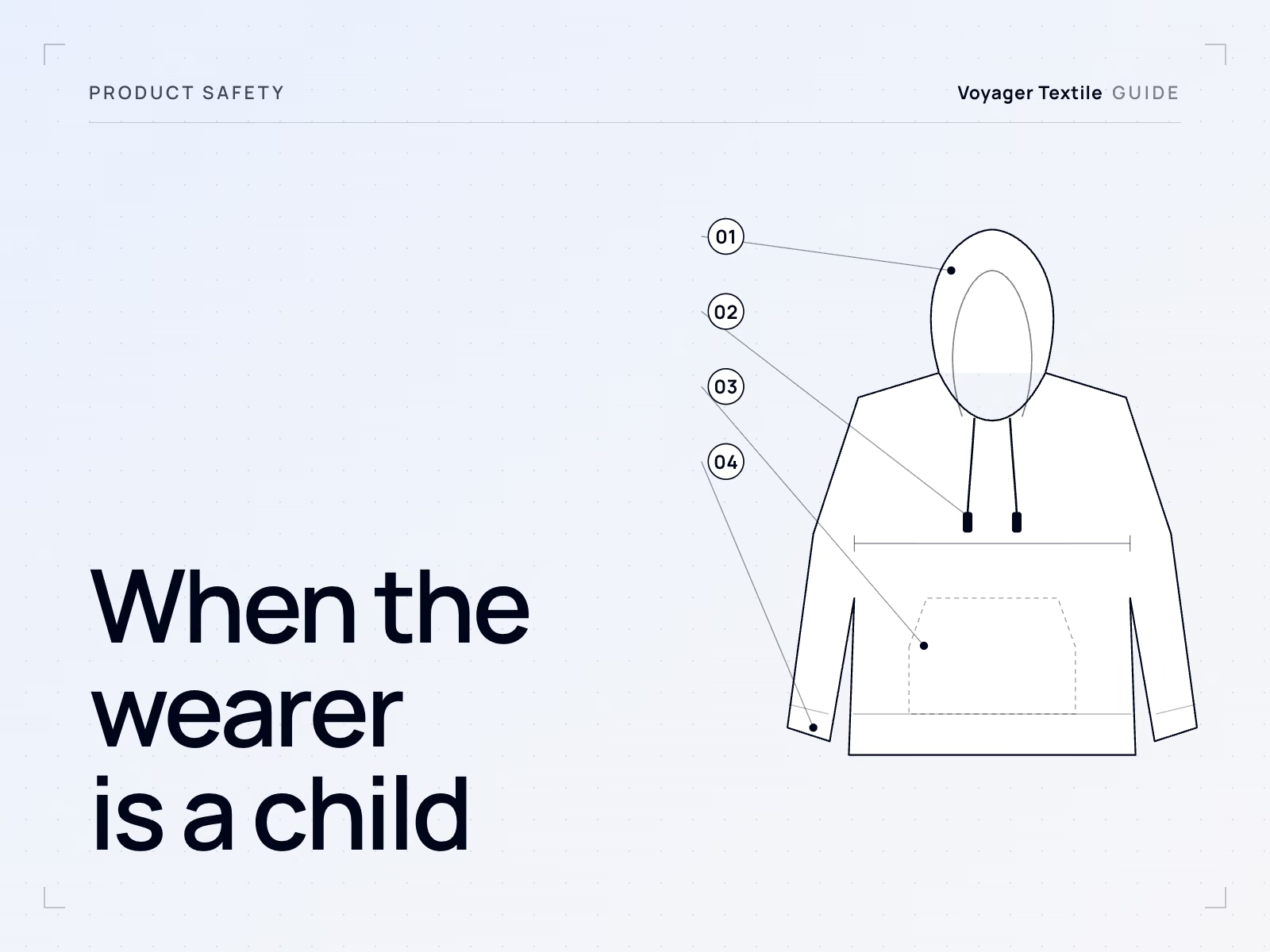
Extending a style into children's sizes is usually treated as grading. It is a new safety assessment. Changing the intended wearer changes foreseeable behaviour, which changes what a cord, a loop, a button or a decorative badge means on the same garment, and none of that is discovered by making the pattern smaller.
Contents
- The principle
- Four separate layers
- The standard that exists, and what it covers
- Detachable components and attachment
- Age is a design input, not merchandising metadata
- This is design work, not inspection work
- When a change reopens the assessment
- Boundaries worth knowing
- Before development starts
- Questions buyers ask
A brand with a successful adult hoodie decides to add a kids' version. The tech pack goes to the factory with the size chart extended downward and everything else unchanged. That is the moment many children's apparel safety problems are created, and none of them will be visible in the sample review.
Specify the age group, intended use and component design before sampling. Check the finished product against the applicable safety requirements and current standards.
The principle
A children's version of an adult garment is not automatically the same safety product in a smaller size. The garment may be identical in construction, materials and appearance, and still present different risks, because the person wearing it behaves differently and is a different size relative to the same cord, the same loop and the same button.
What changing the wearer reopens
Grading the pattern is a dimensional exercise. Changing the intended wearer is a safety one, and the two are routinely treated as the same task.
Children's clothing sits inside the same general framework as any other consumer product, covered in GPSR for apparel. What changes is not the framework but the risk analysis inside it: who uses the product, how they will foreseeably use it, and therefore which hazards are relevant.
Four separate layers
Children's apparel safety gets discussed as one thing. It is at least four, with different sources, different evidence and different status.
What sits where
Meeting one layer establishes nothing about the other three. The status differences between them are the point.
| Layer | Source | Covered in |
|---|---|---|
| Cords and drawstrings | EN 14682:2014, cited in the current Commission decision supporting the general product safety framework | EN 14682 cords and drawstrings |
| Components and their attachment | Risk assessment under the general framework. European documents exist without a current citation | This guide, below |
| Chemical restrictions | A separate regime entirely, with its own requirements for children's products | Chemical compliance |
| Product-specific rules | Where a product falls into another category, such as protective equipment | When workwear becomes PPE |
The standard that exists, and what it covers
Exactly one children's clothing standard sits in the cited list: EN 14682:2014, on cords and drawstrings. Everything else on this page is assessed without a cited standard behind it, which changes what evidence looks like rather than whether the assessment is needed.
What it requires, how its age groups work, which garment areas it treats differently and where the common design errors are is the subject of EN 14682 cords and drawstrings.
Detachable components and attachment
The second hazard family, and the one with no cited standard behind it. Buttons, press fasteners, rivets, decorative badges, beads, sequins, pom-poms, zip pullers, appliqués and labels are all components that can come off a garment, and what that means depends on the child.
None of them is prohibited, and treating them as though they were is as wrong as ignoring them. What matters is the combination.
| What varies | Why it matters |
|---|---|
| The age the garment is intended for | Foreseeable behaviour differs, and a component that is inert for an older child is a different question for an infant |
| The component itself | Size, shape, rigidity and whether it has parts of its own |
| Accessibility | Whether a child can reach, grip and work at it in ordinary use |
| The attachment | How it is fixed, and how that attachment behaves over wear and laundering |
| Foreseeable use | Including use the design did not intend but should have anticipated |
The small-parts boundary, stated precisely
Small parts is used loosely in garment quality control, and it has a specific meaning in toy safety legislation with its own defined test. Those two are not the same thing, and importing the second into ordinary clothing is a common and consequential error.
There is European work specific to clothing. CEN has produced a set of documents on the security of attachment of small components on children's clothing, including a test method for the attachment of functional and decorative buttons and, separately, requirements framed around components that fit entirely within a small parts cylinder without compression, scoped to infants' clothing. These are intended for use against general product safety requirements, the products are not toys and are not covered by toy safety legislation.
There is no universal pull-test figure
Attachment strength testing is routine in children's apparel programmes, and the force values circulating as though they were law are not. A European test method exists for button attachment, and what result a programme requires is set by the buyer's specification or the applicable product requirement rather than by a number everyone knows.
The practical consequence: if attachment strength matters to your programme, state the method and the requirement in the specification. Asking a factory whether components are securely attached, without either, is asking for an opinion. How components are specified and approved more generally is covered in trims and components.
When a decoration stops being a decoration
A garment that incorporates an actual toy, or an item that functions as one, can raise a product classification question rather than only a garment safety one. Equally, a decorative element does not become a toy because it is shaped like something, and sewing an item onto clothing does not remove every question about it.
Age is a design input, not merchandising metadata
The intended age and size range gets set by the merchandising team and treated as a commercial decision. It is also a technical input, and one of the few that changes which requirements apply at all.
- It determines which requirements are relevant, because the cords standard treats age groups differently and component risk varies with the wearer.
- It shapes foreseeable use, which is the core of any risk analysis.
- It affects the smallest sizes most, and the smallest sizes are where a design that works elsewhere tends to fail.
- It should be stated as the standard states it, using the standard's own age definitions rather than a conversion invented from a size chart.
How size and age ranges are built in the first place is covered in apparel sizing, and one sample size does not evidence a range for safety-relevant features any more than it does for fit.
This is design work, not inspection work
A useful thing to understand commercially: a cord configuration that does not meet the specification cannot be fixed at final inspection. By that point the garments exist. Safety-relevant decisions belong in the design, the pattern, the bill of materials and the construction.
Where a component is actually controlled
A trim substituted late has skipped every step. Final inspection cannot recover a decision made in design.
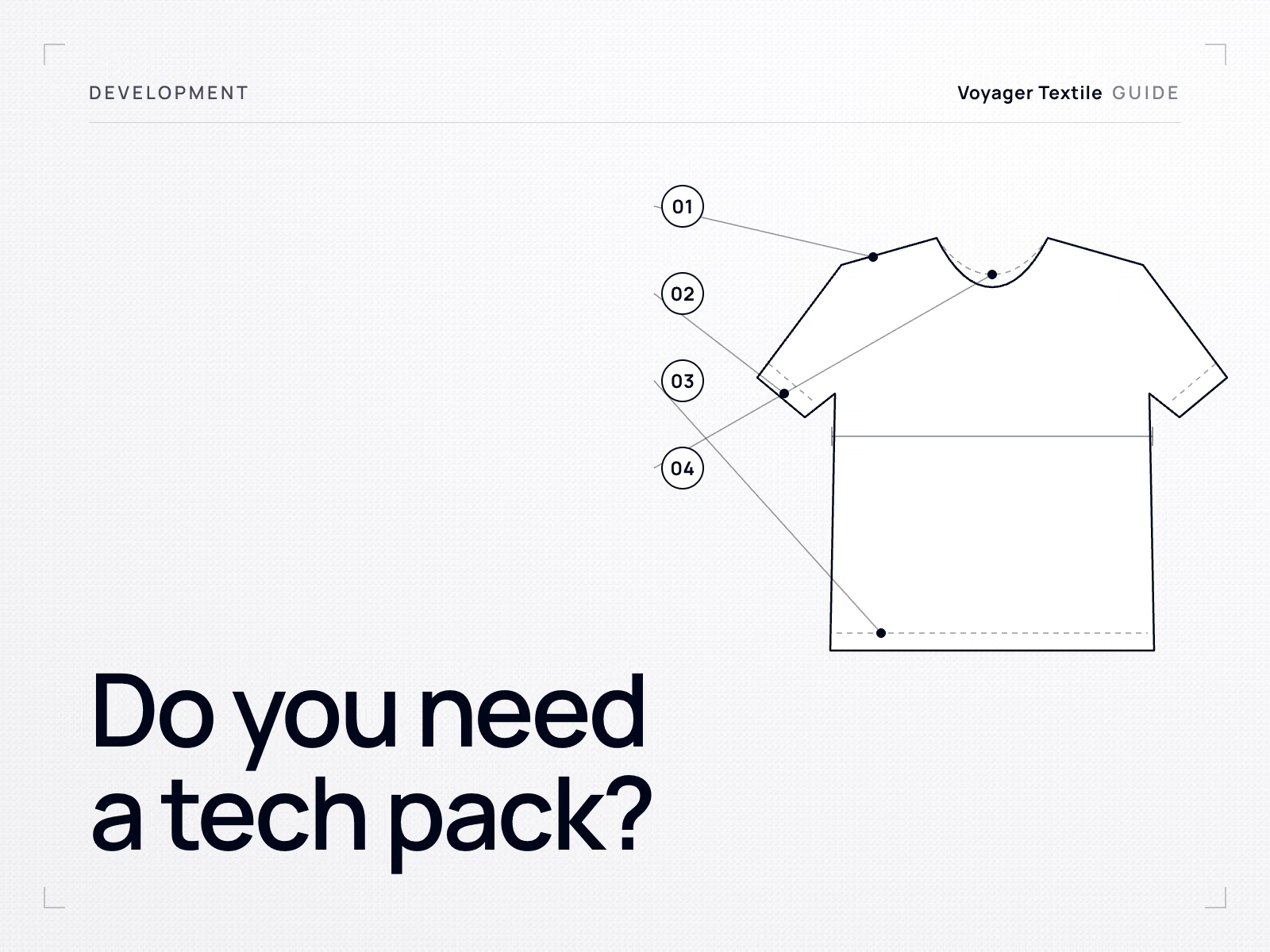
- The tech pack should identify safety-relevant components explicitly rather than leaving them among ordinary trims, the cord type, its position, its termination, the attachment method and the intended age range. See what a factory actually needs.
- The bill of materials should specify safety-relevant trims exactly, not generically, because an equivalent-looking substitution is a change to the assessed product.
- Sample approval is appearance and fit approval. A sample can look right and carry a safety defect, and signing it off does not constitute a safety assessment.
- Production control verifies the specification, the right trim, the right position, the right attachment. It maintains what was decided; it does not decide it. See quality control.
When a change reopens the assessment
The changes that matter are ordinary sourcing decisions, which is exactly why they pass unnoticed.
- A different cord, toggle or stopper, including a visually identical one from another supplier.
- A different button, snap, rivet or zip puller, or a different attachment method for the same component.
- A new decorative element, a badge, patch, bead or appliqué, added after the design was assessed.
- A change to where a cord or loop sits, or to how it is terminated.
- An extension of the size range, particularly downward.
- A change of intended age range, which can change which requirements apply.
- A fabric change that alters stretch or drape enough to change how a feature behaves.
None of these automatically requires retesting, and none is automatically harmless. Each means the existing assessment and evidence should be reviewed for whether they still apply. That review is short when the file records reasoning and long when it contains only results, the same lesson as product safety documentation, which is where a children's risk analysis belongs.
What that analysis should capture is the intended age and user, the foreseeable use, the cord and component hazards identified, the standards applied, what was done about each hazard, and the evidence supporting it. The structure of that documentation, and how long it is kept, is covered in the same place.
Boundaries worth knowing
Nightwear and flame behaviour
There is no single EU-wide rule to state. The European standard on the burning behaviour of children's nightwear is voluntary and is not cited in the current Commission decision, and requirements in this area are national, the United Kingdom, for example, operates its own nightwear safety regulations, whose requirements have been described as in places more demanding than the European standard.
The honest position for a general guide is therefore to say that this is market-specific and to stop. If a programme includes nightwear, the destination market's own requirements are the starting point, and they need checking rather than assuming. US children's sleepwear requirements are a separate regime again and do not transfer.
CE marking
Ordinary children's clothing does not carry CE marking because it is for children. CE marking applies where EU harmonisation legislation requires it, and affixing it outside that scope is not permitted. If a product falls into another category, protective equipment, for instance, that category's own rules apply, which is a separate question covered in when workwear becomes PPE.
Chemicals
Restricted-substance requirements can differ for children's products, and they are covered in chemical compliance, including the position on children's products in the United States. They are a separate assessment from everything on this page.
Promotional and corporate children's garments
A children's hoodie produced as merchandise for an event, a club or a corporate programme is children's clothing. It does not sit outside the assessment because it is not being sold through a retail range, and merchandise programmes are precisely where an adult design gets scaled down without anyone asking the question.
Before development starts
What to define
Product-development readiness rather than a legal completeness test. Some of this needs competent compliance input rather than a supplier's assurance.
- The intended age and size range, stated in the terms the applicable standard uses.
- The destination markets, since requirements outside the EU differ.
- Whether the garment carries cords, drawstrings, ties or loops anywhere, and where.
- How any cord is terminated, free ends, toggles, stoppers, knots or fixings.
- Every detachable or decorative component, named specifically rather than generically.
- The attachment method for each, and any attachment requirement with its method.
- Which standards apply, and what evidence will demonstrate each.
- Who carries out the risk analysis and where it is recorded.
- How production will be controlled for the safety-relevant features.
- How changes will be reviewed once the design is approved.
A valuable line in that list is the first. An enquiry that says children's hoodie, sizes 3 to 12, with a hood cord has already surfaced the question that a brief saying kids' version of our hoodie hides completely.
Questions buyers ask
Does children's clothing have different safety requirements from adult clothing?
It sits inside the same general product safety framework, but the risk analysis inside that framework is different, because the intended wearer determines foreseeable use. Cords and drawstrings have a dedicated European standard for children's clothing, and components such as buttons and decorations are assessed differently for a child than for an adult.
Can I just grade an adult hoodie down into children's sizes?
Not safely by assumption. Grading reduces dimensions proportionally; it does not resolve child-specific hazards such as where a cord sits, how it is terminated, whether a loop is present or whether a decorative component can be detached. Changing the intended wearer reopens the assessment rather than the pattern.
Are drawstrings banned from children's clothing?
No, and describing it that way is a common oversimplification in the subject. EN 14682 does not impose one blanket rule across every garment and age. Requirements depend on the age group the garment is intended for, the area of the garment the cord sits in, and the cord's type and configuration.
Does EN 14682 compliance mean the garment is safe?
No. EN 14682 addresses cords and drawstrings and the strangulation and entrapment risks they create. A garment meeting it can still present other physical hazards, chemical questions or product-specific requirements. It is not the children's clothing safety standard and does not present itself as one.
Are buttons on children's clothing considered small parts?
Small parts has a specific meaning in toy safety legislation with its own defined test, and that is not automatically imported into ordinary clothing. There is European work specific to clothing on the attachment of small components, including requirements framed around a small parts cylinder and scoped to infants' clothing, though it is not currently cited in the Commission decision supporting the general framework. Whether a component is a concern depends on the age, the component, its accessibility and its attachment.
Is there a universal pull-test force for buttons on children's clothing?
No, and figures circulating as though there were one are not a legal requirement. A European test method exists for the attachment of buttons on clothing, and what result is required is set by the buyer's specification or the applicable product requirement. If attachment strength matters to your programme, state the method and the requirement rather than asking whether components are securely attached.
Does a passed chemical test prove a children's garment is safe?
No. A restricted-substance report describes what a material contains. It establishes nothing about cord placement, loops, detachable components, attachment strength or foreign-metal control. Chemical and physical safety are assessed separately, evidenced separately, and one document arriving does not answer the other question.
Does ordinary children's clothing need CE marking?
No. CE marking applies where EU harmonisation legislation requires it, and affixing it to a product outside that scope is not permitted. Being intended for children does not bring ordinary clothing into a CE-marked regime. If the product falls into another category, such as protective equipment, that category's own rules apply.
Is children's nightwear covered by the same rules?
Not by one EU rule. The European standard on the burning behaviour of children's nightwear is voluntary and is not cited in the current Commission decision, and requirements in this area are national, the UK, for instance, has its own nightwear safety regulations. If a programme includes nightwear, the destination market's own requirements are the starting point.
What happens if a cord or trim changes after the design is approved?
The existing assessment and evidence should be reviewed for whether they still apply. A different cord, toggle, button or attachment method, a change to where a feature sits, or an extension of the size range downward can each affect the analysis. It neither automatically requires retesting nor is automatically harmless; what matters is that the review happens rather than the change passing unnoticed.
Raise the age range in the first message
What we can do is make sure a kids' version is treated as a new product rather than a smaller size, and flag the cord and component decisions before anything is sampled.
Discuss a specification