Compliance and shipping
EN 14682: Cords and Drawstrings on Children's Clothing
EN 14682 is the one children's clothing standard cited in the current EU framework, and it addresses a single risk family: strangulation and entrapment from cords and drawstrings. Its requirements depend on the age group, the area of the garment and the cord's configuration together, which is why no single rule about drawstrings is correct.
Contents
Much of what is said about this standard in sourcing conversations is a simplification of it. Drawstrings are banned. Cords have to be short. Kids' hoodies cannot have hood cords. Each contains something true and none of them is the requirement, and working from the simplification produces designs that either fail or are needlessly constrained.
Specify the age group, intended use and component design before sampling. Check the finished product against the applicable safety requirements and current standards.
Where the standard sits
EN 14682:2014, Safety of children's clothing, Cords and drawstrings on children's clothing, Specifications, is listed in Commission Implementing Decision (EU) 2026/901 of 17 April 2026, which sets out the European standards supporting the general product safety framework and replaced the previous decision.
It is the only children's clothing standard in that list. Other children's entries concern child use and care articles, high chairs, cycle seats and similar, which are different product categories. What that means, and what the standard therefore does not cover, is set out in children's apparel safety.
Scope, and what it excludes
The scope is narrower than often assumed in one direction and broader in another, and both matter for a range plan.
| Position | |
|---|---|
| Age reach | Children's clothing up to the age of 14 years |
| Explicitly included | Disguise costumes and ski apparel are within scope |
| Explicitly excluded | Child use and child care articles, footwear, hats, gloves and scarves |
| Risk addressed | Accidental strangulation and entrapment from cords and drawstrings |
Two consequences worth drawing out. Costumes are frequently assumed to sit outside ordinary clothing rules and do not here. And the exclusions are exclusions from *this* standard, not from safety assessment generally, a scarf or a hat is still a product that has to be safe, assessed under the general framework rather than against this specification.
Why there is no single answer about drawstrings
The standard does not contain one rule that applies to every cord on every garment. It treats requirements as depending on several things at once, and that is the structural fact a buyer needs, even without the values.
Four inputs, assessed together
No dimension or requirement value appears here. The point is that four things determine the answer, and changing any one of them can change it.
The age group
The standard distinguishes a younger group of children from an older group, with the division around age seven, and treats them differently. That is why a range spanning both can genuinely need two constructions rather than one design in more sizes.
The exact definitions, including any height criteria the standard uses, come from the standard itself. A size chart is not a substitute for them, and inventing a conversion from your own sizing to the standard's groups is how a range ends up assessed against the wrong requirements. How size and age ranges are built is a separate subject, covered in apparel sizing.
The area of the garment
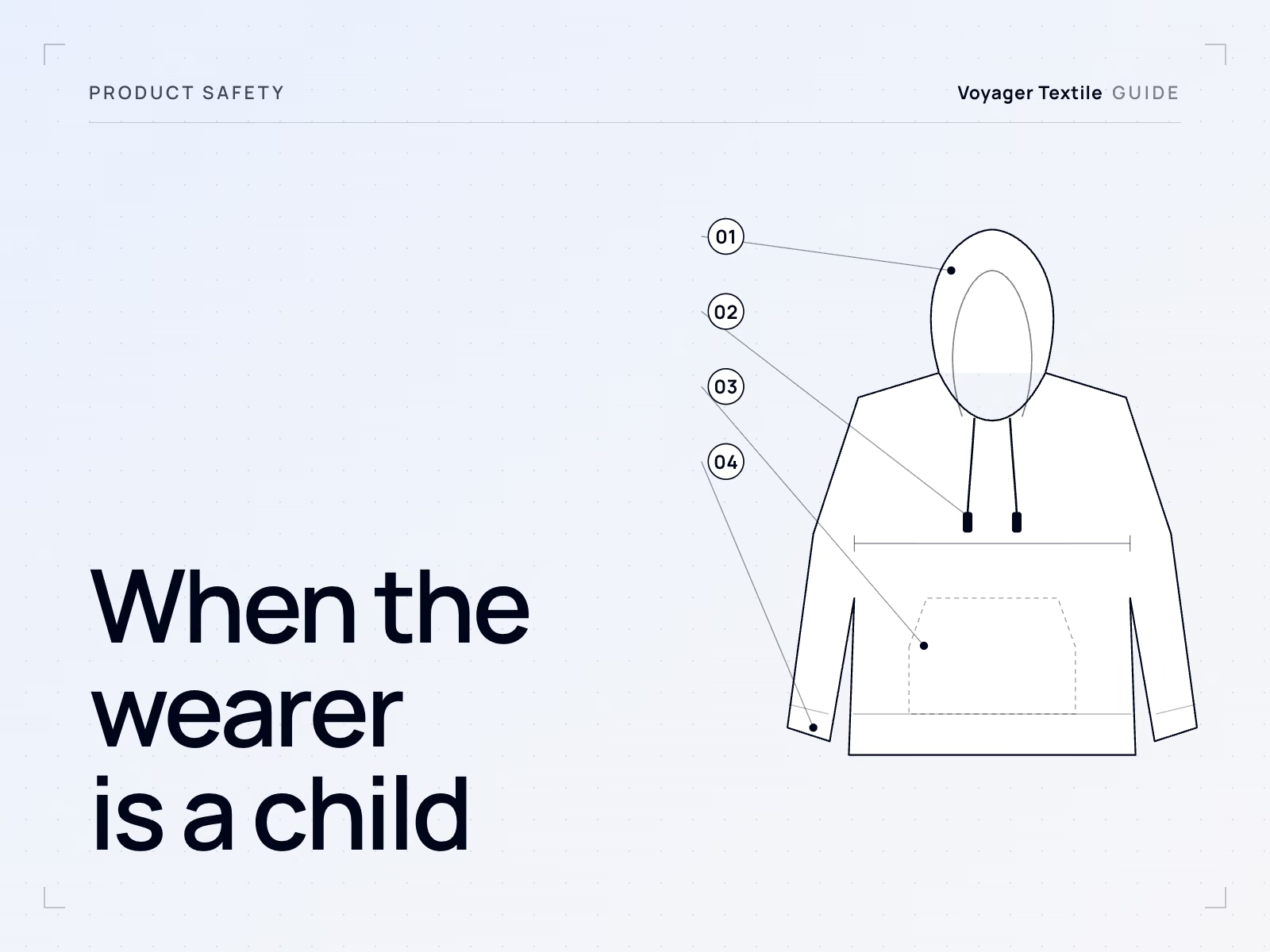
Requirements differ by where on the garment a cord sits. The standard addresses the hood and neck area, the chest and waist, the lower edge of a garment, the back and the sleeves separately, because the hazard each creates is different.
The practical consequence is one designers often miss: the same cord configuration can be treated quite differently depending on where it is. A design decision that is unremarkable at a hem is a different question at a neckline, and moving a feature during development is not a neutral change.
The type of cord
The standard works with defined terms rather than the everyday word string, and the distinctions carry consequences. A functional drawstring that adjusts a garment, a cord or tab used to fasten it, a fixed loop and a purely decorative cord are different things, and a design brief that says cord without saying which has not specified anything.
How it is terminated
What happens at the end of a cord is part of the configuration, not a detail. Free ends, knots, toggles, stoppers, bows and loops all change what the feature is, and the presence of a toggle is a design decision with consequences rather than a trim choice made at the last minute.
Designing around it, not against it
The productive way to use the standard is as a design input at the start rather than a hurdle at the end. Several ordinary construction choices achieve the same functional result a cord was there for.
- Elasticated construction in a hood, waist or hem, where the adjustment was the point rather than the cord.
- Internal or enclosed systems, where an adjustment mechanism does not present free ends.
- Tabs and fastenings, including hook-and-loop and press fasteners, where the garment needs adjusting rather than drawing in.
- Sizing that fits without adjustment, which is often the honest answer on a children's garment and is worth considering before the cord is designed in.
This is not a route around the requirements, and it should not be treated as one. It is the ordinary observation that a cord is a means to an end, and that on children's garments the end is frequently achievable another way with less to assess.
The mistakes that recur
These come up repeatedly in development, and every one of them is cheaper to catch in a design review than in a size set.
- Grading an adult design down and treating the cord as a dimension that scales with the pattern.
- Moving a feature during fitting, a cord repositioned for appearance is a change to what was assessed.
- Adding a toggle late, often for aesthetics, after the configuration was decided.
- Extending the size range downward into a younger group after approval, without revisiting the design.
- Substituting the cord for a visually identical one from another supplier, changing its construction.
- Treating a decorative bow or tie as not a cord, on the basis that it is not functional.
- Assuming the standard covers the whole garment, and stopping the safety work once cords are handled.
Evidence, specification and change control
Because there is no certificate, what exists is a record. What that record contains depends on the programme, and the useful question is what will demonstrate that the design meets the specification and that production matched the design.
What a specification should carry
Product-development readiness rather than a legal completeness test.
- The intended age range, in the terms the standard uses.
- Whether the garment carries cords, drawstrings, ties, loops or bows, and precisely where.
- The cord type for each, using the standard's distinctions rather than the word cord.
- How each is terminated, including any toggle, stopper or knot.
- The trim reference for each safety-relevant component, specified exactly rather than generically.
- The standard applied, with its edition.
- What evidence is required, at which stage, and who produces it.
- How the feature will be verified in production.
Where those items belong is the technical package and the bill of materials, see what a factory actually needs, and the risk analysis behind them belongs in the product's safety documentation, covered in product safety documentation.
And any change to a cord, a toggle, a position, a supplier or the age range means the existing assessment is reviewed rather than assumed to carry over. Not every change matters; the point is that somebody looks.
Questions buyers ask
What is EN 14682?
EN 14682:2014 is the European standard on the safety of children's clothing in relation to cords and drawstrings, addressing accidental strangulation and entrapment. It is listed in Commission Implementing Decision (EU) 2026/901 of 17 April 2026 among the European standards supporting the general product safety framework, and it is the only children's clothing standard in that list.
Which garments does EN 14682 apply to?
Children's clothing up to the age of 14 years, with disguise costumes and ski apparel explicitly within scope. It explicitly excludes child use and child care articles, footwear, hats, gloves and scarves. Those exclusions are from this standard rather than from safety assessment generally, since an excluded product still has to be safe under the general framework.
Are drawstrings banned on children's clothing?
No. The standard does not impose one blanket rule for every garment and age. What applies depends on the age group the garment is intended for, the area of the garment the cord sits in, the type of cord, and how it is terminated. Those four things are assessed together, which is why no single statement about drawstrings is correct.
Is a shorter cord automatically acceptable?
No. Length is one factor among several. Where the cord sits, what kind of cord it is and how it ends all form part of the configuration, so a short cord in the wrong position with the wrong termination is not resolved by being short. Whether a cord is elastic does not by itself settle it either.
Does the standard treat all garment areas the same way?
No, and this is a point designers often miss. Requirements differ between the hood and neck area, the chest and waist, the lower edge, the back and the sleeves, because the hazard each creates is different. The same cord configuration can therefore be treated quite differently depending on where it is placed.
Can I get an EN 14682 certificate?
There is no certificate scheme attached to the standard, so EN 14682 certified describes nothing. What can exist is evidence: a documented design assessment, a measurement record against the specification, an inspection result, or a test report, depending on what the programme requires. Ask for the specific evidence rather than for a certificate.
Does meeting EN 14682 mean the garment is safe?
No. The standard addresses cords and drawstrings and the strangulation and entrapment risks they create. Detachable components, attachment strength, chemical requirements and any product-specific rules are separate questions, assessed separately. A cord-compliant garment can still have other issues.
What happens if we change the cord or extend the size range?
The existing assessment should be reviewed rather than assumed to carry over. Substituting a visually identical cord from another supplier, adding a toggle late, repositioning a feature during fitting, or extending the range downward into a younger age group can each change what applies. Not every change matters, but somebody has to look.
Bring the cord decisions to the design review
Cord type, position and termination on a children's garment are design decisions, and they are far cheaper to settle before a pattern exists. Tell us the age range and where you want adjustment, and we will raise the questions before sampling rather than after.
Discuss a specification