Specification, sampling and quality
Garment Washing and Finishing: What Apparel Buyers Need to Specify
If a garment is washed or dyed after it is sewn, that process is part of the product, not a cosmetic step at the end. It changes dimensions, colour, surface and hand, so a specification that does not say which processing state it applies to cannot be checked, and a sample that never went through the process may not represent what will arrive.
Contents
- Finishing is not one process
- Fabric finishing and garment finishing are different stages
- What garment washing actually covers
- The same wash name does not guarantee the same result
- Two fabrics with the same composition and weight can wash differently
- Measurements: which state is being specified?
- An unwashed sample may be the wrong reference
- "Vintage wash" is not a specification
- Effect or defect?
- Checking the product after finishing
- Repeat orders, new lots and changes
- Questions buyers ask
A washed garment is not a finished garment that was then washed. It is a garment that was only finished by being washed. Everything a buyer normally judges, how it measures, what shade it is, how it feels, how the seams look, is decided in that process, not before it. Which means the version that left the sewing line is not the product, and specifying against it produces arguments nobody can win.
Finishing is not one process
Cotton Incorporated's learning material defines finishing broadly, as any process other than preparation or colouring that gives a fibre, yarn, fabric or garment a desired characteristic. That definition covers several things that happen at different points in production, to different objects, for different reasons, and they are often compressed into one word in specifications.
| Process family | Applied to what, when | Primarily changes | Common misconception |
|---|---|---|---|
| Fabric finishing | Cloth at the mill, before cutting | Dimensional stability, surface, hand | That it is interchangeable with a garment wash |
| Garment washing and wet finishing | The sewn garment | Appearance, surface, hand, dimensions | That it is a cosmetic step added at the end |
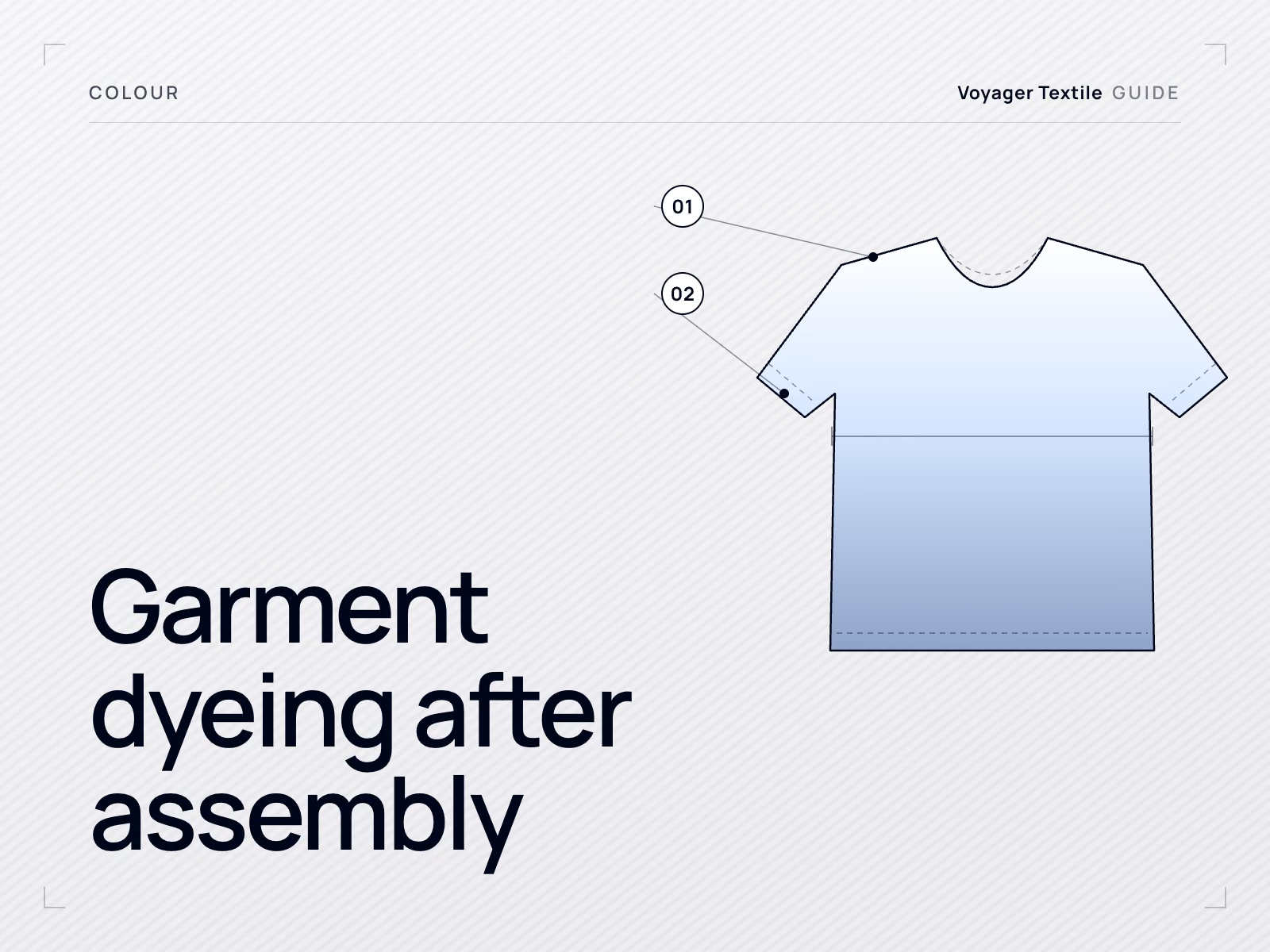
| Garment dyeing | The sewn garment | Colour, and everything the colour touches | That only the body fabric is affected |
| Softening | Usually the last wet step, on either | Hand only | That a soft hand implies a performance property |
| Care laundering | By the consumer, after purchase | Nothing the factory controls | That it is the same event as a garment wash |
Where each family sits in the sequence
Two stages often confused are the first and the third. Both involve water, heat and mechanical action; one happens to cloth at the mill and one happens to a finished garment.
Fabric finishing and garment finishing are different stages
This is a boundary that causes confusion, and it is worth being precise about. At the mill, cloth is stabilised before it is cut. Cotton Incorporated names relaxation drying and compaction as the methods used for this: relaxation drying lets the structure deswell under agitation with no tension applied, and compaction is a dry mechanical effect that forces the structure to compact on itself. Both reduce how much shrinkage is left in the cloth. Both happen before anyone cuts a panel.
The site covers that stage elsewhere, single jersey explains compacting and why an uncompacted jersey carries more residual shrinkage, and twisting and spirality explains why it cannot be applied retrospectively. What matters here is only that it is a different stage from a garment wash, and a specification that says "washed" without saying which one has said very little.
One more overlap catches people out. Enzyme treatment can be carried out on fabric or on garments, Cotton Incorporated states this explicitly. So a fabric described as "enzyme washed" or biopolished has been treated at the mill, and a garment described the same way has been through a drum after sewing. Same phrase, different stage, different consequences for measurements. When a tech pack says enzyme washed, it is worth establishing which one is meant.
What garment washing actually covers
Two overlapping ideas sit under the phrase. Garment washing in the narrow sense means cleaning impurities or removing processing aids from the made-up garment, but in practice it also covers bleaching, enzyme treatments, discharge processes and overdyeing. Garment wet finishing means using abrasive agents or chemistry to alter appearance: removing colour, producing contrast, or softening the surface.
In other words, a garment wash can be almost nothing, a clean and a softener, or it can be the step that creates the entire visual character of the product. The word alone does not tell you which, and the difference matters enormously to what you need to approve.
Enzyme washing
"Enzyme" is a family, not a process. Cotton Incorporated lists several used in textile wet processing: amylase hydrolyses starch and is used for desizing, cellulase acts on cellulose, protease on proteins, catalase on hydrogen peroxide, and laccase decolourises indigo. They do entirely different jobs. A garment can meet an amylase in one step and a cellulase in another, and only the second is what the trade usually means by an enzyme wash.
Cellulase is used for two distinguishable objectives. One is a faded, worn-down appearance. The other is removing surface cotton fibres to leave a smoother, cleaner surface, an effect Cotton Incorporated notes remains visible even after repeated home laundering, and the same effect the mill achieves at fabric stage under the name biopolishing. It matters to pilling behaviour, which is why the two objectives are worth telling apart when you specify one.
Stone washing
Stone washing is mechanical. Abrasive stones are tumbled with the garments to accelerate and intensify the washed effect. Pumice and volcanic rock are the most commonly used media, but they are the usual medium rather than the definition, the effect is abrasion, and it can be produced other ways.
Two practical consequences. The stones abrade the machine as well as the garments, so a drum used for stone washing carries a history that makes it unsuitable for delicate work. And the stones break down as they are used, which gradually reduces the severity of the effect: a consumable is a process variable.
Softening
Softener application is a discrete step, and in published wash procedures it comes after the effect-producing steps and before drying. It changes hand. That is all it is documented to do here.
Two cautions. A soft hand is not a performance property, it does not imply moisture management, durability, easy care or antimicrobial behaviour, and none of those should be inferred or claimed from it. See performance claims for what does need substantiating. And softeners and surface treatments can move colourfastness results in either direction, which is covered in colourfastness; a fastness result from before the softening step is not a result for the finished product.
The same wash name does not guarantee the same result
This is a point likely to cost money, and it is well documented. For cellulase processing alone, the published list of factors affecting the outcome includes equipment type, equipment design, machine speed, load size, liquor ratio, process time, enzyme type and amount, temperature, pH, auxiliary chemicals and any pre-treatment. Mechanical action is stated to vary from machine to machine depending on type and design.
There is also a quieter variable: garments abrade each other. Cotton Incorporated notes that mechanical action in these machines, including garment-to-garment abrasion, is part of what produces surface fibre removal, colour washdown and softness. What else is in the drum, and how full it is, is part of the process.
So the same instruction, run on different equipment or at a different load, can give a different garment. Which means a wash name is a label for an intended result, not a guarantee of one, and repeatability comes from holding the material, the process and an approved reference together, not from the name alone.
Three inputs, one result
A named wash is one of three things that determine the outcome. Hold only the name and the result can move without anyone changing anything they think of as the process.
Two fabrics with the same composition and weight can wash differently
"100% cotton, same GSM" is not a prediction of washed behaviour, and this is not a hedge, the mechanism is documented. Cellulase activity is affected by the fabric's dye system: vat dyes generally do not inhibit it, direct dyes and reactive dyes do, and pigments bound with film-forming acrylics block the enzyme's access to the fibre altogether. It is also affected by earlier finishing: wrinkle-resistance finishes reduce cellulase effectiveness by limiting access to the internal fibre structure.
Construction matters too. In pigment garment dyeing, the substrate is described as critical to the look, with textured surfaces such as twills and single-knit piqués chosen deliberately because they take the effect better.
So two cloths matching on composition and GSM can differ in yarn, structure, dye class and prior finish, and respond differently to an identical process. If the fabric changes, the washed result is an open question until it is seen, which is the same logic as incoming fabric inspection, applied one stage further downstream.
Measurements: which state is being specified?
This is the section to read twice. Cotton Incorporated's shrinkage guidance states the principle without qualification: whenever a cotton knit fabric is manipulated in processing, its dimensions change. Processing shrinkage is defined as the dimensional change a process adds to or removes from the fabric, and the definition explicitly includes steps carried out in the apparel manufacturing operation, not only at the mill.
A post-sewing wet process therefore changes dimensions as a matter of physics. It is not a fault, it is not evidence of a bad supplier, and it is planned for. The failure mode is not the change; it is a measurement table that does not say which state it governs.
Four states, four different questions
Each of these is a legitimate measurement. They answer different questions, and they are not interchangeable.
Note what this does not say. It does not say every garment must be measured only after washing. Process-control measurements taken before the wash are genuinely useful to a factory, and some programmes reasonably use both: one to confirm the garment was made to pattern, one to confirm the product meets specification. What is not defensible is a single table with no state named, because then both parties can measure correctly and still disagree, which is the whole subject of why measurements change after washing.
An unwashed sample may be the wrong reference
If bulk garments receive a wash or dye process that the approval sample did not, the sample does not represent the product. Not approximately, in the attributes that matter most, it represents a different object: different dimensions, different shade, different surface, different hand, and often visibly different seam appearance.
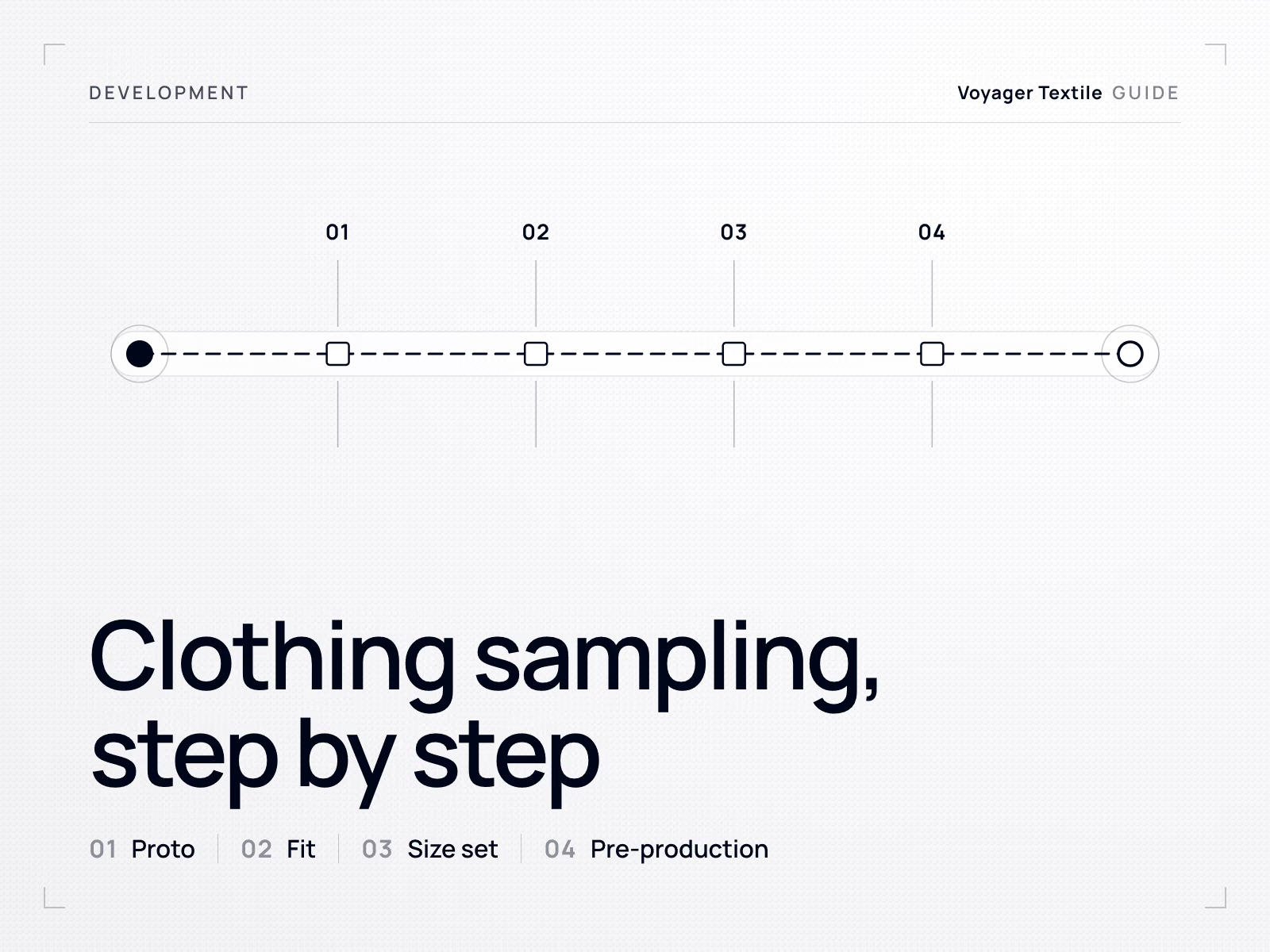
So where a post-sewing process materially defines the product, the approved reference needs to be in that final state. This is not an argument for adding sample stages to every programme, and it is not a claim that unwashed samples have no use, an unwashed fit sample can settle pattern questions perfectly well. It is a narrower point: the thing you sign off as the standard should be in the state the goods will arrive in. How that fits into the sampling sequence is covered in the sampling process, and the general case of bulk diverging from an approved sample in bulk differs from sample.
"Vintage wash" is not a specification
Vintage. Washed look. Broken in. Premium wash. Faded. Peached. These are useful words for describing an intention and useless as acceptance criteria, because two people reading them will picture different garments and neither can prove the other wrong at inspection.
The fix is not to ban the language, it communicates the idea efficiently, but to attach something checkable to it. In practice that means an approved physical reference, a defined process identification, and measurable criteria wherever a measurable criterion exists.
What a washed or finished product needs defined
Not a mandatory template, and not every line applies to every product. It is the set of questions that, left unanswered, produce the disputes this guide describes.
- Which process the product receives, identified clearly enough that both sides mean the same thing
- The approved appearance, held as a physical reference where the finish is visual
- The measurement state the specification governs, stated explicitly
- The colour reference or standard, and whether it applies before or after the finish
- Which components go through the process, and which are attached afterwards
- The attributes to be checked once finishing is complete, and at which stage
- Whether the process happens in the garment factory or elsewhere, and what happens if that changes
Effect or defect?
A washed product is deliberately irregular. Fading, contrast, surface breakdown and unevenness are frequently the point. So the usual inspection instinct, variation means fault, is wrong here, and the only thing that can settle it is the approved standard. Without one, every inspection becomes a negotiation about taste.
The corollary matters just as much: an approved effect does not make unlimited variation acceptable. Distressing is intentional; damage is not. The standard defines where the boundary sits, and that is a decision to make before bulk rather than during inspection.
| What is observed | Possible relationship to the process | Where it is covered |
|---|---|---|
| Measurements outside the chart | Dimensional change during wet processing, or a chart with no stated state | Measurement change after washing |
| Shade varies between pieces | Assembled-garment processing makes shade a property of the whole garment and its load | Dye lot and shade variation |
| Side seams have rotated | Wet processing releases residual torque the dry garment was holding | Twisting and spirality |
| Seams pucker after finishing | Fabric and seam components respond differently to the same process | Seam puckering |
| Ribs, collars or cuffs sit differently | Different construction, fibre and elastane content react differently to the same bath | Rib, collar and cuff shape loss |
| Excessive surface fuzz, or pilling | Surface fibre raised or removed depending on process and material | Fabric pilling |
| Colour rubs off, or is lighter than approved | Colour removal is often the intended effect; fastness is a separate, testable property | Colourfastness |
| Bulk does not match the approved sample | Material lot, load, equipment or a sample that was never in the final state | Bulk differs from sample |
Checking the product after finishing
The general principle is simple and frequently broken: assess the product at the stage that creates it. An inspection carried out before the process that determines appearance, shade and dimensions has inspected something else.
- Measurements, against a chart that names the state being checked
- Colour and shade, against the agreed reference, and between pieces as well as against the standard
- Visual finish, against the approved appearance standard rather than against a preference
- Seam appearance, since seams are where the fabric and the thread respond to the process differently
- Trim condition, hardware, buttons, zips and labels that went through the process with the garment, which is why component approval has to consider the processed state
- Damage as distinct from intended effect, judged against the standard
- Hand, against the reference where the finish was specified for hand
- Legibility of labels, if labels were present during processing
Where and when this inspection happens is a programme decision, not a universal method. What is not optional is that somebody looks at the finished product before it is packed, and knows what they are comparing it to. See quality control for the inspection framework.
Repeat orders, new lots and changes
For a finished product, carrying "enzyme wash" forward on a repeat order is usually not enough continuity. The result depends on the material as well as the process, and the material is exactly what changes between orders. What actually needs to carry forward is the approved physical result, the colour standard, the dimensional result and the identification of the process, with the process knowledge itself remaining with whoever holds it.
A new fabric lot is a reasonable trigger to look again, particularly where the finish is aggressive or the appearance is the product. So is a change of dye system or prior finish on the cloth, for the reasons above. None of this implies a fixed reapproval interval, there isn't one, and inventing one would be worse than judging each change on what actually changed. Reorder consistency covers the general discipline.
Two smaller boundaries worth stating. Wet processing involves water and chemistry, which brings it within scope of chemical compliance, but that is its own subject and this guide does not attempt it. And where a product is finished after sewing, finishing is a distinct milestone between sewing and final inspection, which belongs on the time-and-action calendar if the product has one. Not every garment does.
Questions buyers ask
What is garment washing?
An industrial process performed on the assembled garment after sewing, before shipment. In its narrowest sense it means cleaning impurities or removing processing aids, but in practice it covers a wide family of wet treatments that change appearance, surface, hand, colour and dimensions, including enzyme and stone treatments, bleaching, discharge and softening.
Why are garments washed after sewing?
Because some product characteristics can only be produced on the made-up garment. A softer hand, a worn or faded appearance, seam and edge effects that follow the garment's construction, and a relaxed dimensional state are all outcomes of processing the assembled object rather than the cloth.
Is garment washing the same as garment dyeing?
No. A garment can be washed without being dyed, and a garment-dyed product is normally afterwashed and finished as well. Washing alters appearance, surface, hand and dimensions; garment dyeing applies colour to the assembled garment, which brings the thread, ribs, trims and labels into scope. See garment dyeing.
What is garment wet processing?
The umbrella term for wet treatments applied to the sewn garment, covering both washing and wet finishing. Published technical guidance treats preparation, dyeing, afterwashing and finishing as separate controlled areas within it rather than as one operation.
What is enzyme washing?
Treatment using enzymes, most commonly cellulase, which acts on cellulose. Depending on how it is run it produces a faded, washed-down appearance, or removes surface cotton fibres to leave a smoother, cleaner surface. "Enzyme" alone does not identify the process, amylase, protease, catalase and laccase are all used in textile wet processing and do different jobs.
What is stone washing?
A mechanical treatment in which abrasive stones are tumbled with the garments to produce abrasion, fading and a softer hand. Pumice is the most common medium but the effect is defined by abrasion rather than by any one material.
Are stone washing and enzyme washing the same?
No. They are different mechanisms that can produce similar-looking results, and they are often combined. Cellulase can achieve a washdown appearance without stones or with fewer of them, but the two are not interchangeable terms and they have different effects on surface, strength and hand.
What does softening do?
It changes hand. That is what it is documented to do. A soft hand does not imply moisture management, durability, easy care or any other performance property, and softeners can also affect colourfastness results, so a fastness test from before softening is not a result for the finished garment.
Is sanforising the same as garment washing?
No. Sanforising is controlled compressive shrinkage applied to fabric at the mill, before cutting, and Sanfor and Sanforized are registered trademarks operated as a licensing system with a required test method, not generic process names. Garment washing is performed on the assembled garment. They are different stages and different processes.
Is compaction the same as garment washing?
No. Compaction is a dry mechanical fabric-finishing process that forces the fabric structure to compact on itself, reducing residual shrinkage before the cloth is cut. It happens at the mill, on cloth, not on garments.
Why can garments change size after garment washing?
Because dimensional change is what processing does. Published shrinkage guidance states that whenever a cotton knit fabric is manipulated in processing its dimensions change, and defines processing shrinkage to include steps in the apparel manufacturing operation. The change is expected and planned for; the problem is a measurement chart that does not say which state it applies to.
Should a washed garment be measured before or after washing?
It depends what the specification is controlling. Where the intended product includes a post-sewing wash or dye process, the acceptance measurements normally need to correspond to that final state, because that is what the customer receives. Pre-process measurements remain useful as a manufacturing control, and some programmes use both. What matters is that the chart says which.
If two fabrics have the same composition and GSM, will they wash the same?
No assumption can be made from composition and weight. Yarn, construction, dye system and earlier finishing all change how a fabric responds, reactive and direct dyes inhibit cellulase activity while vat dyes generally do not, pigments bound with acrylic binders block access to the fibre, and wrinkle-resistance finishes reduce enzyme effectiveness. Two cloths matching on the label can behave differently.
Does a garment wash mean the garment is pre-shrunk?
No. A wash changes dimensions during manufacturing; it does not guarantee that no further change will occur in consumer laundering. Those are separate events, established in different ways. Nothing about a garment having been washed is by itself evidence of dimensional stability in use.
Does "vintage wash" define a reproducible finish?
Not by itself. It describes an aesthetic intention rather than an acceptance criterion, and two people will picture different garments. It needs an approved physical reference and a clearly identified process alongside it before it can be produced consistently or inspected fairly.
Should the wash be defined in the tech pack?
The intended result should be, along with the measurement state it governs and the approved reference. The finisher's internal recipe usually should not be, and asking for it is normally the wrong request, process know-how belongs to whoever developed it unless there is a specific agreement otherwise.
Why can bulk look different from the approved washed sample?
Several contributors are possible and they should not be assumed without evidence: a different material lot, a different colour, load size, the equipment used, garment construction, the trims present, and the processing conditions on the day. Establishing which one applies is the point of having an approved reference in the first place.
What should be checked once garment finishing is complete?
Measurements against a chart that names its state, colour and shade against the agreed reference, visual finish against the approved appearance, seam appearance, trim and hardware condition, damage as distinct from intended effect, hand where hand was specified, and label legibility. The method belongs to the programme; the principle is that the product is judged at the stage that creates it.
Specifying a washed or finished product?
Send the intended result, the reference you are working from and the measurement state you want to hold, and we will tell you what we can produce and what would need to be established first.
Send an enquiry