Production problem
Why do necklines, collars and cuffs lose their shape?
Three complaints that look unrelated share the same underlying question: can the knitted component return to its original dimension after being stretched. Recovery comes from the rib or collar itself, not from the sewing, and it is undermined by the ratio the component is attached at, by missing stabilisation, and by heat in laundering.
What you are seeing
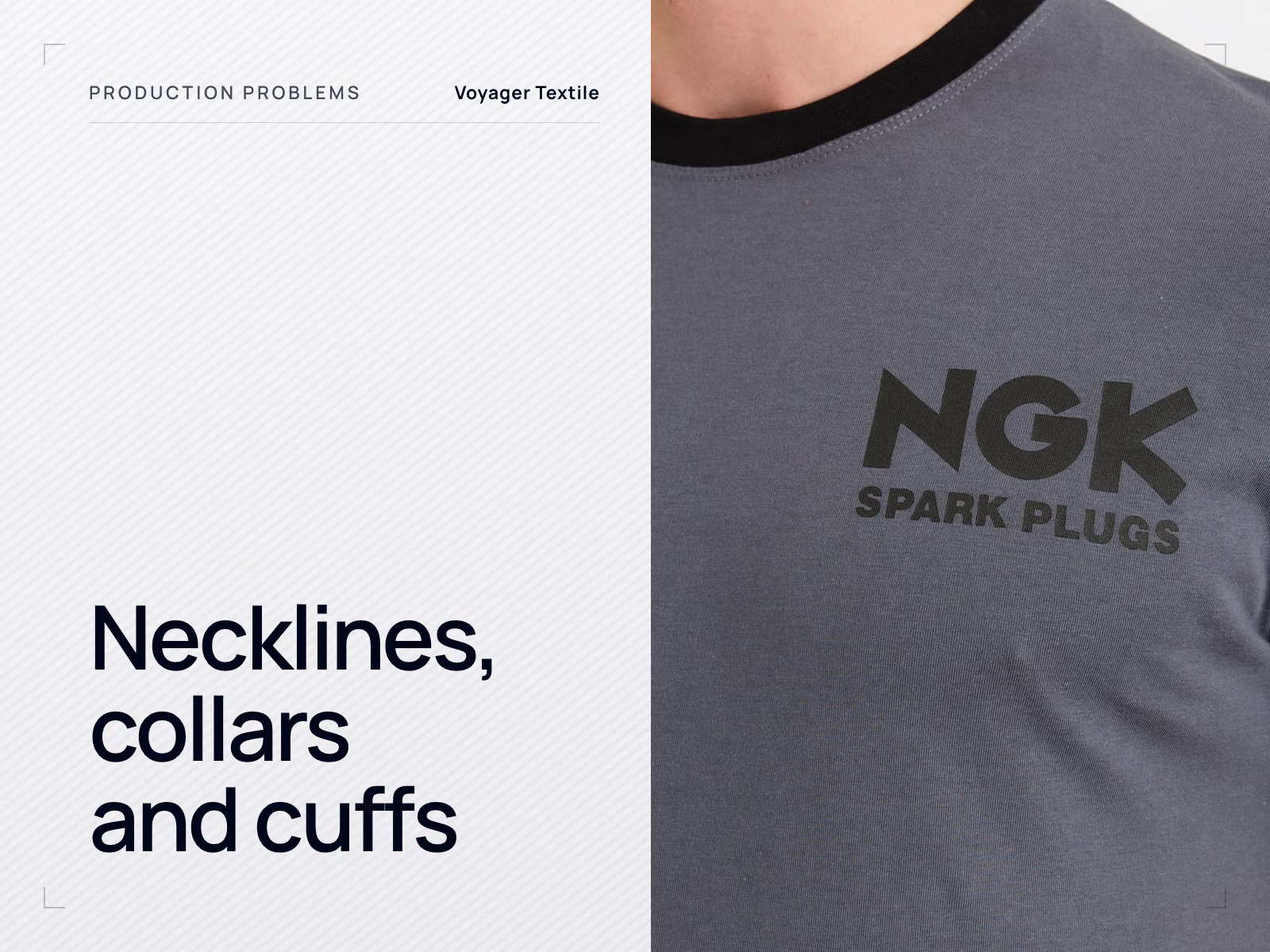
A neckline that no longer sits flat and has grown wider, a polo collar that curls at the edge or will not stand, or cuffs and waistbands that no longer grip after a few weeks. In each case the garment looked correct when it was new.
Contents
Rib is the part of a jersey garment that does mechanical work. It has to stretch enough for a head or a hand to pass through and then return to a dimension that grips. Everything on this page is about that return, which the industry calls recovery, and about the three ways it is lost.
Where recovery comes from
Recovery is a property of the component, decided before the garment exists, and it starts with the rib specification. A 1x1 or 2x2 rib recovers because of its structure: the alternating wales pull the fabric back together. Adding a small percentage of elastane raises recovery further and holds it for longer. Yarn quality and knitting tightness both contribute.
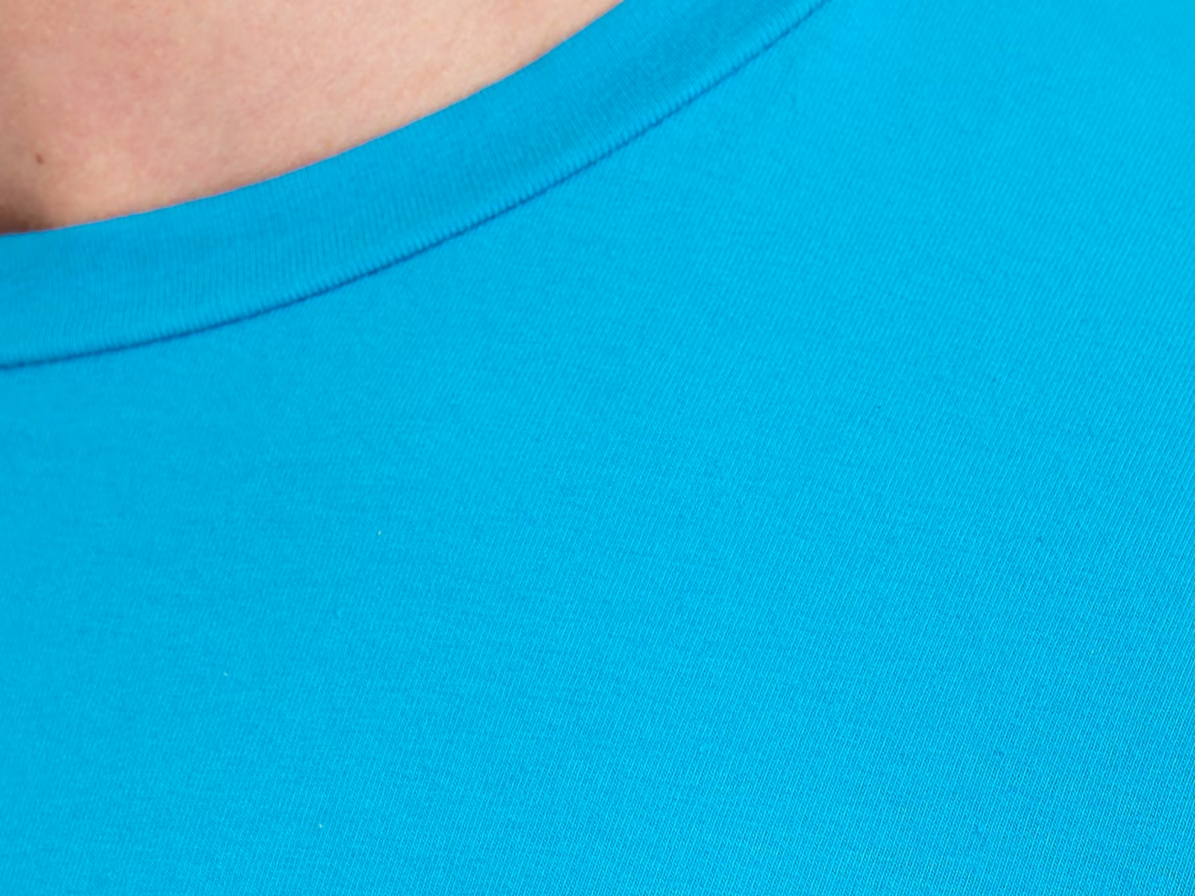
This has an uncomfortable consequence. If a rib was specified only as matching rib and the mill supplied a soft, elastane-free quality, no amount of careful sewing will make the cuffs grip. The specification is where recovery is won.
Three failure patterns
| What you see | Most likely cause | Where to look first |
|---|---|---|
| Neckline wavy or fluted from new | Rib attached with too little tension, so there is more rib than neckline | The attachment ratio, and the sample it was approved at |
| Neckline stretched and wide after wear | Rib with poor recovery, or a missing shoulder tape allowing the shoulder seam to extend | Rib specification and whether the shoulder seam is taped |
| Neckline puckered and tight | Rib attached with too much tension | The attachment ratio again, in the other direction |
| Polo collar curling at the edge | Collar knitting and finishing, since a flat-knitted collar is a separate component with its own edge treatment | The collar supplier and the approved collar sample, not the sewing |
| Polo collar will not stand | Collar quality or a missing stand, and sometimes a neckline that has stretched under it | Collar construction and whether a stand was specified |
| Cuffs and waistband slack after weeks | Rib elastane content and quality, or degradation from hot washing and tumble drying | Rib specification and the laundering the product actually receives |
Attachment ratio, a setting rarely written down
A neck rib is cut shorter than the opening it is sewn into, and it is stretched as it is attached. That ratio is what makes the neckline sit flat against the body rather than standing away from it. Too little tension and the rib is longer than the neckline needs, so it waves. Too much and the neckline is drawn in, puckered and uncomfortable to pull on.
The ratio is rarely stated in a tech pack, which means it is set by the factory and locked in by the approved sample. That is workable, provided the sample is the reference for bulk and the neck opening measurement is on the chart with a tolerance. Where a neckline has to behave identically across repeat orders, ask for the ratio to be recorded with the specification so it survives a change of production team. Rib trims and neck finishing sets out how to write that down.
Shoulder taping
A narrow tape stitched into the shoulder seam stops it extending under load. Without it, the shoulder line stretches over time, the neckline widens with it, and the garment develops the dropped, gaping neck familiar from cheap jersey products. Taping costs very little and is one of the highest-value details in a T-shirt or sweatshirt specification.
Knitted collars behave differently from rib
A polo collar is normally flat-knitted as a finished piece with its own edge, produced to each size, and dyed separately from the body. Curl at the edge and loss of stand are properties of that component and its finishing, so they are addressed with the collar supplier rather than in the sewing room.
Two practical points follow. Approve the collar as a component, not just as part of a finished garment, and where the polo will be laundered industrially, wash-test the collar before bulk. A collar that looks correct new and curls after ten washes is a common polo complaint in uniform programmes. The construction context is in the polo shirt manufacturing process.
What laundering does to recovery
Elastane is sensitive to heat and to mechanical stress. High wash temperatures, hot tumble drying and industrial extraction all shorten the working life of an elastic component, which is why cuffs on garments in a commercial laundry lose grip faster than the same garments washed domestically. If a product will be laundered industrially, that belongs in the specification, and the rib should be chosen and tested for it rather than selected for hand-feel alone.
Testing it on the sample
- Stretch the neckline as if pulling the garment over a head, release it, and watch whether it returns. Do this several times rather than once.
- Do the same on a cuff, holding the stretch for a few seconds before releasing.
- Measure the neck opening before and after that test. A measurable increase is a recovery problem.
- Lay the collar flat and look at the edge for curl, then check whether the stand holds when the collar is folded.
- Wash the sample under the conditions the product will face, then repeat every step. This is the test that predicts month three.
Getting it right next time
Specify
- Rib structure, depth and elastane content, not simply matching rib
- Whether shoulder taping is required, and its width
- Neck opening measurement with a tolerance
- Collar construction, including whether a stand is required
- The laundering regime the garment must survive
- That the sample must be wash-tested before approval
Ask the factory to confirm
- The attachment ratio used on the approved sample
- The rib supplier and quality actually used in bulk
- That collar and rib colour were approved against the approved body fabric
- That recovery was checked after washing, not only when new
- That the same rib specification will be used on reorders
Questions this raises
Why does a new T-shirt neckline wave?
Usually because the rib was attached with too little tension, so there is more rib length than the neckline needs. It is a construction setting rather than a material fault, and it is corrected by adjusting the attachment ratio and re-approving the sample.
Can a stretched neckline be repaired?
Not usefully. Once the rib has lost recovery or the shoulder seam has extended, the dimension does not come back. The remedies are all preventive: better rib specification, shoulder taping and a correct attachment ratio.
Is collar curl a sewing fault?
Usually not. A flat-knitted polo collar is a separate component with its own edge and finishing, so curl is normally a component quality issue to raise with the collar supply rather than with the sewing line.
Do heavier ribs recover better?
Not automatically. Recovery comes from structure and elastane content rather than weight. A deep, heavy rib with no elastane can perform worse than a lighter rib specified with it.
Specifying rib for a programme that has to last?
Tell us the garment, the rib behaviour you need and how the product will be laundered. We will propose a rib specification and wash-test the sample so recovery is proven before bulk rather than after it.
Discuss a rib specification