Quantities, cost and timing
How to Build and Run an Apparel Time-and-Action Calendar
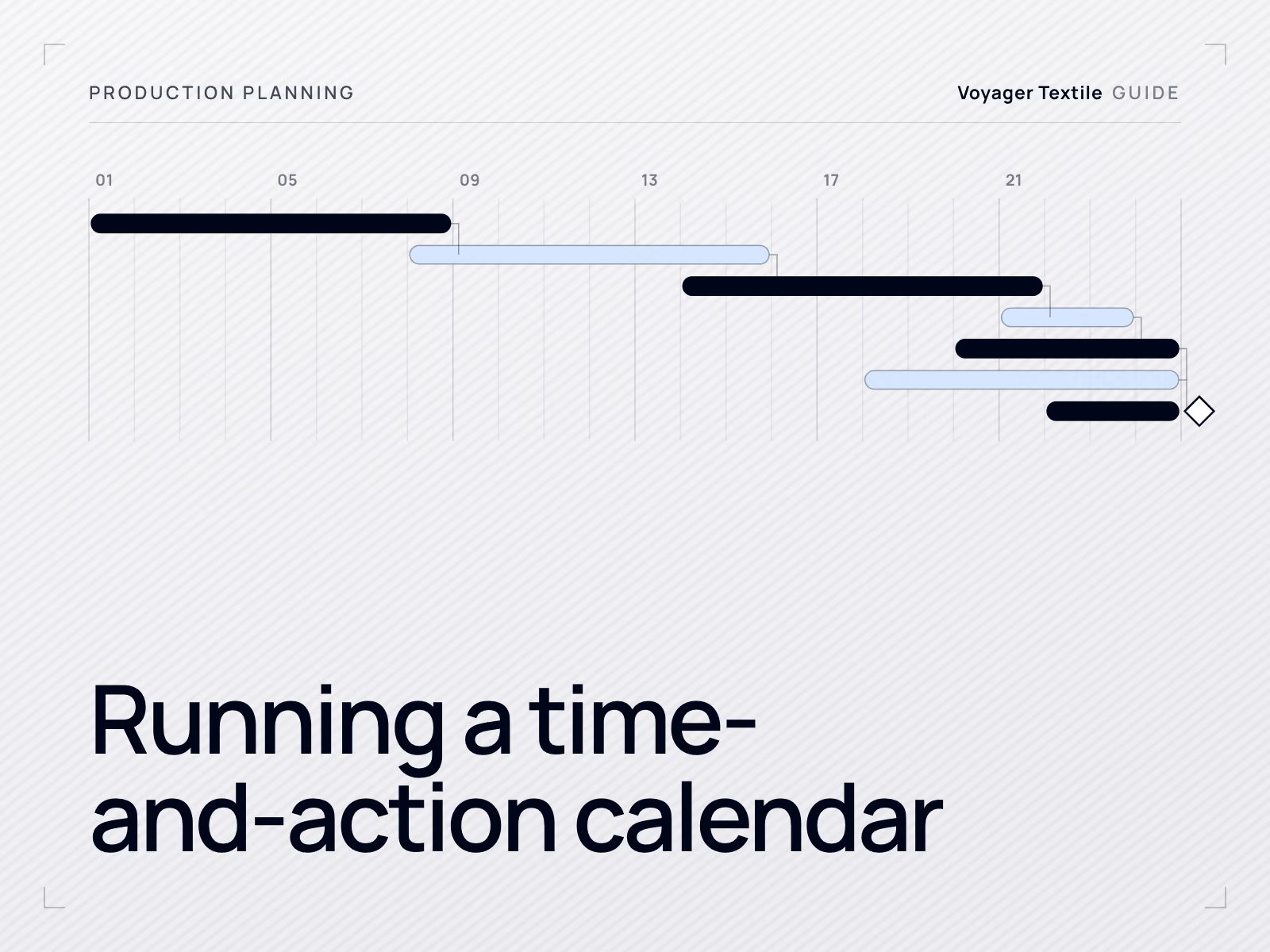
A time-and-action calendar turns a promised delivery date into dated milestones with owners and dependencies. Its value is not the list of dates but the ability to answer one question when something slips: does this actually move the shipment, or not?
Contents
- Lead time answers a different question
- A list of dates is not a critical path
- Build it backwards
- What each milestone actually means
- Buyer approvals are on the calendar
- Dependencies, parallel work and float
- One material, several styles
- When dates move
- When something changes
- Recovery, and what it is not
- Running it, rather than filing it
- What a calendar is not
- Questions buyers ask
Every delayed order was on schedule until it was not. Usually somebody had a calendar, everything on it was green, and the slip was visible weeks earlier to anyone reading it as a dependency chain rather than as a list of dates that had not gone red yet.
Lead time answers a different question
These two are constantly confused, and the difference is the reason this guide exists. Lead time is duration: how long a stage takes and what controls it. It answers *when must I start?* and it is answered once, at the beginning, in production lead times.
A time-and-action calendar is the live document. It converts the real order into dated milestones with owners and dependencies, and it answers a question that has to be re-answered every week: *are we still going to make it?* One is an estimate; the other is control.
A list of dates is not a critical path
A common failure is a calendar that records *what* should happen and *when*, and nothing else. That is a wish list. A calendar that can actually be managed carries more per row.
| Field | Why it earns its place |
|---|---|
| Milestone | Named as a specific event, not a phase |
| Owner | Who has to take the next action, which is more useful than a status of pending |
| Depends on | What must be complete before this can start or finish |
| Baseline date | What was originally planned or committed |
| Forecast date | What is now expected, on current information |
| Actual | What happened, kept separately from the forecast |
| Blocks | What downstream work waits on this, the field that turns a list into a path |
| Evidence | What confirms completion: an approval record, a booking, a receipt, an inspection result |
The blocks column is what makes the difference. Without it, every late milestone looks equally alarming and nobody can tell which one to act on. With it, the same calendar answers the question that matters at the moment something slips.
Build it backwards
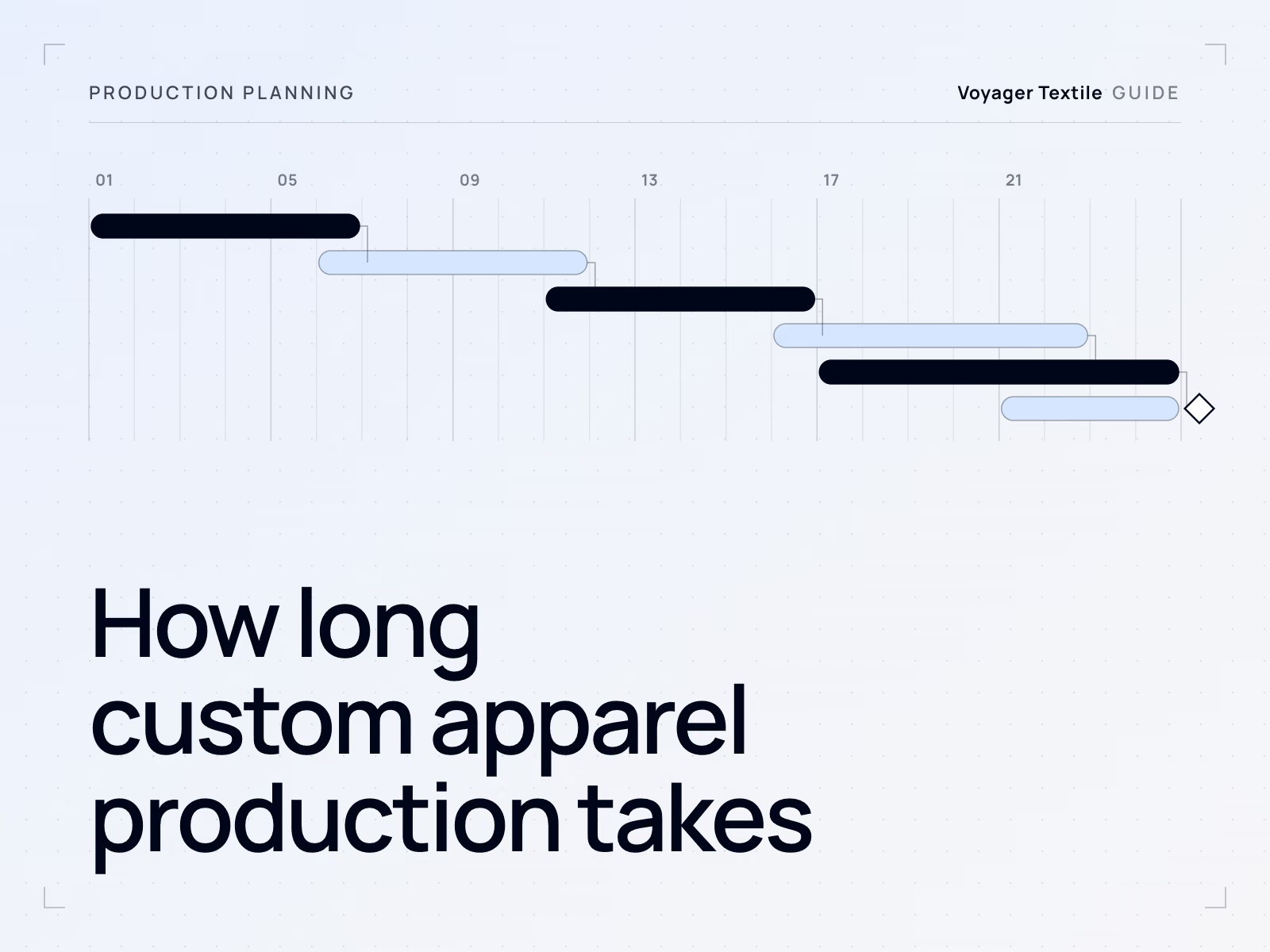
From the required date, working back
No durations here: how long each step takes belongs to the programme and the product.
Before working backwards, define what the end event actually is, and this is where many calendars start wrong. A delivery date and an ex-factory date are not the same thing, and between them sit collection, export formalities, transit, customs and last-mile delivery.
- Ex-factory, goods ready and available at the agreed factory milestone
- Cargo ready, after finishing, inspection, packing and documentation, which is not the same moment as production finishing
- Booked and collected, dependent on the transport mode and its cut-offs
- Departure, then arrival, then warehouse receipt
- The commercial date, a store launch, a campaign, an event, a uniform rollout
Where the backwards calculation lands on a start date that has already passed, the useful response is not to compress every stage by decree. It is to change something real, such as an available fabric instead of a developed one, a stock colour instead of a custom one, a phased delivery or a later launch. The stage durations that feed that calculation are in production lead times.
What each milestone actually means
This is where many calendars quietly lose their meaning. Two people can look at the same green row and believe different things, and neither finds out until goods are late.
| Milestone | What it should mean | The ambiguity |
|---|---|---|
| PO confirmed | The supplier has accepted the order as specified | Frequently read as production having started. It has not |
| Fabric booked | Whatever commercial act actually secures the material for this order | Enquiry, reservation and purchase commitment are three different things, and suppliers use the words differently |
| Colour approved | The bulk colour standard is settled and dyeing can be released | A lab dip approved in principle is not always the same as approval to dye bulk |
| Production started | A specific named event | Knitting, cutting or sewing? For a knitted programme and a woven one these are different points in the calendar |
| Production complete | Sewing finished | Read as ready to ship. Finishing, inspection, packing and documents may all still be ahead |
| Goods ready / cargo ready | Packed, documented and available for collection | Often reported when the last unit is sewn |
| Shipped | Departed | Booked, collected and departed are three events, not one |
Buyer approvals are on the calendar
Two lanes, one calendar
Sequence only. The spacing means nothing, and no durations are shown.
A calendar that shows only what the factory must do, with buyer approvals appearing as unexplained gaps, will misattribute the delay. Approval milestones belong on it, with a date and an owner, for the simple reason that downstream work is waiting on them.
Milestones that commonly sit on each side
Often buyer-owned
- Order confirmation and any revision
- Artwork release in production-ready form
- Fit sample comments
- Colour and lab dip approval
- Packaging and labelling approval
- Final quantity and size split
- Nominated material or supplier instruction
Often supplier-owned
- Sample submission
- Material booking once authorised
- Cutting and production start
- Decoration and finishing
- Production completion
- Packing and documentation
- Cargo handover
A useful upgrade to a calendar is dating the approvals rather than recording them as awaiting. "Awaiting buyer approval" is a state; "comments required by this date to release bulk dyeing" is a milestone. The first invites drift; the second makes the cost of drift visible to the person who has to act.
Approval loops deserve the same honesty. A first submission may come back with comments and need resubmission, and a calendar that assumes first-time approval on everything is optimistic rather than planned. That does not mean scheduling a fixed number of rounds. There is no correct number, and assuming failure is as unhelpful as assuming perfection. It means the risk of a round being needed should be visible where it would hurt.
Dependencies, parallel work and float
A dependency means one activity cannot properly begin or finish until another has reached the state it needs. Some are genuinely hard: bulk dyeing waits on an approved colour standard, cutting waits on material that has been received and released, final packing waits on approved labels and cartons.
Plenty of other work runs in parallel, and a calendar that treats everything as sequential produces a start date that is needlessly early and a false sense of crisis whenever anything moves. Trim sourcing can often proceed while the main fabric is in approval; packaging development can run alongside fit review; shipping planning can run alongside production. What can overlap is specific to the product and the factory, and worth establishing rather than assuming in either direction.
Late, and late
The question is never how late a milestone is, but what it blocks.
The critical path is the chain of dependent activities whose delay moves the required end date, because there is not enough usable float to absorb the slip. It is not a fixed list of milestones. It changes as the order progresses, and an activity that had comfortable float in week two can be on the critical path in week six.
One material, several styles
Where the real critical path often is
Every other milestone on all three styles can read on time.
This is a case that often escapes a style-by-style calendar. Three styles sharing one custom fabric, one nominated trim, one print house or one custom packaging component do not have three independent critical paths. They have one, and it is upstream of all of them. The same structural point, applied to supply continuity rather than to a live order, is in supplier risk management.
It also answers the question of how granular a calendar should be. There is no rule about one calendar per style or per order; the useful level is wherever dependencies actually differ. Two colourways that share everything but the dye lot do not need separate calendars. Two colourways where one uses a custom shade and the other a stock one genuinely do, because their material milestones diverge.
When dates move
Dates move. The question is whether the calendar can still be trusted afterwards, and that depends entirely on whether the original one survived the edit.
| Date | What it records |
|---|---|
| Baseline | What was originally planned or committed, kept unchanged |
| Forecast | What is now expected, on current information: an estimate, not a promise |
| Revised commitment | A new agreed date, where a change was requested and agreed by both sides |
| Actual | What happened |
A calendar holding only the current date can show a supplier permanently on time, because every date was rewritten shortly before it was missed. Keeping the baseline is not about assigning fault later; it is what lets anybody reconstruct why the order ended where it did. The same discipline, applied to measuring delivery performance across orders, is in supplier performance management, and there the measurement basis is the original commitment, with a change requested and agreed becoming the new basis.
Recording *why* is worth as much as recording *what*. A date that moved because the buyer changed the quantity, because a nominated mill was late, because a lot failed inspection, or because a vessel was cancelled reflects one of four different situations that will look identical in six months unless somebody wrote a sentence at the time.
When something changes
Late changes are normal in apparel and are not automatically delays. Some fit inside existing float and cost nothing; some reopen milestones that were closed weeks ago. The calendar's job is to show which, rather than to treat every change as either free or catastrophic.
- Quantity can change the fabric requirement, the trim quantities, the production slot, packing and the transport plan.
- Size curve changes can alter material consumption and production planning even when the total quantity is unchanged.
- An added colourway can reopen lab dips, fabric booking, artwork and packaging depending on the product.
- Artwork changes can reopen screens, transfers, digitising or sublimation layouts, and the setup work behind them is not instant.
- Construction or pattern changes can reopen sampling, material and costing at once.
Recovery, and what it is not
When the critical path does slip, a recovery plan is a specific thing: what will be done, by whom, and what date it produces. "We will try to catch up" is not one, and neither is a revised date with no mechanism behind it.
- Resequencing work where dependencies genuinely allow it
- Moving something into parallel that was planned sequentially
- Additional capacity, where it exists and is realistic rather than promised
- Faster approval on the buyer's side, which is often the cheapest available time
- An alternative material or process, only where already approved
- A logistics adjustment, including a faster mode where the commercial case supports it
- A partial shipment, where the receiving side can actually use one
One further distinction, borrowed from the performance discipline and worth keeping sharp. Recovery protects this order. Corrective action prevents the next one. Expediting a rework so the shipment makes its vessel is recovery; changing the process that produced the defect is corrective action. They can and often should run at the same time, and catching up this order proves nothing about whether it will happen again.
Running it, rather than filing it
A calendar built at order placement and never touched again is a plan, not a control. What makes it useful is updating actuals, revising forecasts, and looking forward rather than only recording what already happened.
- Update frequency follows the calendar, not the diary. How close the next critical milestone is, whether something is already slipping, and how complex the programme is should decide it. There is no universally correct cadence, and this guide does not offer one.
- Track at the level where dependencies differ, not at every factory micro-step. A calendar with a hundred and fifty rows hides the critical path as effectively as one with four.
- Distinguish at risk from late. An at-risk milestone is still on time but the forecast says it will not stay that way, which is when intervention is cheap. A late one has already happened.
- Use blocked as a real status. It means work cannot proceed until a specific dependency resolves, which points at somebody rather than at a colour.
What a calendar is not
| Document | Owns | Not replaced by the calendar |
|---|---|---|
| Purchase order | What is being bought, how much, when, on what terms | The commercial commitment. A calendar plans against it; it does not create or change it |
| Tech pack and BOM | What the product is | The specification. A milestone called PP approved means nothing without the document it was approved against |
| Quality agreement or vendor manual | The operating rules between the parties | How changes and deviations are governed |
| Supplier scorecard | How the supplier performs across orders | Recurring analysis. This order's slip may become one data point in it later |
| Risk register | Structural dependencies that could interrupt supply | Continuity. A calendar shows this order's exposure, not the programme's |
And a calendar does not guarantee a date. It makes the commitments, the dependencies and the current forecast visible enough that both sides are arguing about the same facts, which is a genuinely different thing from certainty, and considerably more than many orders start with.
Questions buyers ask
What is a time-and-action calendar in apparel production?
A working document that turns an order into dated milestones, each with an owner, the dependencies it relies on, and the downstream work it blocks. It runs from order confirmation and material booking through development and approvals, production, inspection and packing, to cargo ready and shipment. Some teams call it a T&A, some a TNA, some just the production calendar.
Is a T&A calendar the same as lead time?
No, and the difference is the useful part. Lead time describes duration, how long a stage takes and what controls it, and answers when you must start. A time-and-action calendar converts the actual order into dated milestones with owners and dependencies, and answers whether you are still going to make it. One is an estimate made once; the other is a control updated continuously.
What is the critical path in apparel production?
The chain of dependent activities whose delay moves the required end date, because there is not enough usable float to absorb the slip. It is not a fixed list of milestones: it changes as an order progresses, and an activity with comfortable float early on can become critical later.
Does every late milestone delay the shipment?
No. A milestone can move without changing the final date if it has usable float, if work that does not depend on it continues in parallel, or if the time is recovered downstream. What matters is whether the delayed activity blocks a critical dependency. That is why a calendar needs a column showing what each milestone blocks, not just when it was due.
What is float in a production calendar?
How much an activity can move before it starts moving something downstream. It exists so that ordinary variation does not become a crisis. It is protection rather than spare time, and consuming it routinely, approving late because there is room, leaves nothing to absorb the problem that genuinely matters later.
Should a T&A be built backwards?
Usually, because the date that matters is the one at the end. Work back from the required delivery or launch date, through transport and clearance, cargo ready and booking, packing and inspection, production, material and approvals, to the point where the order and specification must be settled. The first step is defining what the end event actually is, since a delivery date and an ex-factory date are not the same thing.
What is the difference between a delivery date and an ex-factory date?
Ex-factory is the point at which goods are ready and available at the agreed factory milestone. Delivery is arrival at the buyer's destination. Between them sit collection, export formalities, transit, customs and last-mile delivery. A calendar that uses delivery date loosely for both will be wrong by however long that stretch takes.
Is production complete the same as cargo ready?
No, and reporting them as one is a common source of surprise. After sewing finishes there may still be finishing, inspection, any rework the inspection produces, packing and documentation. Cargo ready means packed, documented and available for collection, and shipped is a further step again, since booking, collection and departure are separate events.
What does production started mean?
It is too vague to be useful unless the event is defined. For one programme it may mean knitting, for another cutting, for another the first sewing line. A calendar should name the actual event it is tracking, because a status that means different things to the two parties reading it is worse than no status.
If buyer approval is late, is the supplier still responsible for the original date?
That depends on the commercial arrangement and is not something a guide can answer categorically. What the calendar should do is make the facts clear: the original baseline, when the approval was actually required to protect the plan, when it arrived, what it blocked, and what the resulting forecast is. Where both sides agree a revised ex-factory date, that becomes the current commitment while the original and the reason remain visible.
Should the original committed date be overwritten when the schedule changes?
No, if the calendar is meant to control anything. Keep four things separately: the baseline, the current forecast, any agreed revised commitment, and the actual. A calendar holding only the latest date can show a supplier permanently on time because every date was rewritten just before it was missed, and it can never explain afterwards why the order ended where it did.
Can production start before the pre-production sample is approved?
It happens, and it should be a deliberate decision rather than a scheduling technique. Starting bulk before approvals are complete converts a schedule problem into a quality and commercial one, and whoever carries that risk should have agreed to it knowingly, with a clear view of what is unapproved and what work is proceeding anyway. It is not offered here as a way to recover a date.
How do repeat orders differ in the calendar?
A genuine repeat of an approved product reuses development, approvals and often material planning, so the calendar is much shorter. But the previous calendar is history rather than a schedule: a change of material, colour, quantity, factory, decoration or packaging can reopen milestones that were closed, and a repeat treated as a copy-paste is how a shorter calendar becomes a late order.
How often should a T&A be updated?
There is no universally correct cadence and this guide does not offer one. What should drive it is how close the next critical milestone is, whether something is already slipping, and how complex the programme is. What matters more than frequency is that updates carry forecasts rather than only recording what already happened. A calendar that only looks backwards cannot warn anybody.
Does a T&A calendar replace the purchase order or the tech pack?
No. The purchase order owns what is being bought, in what quantity, when and on what terms. The tech pack and bill of materials own what the product is. The calendar owns when things happen, and it should reference those documents rather than restate their content. A milestone called PP approved is meaningless without the specification it was approved against.
Agree the calendar before the order, not after the first slip
How a programme's milestones are structured, which approvals are dated and who owns them is something to settle at quotation. We do not run a standard T&A format or promise milestone reporting as a service, but a buyer who arrives with the dependencies and approval owners already named gets a far more honest schedule than one who asks for a delivery date.
Discuss a programme