

How materials, trims and construction constrain a care instruction
Many care instructions are set by a component rather than by the main fabric. A lining that shrinks at a different rate, an elastic that does not like heat, a laminate that can separate, a trim that bleeds: each of these can be the reason a garment carries a more cautious instruction than its shell fabric needs.

Contents
This page works through what a garment is made of. What is applied to its surface is a separate question, covered in decoration and care instructions, and the decision framework both feed into is on the care hub.
Nothing below is a rule about what a given material requires. Materials vary between suppliers, and the same generic description covers products that behave differently. What follows is a list of what to look at and why it matters, which is what turns a test into a designed test rather than a hopeful one.
Fibre and blend
The main fibre sets the broad expectation and the blend sets the exceptions. A blend behaves like neither of its components on its own, and the component present in the smaller proportion is often the one that decides the instruction.
Two blend behaviours are worth understanding. Fibres take up dye differently, so a blend can be dyed in a way that leaves one component more vulnerable to colour loss or transfer than the other. And fibres respond to heat differently, so a blend can be dimensionally stable in one component and not in the other, which shows up as change that continues over several wash cycles rather than settling after the first. The commercial trade-offs of blending are covered in cotton and polyester blends.
Elastane and stretch
Elastane is present in small percentages and has an influence out of proportion to its share. It is highly sensitive to heat, and it often determines whether a garment still fits after twenty washes rather than after one.
The practical consequence is that a stretch garment tested for a single cycle has not really been tested. Leggings, waistbands, cuffs and fitted tops are all products where the interesting result appears later, and where a care instruction that ignores drying is only half an instruction. The materials themselves are described in performance polyester knits and rib knit.
Coatings, laminates and membranes
Technical outerwear is a case where a care instruction is unlikely to be about the face fabric. A softshell or a waterproof jacket is an assembly: face fabric, a membrane or coating, sometimes a backer, adhesives holding them together, and taped seams doing the same job at the joins.
Every one of those is a component with its own tolerance, and the ones that fail first are usually the ones holding the others together. Separation between layers, blistering, and tape lifting at a seam are all failures of adhesion rather than of fabric, and they are permanent.
| Element | What can change |
|---|---|
| Membrane or coating | Whether it stays bonded and whether its performance survives the treatment |
| Seam tape | Lifting, edge peeling, or loss of adhesion at a corner or an intersection |
| Adhesive laminate bond | Delamination or blistering, often first visible at a seam or a fold |
| Durable finish on the face | Whether the surface behaviour is unchanged after laundering |
| Trims set into the assembly | Distortion, and whether a fitting has pulled at the layers around it |
Colour
Colour affects a care instruction in two ways that are easy to confuse. One is whether the garment keeps its own colour. The other is whether it puts colour somewhere it should not be.
The second is the one that generates warnings. A deep shade that transfers to lighter garments in the wash is the classic case, and the answer is often a warning rather than a change of instruction. Transfer within a single garment is the version that catches people out: a dark panel against a pale one, or a dark trim on a light body, can mark the garment itself on the first wash.
Colourfastness is assessed under defined conditions, each with its own rating, and the colourfastness reference covers how that works. What matters here is that a result which is acceptable for one treatment is not automatically acceptable for a hotter one, so the colour evidence has to match the instruction being proposed. Shade movement between lots is a separate issue, covered in dye lot and shade variation.
Linings, interlinings and hidden layers
Hidden components fail visibly. A lining that shrinks more than the shell pulls the outer fabric and shows as drag lines or a hem that no longer hangs straight; the shell is untouched and the garment is ruined.
Fused interlinings are the other common case. The bond between a fusible interlining and the fabric it supports has to survive the treatment, and when it does not, the collar, cuff or placket blisters. That is a materials-compatibility problem established at the bill of materials stage and confirmed by washing a fused sample, which is exactly the argument made in linings, facings and interlinings.
- Pocket bags, which drag the front panel if they shrink at a different rate from the shell
- Linings, which need to move with the shell rather than against it
- Fusible interlinings in collars, cuffs, plackets and waistbands
- Wadding and insulation, where distribution after laundering matters as much as dimension
- Internal tapes and stays, which restrain a seam and can pucker it if they behave differently
Trims and closures
Trims are bought components and they arrive with their own behaviour. They are also a part of a garment that often goes untested, because they are small and were chosen for appearance.

| Trim | What to look for after treatment |
|---|---|
| Elastic | Recovery, and whether the elastic has shortened or slackened inside its channel |
| Zips | Distortion along the tape, corrosion on metal components, and whether the slider still runs |
| Metal fittings, snaps and eyelets | Corrosion, and marking of the fabric around them |
| Drawcords | Shrinkage relative to the channel, and colour transfer from a dyed cord |
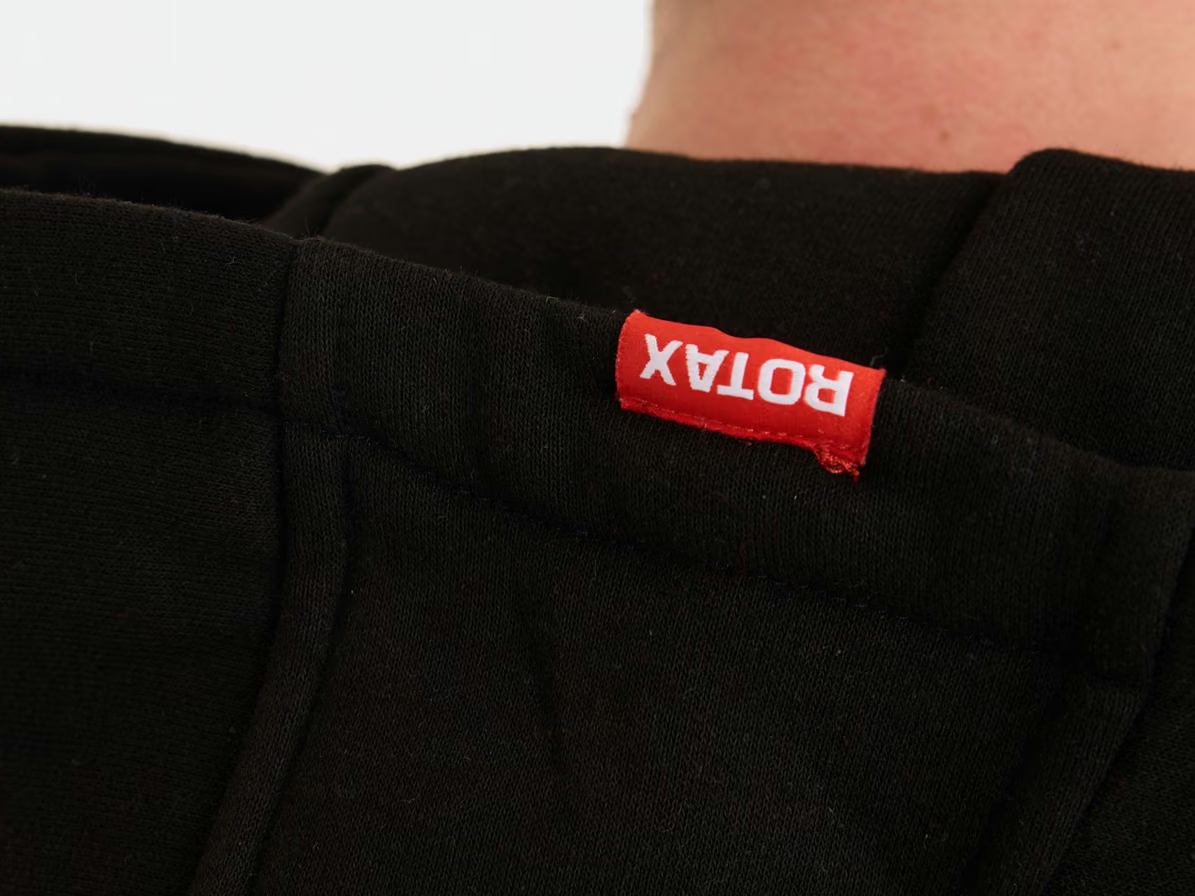
| Woven and printed labels | Legibility, edge curling, and whether the label itself has shrunk |
| Applied badges and patches | Adhesion, edge lifting, and distortion of the panel behind them |
| Sewing thread | Colour change, and shrinkage relative to the fabric, which shows as puckered seams |
The last of those is worth dwelling on. A sewing thread that shrinks more than the fabric it is holding gathers the seam, and the result looks like a construction fault. It appears after washing rather than at final inspection, which is why it is a care question as much as a sewing one and why seam puckering separates the mechanisms.
Construction
How a garment is assembled affects how it behaves after laundering, independently of what it is made from.
- Seams that combine fabrics with different dimensional behaviour will pull towards the one that moves more.
- Rib trims cut at a given ratio to their opening are relying on recovery, so whether they hold their shape after repeated washing is a construction decision as well as a materials one, as covered in rib trims and neck finishing.
- Bulky seam intersections can set a crease that does not come out, which is an appearance failure rather than a dimensional one.
- Bound and taped edges restrain the fabric they enclose, which can be an advantage or can cause the panel to ripple around them.
None of this makes a construction wrong. It means the finished garment has to be the thing that is tested, because these effects do not exist in a piece of fabric.
Turning this into a test brief
Read the bill of materials before the test rather than the label. The purpose is to identify which components are candidates for setting the limit, so the test looks for the right failures.
Questions to ask of a bill of materials
- Which component is the most heat-sensitive, and is drying therefore the critical step
- Is there elastane anywhere, including in a trim rather than the main fabric
- Are any two components likely to shrink at different rates
- Is anything fused or laminated, and has that bond been washed
- Are dark and light colours in contact anywhere in the garment
- Are any trims metal, and will they be in water
- Is anything applied with adhesive
- Does any component come with a supplier care recommendation that conflicts with the others
The last question is the useful one. When two components carry different supplier recommendations, that conflict is the care decision, and it has to be resolved by testing the assembled garment rather than by choosing whichever recommendation is more convenient.
Questions this raises
Can a trim really decide the wash instruction for a whole garment?
Yes, and it frequently does. An elastic that loses recovery under heat, a metal fitting that corrodes, a dyed drawcord that bleeds or a thread that shrinks more than the fabric will each damage or spoil the garment regardless of how robust the main fabric is. The instruction has to hold for the whole product.
Does elastane mean a garment cannot be tumble dried?
Not automatically. Elastane is often the most heat-sensitive component in a garment that contains it, which makes drying a step likely to cause a problem, but what a particular garment tolerates depends on the elastane content, how it is incorporated, the rest of the construction and the temperature involved. It is established by testing the garment through repeated cycles, not by a rule about the fibre.
How should technical outerwear be assessed?
As an assembly rather than as a fabric. The failures that matter on a laminated or coated garment are separation between layers, blistering and seam tape lifting, and they are failures of adhesion. A material supplier's guidance for their laminate is a starting point; the adhesives and tapes in your garment are part of your construction and have to be assessed in the finished product.
What if the lining and the shell shrink differently?
The garment distorts even though neither fabric has failed on its own, usually showing as drag lines or a hem that no longer hangs straight. It is a materials compatibility problem best caught when the bill of materials is set, by checking that hidden layers behave like the shell, rather than by making the care instruction more cautious.
Send the bill of materials, not just the fabric
Many care limits come from a component rather than from the shell. Give us the full materials list and we will say which ones are likely to set the instruction before anything is sampled.
Request a quotation