Outerwear and shells
Rain Jacket and Raincoat Manufacturing Process
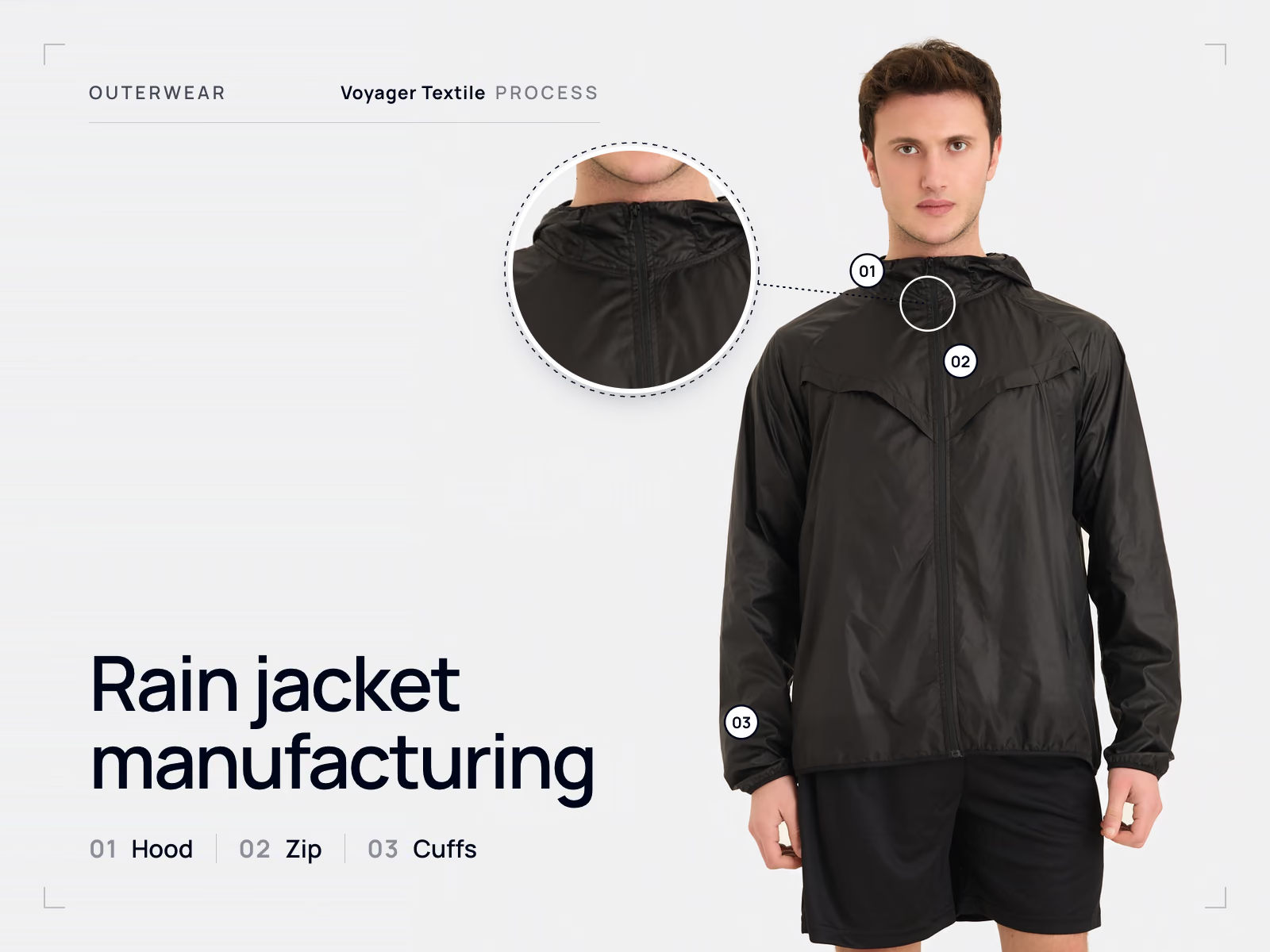
Rainwear is an apparel category where the seams matter as much as the fabric. A coated or laminated cloth can resist water, but every needle hole is a potential leak, so a genuinely waterproof garment needs its seams sealed and the finished garment tested. Anything short of that is a water-resistant jacket, and it should be described that way.
Contents
The word waterproof is used loosely in apparel, and rainwear is where that vagueness becomes expensive. A jacket can be made from a coated fabric and still leak through its shoulder seams within minutes. This page sets out what actually makes a rain garment work, what has to be tested, and where the honest boundary sits between water resistant and waterproof.
Rain jacket production sequence
The distinction below is one instance of a wider discipline: a performance word only becomes a requirement once the property, the method and the acceptance criterion are named. That model is set out in apparel performance claims.
Water resistant, water repellent, waterproof
These three are not synonyms, and getting them right protects you commercially as well as technically.
| Term | What it means | What it needs |
|---|---|---|
| Water repellent | The fabric surface sheds water because of a finish, so light rain beads and runs off | A durable water repellent finish, which wears and can be renewed |
| Water resistant | The garment resists water to a limited degree, usually in light or short exposure | A coated or tightly woven fabric; seams typically not sealed |
| Waterproof | The garment resists water penetration to a stated level under pressure | A coated or laminated fabric with a measured performance, plus sealed seams and a tested finished garment |
Coated and laminated fabrics
Two routes produce a rain fabric, and they behave differently in production.
| Route | Construction | Character | Consideration |
|---|---|---|---|
| Coated fabric | A polyurethane or similar coating applied to the back of a woven polyester or polyamide | Economical, effective against rain, generally less breathable | The coating is heat sensitive, which restricts pressing and decoration |
| Laminated fabric | A membrane bonded to the face fabric, sometimes with a backing layer | Combines water resistance with breathability | More expensive; needle penetration through the membrane matters more |
| PVC and heavy coated cloth | Thick coating on a woven or knitted base | Very high water resistance, low breathability, industrial appearance | Welded rather than sewn construction is common |
| Uncoated tight weaves | Densely woven polyester or polyamide with a repellent finish | Wind resistant and shower resistant only | Should be described as a wind shell, not as rainwear |
Seams: where rain jackets fail
Every stitch is a hole. A jacket cut from a fabric with excellent water resistance will still leak at the shoulders and hood if nothing is done about the seams, and that is a common failure in cheap rainwear.
- Seam sealing tape. A tape applied over the seam on the inside using heat, bonding to the coating or membrane and closing the needle holes. It is the standard solution and it requires a fabric whose back surface the tape can bond to.
- Fully taped or critically taped. Fully taped means every seam is sealed. Critically taped means only the most exposed seams, usually shoulders and hood, are sealed. Both are legitimate; the difference must be stated rather than assumed.
- Welded seams. Some heavy coated fabrics allow seams to be welded rather than sewn, removing needle holes altogether. It is a different production route with different equipment.
- Seam type. Seams intended for taping are constructed so the tape can lie flat, which restricts which seam types can be used.
- Tape adhesion. The tape has to be applied at the correct temperature and speed for the specific fabric. Poor adhesion peels away in service, and it is checked on the sample rather than trusted.
Hood construction
The hood is what makes a rain jacket usable, and it is a part often built without enough thought.
- Peak or brim. A stiffened or wired peak keeps rain off the face. Without one, water runs onto the wearer's face regardless of how good the fabric is.
- Volume adjusters. A rear or side drawcord that pulls the hood closer so it turns with the head rather than blocking vision.
- Face aperture drawcord. Closes the opening around the face, with cord locks positioned where they can be used with one hand.
- Fixed, detachable or roll-away. A roll-away hood stows in the collar, which suits corporate and travel garments. A detachable hood attaches with a zip or studs, and both add construction.
- Coverage. The hood must cover the neck at the back, and the collar must sit high enough to close the gap when the main zip is fully closed.
Closures, ventilation and detailing
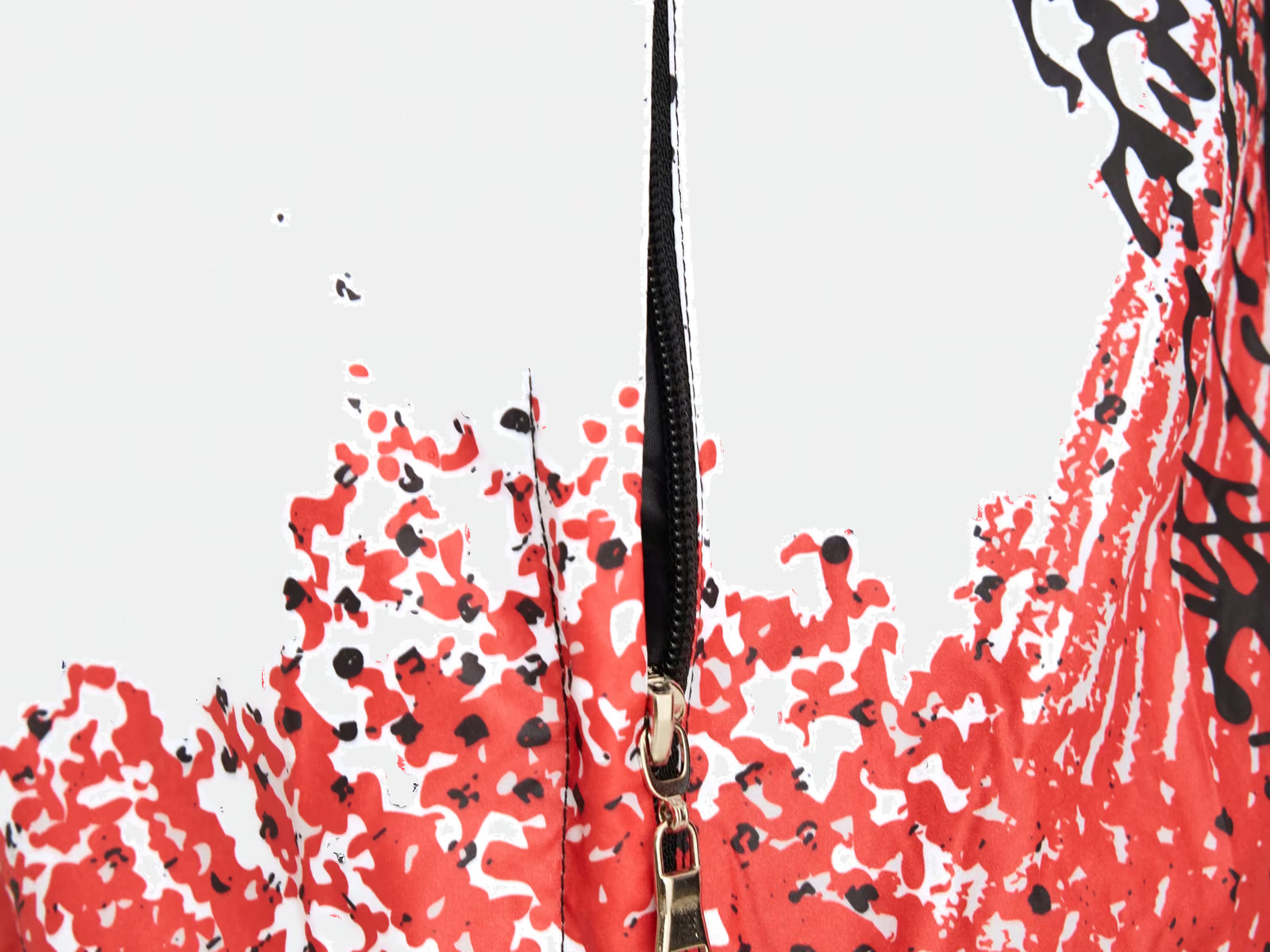
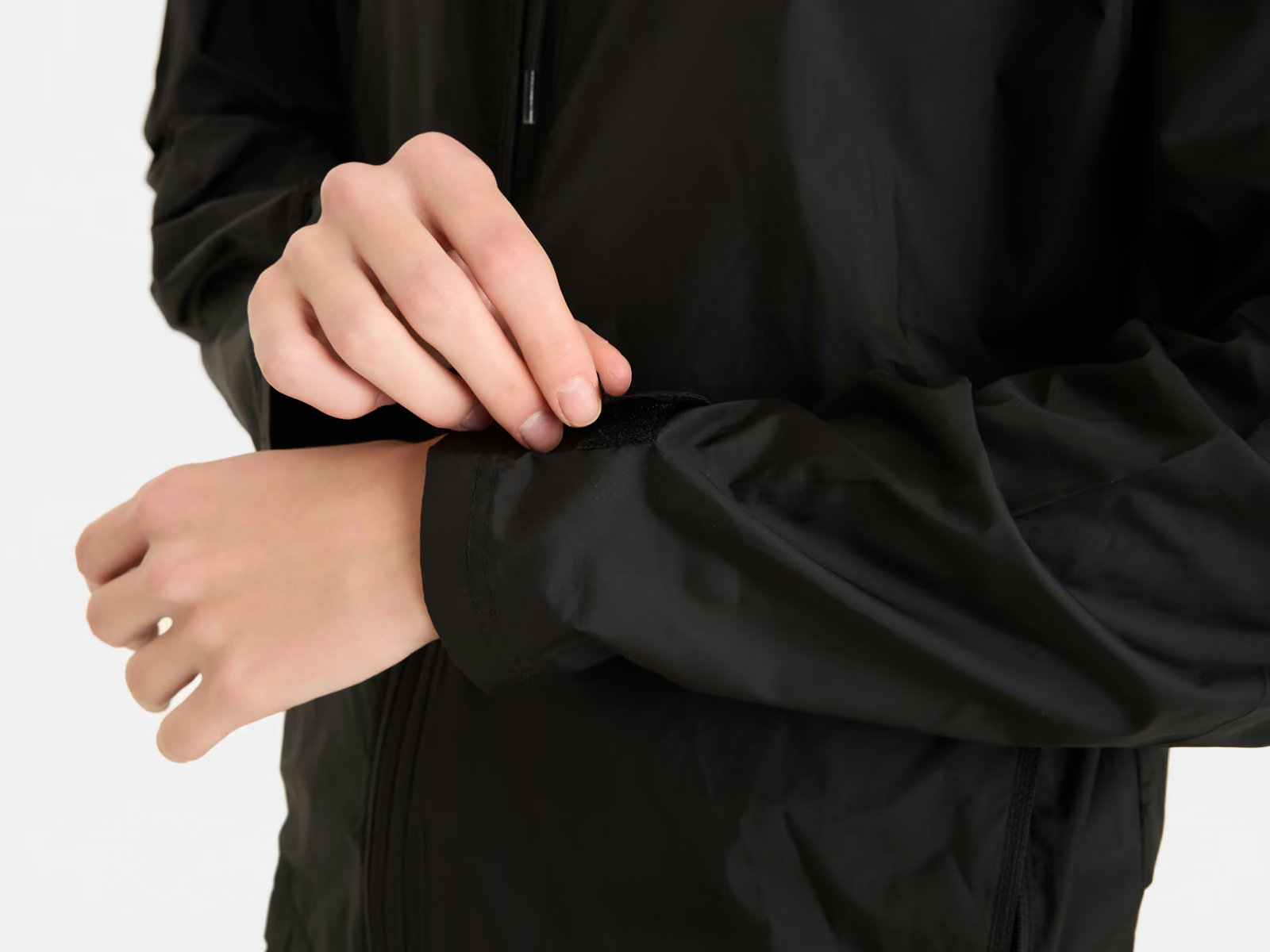
- Storm flap. A fabric strip covering the main zip, secured with studs or hook-and-loop. On a rain garment this is a functional part rather than a styling detail, since standard zips are not watertight.
- Water-resistant zips. Coated zips reduce water passage and are common on lighter rainwear. They are water resistant rather than waterproof, and on demanding garments they are used with a flap rather than instead of one.
- Pocket openings. Angled or flapped so they do not collect water, with the pocket bag positioned so water does not sit inside it.
- Cuff adjusters. Hook-and-loop tabs or elastic to close the sleeve opening at the wrist.
- Hem drawcord. Closes the bottom opening so wind and rain do not drive up inside the jacket.
- Ventilation. Coated fabrics trap moisture from the wearer, so vents matter: mesh-lined body panels, underarm eyelets or zipped vents. Any vent is a deliberate opening, so it is positioned where rain will not enter.
- Lining. Mesh gives ventilation and a comfortable inner face; taffeta gives easier on and off; unlined garments are lighter and pack smaller. On a taped garment the lining also hides the tape.
Decoration on rainwear
Decoration is more restricted here than on most garments in this section, and for a good reason.
- Embroidery perforates the barrier. Every stitch is a hole through the coating or membrane, so embroidery on a waterproof panel compromises the performance it was bought for. Where it is required, it is placed on a non-critical area or on an applied patch, and the customer should be told what it means.
- Heat transfers. The usual solution, because they add a layer without perforating the fabric. Coated fabrics are heat sensitive, so temperature and dwell must be tested on the actual fabric before bulk.
- Printing. Possible on some coated shells and not others. Ask for a test rather than assuming.
- Reflective transfers and tape. Effective for visibility in poor weather, applied as heat transfer or stitched tape. Stitched tape reintroduces needle holes, so on a sealed garment it is usually heat applied.
- Branded hardware. Zip pullers, cord locks and stud finishes, which brand the garment without touching the barrier.
Assembly sequence
- Fabric is inspected, including the coating or membrane surface, and cut with care not to crease coated cloth.
- Decoration is applied where it has been tested and agreed, before assembly.
- Pockets are constructed with their flaps and bags.
- Body panels are joined using seam types that will accept tape.
- Sleeves are set and the side seams closed.
- The hood is assembled with its peak and adjusters, then attached, or the collar is built for a roll-away hood.
- Seams are taped, fully or critically according to the specification.
- The main zip is set with its storm flap; cuff adjusters and hem drawcord are fitted.
- The lining is fitted where used, then labels are attached and the garment is inspected and tested.
Quality control and testing
| Check | What it catches |
|---|---|
| Tape adhesion, including a peel check on a sample | Sealing applied at the wrong temperature or speed |
| Tape coverage against the specification | Seams that were meant to be taped and were not |
| Spray or water testing of the finished garment | Leaks at seams, zips and pockets that fabric tests miss |
| Hydrostatic head on the fabric, where specified | Material that does not meet the agreed performance |
| Zip function and storm flap closure | Heavily used components on the garment |
| Hood adjusters and field of vision when closed | A hood that cannot be tightened or blocks sight |
| Pocket openings under water | Openings that collect rather than shed water |
| Decoration integrity and surrounding fabric | Heat damage from transfer application |
If rain performance is contractual, put the test method and the pass level in the specification, and test the finished garment rather than only the fabric. Guidance on setting inspection and testing requirements is in the quality control guide.
What to put in a rain jacket tech pack
- Fabric: coated or laminated, base cloth composition and weight, coating or membrane type.
- Required water penetration performance, with the test method and pass level if it is contractual.
- Seam sealing: fully taped or critically taped, with the seams to be sealed listed.
- Hood: fixed, detachable or roll-away, with peak, adjusters and coverage.
- Main zip: type, whether water resistant, plus storm flap construction and closure.
- Pockets: type, opening angle, flaps and bag positioning.
- Ventilation: mesh lining, eyelets or zipped vents, with positions.
- Cuff and hem adjusters.
- Lining: mesh, taffeta or unlined.
- Decoration: method, artwork and placement, with a fabric test approved and any effect on performance acknowledged.
- Reflective detailing, and whether certification is required.
- Measurements with tolerances, including body and sleeve length for coverage.
- Packing, including whether the garment packs into its own pocket or bag.
Sampling
Test the sample with water. Put it under a shower or a spray rig with the zip closed and the hood up, and look for the classic leak points: shoulder seams, the hood seam, the zip, and the pocket openings. Ten minutes of that reveals more than a specification review alone.
Also check the hood with the adjusters closed and the wearer turning their head, and confirm that the collar covers the neck when the zip is fully closed. Both are comfort issues that turn into complaints in the field.
Before you send a rain jacket RFQ
- What conditions the jacket must handle, described honestly
- Whether a stated water penetration performance is required, and whether it is contractual
- Coated or laminated fabric preference
- Fully taped or critically taped seams
- Hood type, and whether it must be detachable or roll-away
- Zip type and storm flap requirement
- Ventilation requirements
- Lining preference
- Decoration method, accepting that embroidery perforates the barrier
- Any reflective or certification requirement
- Size range, split and quantity
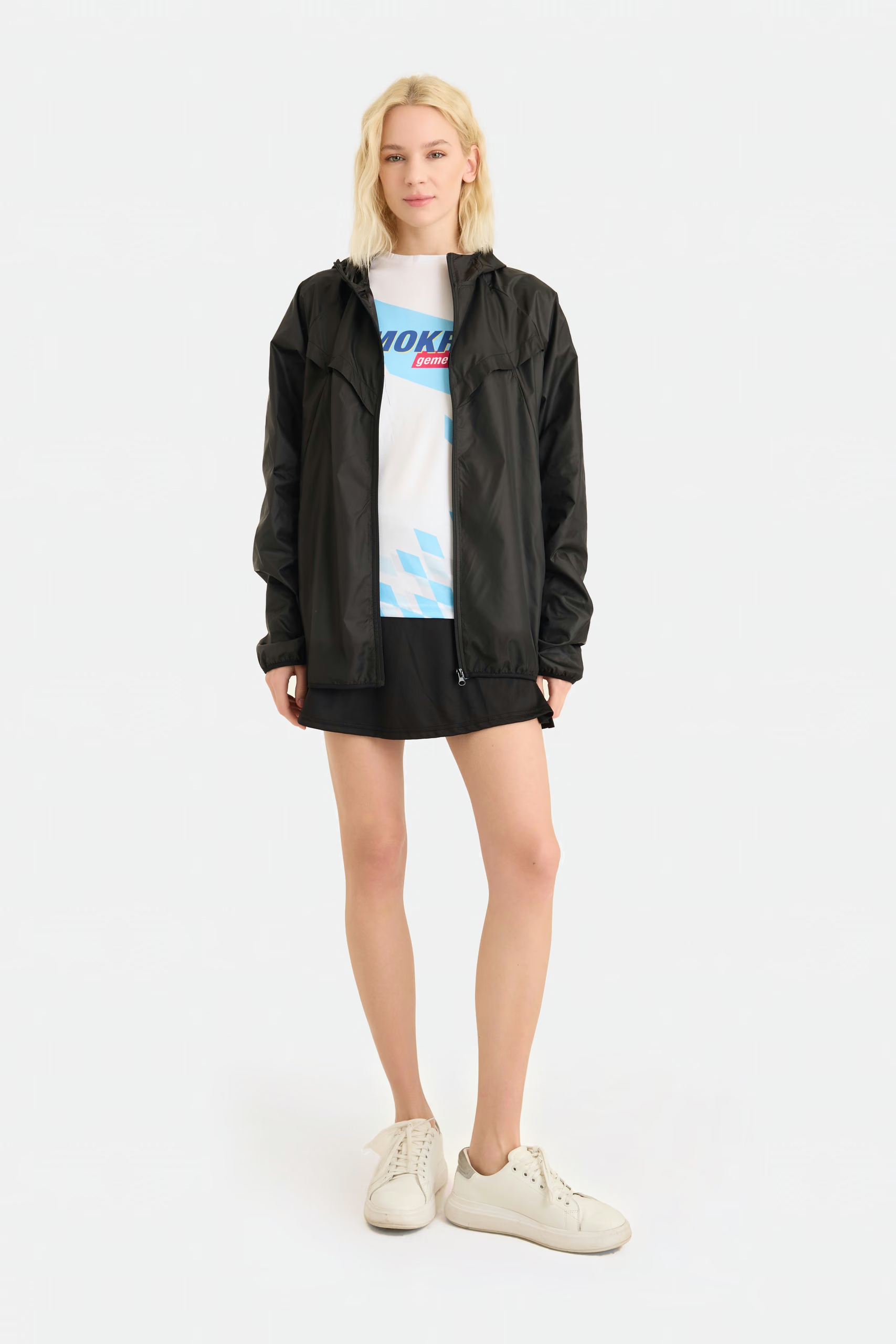
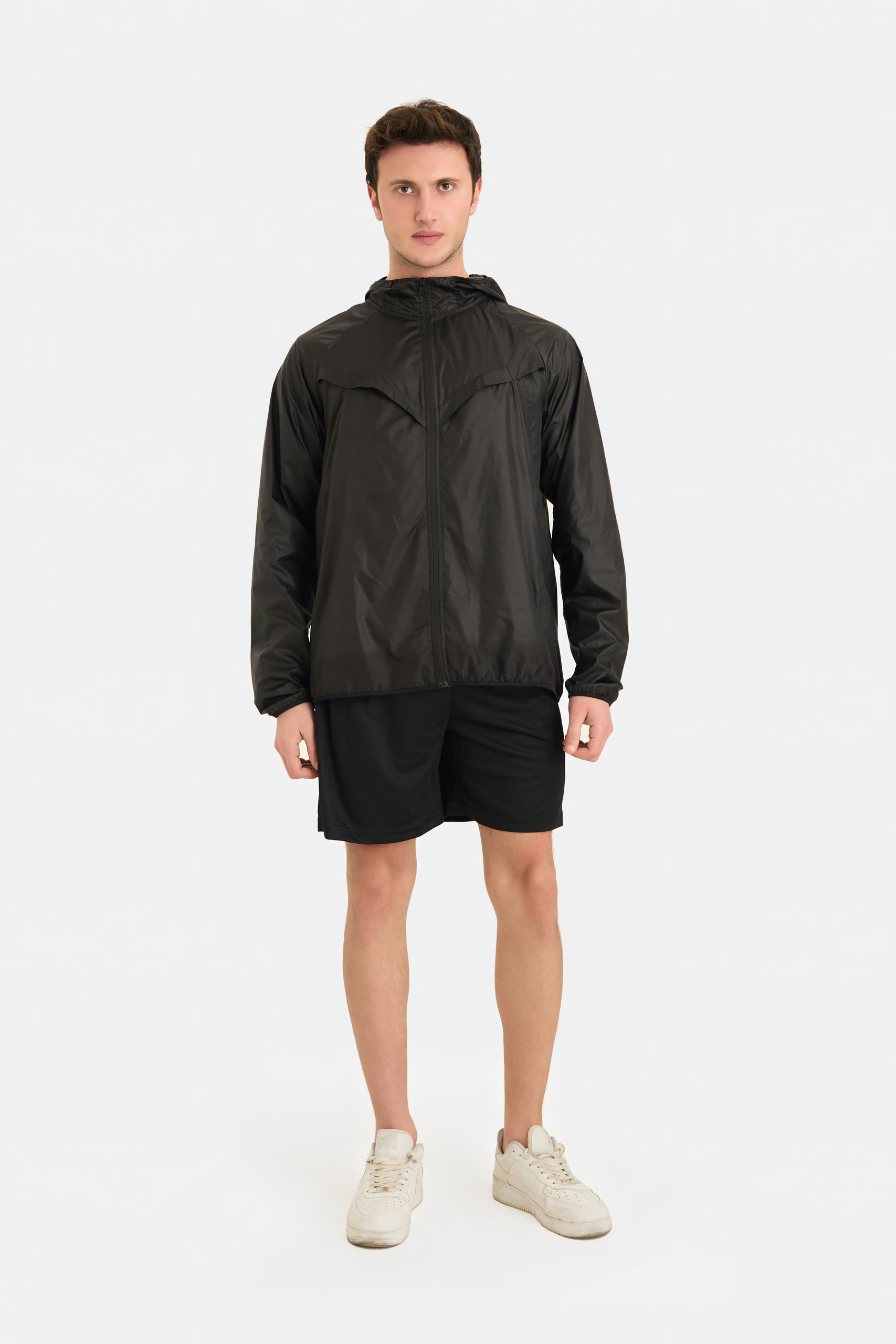
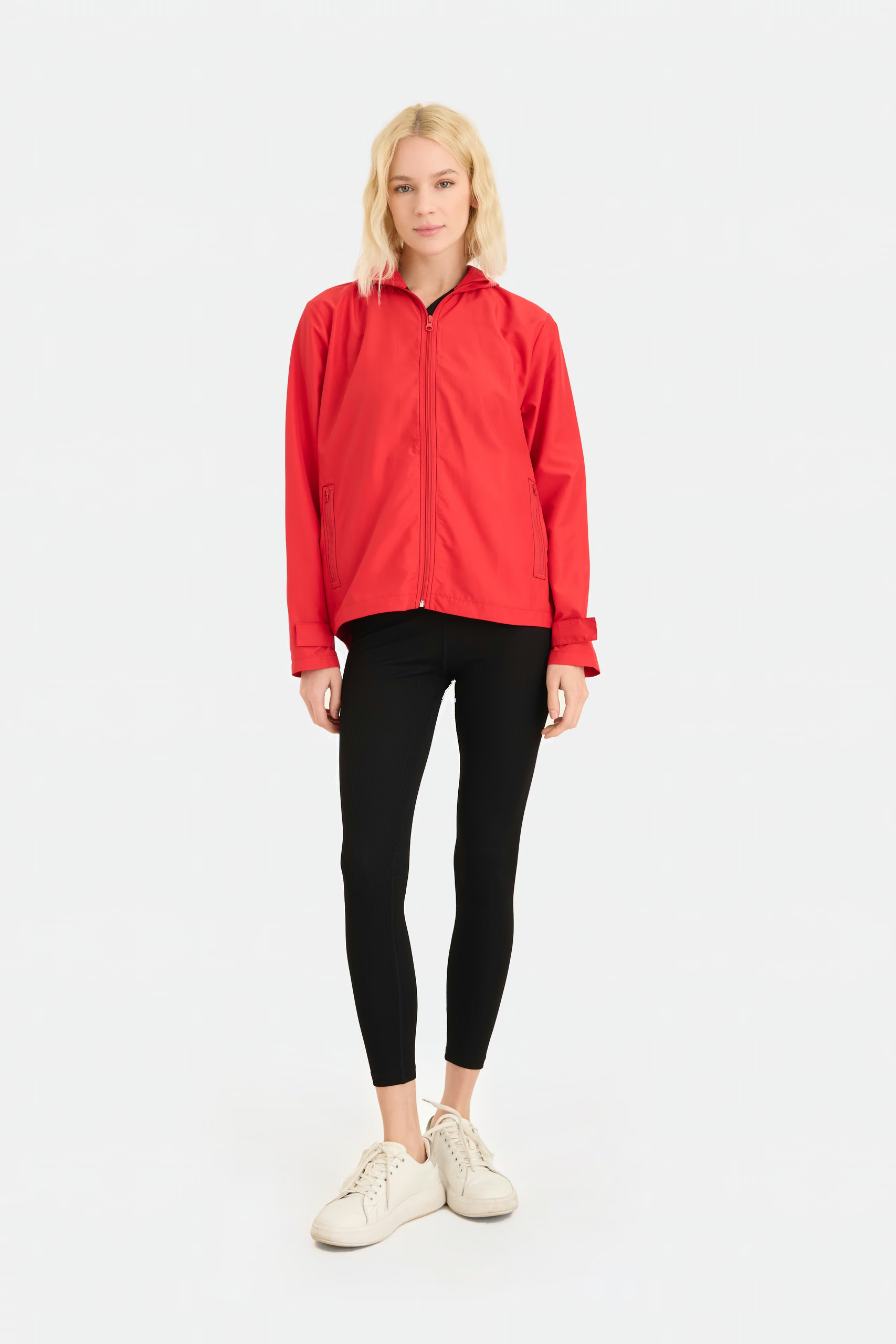
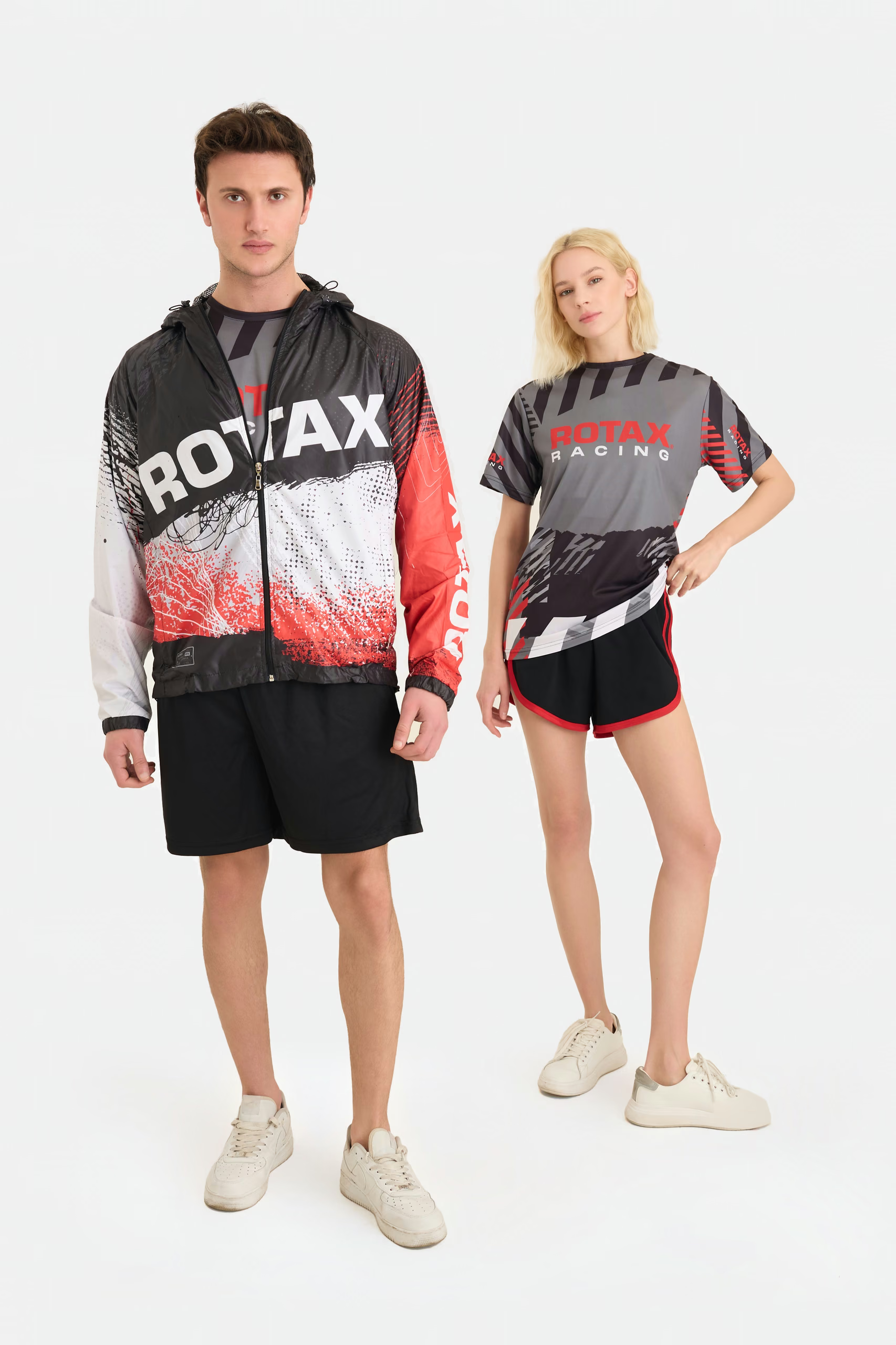
Wind shell references produced by Voyager Textile
Hooded windbreakers and packable shells produced to customer specification. These are wind-resistant shell references and no waterproof rating is claimed for them; rain performance is specified and tested per project.
Buyer questions
What makes a jacket waterproof rather than water resistant?
Two things together: a fabric with a measured resistance to water penetration, and seams that have been sealed so the needle holes do not leak. A coated fabric alone gives water resistance. Without sealed seams and a tested finished garment, a jacket should not be described as waterproof.
How is waterproofing measured?
By hydrostatic head, under EN ISO 811, where water pressure is increased against the fabric until it penetrates. In Europe, protective clothing against rain is covered by EN 343, which classifies water penetration resistance in four classes and assesses seams as well as fabric, before and after pre-treatment.
What is seam taping?
A tape bonded over the inside of a seam with heat, closing the needle holes made when the panels were sewn. Fully taped means every seam is sealed; critically taped means only the most exposed seams are. The fabric must have a back surface the tape can bond to, and adhesion should be checked on the sample.
Can a rain jacket be embroidered?
It can be, but every stitch perforates the coating or membrane, which compromises the performance in that area. On a garment sold for rain protection, use a heat transfer or an applied patch on a non-critical area instead, and if embroidery is insisted on, make sure the customer understands the consequence.
Are water-resistant zips enough on their own?
Not on a garment intended for sustained rain. Coated zips reduce water passage but are not watertight, which is why a storm flap over the main zip remains standard on serious rainwear rather than being a styling detail.
Why do rain jackets feel damp inside even when they do not leak?
Because coated fabrics trap moisture from the wearer. That is a breathability limitation rather than a leak. Laminated fabrics with a breathable membrane reduce it, and ventilation features such as mesh linings, underarm eyelets or zipped vents help on coated garments.
What should a rain hood include?
A peak or brim to keep water off the face, a volume adjuster so the hood turns with the head, a face aperture drawcord with usable cord locks, and enough coverage at the back of the neck. A hood without a peak leaves water running onto the wearer's face regardless of the fabric.
Does polyester make a jacket waterproof?
No. Polyester is a fibre, not a barrier. A tightly woven polyester with a repellent finish is a wind shell that sheds light rain. Water resistance comes from a coating or a membrane, and waterproof performance additionally requires sealed seams and testing.
Can Voyager Textile produce certified rainwear?
Rain performance and any class claim have to be specified, produced and tested for the actual material and finished garment, and certified protective clothing is a regulated category with its own requirements. Raise the requirement at enquiry stage so the scope can be confirmed rather than assumed. The wind shell references shown on this page carry no waterproof rating.
What is the difference between a rain jacket and a softshell?
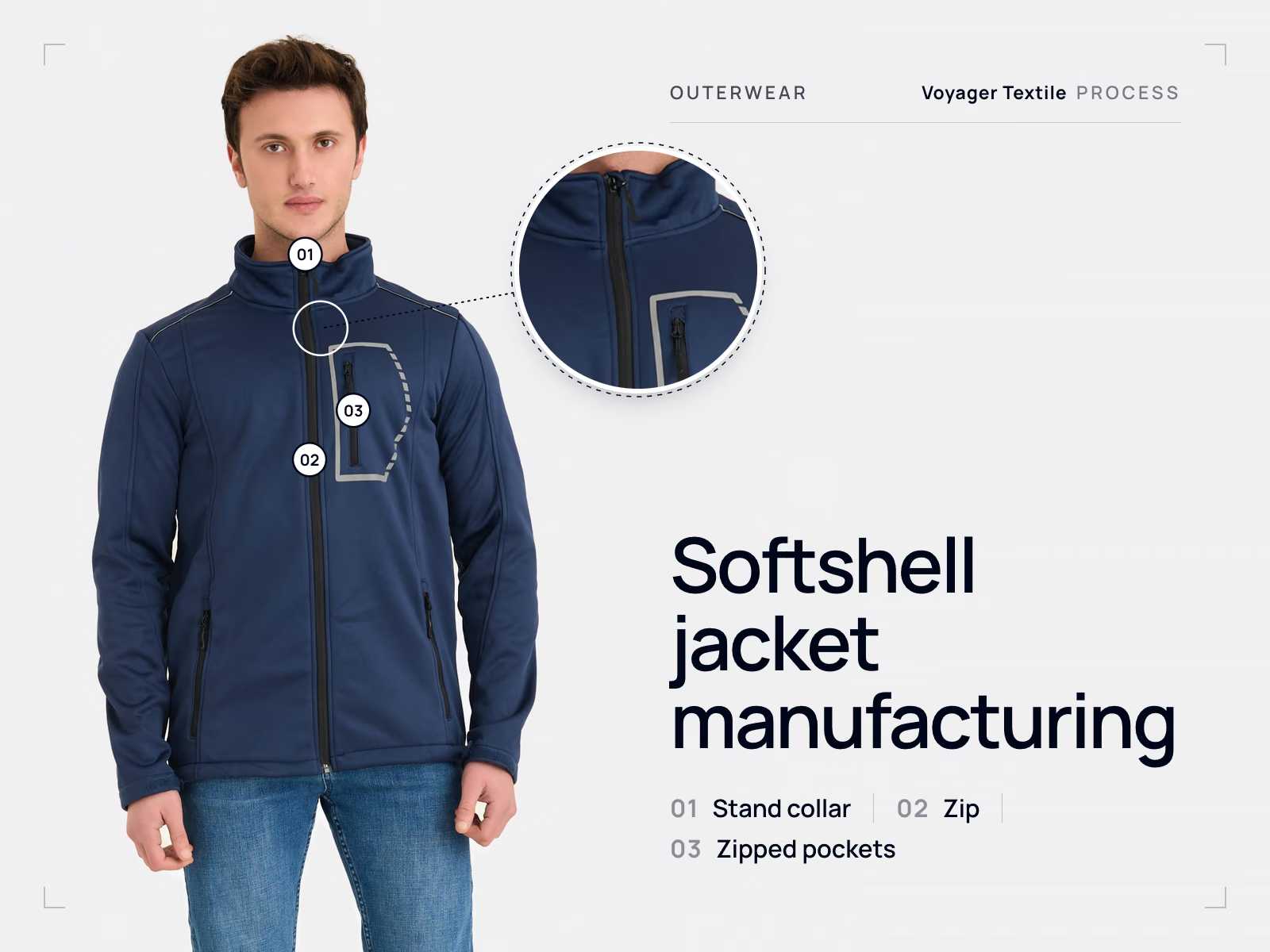
A softshell is normally water-repellent and breathable rather than waterproof, with unsealed seams, and it is built for comfort and movement. A rain jacket uses a coated or laminated fabric with sealed seams and protective detailing such as a storm flap and a peaked hood. See the softshell process.
Ordering this garment from Voyager Textile
- Every garment is made to order, to your own design.
- The minimum order is 300 pieces per colour and per style. Sizes can be split inside the 300, and a custom Pantone colour carries the same minimum of 300 pieces. Polyester-based fabrics are assessed separately.
- A sample takes 5–7 business days. Bulk production takes 4–5 weeks after sample approval; development, sampling and shipping are additional.
- Cutting, sewing, embroidery, transfer printing and sublimation printing are done in our own factory in Türkiye. Screen printing and garment washing are coordinated with partner facilities.
Quantities, timing and any open point are confirmed per project at the quotation stage, once we have your specification or tech pack.
Request a quoteSpecifying a rain jacket?
Tell us the conditions the garment has to handle and whether a stated performance level is contractual. We will confirm the fabric route, the seam sealing scope and what can honestly be claimed, then sample and water-test before bulk.
Send a rainwear brief