Compliance and shipping
US Tariff on Clothing from Turkey: How the Section 301 Duty Adds to the MFN Rate
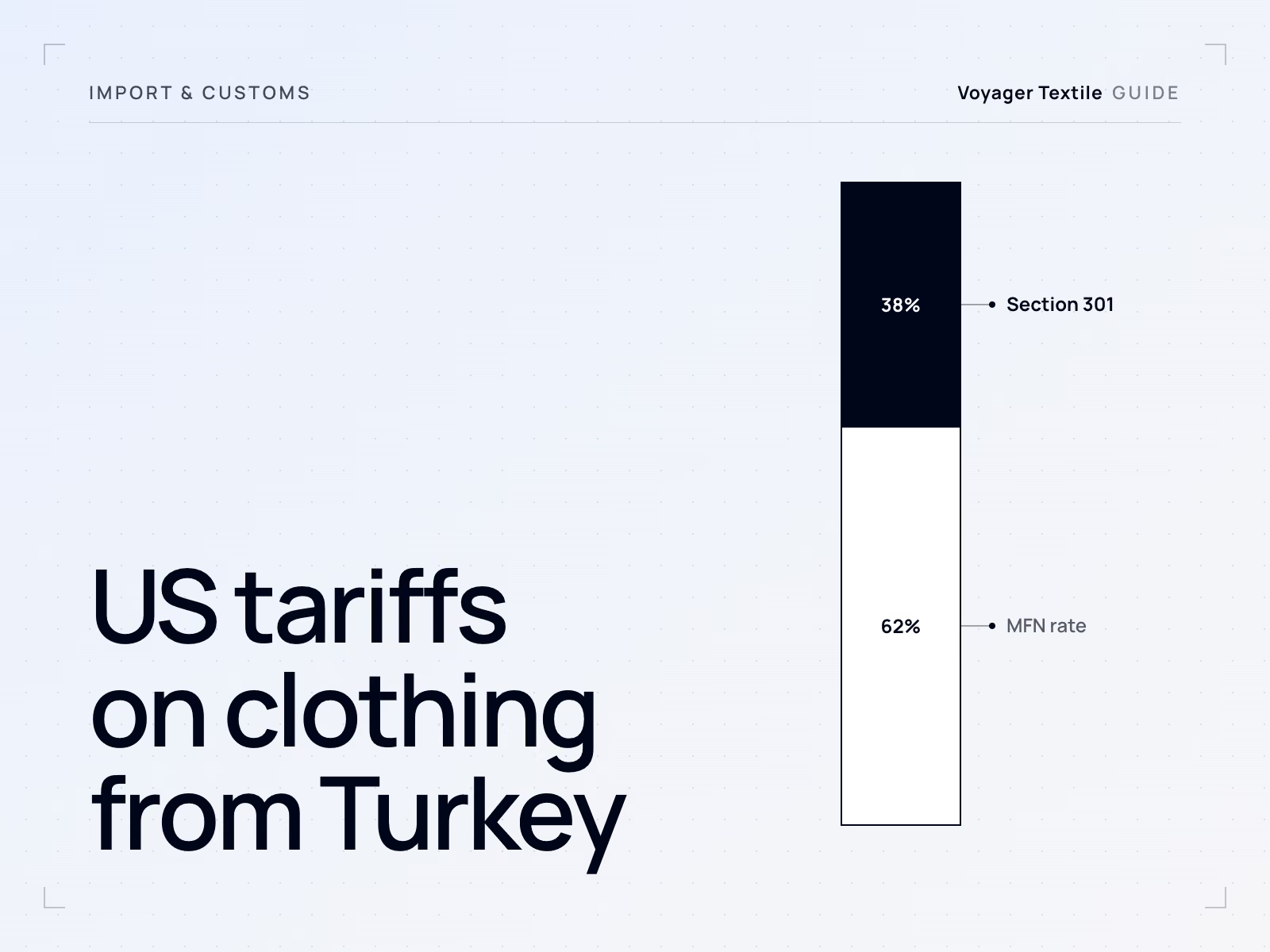
Clothing of Turkish origin entered in the United States on or after 24 July 2026 pays two layers of duty: the general rate for its HTSUS subheading, and an additional 12.5% ad valorem under Section 301, heading 9903.05.79. The importer of record owes both. The Section 301 action is under challenge at the US Court of International Trade, and CBP collects it unless a court orders otherwise.
Last reviewed:
Contents
For a US buyer the duty on a Turkish-made garment is two rates added together, both charged on the customs value. The first depends on what the garment is, the second on where it was made. Neither depends on the supplier, the Incoterm or the price.
Confirm product classification, origin and documentation with your customs representative for the destination market and date of import.
Which US duties apply to Turkish-origin apparel
Two duties apply: the column 1 general rate of the Harmonized Tariff Schedule of the United States (HTSUS) for the garment's subheading, often called the MFN rate, and the Section 301 duty for products of Türkiye. Türkiye does not appear in the Special column for the apparel subheadings below, so no preferential rate replaces the general rate.
How the rates stack on common garments
The Section 301 duty for Türkiye is added in full to the general rate. The same action caps the combined rate for some other economies: for products of the European Union and Taiwan the two together are held at 10%, and for Japan, Korea and Switzerland at 12.5%. Türkiye is not one of them, so its 12.5% stacks on apparel rates that are already high.
| HTSUS subheading | Garment, as the tariff describes it | General rate | Section 301, Türkiye | Combined rate |
|---|---|---|---|---|
| 6109.10.00 | T-shirts, singlets, tank tops and similar garments, knitted, of cotton | 16.5% | +12.5% | 29% |
| 6109.90.10 | The same garments, of man-made fibres | 32% | +12.5% | 44.5% |
| 6105.10.00 | Men's or boys' shirts, knitted, of cotton | 19.7% | +12.5% | 32.2% |
| 6110.20.20 | Sweaters, pullovers, sweatshirts and similar articles, knitted, of cotton (other than 36% or more flax) | 16.5% | +12.5% | 29% |
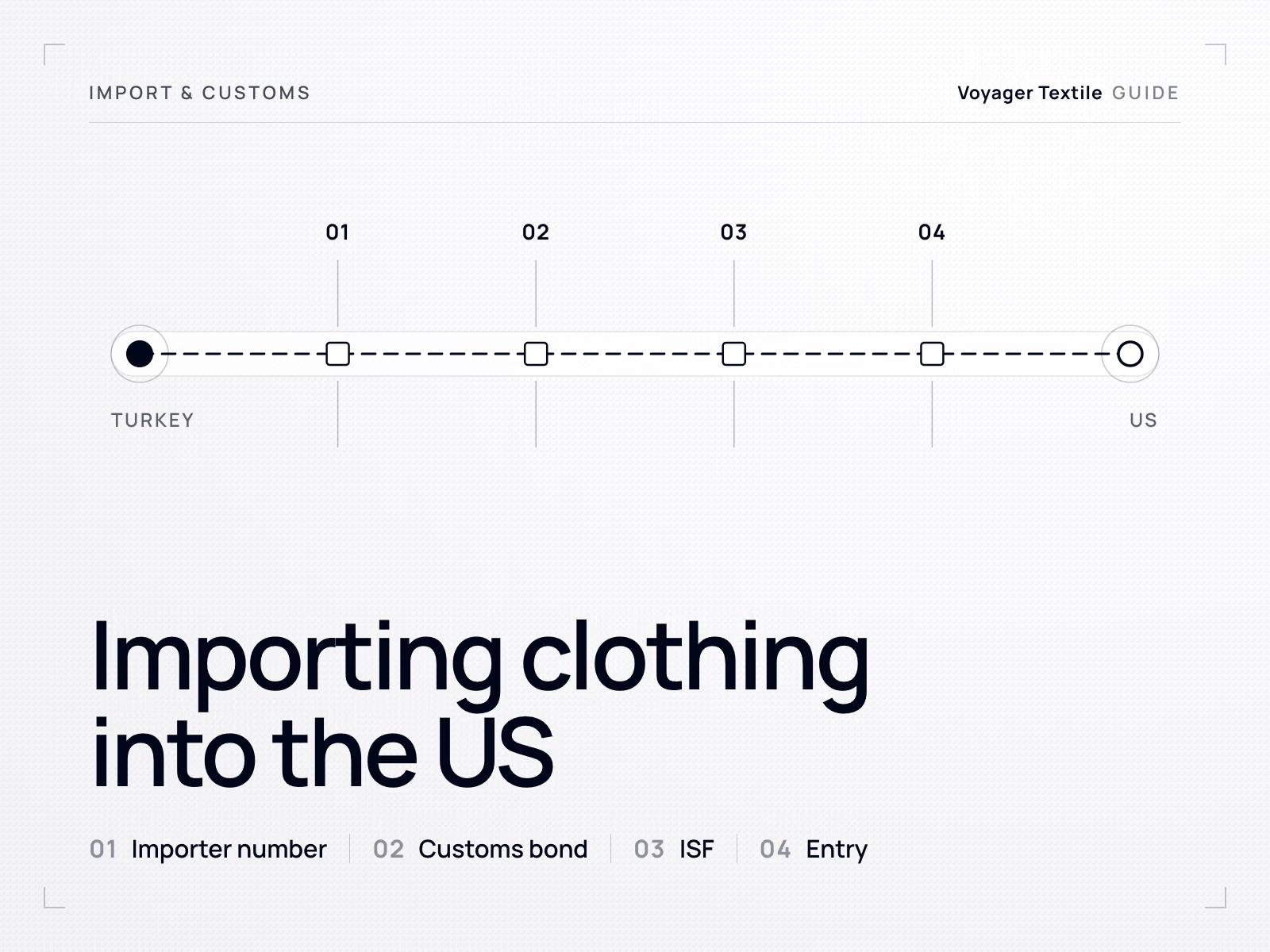
Fibre content and construction move the first layer far more than the second, as the cotton and man-made fibre T-shirt rows show. How the US classifies apparel, and what else the importer must do at the border, is covered in US apparel labelling and import requirements.
Origin decides which Section 301 rate applies
The Section 301 rate follows the garment's country of origin, and for most cut-and-sewn garments that is where they were assembled. Under 19 CFR 102.21, a garment of chapters 61 or 62 made from two or more pieces and wholly assembled in one country takes that country as its origin; knit-to-shape garments follow a different rule. A garment cut and sewn in Türkiye is Turkish for US purposes and takes Türkiye's 12.5%, wherever its fabric was made.
Origin for duty is not the only test the inputs face. The Uyghur Forced Labor Prevention Act looks through the garment to the cotton and other materials, and the evidence the importer needs for that is set out in the US import requirements guide. How origin is determined more generally is covered in the country of origin of clothing.
How the US measures on Turkish apparel changed
The Section 301 duty is the third across-the-board additional duty to reach Turkish apparel since 2025. The earlier two have ended, and the table records why, so that an old quotation or broker note can be read correctly.
| Measure | Legal basis | Period | Status |
|---|---|---|---|
| Tariffs under the International Emergency Economic Powers Act (IEEPA) | Executive orders from 2025 | From 2025 | Ended. The Supreme Court held in Learning Resources, Inc. v. Trump, No. 24-1287, decided 20 February 2026, that IEEPA does not authorize tariffs |
| Temporary import surcharge of 10% ad valorem | Section 122 of the Trade Act of 1974, Proclamation 11012 of 20 February 2026 (91 FR 9339) | 12:01 a.m. 24 February 2026 to 12:01 a.m. 24 July 2026 | Expired at the end of its 150-day period |
| Additional duty of 12.5% on products of Türkiye | Section 301 of the Trade Act of 1974, USTR notice 91 FR 47318; HTSUS heading 9903.05.79 | From 12:01 a.m. eastern time, 24 July 2026 | In force; under challenge at the US Court of International Trade |
Goods that were loaded on a vessel and in transit on the final mode of transport before 24 July 2026, and entered before 12:01 a.m. on 28 July 2026, were exempt under heading 9903.05.85. That window has closed.
The court challenge
The Section 301 action is contested, and the outcome is open. Twenty-five states led by Oregon filed a complaint at the US Court of International Trade on 3 August 2026 (Court No. 26-03467), asking the court to set the action aside, stop its enforcement and award refunds of tariffs the states have paid. Until a court orders otherwise, CBP collects the duty on every entry, and a buyer should cost orders on that basis rather than on a possible ruling.
Who pays: the importer of record
The importer of record pays US duty, not the factory. Under 19 U.S.C. 1484, entry is made by the owner or purchaser of the goods, or by a licensed customs broker they designate, and the importer of record must use reasonable care to declare the value, classification and rate of duty. Under 19 CFR 141.1(b), duty is a personal debt of the importer; paying a broker does not discharge it if the broker fails to pay CBP.
- A foreign company can be importer of record only on conditions. Under 19 CFR 141.18, a nonresident corporation needs a resident agent authorised to accept service of process and a bond with a resident corporate surety.
- A DDP price moves the duty to the seller. Whoever quotes delivered duty paid has taken on US import clearance and the duty, so the quotation must say who acts as importer of record.
- Low-value shipments are no shortcut. CBP's interim final rule of 24 June 2026 (91 FR 37789) suspends the de minimis exemption indefinitely for shipments arriving other than by post, and a companion rule (91 FR 37801) does the same for mail from 24 July 2026.
How to state duty assumptions in a quotation
A quotation for US delivery should state the Incoterm, the country of origin assumed, the HTSUS subheading used for costing and the duty rates assumed on a named date. Without those, two quotations cannot be compared and a rate change has no agreed owner. The lines below are examples of wording a buyer can ask to see; they are not Voyager terms.
- Delivery term. "Prices [Incoterm and named place]. US import duties, Section 301 duties, fees and taxes are excluded and payable by the importer of record."
- Origin. "Country of origin: Türkiye. Garments cut and wholly assembled in Türkiye."
- Classification. "Costing assumes HTSUS [subheading], to be confirmed by the importer's customs broker before shipment."
- Rates and date. "Duty assumed: HTSUS general rate plus 12.5% under heading 9903.05.79, as in force on [date]."
- Change of rate. "Any change in US duty between quotation and entry is for the account of [party], as agreed in the contract."
How delivery terms change what a price includes is covered in shipping apparel from Türkiye. How Türkiye compares with other origins on US duty, minimums and lead time is set out in where to make apparel for the US market.
What does not change the US duty
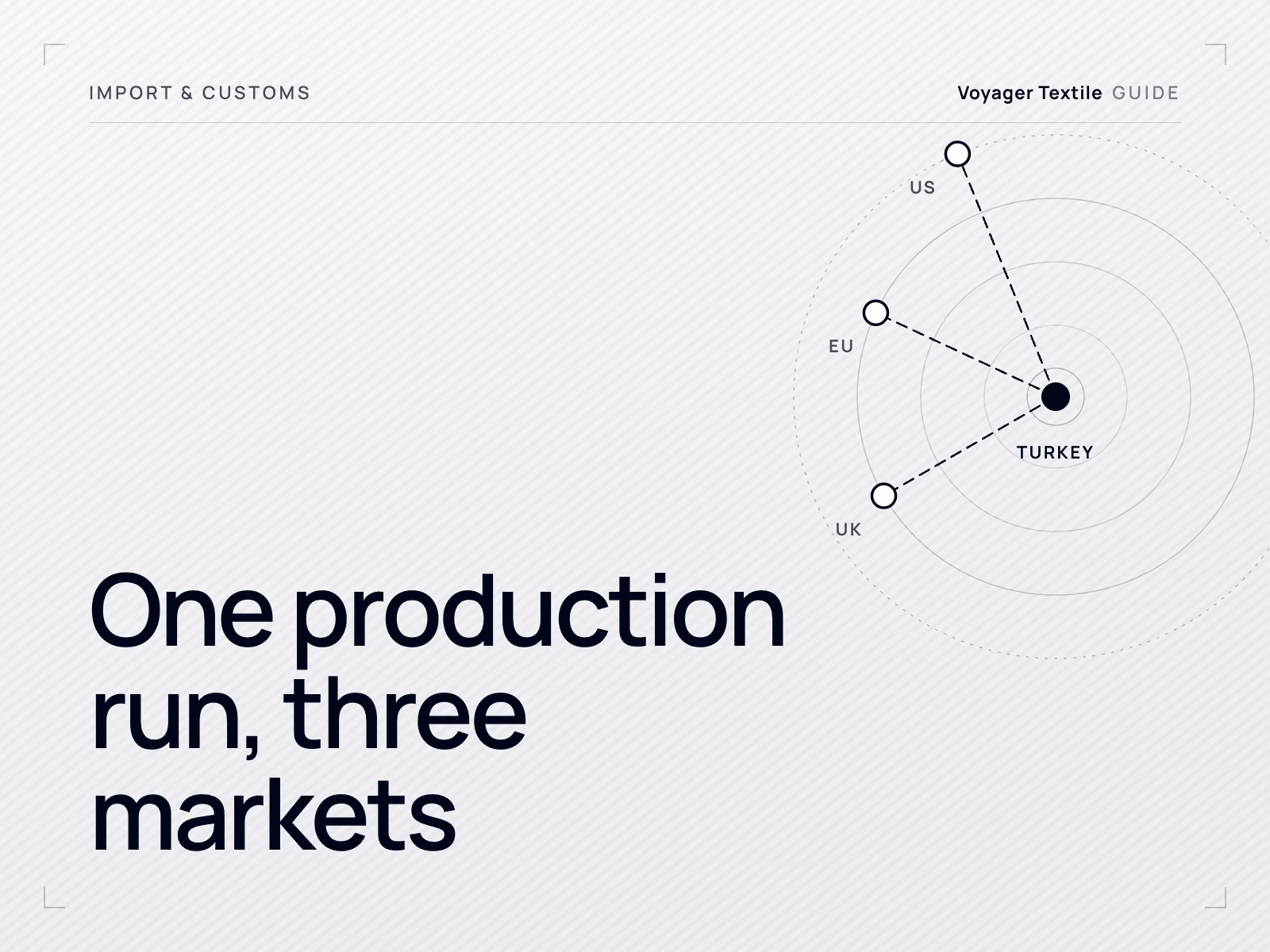
- An A.TR or EU customs status. The A.TR belongs to the EU–Türkiye Customs Union and has no effect on US duty. The three-market comparison is in one production run, three markets.
- Fabric from another country. For a garment wholly assembled in Türkiye, the origin stays Turkish and so does the Section 301 rate.
- Routing through another country. Shipping via an EU or other port without further processing does not change origin.
- The order date. The rate is the one in force when the goods are entered, not when the order was placed.
Before costing a US order from Türkiye
- Agree who is importer of record, and whether that party can act as one.
- Have the importer's broker confirm the HTSUS subheading for each style.
- Look up the general rate for that subheading in the current HTSUS and add 12.5% under heading 9903.05.79.
- Add the merchandise processing fee and, for ocean freight, the harbor maintenance fee.
- Write the origin, subheading, assumed rates and their date into the quotation.
- Agree in the contract who carries a change in duty between order and entry.
- Collect the supply-chain records the importer needs for forced-labour due diligence.
Questions buyers ask
What is the US tariff on clothing from Turkey?
The US tariff on clothing from Turkey is the HTSUS general rate for the garment's subheading plus 12.5% under Section 301 heading 9903.05.79, for goods entered from 24 July 2026. A cotton knitted T-shirt, 6109.10.00, carries 16.5% plus 12.5%.
Is the Section 301 duty added on top of the MFN rate for Turkish goods?
Yes. For Turkish goods, heading 9903.05.79 reads the duty in the applicable subheading plus 12.5%, so the Section 301 duty is added in full to the MFN rate. The combined-rate caps apply only to products of the EU, Taiwan, Japan, Korea and Switzerland.
Who pays US import duty on garments made in Turkey?
The importer of record pays US import duty on garments made in Turkey. Under 19 CFR 141.1(b), duty is a personal debt of the importer, and paying a customs broker does not discharge it if the broker fails to pay CBP.
Are the Section 301 tariffs being challenged in court?
Yes. The Section 301 tariffs are challenged at the US Court of International Trade, including by 25 states led by Oregon in Court No. 26-03467, filed 3 August 2026. CBP collects the duty unless a court orders otherwise.
Do IEEPA tariffs still apply to clothing from Turkey?
No. IEEPA tariffs ended when the Supreme Court held in Learning Resources, Inc. v. Trump, decided 20 February 2026, that IEEPA does not authorize tariffs. The Section 122 surcharge that followed ran from 24 February to 24 July 2026.
Does fabric from another country change the US duty on a garment sewn in Turkey?
Usually not. Under 19 CFR 102.21, a cut-and-sewn garment wholly assembled in one country takes that country as its origin, so a garment sewn in Turkey pays Türkiye's Section 301 rate whatever the fabric's origin. Knit-to-shape garments follow a different rule.
Quote a US programme on stated assumptions
Send the specification, quantity per colour and style, and your delivery terms. We will quote with the origin and the delivery term stated, so your broker can apply the duty for your subheading.
Request a quote