Choosing a manufacturer
Turkey vs Bangladesh vs Vietnam for 300 to 3,000 Pieces: Minimums, Lead Time and Duty
At 300 to 3,000 pieces per style, Türkiye usually fits better than Bangladesh or Vietnam: minimums are lower, road freight to Europe takes days, and apparel enters the EU duty free under the customs union. Bangladesh and Vietnam are typically built for larger volumes, and their advantage grows as the quantity per style rises. Duty into the EU and the US differs for all three and should be checked for the exact tariff code.
Last reviewed:
Contents
These three countries are compared often and usually for the wrong order size. Bangladesh and Vietnam are among the largest apparel exporters in the world and are organised around long runs. Türkiye is organised around shorter runs close to Europe. Between 300 and 3,000 pieces per style and colour the differences are at their largest, so this guide looks only at that range.
The short comparison
| Factor | Türkiye | Bangladesh | Vietnam |
|---|---|---|---|
| Minimum per style and colour | 300 pieces at Voyager Textile; sizes can be split inside it | Typically in the low thousands at export factories; higher for custom fabric | Typically from around 1,000 pieces at export factories; some accept less |
| Fabric base | Knitting, weaving and dyeing in the country | Strong domestic knit fabric base; woven fabric is often imported | Growing domestic base; much fabric is imported from elsewhere in Asia |
| Sample | 5 to 7 business days at Voyager Textile | Typically 2 to 4 weeks, plus courier time | Typically 2 to 3 weeks, plus courier time |
| Bulk after sample approval | 4 to 5 weeks at Voyager Textile | Typically 8 to 12 weeks | Typically 6 to 10 weeks |
| Transit to northern Europe | Road freight, typically a few days | Sea freight, typically 4 to 6 weeks | Sea freight, typically 4 to 6 weeks |
| Duty into the EU | None under the EU-Türkiye customs union, with an A.TR certificate | None under Everything But Arms, subject to origin rules | Preferential under the EU-Vietnam FTA, subject to origin rules |
| Additional US duty (Section 301) | 12.5 percent on top of the normal rate | 10 percent on top of the normal rate | 12.5 percent on top of the normal rate |
Minimums at 300 to 3,000 pieces
Minimums are the first filter in this range: an order of 300 to 1,000 pieces per style is below what many large export factories in Bangladesh and Vietnam are set up to run. Their lines are typically balanced for long runs of one style, and a short run costs them the same set-up time for far fewer pieces. Many will decline it, pass it to a smaller unit or accept it on different terms. Above about 3,000 pieces per style the picture changes and every country quotes.
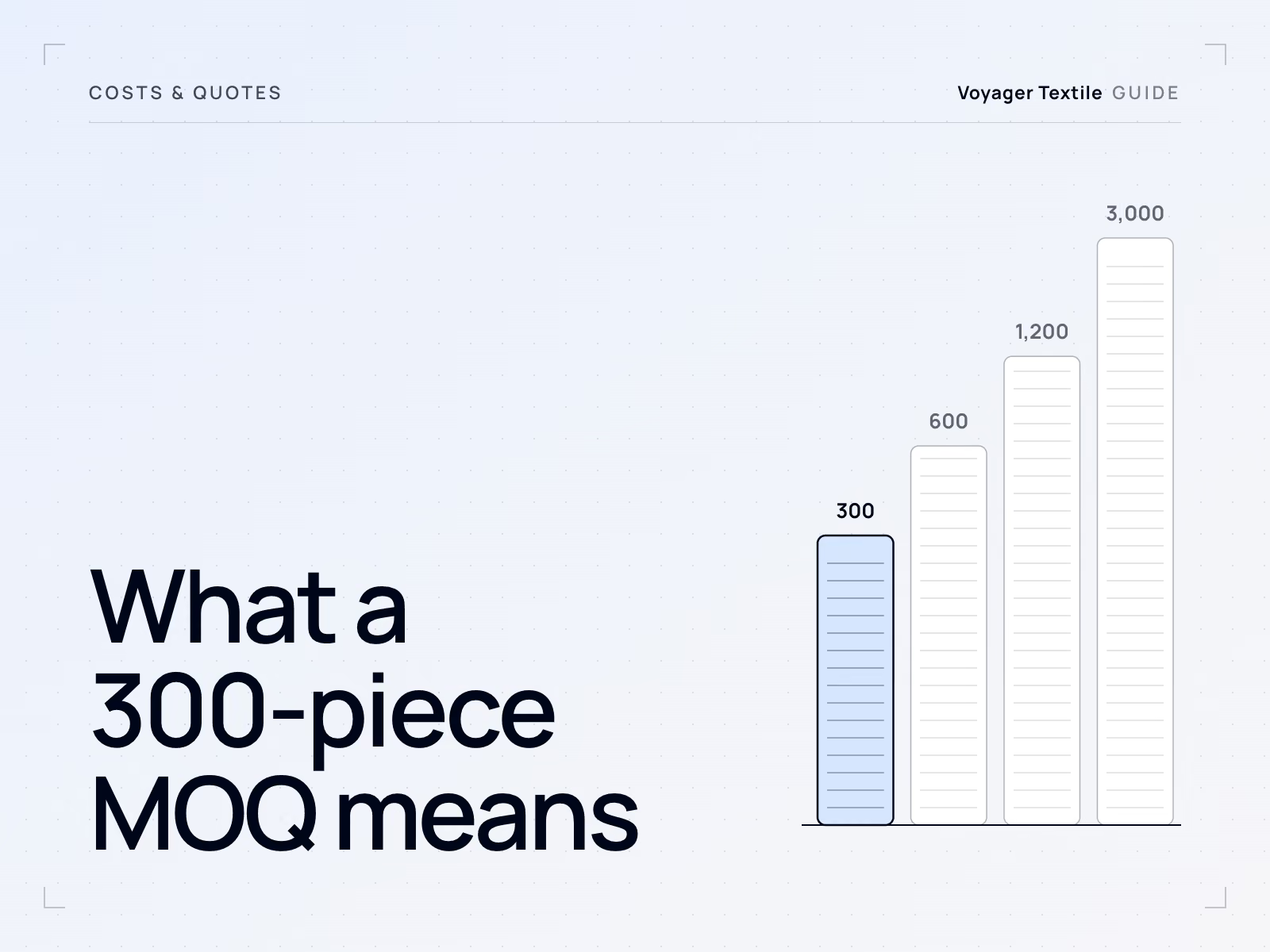
Fabric adds its own minimum. A custom colour or custom knit needs a dye lot, and where the fabric is imported the order also depends on a second supplier's minimum and shipping time. How minimums are built, and how to plan a range inside one, is covered in apparel manufacturing MOQ. At Voyager Textile the minimum is 300 pieces per colour and per style, including sublimation and custom Pantone colours.
Lead time door to door
Door to door into Europe, Türkiye is typically several weeks faster than Bangladesh or Vietnam for the same garment, mainly because of transit and fabric. The table below adds the stages for a repeat style in available fabric. Custom fabric adds time in all three countries.
| Stage | Türkiye (Voyager Textile) | Bangladesh (typical) | Vietnam (typical) |
|---|---|---|---|
| Sample | 5 to 7 business days | 2 to 4 weeks | 2 to 3 weeks |
| Bulk after approval | 4 to 5 weeks | 8 to 12 weeks | 6 to 10 weeks |
| Transit | A few days by road | 4 to 6 weeks by sea | 4 to 6 weeks by sea |
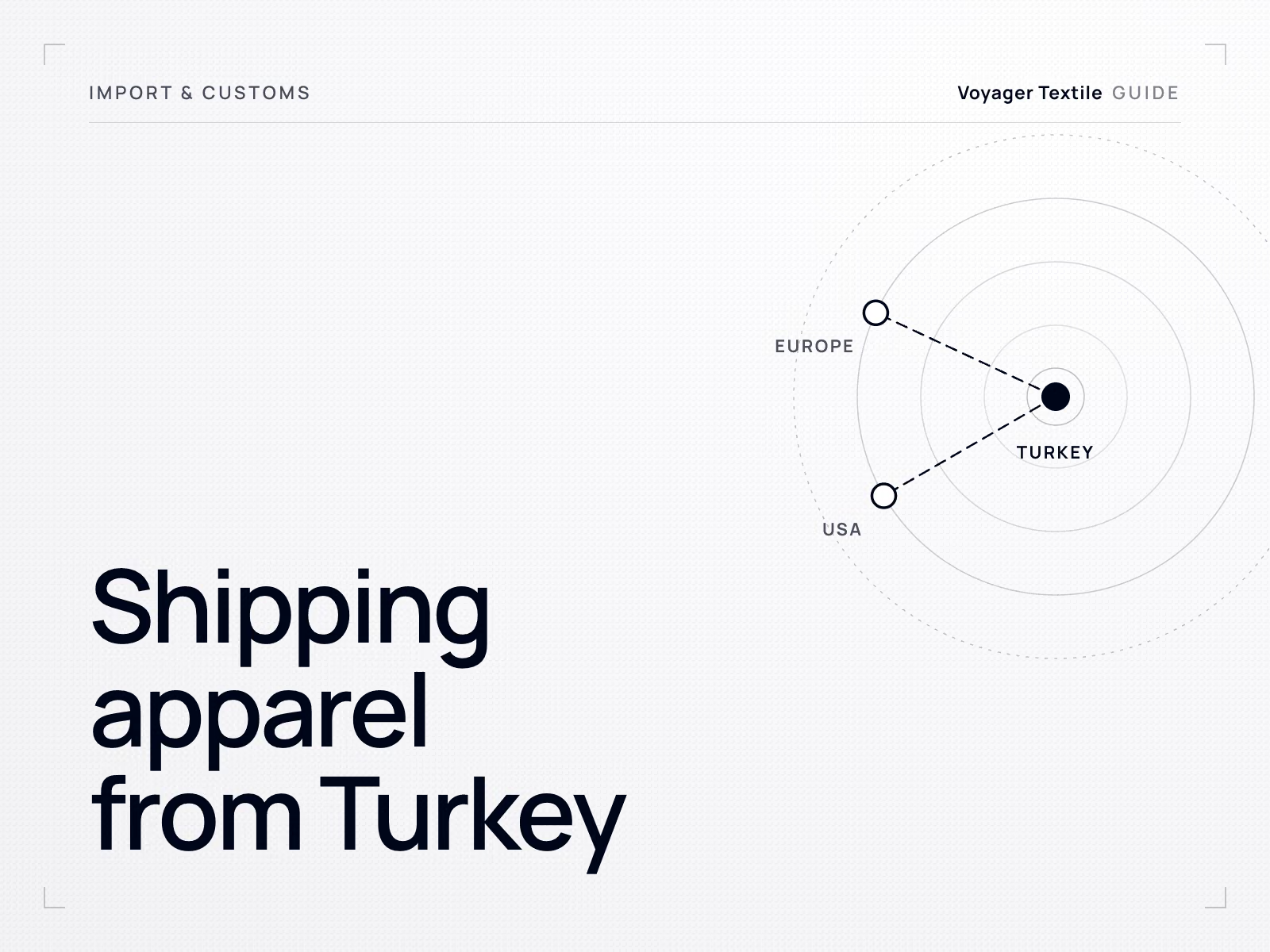
The gap matters especially for reorders. A style that sells out can be remade and delivered from Türkiye within the same season; from Asia, a reorder usually has to be placed before the first delivery has sold. Routes and documents from Türkiye are in shipping apparel from Turkey, and the stage-by-stage view is in apparel production lead times.
Duty into the EU
All three countries can ship apparel into the EU at zero or reduced duty, but under three different instruments with different conditions. Without any preference, most garments in Chapters 61 and 62 pay the normal EU rate, for example 12 percent on cotton T-shirts (CN 6109 10 00).
- Türkiye: customs union. Apparel in free circulation moves duty free under Decision No 1/95 of the EC-Turkey Association Council, with an A.TR movement certificate. The A.TR proves free-circulation status, not origin, as explained in A.TR versus origin.
- Bangladesh: Everything But Arms. As a least developed country, Bangladesh has duty-free access under the Everything But Arms arrangement of Regulation (EU) No 978/2012. Under the GSP rules of origin, apparel from a least developed country qualifies when it is made from fabric, which may be imported. Proof is a registered exporter (REX) statement on origin.
- Vietnam: EU-Vietnam Free Trade Agreement. In force since 1 August 2020, the agreement removes EU duties on apparel on a staged schedule of up to seven years. Garments qualify only when the fabric is made in Vietnam or the EU, with fabric from South Korea allowed under a cumulation provision. Garments sewn from other imported fabric pay the normal rate.
Bangladesh's position is set to change. It is scheduled to leave the UN least-developed-country category on 24 November 2026, and a request to defer graduation by three years is before the UN General Assembly. Article 17(2) of Regulation (EU) No 978/2012 keeps a graduated country in Everything But Arms for a three-year transitional period after removal, so duty-free access continues for some years either way. What applies afterwards depends on the preference rules then in force and on Bangladesh qualifying for them.
Duty into the United States
None of the three has a trade agreement with the United States, so all pay the normal Harmonized Tariff Schedule rate plus an additional Section 301 duty. The normal rates are high for apparel: 16.5 percent for cotton knitted T-shirts (HTSUS 6109.10.00) and for cotton sweatshirts and hoodies (6110.20.20), and 32 percent for the same garments in man-made fibres (6109.90.10, 6110.30.30).
| Origin | Additional Section 301 duty | HTSUS heading | Textile note |
|---|---|---|---|
| Türkiye | 12.5 percent | 9903.05.79 | No textile quota arrangement |
| Bangladesh | 10 percent | 9903.05.26 | A tariff-rate quota is provided for textiles and apparel from Bangladesh, Cambodia, Indonesia and Malaysia, linked to the use of US cotton or textile inputs, once implemented |
| Vietnam | 12.5 percent | 9903.05.84 | No textile quota arrangement |
The measure is being challenged before the US Court of International Trade by importers and a group of US states. Until a court decides otherwise it applies at entry, so recheck the rate close to the shipping date. Labelling, entry and forced-labour documentation for US imports are covered in the US labelling and import guide, and the US market as a whole in where to make apparel for the US market.
When Bangladesh or Vietnam is the better choice
Bangladesh or Vietnam is typically the better choice once the quantity per style runs well into the thousands and the style repeats. Basics in cotton jersey and fleece, bought on a long forecast, are where large Asian export factories are typically most competitive on unit cost, and the EU preferences above remove duty when the origin rules are met. Vietnam is also often chosen for technical outerwear and synthetic sportswear.
When Turkey is the better choice
Türkiye is typically the better choice between 300 and 3,000 pieces per style, when the range has many styles or colours in small quantities, and when the brand needs to see a sample within days and reorder within the season. It also suits programmes that need custom fabric or a custom colour developed close to the sewing factory. For the wider choice of production country, see the decision framework; for China, see Turkey vs China.
Questions buyers ask
What are the minimum order quantities in Bangladesh and Vietnam?
Minimum order quantities in Bangladesh and Vietnam are typically in the low thousands of pieces per style at export factories, with Vietnam sometimes lower. These are indicative ranges. Voyager Textile in Türkiye works from 300 pieces per colour and per style.
Is Turkey faster than Bangladesh or Vietnam for European orders?
Yes, for European orders Türkiye is typically several weeks faster door to door. Road freight takes days instead of weeks at sea, and fabric is usually made in the country. Custom fabric adds time in all three.
Does clothing from Bangladesh enter the EU duty free?
Clothing from Bangladesh enters the EU duty free under Everything But Arms when it meets the GSP origin rules. Bangladesh is scheduled to graduate from LDC status in November 2026, followed by a three-year transitional period.
Does clothing from Vietnam enter the EU duty free?
Clothing from Vietnam gets preferential EU duty under the EU-Vietnam Free Trade Agreement only if the fabric is made in Vietnam or the EU, or in South Korea under cumulation. Other garments pay the normal EU rate.
What is the US tariff on clothing from Turkey, Bangladesh and Vietnam?
The US tariff on clothing from all three is the normal HTSUS rate plus a Section 301 duty: 12.5 percent for Türkiye and Vietnam, 10 percent for Bangladesh. The measure is being challenged in court.
Quote your run of 300 to 3,000 pieces
Send the specification and your quantity per colour and style. We will quote it with sample and bulk timing, and tell you plainly if your volume would be better placed in Asia.
Request a quote