Uniform, medical and workwear
Scrub and Medical Uniform Manufacturing
Scrubs are working garments judged by pocket layout, freedom of movement and how they survive laundering. Modern scrub cloth is usually a polyester, rayon and spandex twill with four-way stretch, cut with more ease than fashion garments and reinforced where pockets and vents take stress. The set is produced and packed as a top and a bottom.
Contents
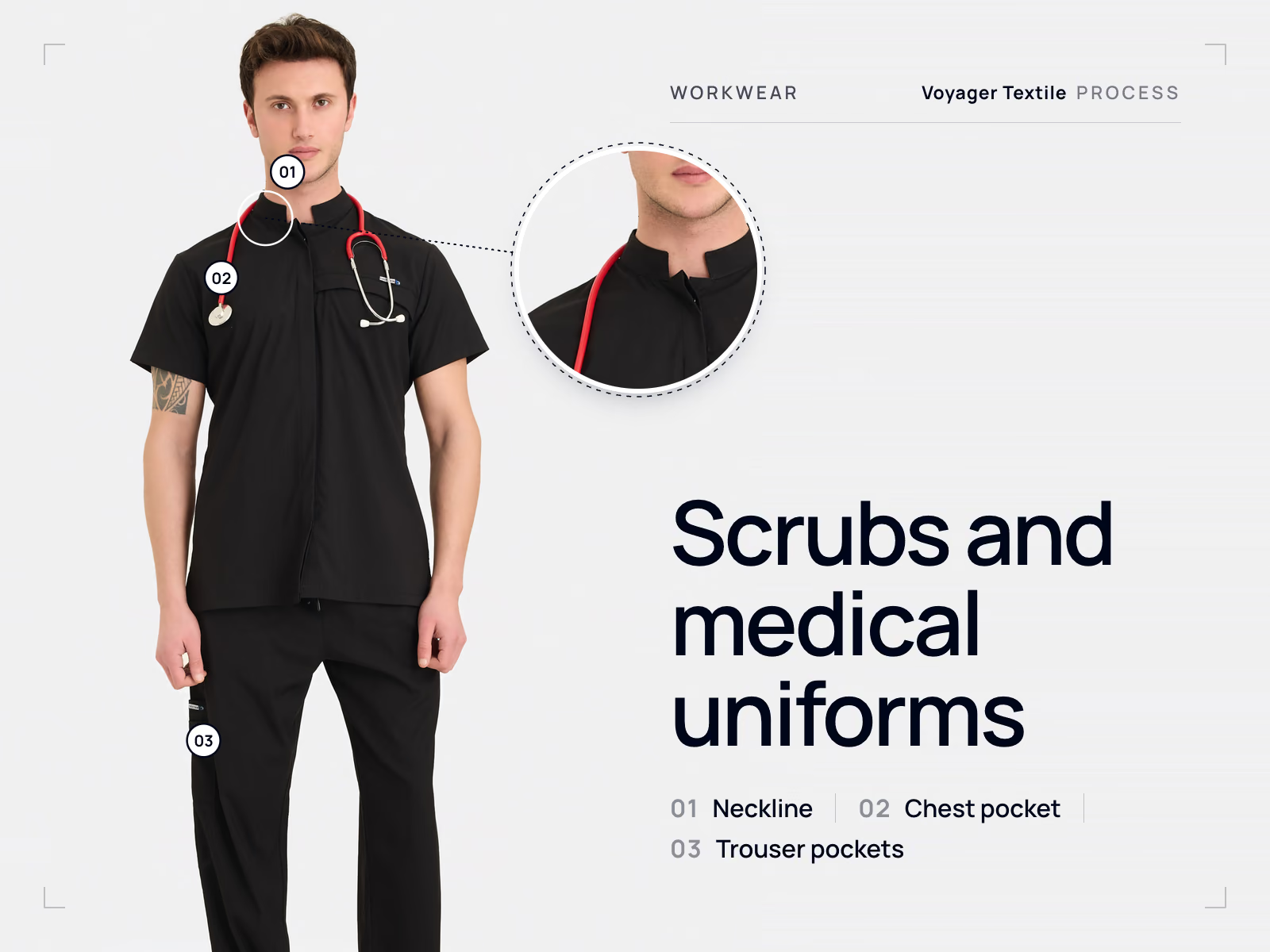
A scrub top is a simple garment carrying a difficult brief. It has to allow a full range of arm movement, hold a working amount of equipment without sagging, wash at high temperature several times a week for a couple of years, and still look presentable in front of patients. Every construction decision below comes from one of those four requirements.
Scrub production sequence
Scrub fabric: what has replaced plain poly-cotton
Traditional scrubs were woven poly-cotton, and they are still produced. A common modern choice in many markets is a blend that adds a small amount of elastane to a polyester and rayon base, giving a soft twill with four-way stretch that moves with the wearer and recovers.
| Fabric | Typical composition | Indicative GSM range | Character | Consideration |
|---|---|---|---|---|
| Polyester, rayon and spandex twill | Around 72 to 75% polyester, 20 to 22% rayon, 5 to 7% spandex | Around 160 to 190; commonly around 175 | Soft hand, four-way stretch, good recovery and drape | A common modern choice for clinical wear; confirm elastane behaviour at wash temperature |
| Polyester and cotton twill | Commonly around 55/45 or 65/35 | Around 140 to 190 | Crisper, more traditional, breathable | More shrinkage than an all-synthetic cloth; test at the real wash temperature |
| Heavier polyester twill | Polyester-rich, sometimes with a soil-release finish | Around 200 to 240 | More robust, holds shape, suited to heavy-use environments | Warmer to wear; consider it for outer layers rather than tops |
| Lightweight scrub cloth | Polyester-rich blends | Around 115 to 140 | Cool and light for warm climates | Check opacity, particularly in light colours |
Pattern: ease is the specification
Scrubs are cut with working ease rather than fashion ease. The armhole is deeper and the sleeve is wider than on a retail top, because the wearer reaches, lifts and leans all day. Where a stretch cloth is used, a slightly closer cut becomes possible, but ease at the shoulder and armhole is where comfort actually lives.
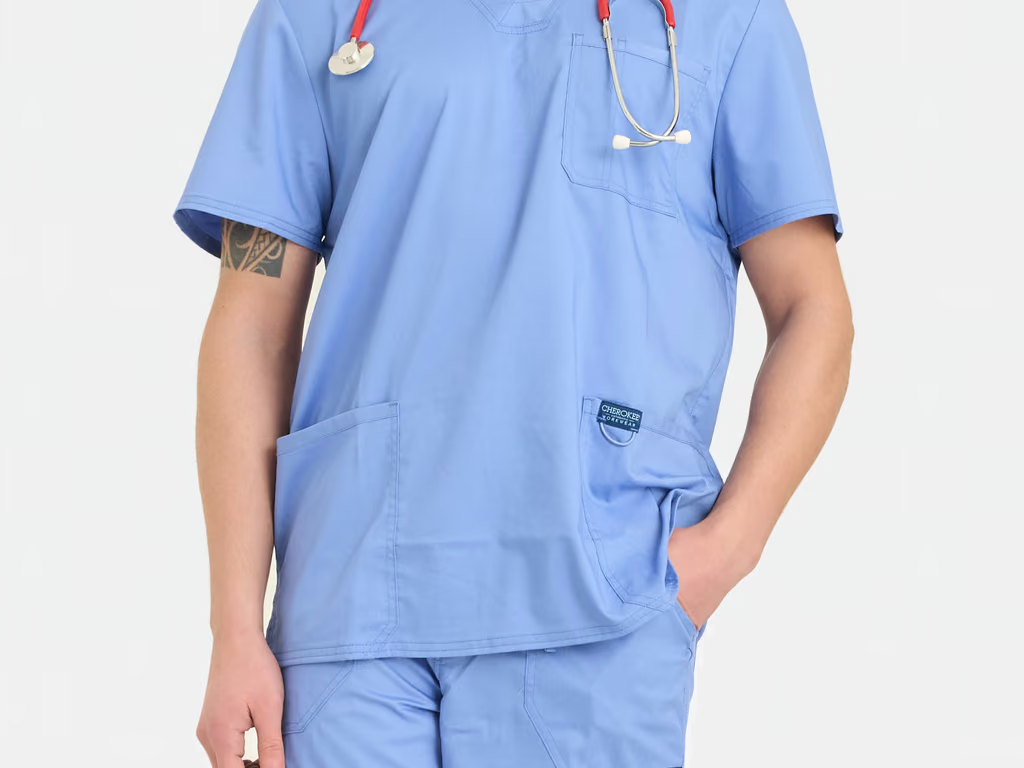
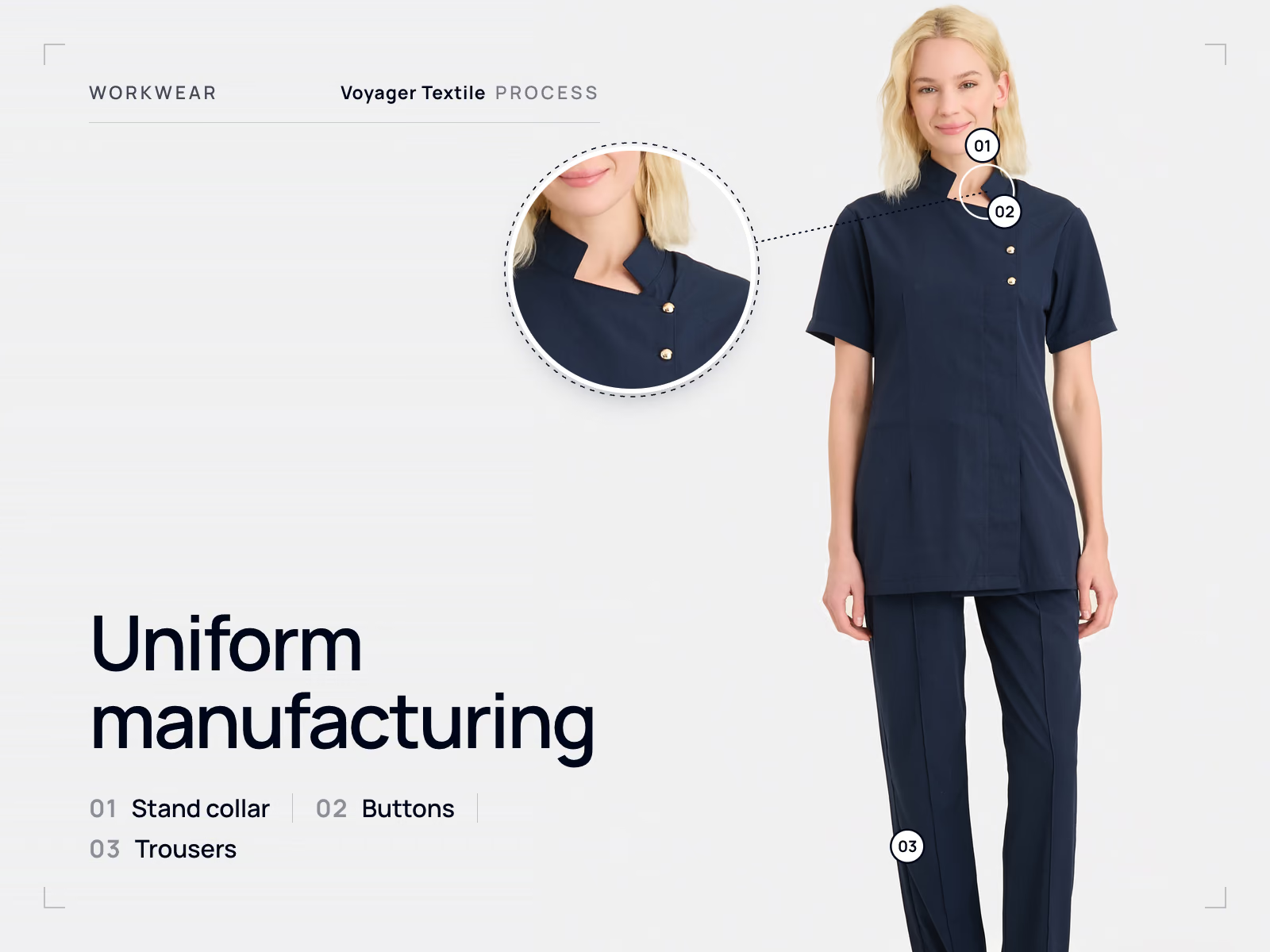
- Neckline. A V-neck is the standard; a mock wrap gives a more tailored look; a round neck with a placket is used in some services. Each has a different facing construction.
- Length. Tunic length or hip length, and whether the top is worn tucked or loose, which changes the hem finish and side vents.
- Side vents. Common on longer tops for movement, and a stress point that needs reinforcement at the top of the vent.
- Cuts. Unisex, men's and women's fits are genuinely different patterns rather than graded variants, particularly through the shoulder and hip.
Pockets are the product
Pocket layout is one of the main features clinical staff judge scrubs on. It is also where the manufacturing detail concentrates.

- Chest pocket. Usually one on the top, sometimes divided for pens. State the divisions and their widths rather than leaving them to the factory.
- Lower patch pockets. Set at a height that is reachable when the wearer is standing, with the opening reinforced at both corners.
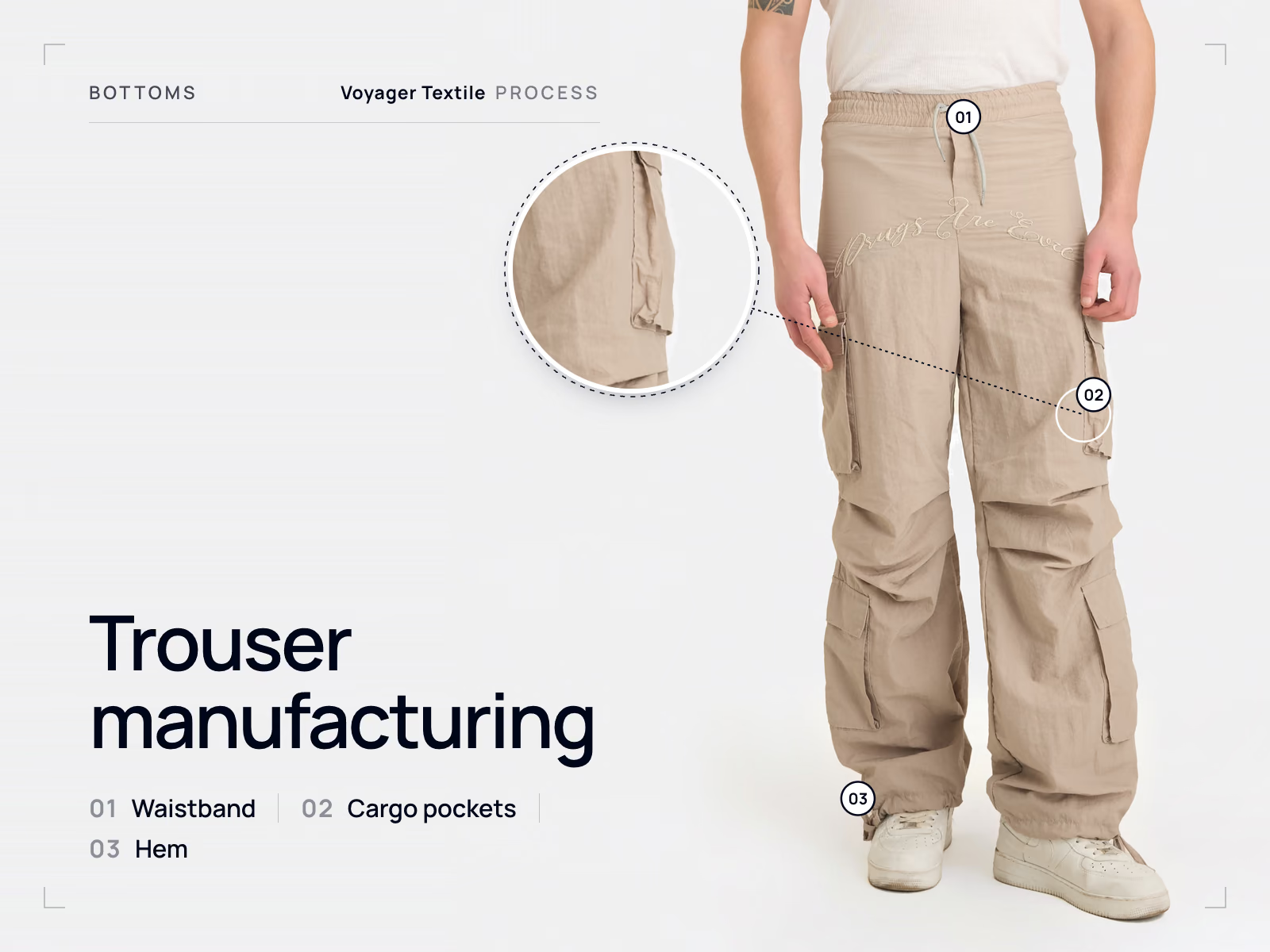
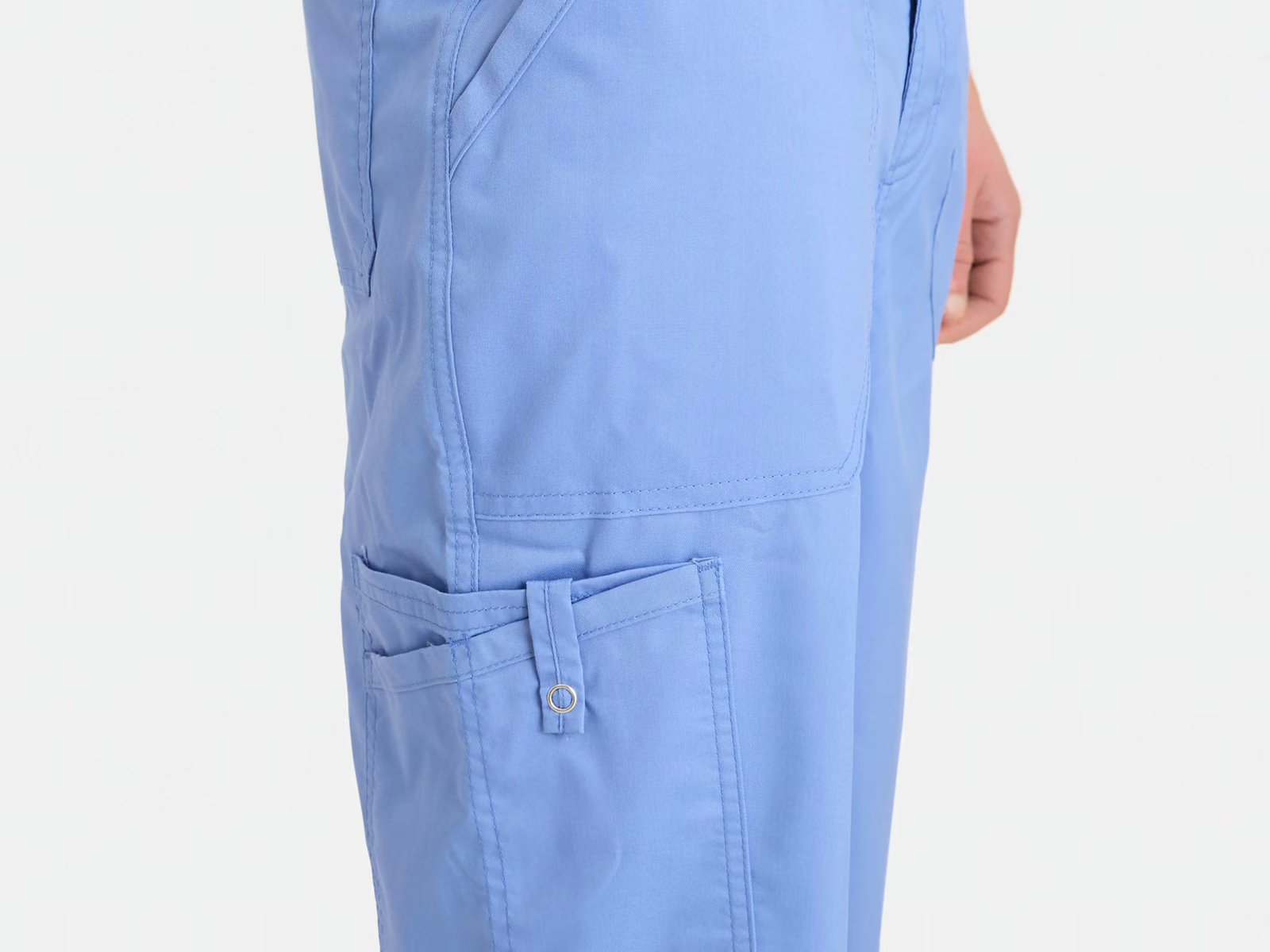
- Cargo or utility pockets on the trouser. Positioned so they do not swing when the wearer walks, and specified with a bag depth that actually holds equipment.
- Reinforcement. Bartacks at every pocket opening corner. This is not optional on a garment carrying scissors and devices, and it is a common quiet omission when a specification is vague.
- Pocket bag fabric. Self fabric holds shape; a lighter bag reduces bulk. On light colours, check that a loaded pocket does not show through.
- Sag control. A heavy pocket on a soft stretch cloth pulls the garment out of shape. This is why pocket placement and bag construction are specified together rather than separately.
Trouser construction
Scrub trousers are built for movement and quick changing, so the waistband is the defining component.
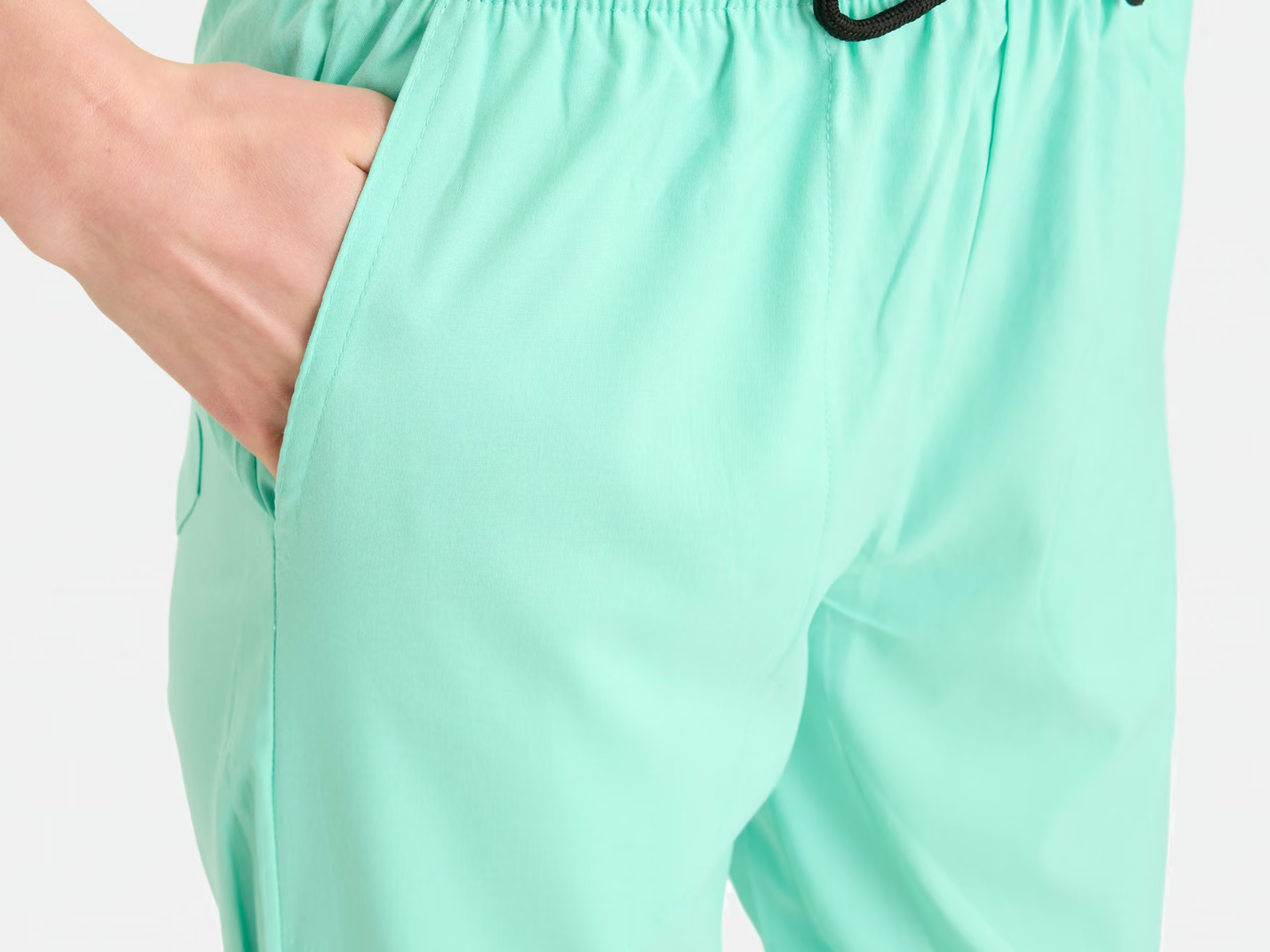
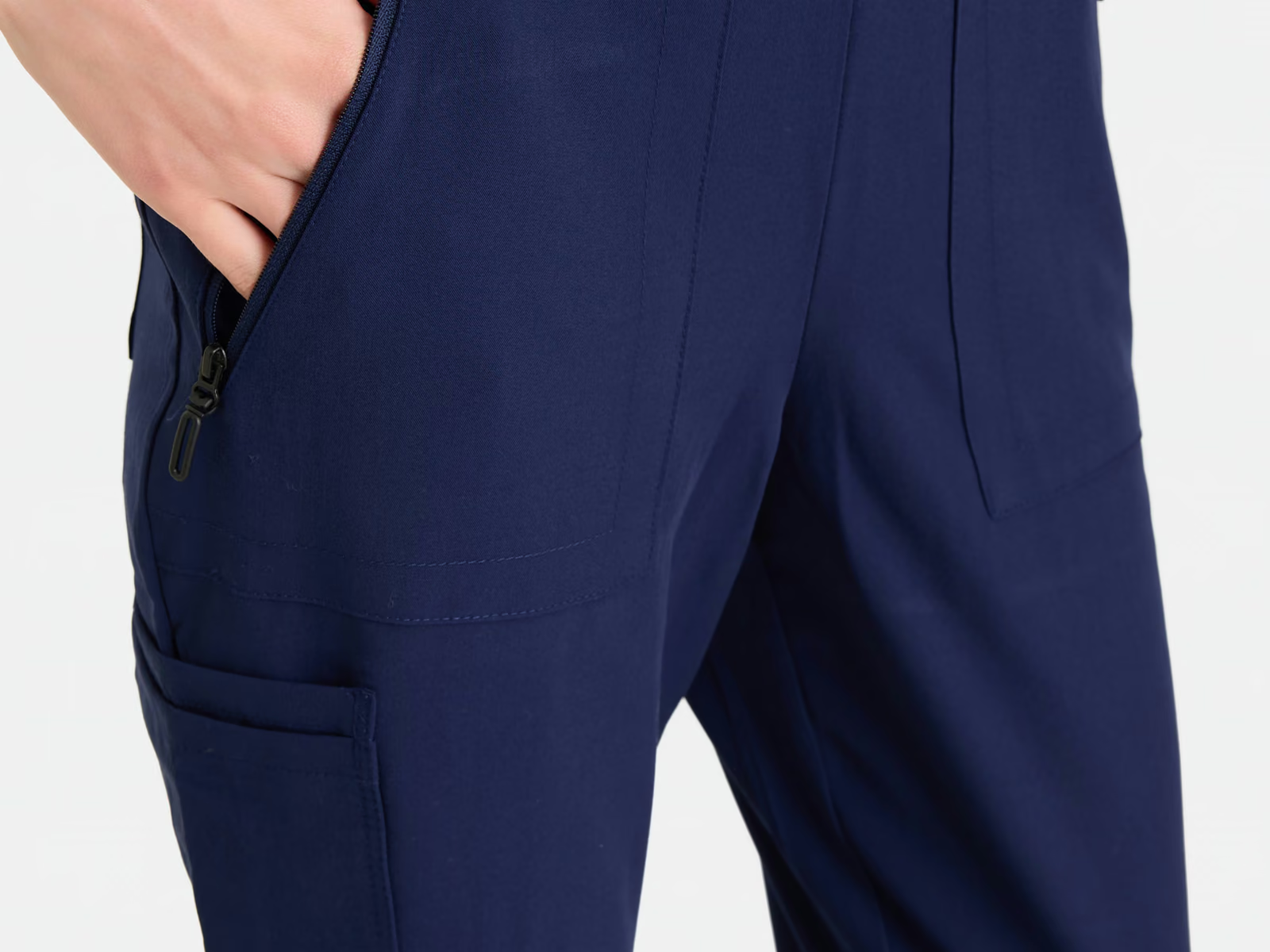
- Waistband options. Full elastic in a casing, elastic with a drawcord, a partly elasticated waistband with a flat front, or a rib waistband on modern styles.
- Drawcord. Specify width and finished length, and whether it exits through eyelets, buttonholes or a gap in the seam.
- Rise. State it as a measurement. It decides whether the trouser sits comfortably under a tunic length top.
- Gusset. Worth specifying for the same reasons as in sportswear: it removes the four-seam intersection at the highest-stress point.
- Leg finish. Straight, tapered or with a knitted cuff, and the inseam stated per size rather than as one value.
Laundering is the design constraint
Clinical garments are washed frequently, often hot, and sometimes in industrial laundries with mechanical extraction. That regime dictates fabric selection, colour choice and construction, and it should be written into the specification as a requirement rather than mentioned in conversation.
- Specify dimensional stability testing at the actual wash temperature, not at a domestic cycle.
- Specify colourfastness to washing, and to rubbing for dark shades worn against skin.
- Ask about elastane behaviour: high temperatures and mechanical stress shorten the working life of elastic fibres, which is why waistband and cuff recovery is worth testing after repeated washing.
- Confirm that any finish claimed on the fabric survives the number of wash cycles the programme expects.
The tests and how to specify them are covered in the quality control guide.
Identification and branding
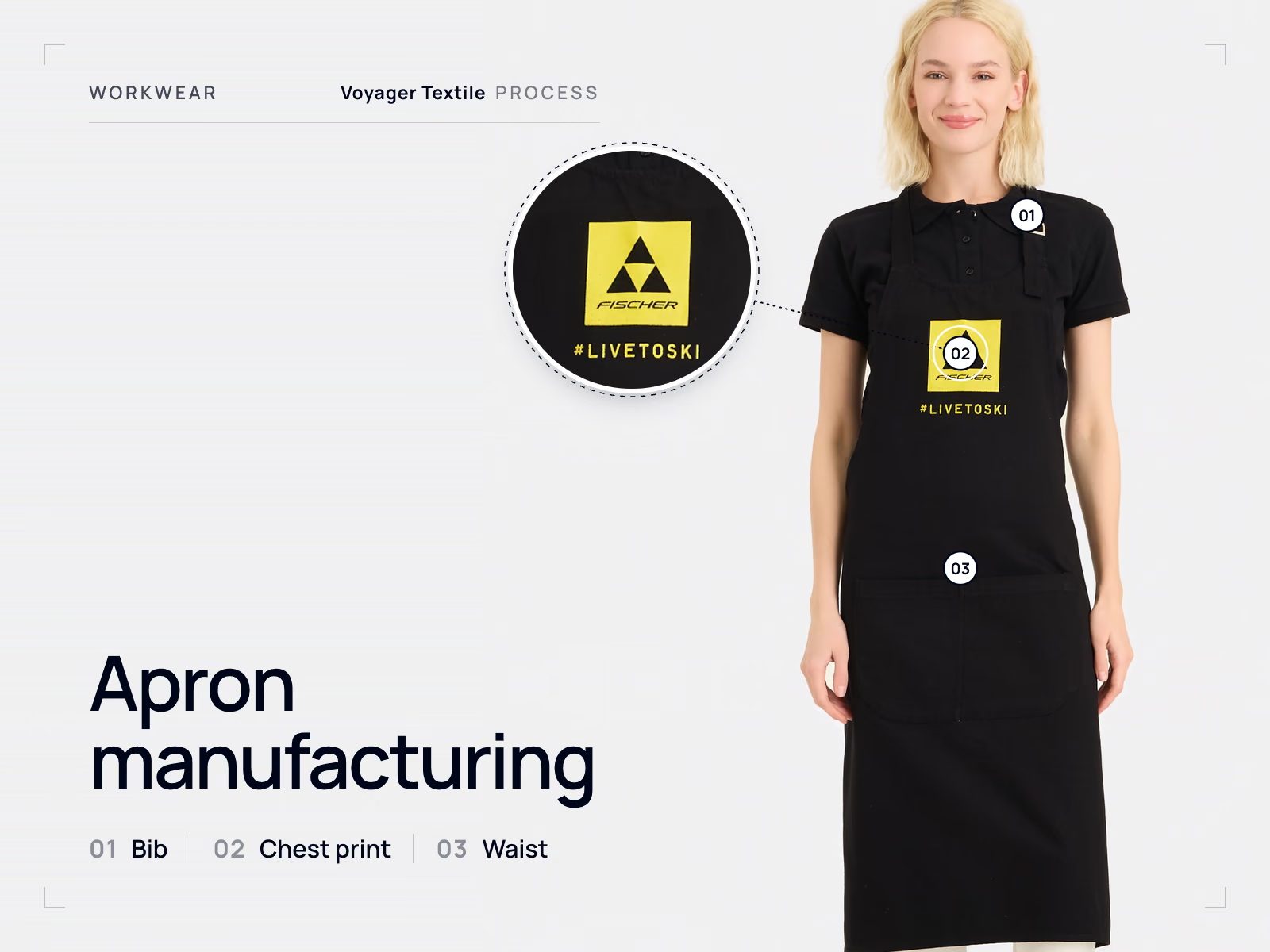
Embroidery is the standard, because it survives laundering and reads professionally. Facility logos are normally embroidered on the chest, worked on the panel before assembly. Names and roles change more often than logos, so applied badges or heat-applied lettering are the more practical route for individual identification.
Where a clinic or hospital uses colour to identify roles, treat those colours as programme colours with approved physical standards, because staff from different departments stand next to each other and any drift is visible. Managing that across a wider set of garments is covered in the uniform manufacturing process.
Assembly sequence
- Fabric is inspected and cut, with top and bottom taken from the same lot so the set matches.
- Pockets are constructed and reinforced as sub-assemblies.
- Top: chest pocket attached, shoulders joined, neckline faced or bound, sleeves set, side seams closed with vents formed, hems finished.
- Bottom: pockets attached, inseams and side seams closed, gusset set where used, waistband assembled with elastic and drawcord, legs hemmed.
- Embroidery is applied on the panel or the finished garment depending on placement.
- Labels are attached, garments are pressed lightly, measured, inspected and packed as sets.
Quality control: scrub-specific checks
| Check | What it catches |
|---|---|
| Bartacks present at every pocket corner | A common omission and an early failure in service |
| Pocket placement and symmetry, top and bottom | Pockets that are unreachable or visibly uneven |
| Neckline shape and facing flatness | A V-neck that gapes or twists |
| Vent reinforcement | Splitting at the top of the side vent |
| Top and bottom shade compared side by side | Two dye lots in one set |
| Shrinkage after washing at the real temperature | Sets that no longer fit after a month in service |
| Waistband and cuff recovery after wash testing | Elastane degradation under hot laundering |
| Set contents and size pairing in each pack | Mismatched sets reaching individual staff |
What to put in a scrub tech pack
- Fabric: composition with elastane percentage, weave, target weight and any finish, with the evidence required for a finish claim.
- Laundering regime the garments must survive, with required tests and pass criteria.
- Top: neckline type, length, side vents, sleeve length and ease at the armhole.
- Pockets: number, dimensions, placement, divisions and reinforcement, for both garments.
- Bottom: waistband construction, rise, drawcord, gusset, leg shape and inseam per size.
- Cuts required: unisex, men's, women's, and which sizes in each.
- Measurement charts with tolerances for both garments.
- Embroidery artwork, size and position, plus the method for names and roles.
- Colours, with approved physical standards where roles are colour coded.
- Packing: as sets, by department or by individual, and how sizes are marked.
Sampling
Sample the set together and have it worn by someone who will actually use it. Reach, bend and pocket loading reveal problems that a flat measurement never will, and clinical staff give precise feedback if asked specific questions rather than whether they like it.
Wash the sample at the intended temperature before approving bulk. For a multi-year programme, that single test is among the most useful steps in the sampling cycle.
Before you send a scrubs RFQ
- Fabric preference and whether stretch is required
- Laundering regime, including temperature and whether it is industrial
- Neckline style and top length
- Pocket layout for top and trouser, with any divisions
- Waistband construction and rise
- Cuts required: unisex, men's, women's
- Size range and split, ideally from staff data
- Colour coding by role, if used
- Embroidery artwork and placement, plus name and role method
- Any finish claims that must be evidenced
- Packing model and annual replacement estimate
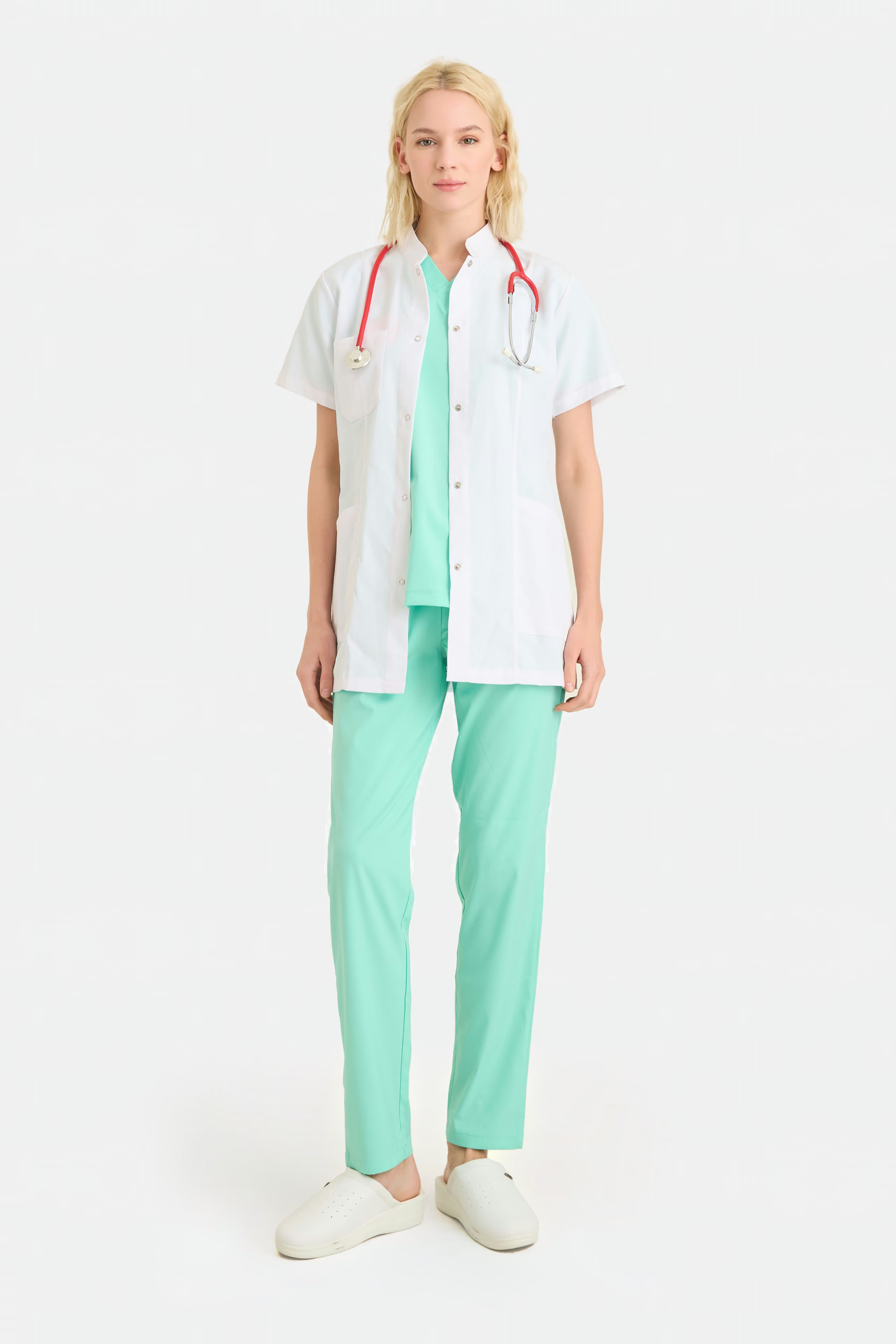
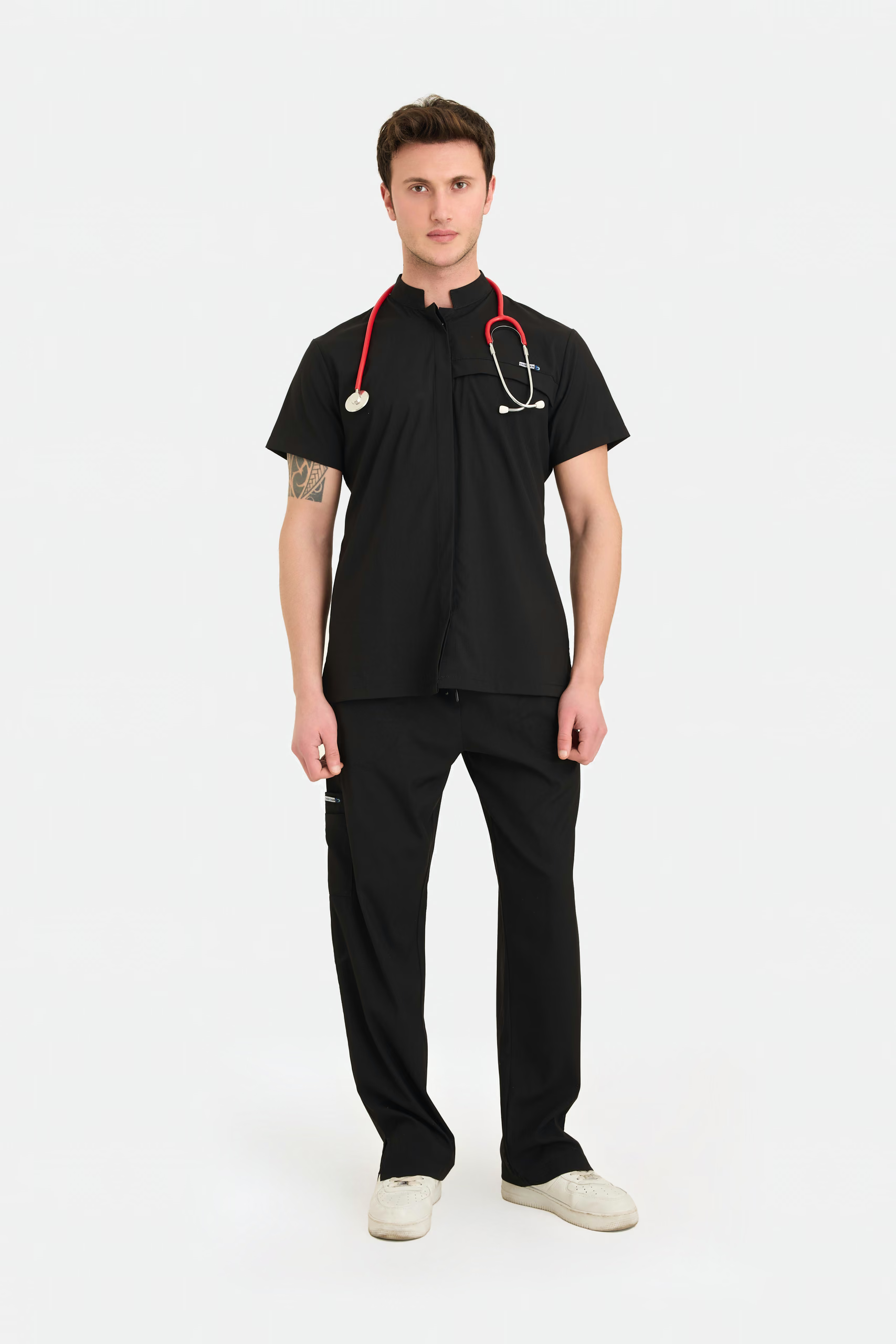
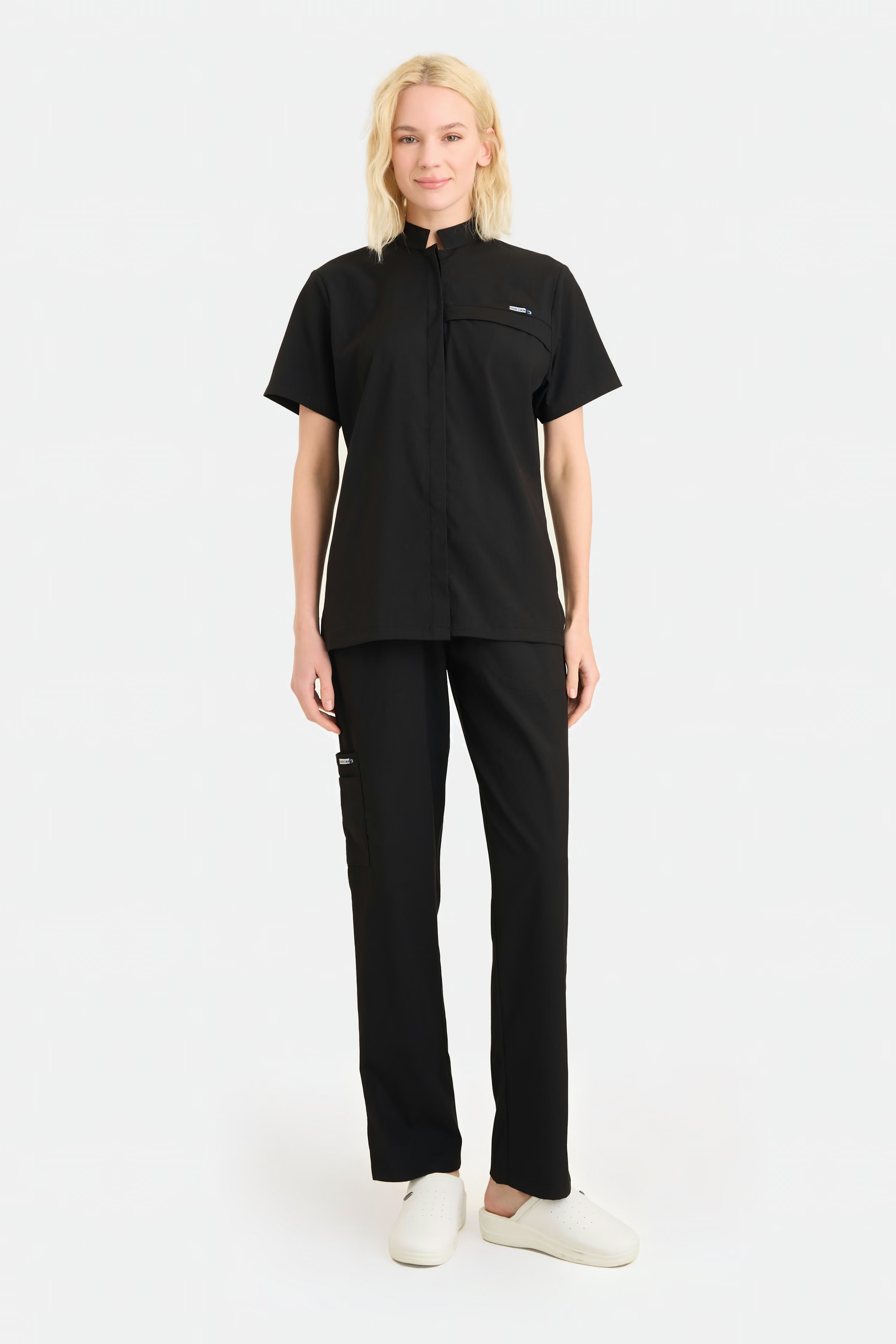
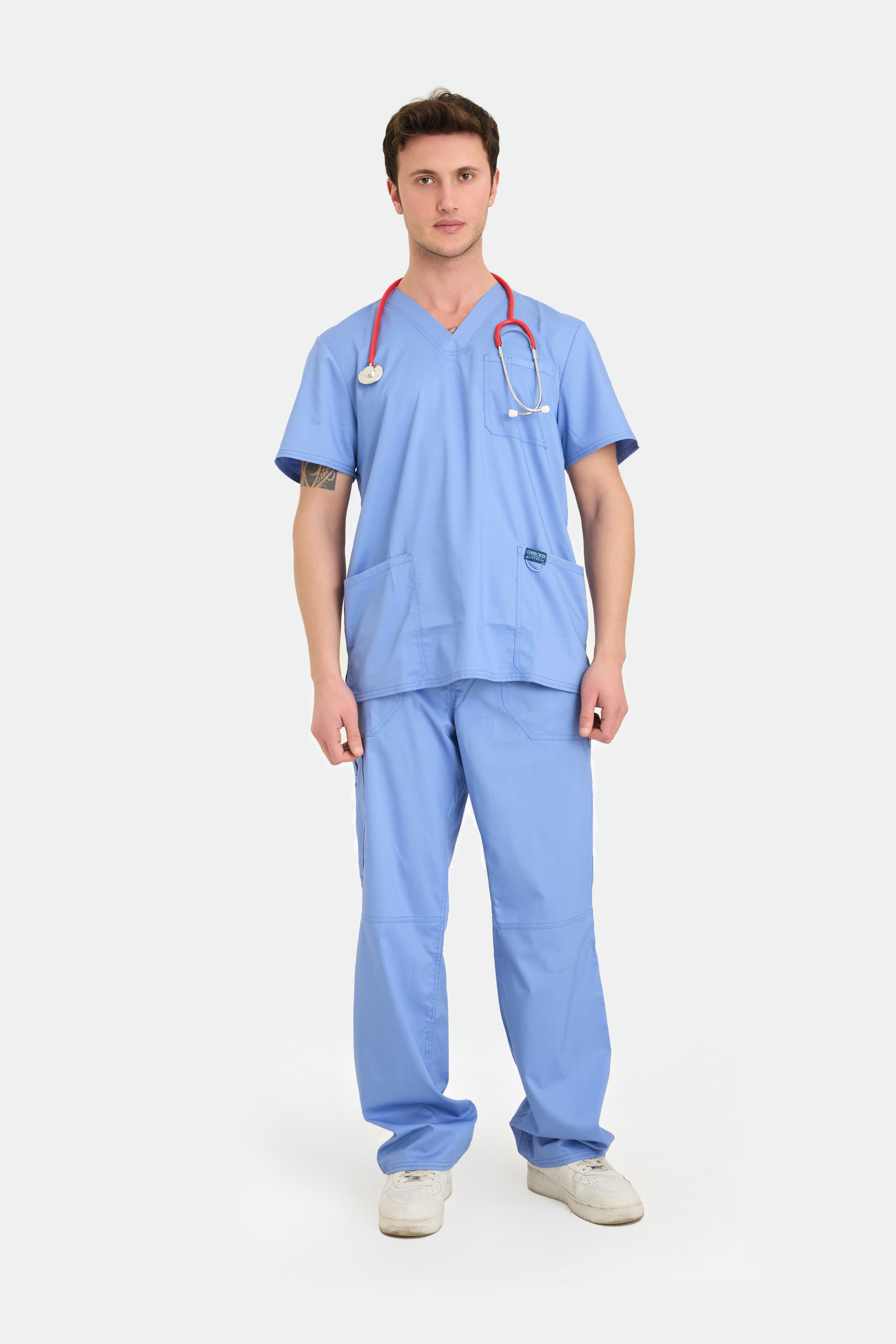
Scrub references produced by Voyager Textile
Scrub sets produced to customer specification for clinical and beauty-sector programmes.
Buyer questions
What fabric are medical scrubs made from?
A common modern choice is a polyester, rayon and spandex twill, commonly around 72 to 75% polyester, 20 to 22% rayon and 5 to 7% spandex, typically near 175 g/m², which gives a soft hand with four-way stretch. Traditional poly-cotton twills around 140 to 190 g/m² are still produced and are crisper and more breathable.
Why do scrubs use stretch fabric?
Because clinical work involves reaching, bending and lifting all day. A small elastane content lets the garment move with the wearer and return to shape, which allows a slightly closer cut without restricting movement.
How many pockets should scrubs have?
It depends on the role, which is why pocket layout should be specified rather than left to a standard. A common arrangement is one chest pocket on the top, two lower patch pockets, and cargo or utility pockets on the trouser. State dimensions, placement, any pen divisions and the reinforcement at each opening.
Do scrubs shrink?
Polyester-rich fabrics move less than cotton-rich ones, but every fabric moves to some degree at high wash temperatures. Specify dimensional stability testing at the actual laundering temperature rather than a domestic cycle, and state whether the measurement chart applies before or after washing.
Can scrubs be antimicrobial or fluid repellent?
Those are fabric finishes with specific test methods behind them, not general properties of scrub cloth. If the claim will appear on a label or in a tender, ask for the finish to be named and evidenced for the exact fabric, and confirm how it performs after the number of wash cycles your programme expects.
Should scrubs be embroidered or printed?
Embroidery is the normal choice for facility logos, because it survives industrial laundering and reads professionally. Names and roles change more often than logos, so applied badges or heat-applied lettering are usually more practical for individual identification.
Are scrub tops and trousers sold as sets?
Often, but staff frequently need different sizes on top and bottom. Decide whether you are buying fixed sets or separates before the order, because it changes the size split, the packing specification and how the goods are received.
What causes scrub pockets to tear?
Missing or insufficient bartacks at the pocket opening corners, combined with pockets loaded with equipment. Specify reinforcement explicitly at every opening and include it as a checked item at final inspection.
What is the minimum order for custom scrubs?
At Voyager Textile, custom apparel production starts at 300 pieces, with custom Pantone colour production also from 300 pieces. Because a scrub set is two garments, confirm how the minimum applies to the set at RFQ stage.
Ordering this garment from Voyager Textile
- Every garment is made to order, to your own design.
- The minimum order is 300 pieces per colour and per style. Sizes can be split inside the 300, and a custom Pantone colour carries the same minimum of 300 pieces. Polyester-based fabrics are assessed separately.
- A sample takes 5–7 business days. Bulk production takes 4–5 weeks after sample approval; development, sampling and shipping are additional.
- Cutting, sewing, embroidery, transfer printing and sublimation printing are done in our own factory in Türkiye. Screen printing and garment washing are coordinated with partner facilities.
Quantities, timing and any open point are confirmed per project at the quotation stage, once we have your specification or tech pack.
Request a quoteProducing scrubs for a clinical programme?
Send the fabric preference, pocket layout and the laundering regime the garments have to survive. We sample the set, wash-test it at your temperature and hold the specification for repeat orders.
Send a scrubs brief