Wovens
Twill and gabardine
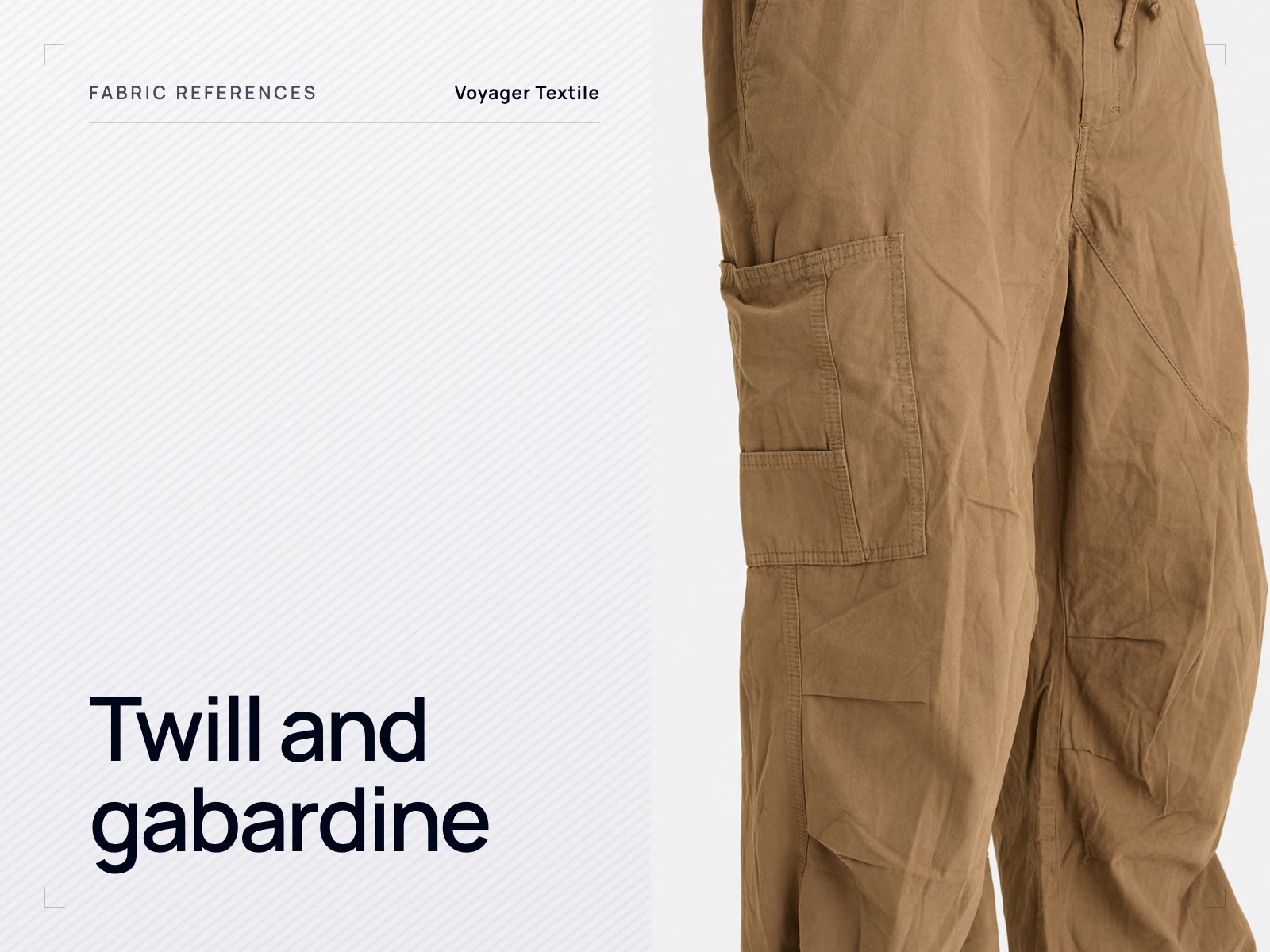
Twill is a weave in which the interlacing points step across the cloth, producing the diagonal line visible in chinos, workwear and denim. Gabardine is a tightly woven twill with a smoother, firmer face. Both belong to the bottom-weight family, which is where much woven garment production sits.
Contents
What a twill is
In a plain weave every yarn passes alternately over and under, which produces a flat, symmetrical surface. In a twill the interlacing point moves along by one yarn on each successive row, and the result is the diagonal line that runs across the face of the cloth.
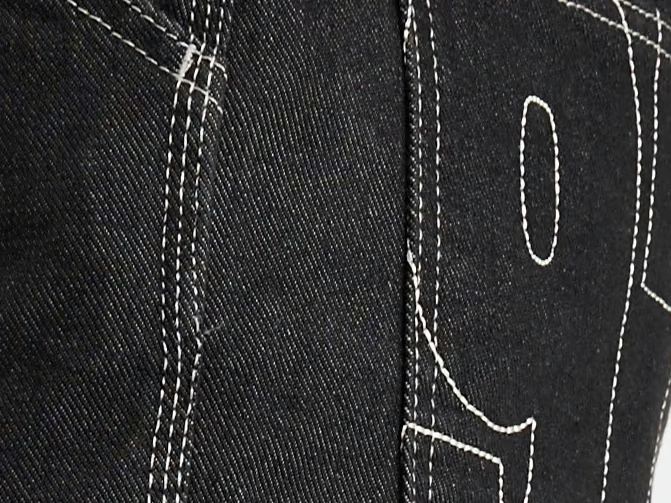
That structure has practical consequences. Fewer interlacing points mean the yarns can pack more closely, so a twill of a given weight is denser and drapes better than a plain weave of the same weight. The diagonal surface also disguises soiling and light creasing, which is why twills are widely used in workwear and service clothing.
Mills describe the construction as a ratio: a 2/1 twill passes over two yarns and under one, a 3/1 passes over three. A higher first number produces a more pronounced diagonal and a more warp-faced surface, which is the construction used in denim.
Where gabardine differs
Gabardine is a twill woven tightly with a fine, hard yarn, producing a smooth face with a steep, closely spaced diagonal. It reads as more tailored than a standard chino twill, holds a pressed crease well and resists abrasion.
For a buyer the distinction is mostly about appearance and formality rather than performance. A gabardine trouser looks like uniform or corporate clothing; a softer cotton chino twill looks casual. Both can be specified at similar weights.
Typical sourcing weights
| Cloth | Indicative weight | Character | Typical use |
|---|---|---|---|
| Cotton chino twill | Around 250 to 300 g/m² for year-round weights | Softer hand, casual appearance, takes a crease | Chinos, casual trousers, light jackets |
| Cotton gabardine | Around 250 to 280 g/m² | Smooth, firm, tailored | Uniform and corporate trousers, skirts |
| Polyester-cotton workwear twill | Around 195 to 300 g/m² | Durable, holds colour, dries faster, resists shrinkage | Workwear trousers, aprons, service uniforms |
| Heavier winter cloths | Around 350 g/m² and above | Substantial, warmer, more structured | Winter trousers and outerwear shells |
| Cotton canvas and duck | Around 8 to 12 oz, roughly 270 to 410 g/m² | Dense plain or basket structures, hard wearing | Aprons, bags, heavy workwear |
| Denim | Around 8 to 14 oz, roughly 270 to 475 g/m² | Warp-faced twill, usually indigo warp with undyed weft | Jeans, jackets, skirts |
Stretch wovens
Adding 2 to 5% elastane to a woven cloth changes how a bottom feels without changing how it looks. It is now common for service and field roles where people move all day, and it is common in retail chinos.
Two things change in production. Shrinkage behaviour differs from the plain cloth, so a stretch version needs its own wash test and its own fit sample rather than inheriting the results. And recovery becomes a property worth specifying, because a stretch trouser that bags at the knee after a day is a recovery failure rather than a fit failure.
What changes when a garment is woven
A woven cloth does not stretch unless elastane is present, which means ease has to be designed into the pattern rather than borrowed from the fabric. It also frays at cut edges, so seam allowances need finishing, and it holds a pressed shape, which is why pressing is part of the construction of a woven garment rather than a finishing step.
Grain control matters more than on a knit. A leg cut off-grain twists as soon as it is washed, and it cannot be corrected afterwards. The garment-side detail is in the trouser manufacturing process, and the broader comparison is in the knitted versus woven guide.
Finishing and behaviour
- Sanforising or comparable pre-shrinking reduces residual shrinkage, and it is worth asking whether a cotton-rich cloth has had it. It is a fabric-stage process and a licensed trademark rather than a generic one, so it is not the same thing as a garment wash.
- Peached or brushed finishes soften the face and change the appearance, at some cost to abrasion resistance.
- Soil-release and water-repellent finishes are available for service and workwear cloths. They are treatments with a service life rather than permanent properties, and any claim needs the finish named and evidenced.
- Colour retention on dark workwear cloths is worth testing, since industrial laundering is hard on shade and dark trousers are usually washed with everything else.
Decoration on wovens
Wovens are stable, which makes them straightforward to embroider: there is far less distortion risk than on a light knit, though backing is still selected for the cloth. Printing works well on smoother twills and gabardines, while a heavy canvas texture softens fine detail, so bold artwork reproduces better than thin lines. Both are normally applied to the flat panel before the garment is assembled.
Questions buyers ask about this fabric
What is the difference between twill and gabardine?
Gabardine is a twill, woven tightly with a fine hard yarn to give a smooth face and a steep, closely spaced diagonal. A standard chino twill is softer and more casual in appearance. Both sit in similar weight ranges; the difference is surface, formality and firmness.
What weight should trouser fabric be?
Cotton chino and gabardine cloths commonly sit around 250 to 300 g/m² for year-round wear, with heavier winter cloths above that. Polyester-cotton workwear twills are commonly offered around 195 to 300 g/m². Denim is usually quoted in ounces, most often between 8 and 14.
Why do workwear trousers use polyester-cotton rather than cotton?
Because polyester content holds dimensions and colour better under frequent hot or industrial laundering, and dries faster. Cotton-rich cloths feel better and are more breathable, which is the trade-off to weigh against the wash regime.
Is elastane worth adding to a woven trouser?
For roles involving movement, usually yes: it improves comfort noticeably at 2 to 5%. Plan for it changing shrinkage behaviour and specify recovery, because a stretch cloth with poor recovery bags at the knee.
Can twill be used for aprons?
Yes, and it is common. A cotton twill around 240 to 300 g/m² gives a softer front-of-house apron, while canvas in the 8 to 12 oz band is used where the apron has to survive kitchen and workshop use.
Specifying a woven bottom or workwear cloth?
Tell us the role, the laundering and whether stretch is needed. We will propose a construction and weight, confirm what finishing is available, and wash-test the sample before bulk.
Ask about woven fabrics