Choosing a manufacturer
How to Compare Clothing Manufacturer Quotes: Incoterms, Size Ratios, Trims and Tolerances
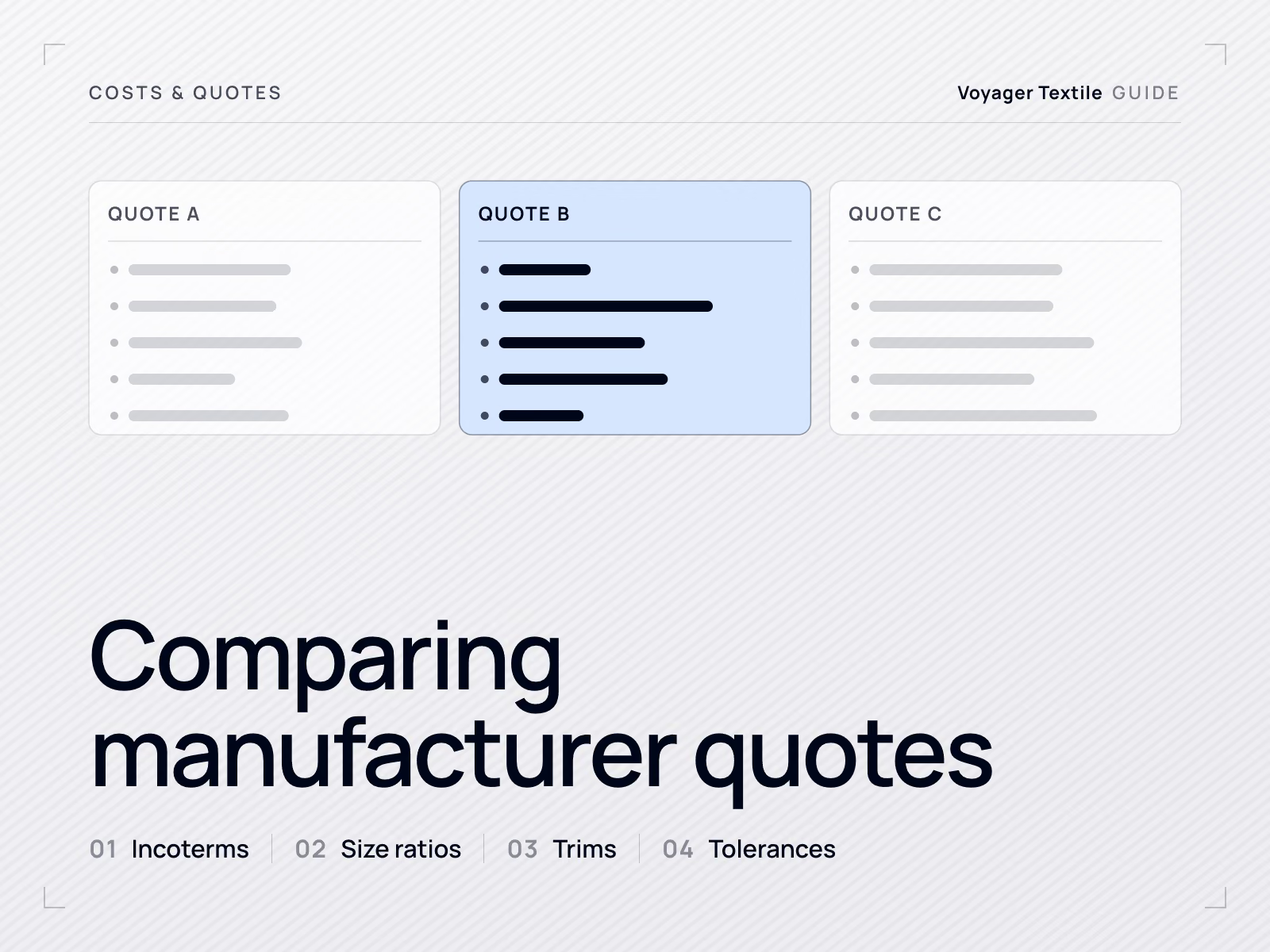
Compare clothing manufacturer quotes line by line against one specification, not by unit price. Put every quote on the same Incoterm, the same quantity basis and size ratio, the same trims and packing, and the same tolerances, and list what each one excludes. Only then do the unit prices describe the same garment.
Last reviewed:
Contents
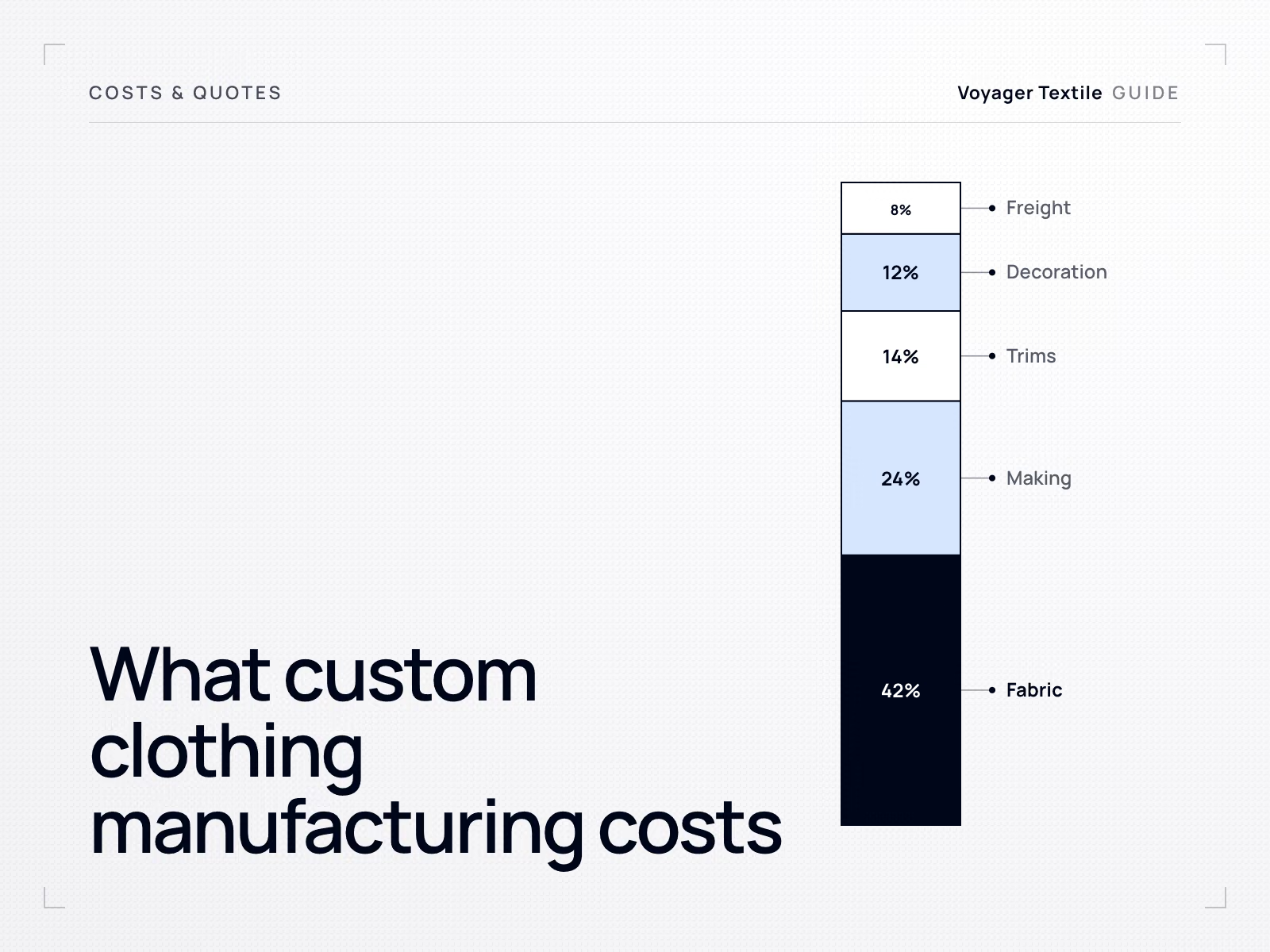
Two quotes for the same tech pack rarely price the same garment. One may assume a lighter fabric, an even size split and delivery at the factory gate, the other the specified fabric, a weighted size split and delivery to your warehouse. The unit price is the last line to compare, after every other line has been put on the same basis. This guide gives the order of that work, the lines a quote must state and a worked example. What a quotation is built from is covered in custom clothing manufacturing cost.
Start from one specification
Quotes can be compared only if they answer the same request. Send each supplier the same specification version, with fabric, size chart, colours, decoration, labels, packing and quantities, and ask them to name every point where they have quoted something different. A supplier that quotes an alternative fabric may be making a useful suggestion, but that alternative belongs on a separate line. What the request should contain is set out in the RFQ guide.
The lines a quote must state
A complete quote states each of the lines below. Where a line is missing, the supplier has made an assumption you cannot see, and that assumption is where two prices usually diverge.
| Line | What it should state | What happens if it is missing |
|---|---|---|
| Specification version | Style reference and the tech pack version quoted | The quote may price an older or simplified garment |
| Fabric | Composition, knit or weave, weight in g/m², finish | A lighter or different fabric can lower the price unseen |
| Colour | Number of colours, Pantone TCX references, lab dip approval | Custom colour development appears later as an extra |
| Quantity basis | Pieces per style, per colour and in total | The price may assume a larger order than yours |
| Size ratio | The size split the price assumes | Larger sizes use more fabric; an even split can understate cost |
| Decoration | Method, size, position, colours; in-house or partner | Screens, digitising or a partner step appear later |
| Trims and labels | Each component, whether nominated or sourced by the factory | Cheaper substitutes, or trims left for you to supply |
| Packing | Fold, polybag, hangtags, carton contents and marks | Packing billed separately or done differently |
| One-off costs | Sampling, patterns, screens, digitising, shown apart | One-off costs hidden in the unit price, or added later |
| Delivery term | Incoterms rule with its named place | Freight, insurance or duty sit with a party you did not expect |
| Lead times | Sample time and bulk time, each with its start event | Two lead times counted from different events look equal |
| Tolerances | Measurements, shade, fabric weight, quantity | Nothing to reject against at inspection |
| Validity | The date until which the price holds | The price changes when material costs move |
| Payment terms | Timing and mechanism of payment | Different terms change the real cost of the order |
Incoterms: compare on one delivery basis
Two prices on different Incoterms are prices for different services, so convert them to one term before comparing. The rules, published by the International Chamber of Commerce, decide who arranges and pays for each leg of transport, where risk passes, and who handles export and import formalities. They do not set payment terms.
| Term | Where the seller's obligation ends | What the buyer still adds to compare |
|---|---|---|
| EXW | Goods made available at the seller's premises | Loading, export clearance, all transport, insurance, import duty and clearance |
| FCA | Goods handed to the buyer's carrier at the named place, export-cleared | Main transport, insurance, import duty and clearance |
| FOB | Goods loaded on board the vessel at the named port (sea only) | Sea freight, insurance, import duty and clearance |
| CIF | Goods on board, with sea freight and minimum insurance paid to the named port (sea only) | Destination charges, onward transport, import duty and clearance |
| DAP | Goods delivered at the named destination, ready for unloading | Unloading, import duty and clearance |
| DDP | Goods delivered at the named destination, import duty paid and cleared | Unloading |
The simplest conversion is to ask every supplier to quote the same term and named place. The alternative is to ask a forwarder for the missing legs and add them yourself. How the terms work for shipments from Türkiye is in shipping apparel from Turkey, and why an Incoterm is not a payment term in payment terms in apparel manufacturing.
Size ratios: the same total, a different garment
A quote's unit price depends on the size split it assumes, because larger sizes consume more fabric. A price built on an even split and a price built on a split weighted to the larger sizes are not the same offer, even for the same total. Ask each supplier which ratio the price uses, and whether larger sizes carry a separate price band. How consumption is calculated is in fabric consumption in apparel manufacturing.
| Ratio | S | M | L | XL | XXL | Total |
|---|---|---|---|---|---|---|
| Even split | 60 | 60 | 60 | 60 | 60 | 300 |
| Weighted to the larger sizes | 30 | 60 | 90 | 75 | 45 | 300 |
Check the quantity basis on the same line. A minimum stated per order, per style or per colour changes how many pieces a range really needs. At Voyager Textile the minimum is 300 pieces per colour and per style, with sizes split inside the 300; the MOQ guide explains the units.
Trims: nominated, sourced or left out
Compare trims component by component, not as one line called "accessories". For each zip, button, drawcord, label and hangtag, the quote should say whether the factory sources it to your specification, uses a supplier you nominate, or expects you to deliver it. A trim you supply is a cost and a delivery date that sit with you. The approval layers are in trims and components, and a full component list in the bill of materials.
Tolerances: what the price promises
A quote without tolerances promises less than one with them, even at the same price, because nothing defines an acceptable garment. Four tolerances are worth stating on the comparison sheet:
- Measurement: a tolerance per point of measure, narrower than the grade between sizes; see the size chart for production.
- Shade: approval against a physical standard, and how dye lots are handled; see dye lot shade variation.
- Fabric weight: an agreed band around the stated g/m².
- Quantity: whether delivery may be above or below the ordered quantity; there is no universal figure, as the purchase order guide explains.
The inspection method and AQL level belong on the same sheet, as set out in apparel quality control.
One-off costs and what repeats
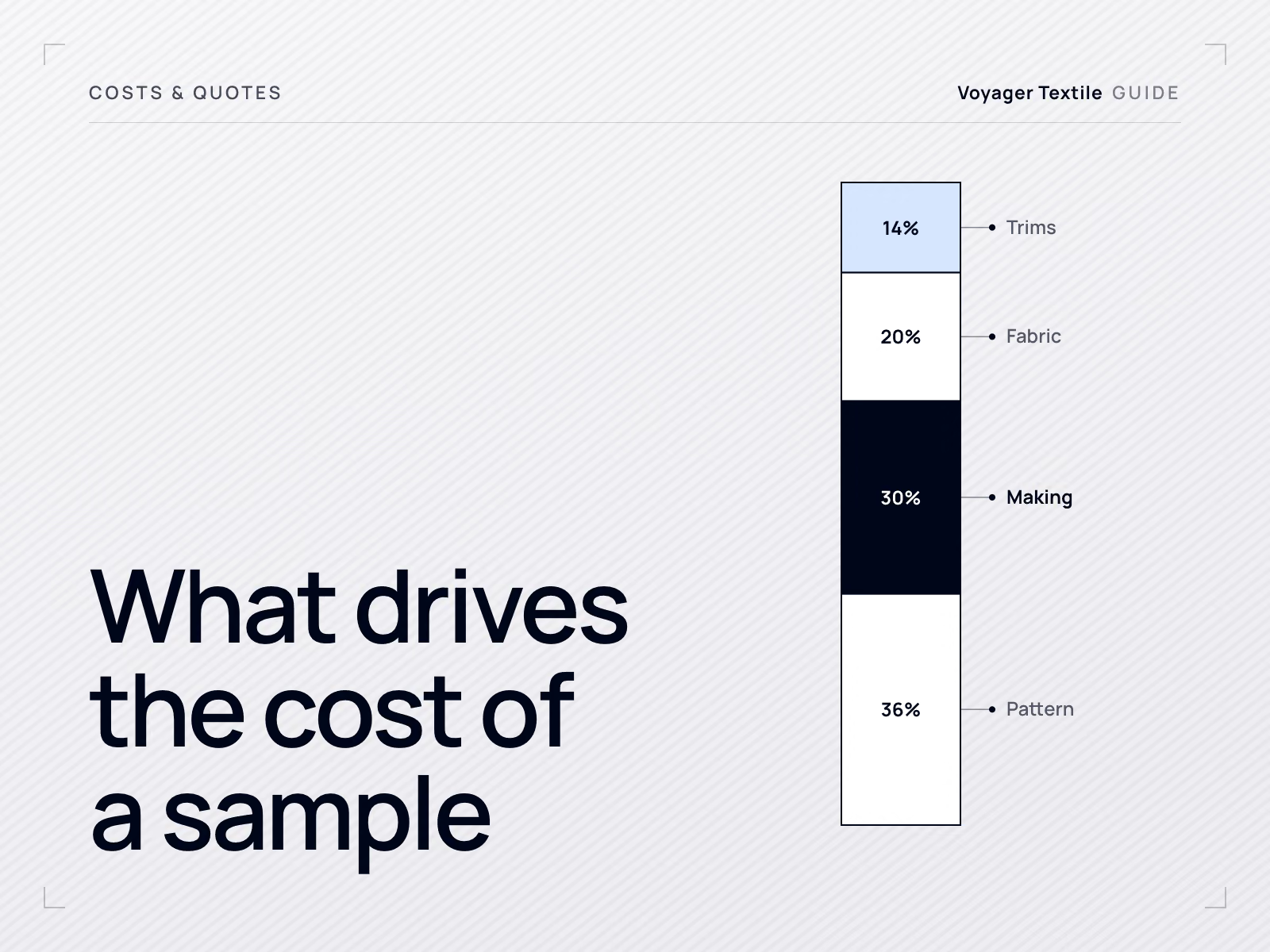
Keep one-off costs apart from the unit price. Sampling, pattern making, screens and embroidery digitising are paid once per specification; spreading them into the unit price makes a quote look higher or lower depending on the quantity. For a reorder, they usually fall away. Why a sample is priced differently from bulk is in what a sample costs.
A worked comparison
The example below compares two fictional quotes for one hoodie. Prices are left out on purpose: the work is in the other lines.
| Line | Quote A | Quote B | Action |
|---|---|---|---|
| Fabric | 80% cotton, 20% polyester, 320 g/m² brushed fleece | "Cotton-rich fleece" | Ask B for composition and g/m² |
| Quantity basis | 300 per colour | 500 per style, any colours | Price both at your real split |
| Size ratio | Even split | Missing | Ask B; give both your ratio |
| Decoration | Chest embroidery, in-house | Chest print, method missing | Ask B for method and facility |
| Trims | Drawcord and labels included | Labels excluded | Add label cost to B |
| Delivery term | FCA, named place | DAP, named destination | Convert to one term |
| Bulk lead time | From sample approval | From order | Put both on one start event |
| Tolerances | Size chart tolerances accepted | Missing | Ask B to accept the same chart |
| Validity | 30 days | Missing | Ask B |
Quote B's price cannot be compared until the missing lines are answered. Send the questions in one written list to each supplier, and compare the revised quotes. The quote you choose then becomes the basis of the order; what the order itself must state is in what an apparel purchase order should contain.
Questions buyers ask
How do I compare clothing manufacturer quotes?
Compare clothing manufacturer quotes line by line against one specification: fabric, quantity basis, size ratio, decoration, trims, packing, Incoterm, lead times, tolerances and validity. Ask for missing lines in writing, convert to one delivery term, then compare unit prices.
Why are two quotes for the same tech pack so different?
Two quotes for the same tech pack usually differ because of assumptions: a different fabric weight, a different Incoterm, an even size split, excluded trims or packing, or one-off costs spread into the unit price.
Which Incoterm should I compare quotes on?
Compare quotes on the Incoterm you will actually buy on, with the same named place for every supplier. Common terms are EXW, FCA, FOB, CIF, DAP and DDP. FOB and CIF apply to sea transport only.
Does the size ratio change the price of a quote?
Yes, the size ratio can change the price of a quote, because larger sizes use more fabric. Ask each supplier which size split the price assumes and give every supplier the same ratio.
What tolerances should a clothing quote state?
A clothing quote should state or accept tolerances for measurements per point of measure, shade against a physical standard, fabric weight in g/m², and delivered quantity. Without them, inspection has nothing to accept or reject against.
Should sampling costs be in the unit price?
No, sampling costs are best shown apart from the unit price. Sampling, patterns, screens and digitising are paid once per specification; spread into the unit price, they distort the comparison and reappear on reorders.
Get a quote you can compare
Send your specification, size ratio and delivery term. We quote per project from your specification, from 300 pieces per colour and per style, with sizes split inside the 300.
Start an RFQ